








Intro
AI in 3D Printing Statistics: AI in 3D printing means using smart computer technology, like machine learning, to make 3D printing better. It helps printers monitor themselves while working, catch mistakes early, and improve how objects are designed and built. Studies from McKinsey and ASTM International show that AI helps printers work smarter by predicting problems before they happen, making the whole printing process more reliable.
This mix of AI and 3D printing is growing fast. More industries, like healthcare, cars, and aerospace, are using it to make products faster, waste less material, and cut costs. Reports from Gartner and Deloitte show that companies are adopting AI-powered 3D printing to speed up how quickly they can design and test new products.
Overall, this technology is making manufacturing more efficient, flexible, and ready for the future.
What Caught the Editor’s Eye
- The AI in 3D printing market is projected to grow at a CAGR of 36.5% between 2024 and 2033, reaching USD 34.8 billion by 2033.
- AI-driven defect-detection algorithms have improved accuracy in identifying 3D printing flaws to over 80%.
- Airbus used AI-generated designs for aircraft brackets, cutting their weight by 45% while maintaining strength.
- An MIT study found AI-optimized lattice structures reduced material use by 40% without compromising strength.
- 82% of manufacturers surveyed by Protolabs Network said 3D printing helped them achieve substantial cost savings.
- Prototyping accounted for over 55% of global 3D printing revenues in 2024.
- General Motors used AI-driven generative design to create a seat bracket that was 40% lighter and 20% stronger.
- Medical applications, including customized prosthetics, were ranked as the industry with the most potential for 3D printing impact by 77% of survey respondents.
Global AI in 3D Printing Market Growth
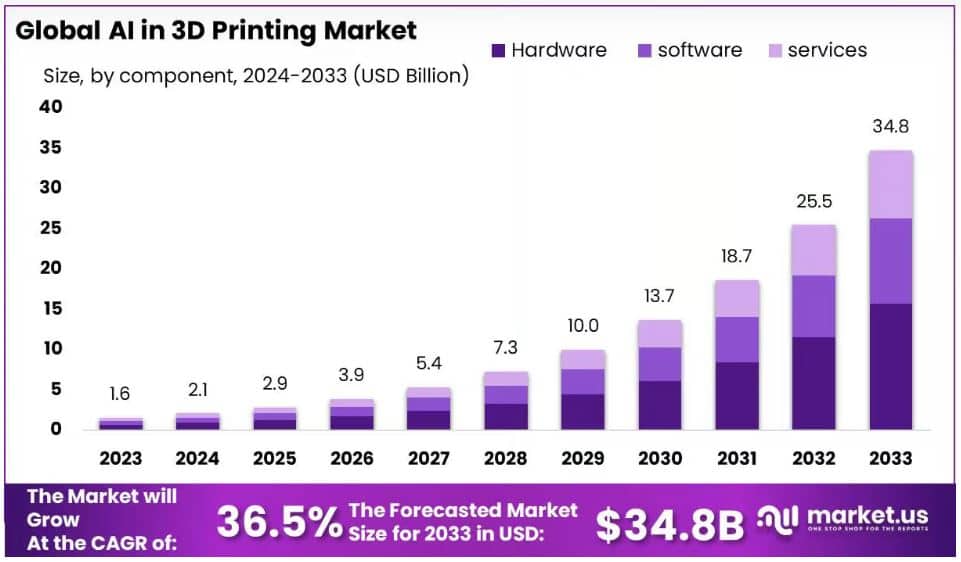
(Source: market.us)
- The market grew to USD 2.1 billion in 2024 and is expected to reach USD 2.9 billion in 2025.
- The market is projected to increase to USD 3.9 billion in 2026, USD 5.4 billion in 2027, and USD 7.3 billion in 2028.
- The market is forecast to grow to USD 25.5 billion in 2032 and USD 34.8 billion by 2033.
- Overall, the AI in 3D printing market is expected to grow at a compound annual growth rate of 36.5% from 2024 to 2033.
AI-Based Material Selection for 3D Printing
- AI has greatly improved how materials are selected for 3D printing by keeping large databases updated with information on different materials, their properties, and how well they work with various printing processes.
- Machine learning algorithms predict how a material will behave under specific printing conditions and estimate its mechanical behavior in advance.
- By analyzing variables such as nozzle temperature, raster angle, and layer thickness, AI-powered simulations and models help optimize the 3D printing process.
- By using data collected from how printed objects actually perform in real life, AI creates a feedback loop that continuously improves material selection models over time.
- AI supports customization and personalization of material choices based on specific requirements, helping advance the overall field of 3D printing.
- VAEs were used to compress Representative Volume Element (RVE) images into a smaller, simplified data space, and Bayesian Optimization was then applied to find the best RVE configuration for a given design goal.
- The VAE model was built using PyTorch, and 200 samples were generated from the simplified, low-dimensional data space.
- Principal component analysis compressed the simplified data space into a 2D representation for easier interpretation.
AI-Powered Quality Control and Defect Detection in 3D Printing
- Quality control and defect detection in 3D printing have improved significantly with the use of AI.
- AI-driven algorithms have increased defect-detection accuracy in 3D-printed objects to over 80%.
- AI systems, especially machine learning models, are trained on large datasets of 3D-printed objects to identify deviations from design specifications, such as layer misalignments, voids, or irregularities.
- Real-time monitoring powered by AI helps identify defects while printing is still in progress, which reduces material waste and saves time.
- Detection results were evaluated using the Intersection over Union (IoU) metric, which measures the overlap between bounding boxes and helps calculate True Positives, False Positives, or False Negatives from a test set.
- At an IoU of 0.4, the trained model achieved a Precision of 0.44 and a Recall of 0.69.
- At an IoU of 0.5, Precision was 0.41 and Recall was 0.63.
- At an IoU of 0.6, Precision stood at 0.4 with Recall at 0.62.
- The F1-Score at an IoU threshold of 0.4 was 0.55.
Generative AI in 3D Printing
- Autodesk’s Fusion 360 uses AI-driven generative design to explore thousands of design options in minutes, which greatly shortens development time.
- Airbus used AI-generated designs for aircraft brackets and cut their weight by 45% while keeping them strong.
- An MIT study found that AI-optimized lattice structures used 40% less material in 3D-printed objects without losing strength.
- Companies using AI-driven material optimization have reported a 20% to 30% drop in material costs.
- Tesla uses AI-powered simulations in its 3D printing process to reduce prototyping rounds, cutting design-to-production time by nearly 50%.
- AI tools can read real-time sensor data from 3D printers and make quick adjustments, which improves print accuracy and reduces failures.
- The healthcare industry has adopted AI-driven 3D printing for custom prosthetics, which can cost up to 90% less than traditional methods.
- Companies using AI-driven 3D printing report a 30% to 50% reduction in manufacturing costs.
3D Printing Delivers Cost Savings for Most Manufacturers
- A Protolabs Network survey conducted in March 2024 asked 712 respondents whether 3D printing has helped save substantial costs in their manufacturing pipeline.
- 82% of respondents said yes; 3D printing has helped them save substantial costs.
- 18% of respondents said no.
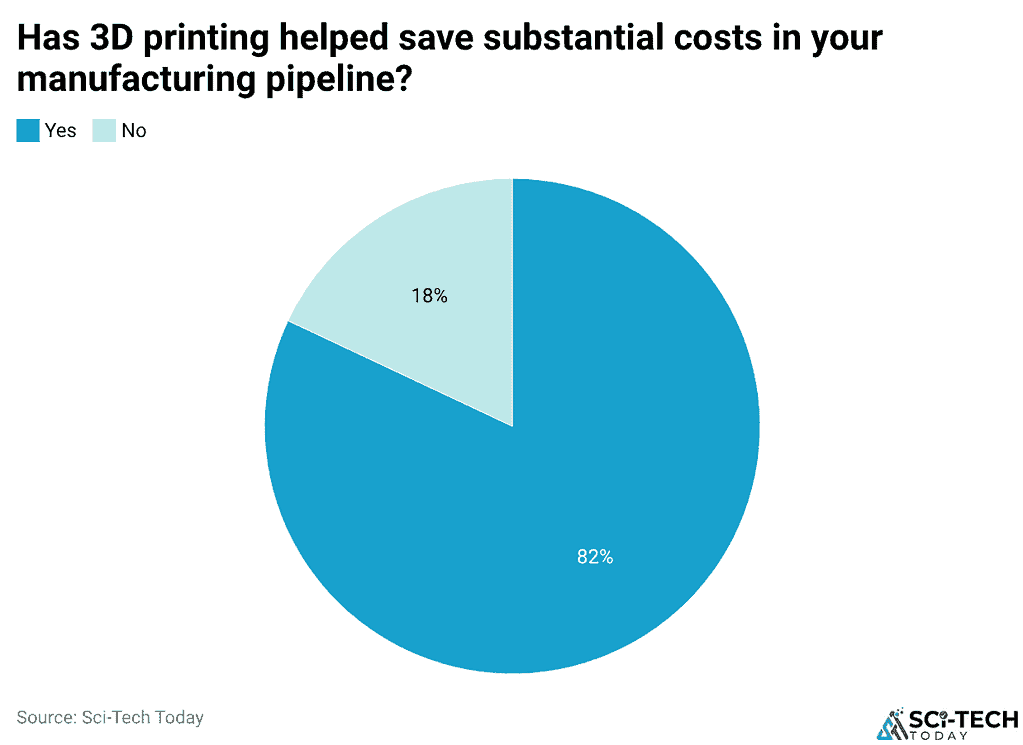
(Reference: protolabs.com)
Prototyping Leads 3D Printing as End-Use Grows
- In 2024, prototyping made up over 55% of global 3D printing revenues.
- End-use production is growing, especially in aerospace, medical, and automotive, where certification and materials now allow companies to use 3D-printed final parts.
- Metal 3D printing is a key driver of end-use production, and its growth rate is among the fastest of all material types.
- Demand for custom end-use parts, such as implants, dental devices, and personalized tools, is pushing companies to prove that 3D printing works for regulated manufacturing.
- Prototyping is still cheaper for many design cycles, but better speed, precision, and material choices are narrowing the gap for production.
- Some businesses use hybrid production, where they print some parts and machine others, to balance cost and performance.
- Prototyping is strong in research and development and education because it allows quick design changes, while production usually needs industrial printers and stricter quality control.
Industries Gaining From AI-Powered Prototyping
- Boeing and Airbus use AI in 3D printing to make lightweight parts, which lowers aircraft weight and fuel use.
- General Motors used AI-driven generative design to make a seat bracket that was 40% lighter and 20% stronger than traditional designs.
- The orthopedic industry gains from AI-driven prosthetics, which fit better and lead to better patient outcomes.
- Nike and Adidas use 3D printing and AI to personalize shoe designs and improve comfort and performance.
- Eyewear makers use AI to create custom glasses that look better and work better.
Medical Leads Industries Set for 3D Printing Impact
- A Protolabs Network survey conducted in March 2024 asked 712 respondents which industries have the most potential for 3D printing to make a significant impact.
- Medical, including customized prosthetics, ranked first at 77%.
- Construction, especially housing, ranked second at 45%.
- Art was chosen by 15% of respondents.
- Fashion was chosen by 7% of respondents.
- Food was chosen by 5% of respondents.
- Other industries were chosen by 18% of respondents.
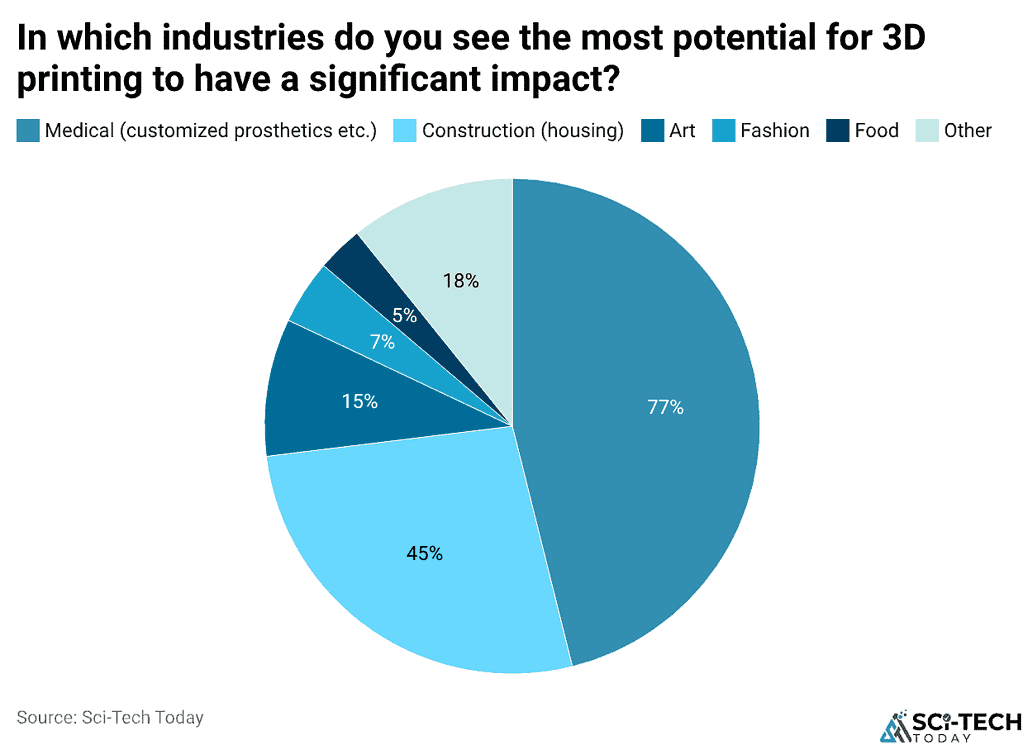
(Reference: protolabs.com)
Recent AI in 3D Printing Developments
- On May 29, 2026, Orbbec and Creality expanded their partnership by creating a 3D Scanner Digital Joint Innovation Center and committing to develop an AI-vision platform for 3D printing.
- On March 25, 2026, Tripo AI announced USD 50 million in new funding, backed by Alibaba and Baidu Ventures, to develop production-ready AI-generated 3D assets and expand its developer platform.
- On June 15, 2026, Limitless Labs raised USD 20 million for its agentic CAD/CAM platform, bringing its total funding to USD 27.3 million.
- On May 18, 2026, Instalimb announced funding from Orthomos Investment and a partnership with Alcare for AI- and 3D-printing-enabled prosthetic and orthotic products; its cumulative funding had reached about JPY 2.13 billion by March 2025.
- On July 21, 2026, Meshy raised nearly USD 400 million in a Series B round at a USD 1.5 billion valuation to expand its AI-powered 3D-generation foundation models.
- On August 20, 2026, Math Magic closed a Series A+ funding round, taking the company’s funding across 2 rounds in 6 months to nearly USD 50 million for AI 3D technology, manufacturing, and fulfillment.
- On September 2, 2026, Norwegian additive-manufacturing company AM North adopted amsight’s data-driven quality-management software to support certified production, improve traceability, and reduce manual documentation.
- On January 26, 2026, Stratasys launched its Post Processing Partnership Program to provide customers with validated post-processing options across end-to-end additive-manufacturing workflows.
- On July 23, 2024, DARPA awarded Intact Solutions USD 1.8 million to develop generative-AI software for pre-qualified metal 3D-printed component designs.
Conclusion
AI is transforming 3D printing from a simple prototyping tool into a smart, self-improving manufacturing process. With market growth accelerating and applications expanding across healthcare, aerospace, automotive, and consumer goods, AI-powered 3D printing is helping businesses cut costs, reduce material waste, speed up production, and improve product quality.
As adoption grows and funding pours into AI-driven innovation, this technology is set to reshape the future of manufacturing.
FAQ
AI in 3D printing refers to using machine learning and computer vision to improve the design, printing, and quality-control process, from generating models automatically to detecting print failures in real time.
Artificial intelligence is used in 3D printing to automate design, optimize print paths, and monitor prints in real time to prevent failures.
Text-to-3D AI tools can now turn a written description or a single reference photo into a full printable mesh in 90 seconds to two minutes, removing the need for a separate modeling step.
Yes, generative AI tools can turn a text description or reference photo into a printable 3D model within minutes, though the result may still need manual adjustment for print quality.
Not entirely. AI handles repetitive design and monitoring tasks well, but human oversight is still needed for creative decisions, structural judgment, and printer-specific troubleshooting.
Some AI design and failure-detection tools offer free tiers for hobbyists, though more advanced features like commercial-grade quality control are typically part of paid plans.
Not fully yet. Most current tools can detect a failure and pause or cancel the print, but fully self-correcting printers that fix issues mid-print are still an emerging capability.

Sources