








Initial Overview
AI Server Statistics: AI servers are changing how businesses build and run artificial intelligence applications. These powerful systems combine high-performance GPUs, processors, and fast memory to handle complex AI workloads quickly. As companies use AI for automation, data analysis, generative AI, and machine learning, the need for reliable computing power is growing. Unlike traditional servers, AI servers are designed to process large volumes of data and efficiently train or run advanced AI models. At the same time, cloud providers and data centers are investing heavily in AI-ready infrastructure to meet rising demand.
This article explores the AI server market, major technologies, key applications, growth trends, and the factors shaping its future.
Featured Selection
- The global AI server market is projected to reach USD 47,761.6 million in 2025 and USD 59,907.4 million in 2026.
- At a 27.6% CAGR, the market could reach USD 343,260.5 million by 2033.
- North America is expected to lead with a 36.50% share in 2026, ahead of Europe at 30.20%.
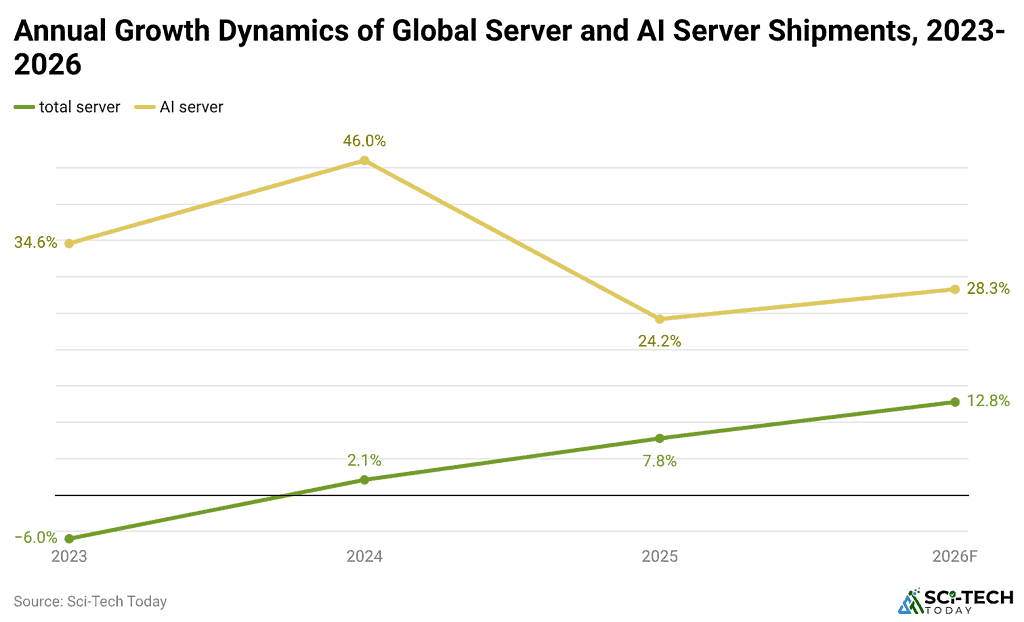
- AI server shipments are forecast to grow 28.3% in 2026, following a 24.2% increase in 2025.
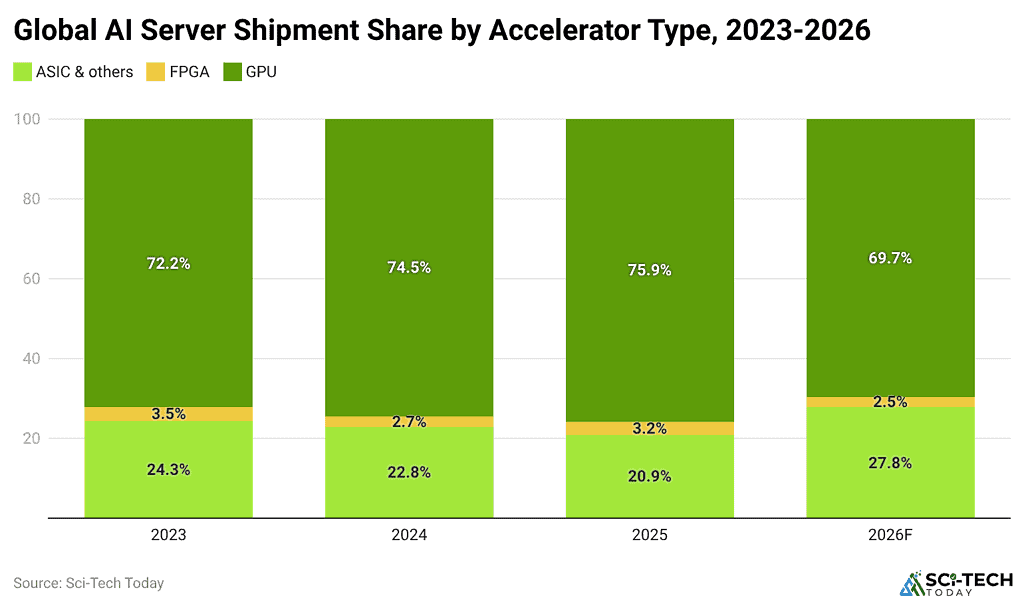
- GPUs are expected to account for 69.7% of AI server shipments in 2026.
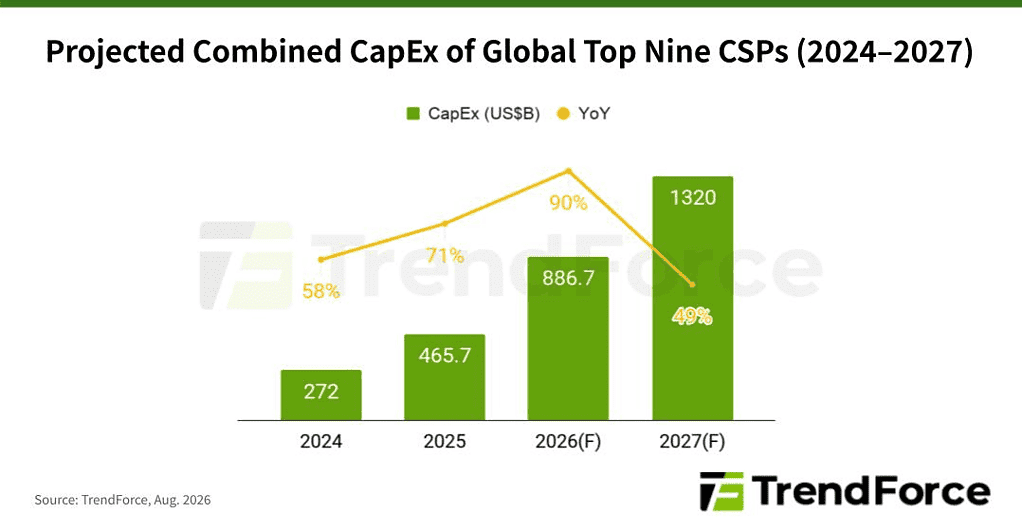
- Nine major CSPs could exceed USD 886.7 billion in 2026 CapEx, up about 90% YoY.
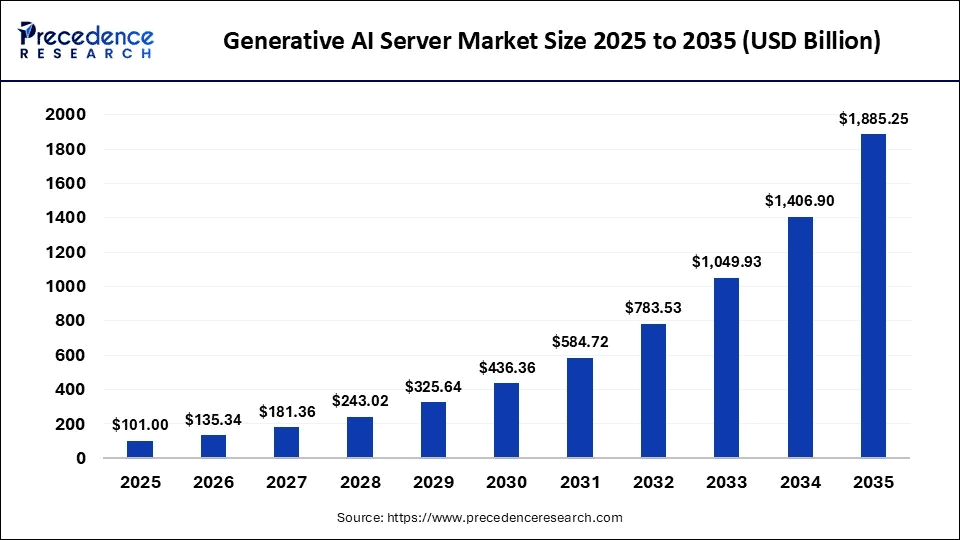
- Generative AI server revenue is projected to reach USD 135.34 billion in 2026.
- AI-optimized servers could consume 175 TWh of electricity in 2026, up 84% from 2025.
- NVIDIA AI server cabinet demand could exceed 60,000 units in 2026, versus 28,000 in 2025.
- AI server power and cooling needs are rising rapidly, pushing liquid cooling toward mainstream adoption in 2026.
Key Initiatives in the AI Server Market
- The market is highly consolidated, with NVIDIA, HPE, Dell Technologies, OpenAI, and Supermicro leading the industry.
- According to Roots Analysis, Supermicro’s 6U SuperBlade uses dual Intel Xeon 6900 processors, reducing cables by 93% and saving 50% of space.
- OpenAI committed more than USD 1.4 trillion to cloud infrastructure across major providers.
- Modular raised USD 250 million in September 2025 to build a unified AI computing layer.
- Groq and Upscale AI raised USD 750 million and USD 100 million, respectively, to address rising AI inference demand.
- The UAE launched Stargate UAE in May 2025 with USD 10 billion to develop 1 GW of AI data center capacity.
- The first 200 MW is expected to become operational by late 2026.
- Together, AI and 5C operate an AI factory using NVIDIA B200 GPUs, with expansion planned across the US in 2026.
- Databricks raised more than USD 4 billion in Series L funding in December 2025.
- IT and telecommunications lead AI server demand, accounting for 25.7%- 26% of the market.
Global AI Server Market Size
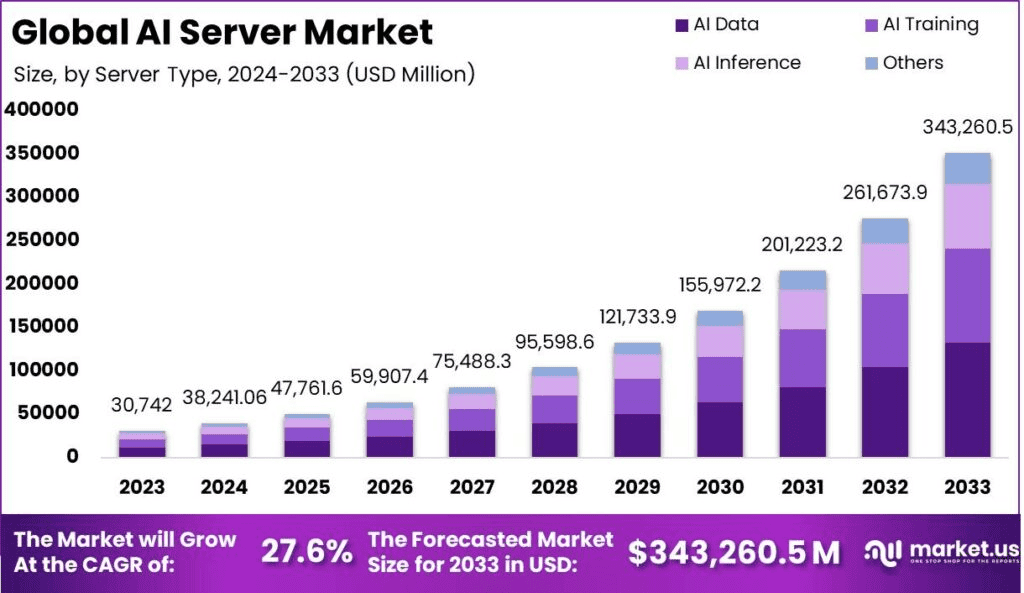
(Source: market.us)
- The global AI server market is expected to reach USD 47,761.6 million in 2025.
- The market is projected to grow to USD 59,907.4 million in 2026 as enterprises increase investments in AI infrastructure and high-performance computing systems.
- At a CAGR of 27.6%, the market is forecast to reach USD 343,260.5 million by 2033.
By Region
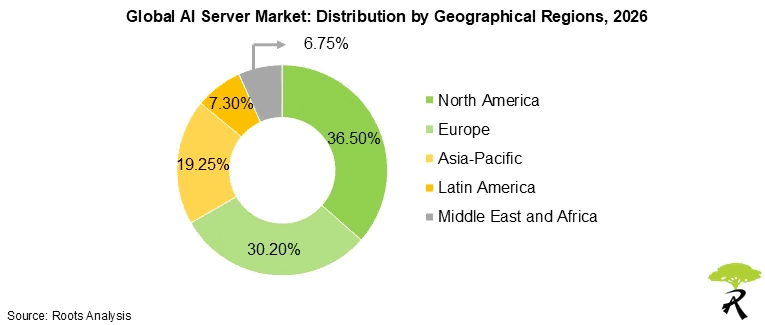
(Source: rootsanalysis.com)
- North America is expected to lead the global AI server market with a 36.50% share in 2026.
- Europe holds a 30.20% share, followed by Asia-Pacific at 19.25%.
- Latin America represents 7.30%, while the Middle East and Africa account for 6.75% of the market.
AI Data-Center Usage Capacity
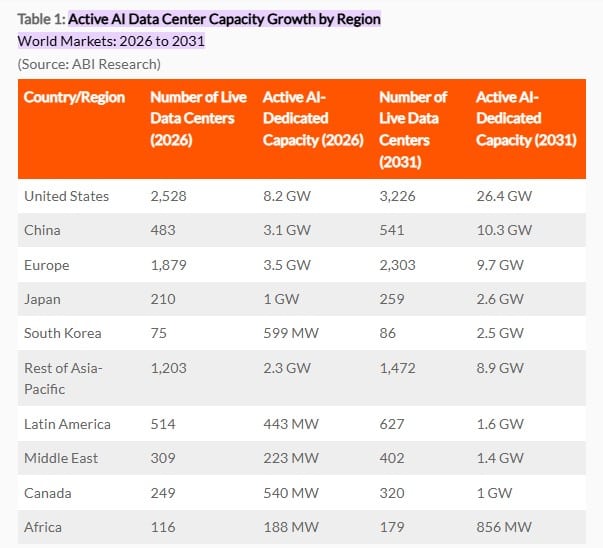
(Source: abiresearch.com)
- The United States will remain the largest market for active AI-dedicated data center capacity from 8.2 GW in 2026 to 26.4 GW by 2031, while the number of live data centers rises from 2,528 to 3,226.
- China is projected to expand AI-dedicated capacity from 3.1 GW to 10.3 GW, supported by an increase in live data centers from 483 to 541.
- Europe is expected to grow from 3.5 GW in 2026 to 9.7 GW by 2031, with data center sites increasing from 1,879 to 2,303.
- The rest of Asia-Pacific is forecast to reach 8.9 GW by 2031, compared with 2.3 GW in 2026.
- South Korea is projected to record strong growth, increasing from 599 MW to 2.5 GW.
- Latin America, the Middle East, Canada, and Africa are also expected to expand capacity to 1.6 GW, 1.4 GW, 1 GW, and 856 MW, respectively, by 2031.
AI Server Shipments and CapEx Trends
(Source: trendforce.com)
- TrendForce raised its 2026 AI server shipment growth forecast from 28% to nearly 31% YoY.
- The combined 2026 CapEx of nine major cloud service providers (CSPs) is expected to exceed USD 886.7 billion, up approximately 90% YoY.
- CapEx is expected to total USD 1,320 billion in 2027, up 49%.
- The five North American hyperscalers are expected to account for nearly 90% of this spending, which will support AI data centers, GPU clusters, and liquid-cooling systems.
- Google and AWS are expected to increase production of their next-generation in-house AI chips in H2 2026, while Chinese CSPs are expanding domestic AI solutions.
- The combined CapEx of ByteDance, Tencent, Alibaba, and Baidu is forecast to grow by more than 80% YoY in 2026.
(Reference: trendforce.com)
- In 2025, total server shipments are projected to grow by 7.8%, while AI server shipments are expected to increase by 24.2%.
- In 2026, total server shipments are forecast to rise by 12.8%, supported by a 28.3% increase in AI server shipments.
(Reference: trendforce.com)
- In 2026, GPUs are forecast to account for 69.7% of AI server shipments, followed by ASICs and others at 27.8% and FPGAs at 2.5%.
Generative AI Server Market Statistics
(Source: precedenceresearch.com)
- The global generative AI server market was valued at USD 101.00 billion in 2025 and is projected to reach USD 1,885.25 billion by 2035, growing at a 34% CAGR from 2026 to 2035.
- The market is expected to reach USD 135.34 billion in 2026.
- AI training servers led the market with a 46% share in 2025, while AI inference servers held 31% and could grow at a 36.5% CAGR.
- GPU-based servers dominated at 67%, while AI accelerator-based servers accounted for 18% and are projected to grow at a 38.7% CAGR.
- DRAM prices rose by 50%-55% in early 2026, increasing AI server costs.
- TSMC’s CoWoS capacity may reach 130,000 wafers/month by late 2026.
- HBM4 mass production began in February 2026, supporting accelerator supply.
- Data center electricity use could reach 945 TWh by 2030.
- Only 28% of enterprise AI use cases met ROI expectations in late 2025.
Global AI Server Chassis Market Analysis
(Source: futuremarketinsights.com)
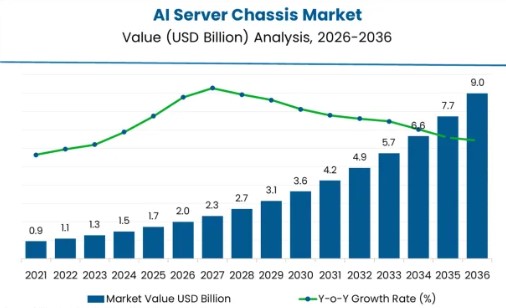
- Future Market Insights further noted that the global AI server chassis market is valued at USD 2 billion in 2026 and is expected to reach USD 9.0 billion by 2036, growing at a 16.2% CAGR.
- 4-GPU configurations lead with a 37% share, while air-cooled systems account for 35%, and 4U rackmount chassis hold 40% of demand.
- China is projected to grow at 15.4%, followed by the USA at 13.9%, the UK at 13.7%, and Japan at 12.7% during 2026-2036.
- NVIDIA’s Blackwell Ultra chassis requires 15 kW of cooling capacity, while Wiwynn reported a 500% YoY increase in direct-to-chip cold-plate chassis orders in early 2026.
- Super Micro’s 2026 liquid-cooling chassis supports 4, 8, or 16 GPUs, while Foxconn’s carbon-fiber design cuts chassis weight by 30%.
- High-density chassis validation can cost over USD 1.5 million and take 9-12 months.
- Foxconn announced a USD 200 million investment in February 2026 for an AI server chassis facility in Wisconsin.
AI Security Skills Gap
- According to practical-devsecops.com, only 24% of enterprises have a dedicated AI security governance team, showing a major skills shortage as AI-specific attacks increase.
- Demand for AI red-teaming is projected to rise by 35% by 2028, while organizations face limited access to trained professionals.
- The EU AI Act enters into force in August 2026, increasing the need for AI security and compliance skills.
AI Security Certifications
- AAISM and AAIA mainly address AI security management and auditing, while AIGP focuses on policy and legal requirements.
- SANS SEC598 provides advanced automation training but gives less attention to governance and costs around USD 5,000-8,000.
- CAISP covers prompt injection, AI red teaming, OWASP LLM Top 10, NIST AI RMF, MITRE ATLAS, and AI supply-chain attacks, providing broader coverage for 2026 security needs.
Enterprise AI Security Risks
- AI-related threats are becoming widespread, with 77% of businesses reporting an AI security incident in 2024 and average breach costs reaching USD 4.88 million.
- Employees can also expose sensitive information through GenAI tools. A 2024 Cyberhaven study found that 11% of data pasted into ChatGPT was confidential.
Defensive AI Strategies
- AI and security automation can help organizations contain breaches 108 days faster and save an average of USD 2.22 million.
- SOC teams receive about 4,484 alerts daily, with up to 27% of analyst time spent on false positives. AI-augmented SOCs can reduce MTTD by 50% and manual triage by 60%.
- AI-based behavioral analytics can detect up to 95% of insider threats and unknown malware, while Darktrace reported an average automated response time of 2 seconds, compared with 196 days for human breach identification.
- Microsoft’s AI Red Team has conducted more than 200 AI red-team operations since 2018. Unmonitored models can lose up to 40% of their security posture within 6 months.
Regulation and Compliance
- More than 25 countries have introduced or enacted AI legislation since 2023, while Gartner expects over 50% of large enterprises to face mandatory AI compliance audits by 2026.
- The NIST AI RMF, released in January 2023, uses four functions: Govern, Map, Measure, and Manage.
- The EU AI Act covers high-risk AI systems across 8 sectors and allows fines of up to €35 million or 7% of global annual turnover.
- ISO/IEC 42001 is the first international AI management system standard, while OECD AI Principles support broader global alignment.
Explosive AI Server Demand
- AI server demand is accelerating, with NVIDIA AI server cabinet demand expected to rise from 28,000 units in 2025 to at least 60,000 units in 2026, more than doubling, according to eu.36kr.com.
- NVIDIA’s Blackwell platform, particularly GB200, remains a major growth driver, while GB200/300 and Vera Rubin platforms are expected to shape the 2026 market.
- GPU power consumption is rising from 700W for H100 to 1,000W for B200, 1,200W for GB200, and up to 2,300W for VR200, while VR200 NVL44 CPX could reach 3,700W by late 2026.
Power and Cooling Upgrades
- As AI GPUs approach 4 kW, traditional air cooling is becoming ineffective, making liquid cooling increasingly important for high-performance systems.
- NVIDIA is moving toward 48V DC power systems and developing the Kyber architecture, with mass production targeted before the end of 2026.
- By 2027, the Kyber-based power solution for Rubin Ultra cabinets could be more than 10 times the value of today’s GB200 cabinet solution.
- GB300 full liquid cooling can manage around 1,400W of heat, while GB300 NVL72 cooling components are valued at USD 49,860, about 20% higher than GB200 NVL72.
- Vera Rubin cooling component value is expected to increase by 17% to about USD 55,710, while switch-rack cooling module value could rise by 67%.
AI Server Electricity Demand
- A report published by Tom’s Hardware Today reported that global data center electricity use is expected to rise by 26% in 2026, reaching 565 TWh from 447 TWh in 2025.
- Global data center power demand is projected to increase by 27%, reaching 132 GW in 2026 from 104 GW in 2025, and electricity use could exceed 1,200 TWh by 2030.
- AI-optimized servers are forecast to consume 175 TWh in 2026, up about 84% from 95 TWh in 2025, and reach 258 TWh in 2027.
- AI servers are expected to account for 31% of data center electricity use in 2026, rising from about 20% in 2025.
- By 2030, AI-optimized servers could consume nearly 50% of global data center electricity.
- Conventional servers are projected to use about 195 TWh in 2026 and 200 TWh in 2027, while cooling-related electricity use is expected to reach 195 TWh, a 22.6% increase.
- The U.S. is expected to consume 204 TWh, or 36% of global data center electricity, in 2026, with dedicated AI data centers using around 68 TWh.
Closing Remarks
AI servers are becoming an important part of modern technology as businesses use AI for a wider range of tasks. They provide the speed and computing power needed to process large amounts of data and run complex AI models. As AI adoption grows, demand for faster, smarter, and energy-efficient servers is also expected to rise.
Overall, AI servers will play a key role in supporting AI applications, improving business performance, and building the digital infrastructure of the future.
FAQ
AI servers power machine learning, model training, data analysis, generative AI, and real-time AI applications.
AI servers use powerful GPUs, high-speed memory, and advanced cooling to handle demanding AI workloads efficiently.
AI servers need powerful GPUs, CPUs, high-speed memory, storage, networking, and efficient cooling systems.

Sources