









Introduction
Partner Marketing Statistics: In 2026, Partner marketing looks like a real growth driver as more B2B firms are relying on resellers, tech partners, affiliates, distributors, agencies, marketplaces, and alliances to meet buyers and earn revenue. Recent findings suggest that partner-led pipeline, partner experience, marketing automation, and ecosystem reporting are getting more attention at the top of the org chart.
Meanwhile, many organisations suggest that they struggle with partner readiness, tracking results, matching the right buyer profiles, and seeing the pipeline clearly. Marketers are also under pressure to show real money impact because of increasing budgets. In 2026, these moderations suggest that there may be a key shift for partner marketing plans, tools, and how results are measured.
This article will highlight the major shift in partner marketing statistics via investment, AI and revenue in 2026.
Top Highlights
- 69% of B2B SaaS firms plan to spend more on partnerships in 2026.
- 99% of B2B SaaS senior leaders say partnerships are part of go-to-market.
- 48% report that partner alignment helps cut sales cycle time.
- Only 42% of B2B SaaS firms use multi-touch attribution to track partner revenue.
- 49% of B2B SaaS senior leaders use AI for targeting and for running programs.
- Partner-sourced or partner-influenced work makes up 35% of pipeline in mid-market and enterprise.
- 67% expect indirect revenue to rise by over 30% year over year.
- Services-led firms and agencies report the biggest partner-sourced share at 58%.
- PRM adoption among companies increased from 39% in 2023 to 62% in 2026 with $25M+ ARR.
- 81% of channel marketing leaders plan to increase partner marketing investment, but only 16% expect a significant increase.
- Only 15% of organisations’ partners understand buyer personas extremely well.
- 45% of organizations are launching 1:1 ABM with their top partners, and 85% invest in webinars and events.
- Approximately 41% of MDF is reported as unused or underutilized.
What Is Partner Marketing?
- Partner marketing is a collaborative marketing strategy in which two or more organizations collaborate to create awareness, generate demand, influence opportunities or sell solutions.
- It uses multiple models, including channel marketing, reseller programs, referral partnerships, affiliates, creators, technology integrations, strategic alliances, distributors, managed service providers, systems integrators and cloud marketplaces.
- Practically, partner marketing can include co-branded campaigns, joint webinars, field events, marketplace listings, account mapping, content syndication, referral links, market development funds, co-selling and bundled solutions.
- It neglects traditional paid media, which uses the approach of using another organization’s customer relationships, market access, expertise, or audience trust to improve reach and conversion.
Partner Marketing Statistics: Attribution and AI
(Source: partnerstack.com)
- PartnerStack and Wynter’s State of Partnerships in GTM 2026 say partnership work is playing a bigger role in how B2B SaaS teams sell.
- In the survey, 69% of firms plan to put more money into partnerships, pointing to more human resources, programs, and budget growth toward partner-led growth.
- The report also notes that 99% of senior leaders view partnerships as part of their GTM strategy, pointing out that partnerships are not just a small add-on anymore.
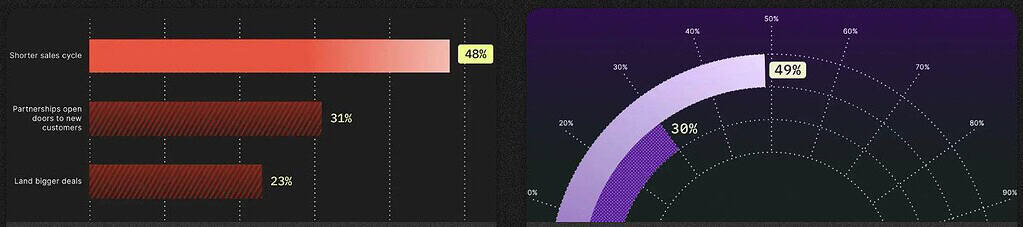
- 48% of people said partner teams that coordinate with other GTM groups help cut sales cycle time, and 23% said partner alignment helps them win larger deals. This suggests that partner marketing is not limited to bringing leads, which can also help sales push deals along and may support higher deal size.
- On the Tracking partner, only 42% of B2B SaaS companies use multi-touch attribution for partner revenue, whereas 31% use first-touch attribution and 19% use last-touch attribution, and the remaining 8% either use other methods or do not track attribution at all.
- The attribution data reflect that partner effects can show up in more than one step of a buyer journey and may be underrepresented when companies depend heavily on single-touch models.
- In B2B SaaS, 49% of senior leaders say they want to use AI to improve partner and account targeting and also want AI to help run partner programs with less friction.
- AI is not only for automating tasks, but also for finding partners that match better, focusing on stronger accounts, and keeping partner programs on track.
- In mid-market and enterprise firms, 35% of pipeline is described as partner-influenced or partner-sourced.
- The above facts suggest partner marketing is moving toward a more measurable GTM market, although it still seems key to get attribution right and align marketing, sales, and partnership teams. That is how full impact can be proven.
Partner Ecosystems Support Indirect Revenue Growth
- Forrester’s 2025 Partner Ecosystem Marketing Survey suggests partner marketing is taking on a bigger role in B2B growth plans.
- The survey points to more partner ecosystems over time, with many decision-makers in partner ecosystem and channel marketing expecting their partner counts to increase.
- The growth is expected in many partner types and business setups, with technology partners, distribution partners, and digital routes to market showing the strongest expected expansion.
- According to Partner Influence, about 2 out of three respondents say partner-driven revenue will grow over the previous year, and many expect it to grow a lot, pointing to a change of more than a 30% increase year over year.
- This change suggests that partners are doing more than closing deals and are shaping how customers decide.
- For partner marketers, implies that measuring partner impact should extend beyond direct sales to include the influence partners have throughout the buyer journey.
- Forrester’s results show a partner marketing world is also playing a bigger role by expanding in size, with large ecosystems, indirect revenue from partners is getting stronger, and greater partner influence.
- Partner marketing should be treated as a growth effort at the strategy level, not just a basic support channel.
Partner-Sourced Industry Revenue
| Rank | Industry | Partner-Sourced Revenue | Category / Partner Model |
| 1 | Services-led / Agencies | 58% | Implementation, integration, MSP |
| 2 | Cybersecurity | 47% | Channel-heavy enterprise sale |
| 3 | Hardware / Infrastructure | 41% | VAR/distribution channels |
| 4 | Manufacturing Software | 36% | Industry vertical SaaS |
| 5 | Telco & Carrier Services | 31% | Wholesale & co-sell motions |
| 6 | Healthcare IT | 29% | EHR & integration partners |
| 7 | AdTech | 28% | Agency & holding-co channel |
| 8 | Horizontal SaaS | 24% | Direct-led with partner overlay |
| 9 | MarTech | 22% | Agency & implementation partners |
| 10 | Fintech | 19% | Direct-led, low partner attach |
(Source: digitalapplied.com)
Partner Relationship Management (PRM) Platform Adoption
- PRM platforms are now showing up more often as key systems in bigger companies.
- In the 2026 benchmark you shared, PRM use among firms with at least $25M in ARR went from 39% in 2023 to 62% in 2026, which shows that the jump of 23 points means many teams have moved beyond simple partner tracking.
- Partner data used to live in basic tools toward organized systems for partner records, co-selling work, channel tasks, and referral handling.
- The benchmark is posted by Digital Applied, which shows their wider set of data comes from sources such as Crossbeam, Partnership Leaders, and Forrester.
- Only 62% are adopting cohort, and platform usage is split across multiple products.
- Crossbeam has the biggest slice at 24%, which is often chosen for ecosystem-led growth and account mapping.
- Salesforce PRM is close behind at 21%, which shows many buyers seem to pick it when their teams already work inside Salesforce CRM.
- Impartner takes 18% and leans more toward older-style channel management.
- PartnerStack sits at 16%, mainly used for referrals, affiliates, and partner payouts, while Allbound is 14% and combines PRM with learning and co-branded content tools.
- ZINFI presents at 9%, as it is used more for large enterprise channel work and automation.
- PRM is becoming normal for higher-ARR companies, and the choice of platform still depends on how each firm runs its partner program.
- The PRM shift is a more formal way to handle partner data, relationships, and the paths that lead to revenue, rather than only more software in place.
Partner Marketing Investment Is Rising
- The Sherpa Group 2026 Channel Marketing Leaders Survey Report shows a change in priorities as more firms say they want to spend more on partner marketing, but they still report problems when it comes to execution and how ready partners are to act on new plans.
- In the survey, 81% of people plan to boost partner marketing spend, but only 16% think the increase will be major, indicating this as a repeat issue because partner teams face higher expectations, yet the support they get does not always rise at the same pace.
- Just 15% say their partners grasp buyer personas very well, and also, 65% do not do a formal review of partner go-to-market maturity. The data suggest that many organizations do not have a steady way to judge which partners can handle more advanced marketing programs.
- Account-based marketing is moving forward, but only 45% are running 1:1 ABM with their top partners, which means personalized partner marketing has not become a default method.
- 85% of partners invest in webinars and events, so those formats remain a big part of how they engage buyers.
- Just 30% of partners are using or plan to use AI-powered targeting, as traditional partner engagement is already widely used, while advanced AI-powered targeting capabilities are still developing.
- Overall, the results point to a market that is spending before its operational maturity. The main gap is less about higher budget, but about better alignment with buyer personas, stronger partner review, more personalized ABM, and more data-driven targeting.
Market Development Funds (MDF) and Co-op Utilization Rates
- Market Development Funds (MDFs) are going from an emphasis on the amount of money that suppliers spend to the ability of their partners to successfully utilize MDFs.
- Forrester estimates that MDFs comprise nearly 50% of a supplier’s average annual channel marketing budget, thus making the effective use of MDFs an important element of channel development.
- Research has suggested that between 50% and 60% of the allocated MDF stays unused.
- Moreover, an ITA Group global channel survey was conducted and concluded that 60% of MDFs are left without claim in each quarter.
- The latest ChannelScaler research states that 41% of MDFs are unused or underused, while 54% of the respondents indicate that they do not use more than 10% of available funds.
- Computer Market Research reports that manual administration of MDFs takes up to 25% of a channel manager’s working week, and nearly 60% of funding may be unutilized due to administrative obstacles.
- MDF has become more of an operational challenge increasingly, which could particularly impact smaller partners, who may lack dedicated marketing personnel or financial resources for pre-funding possible campaigns prior to reimbursement.
- A good MDF program should link spending with leads, sales opportunities, deals, revenue, and retention, and companies may also analyze approval, settlement, and repayment time, expiration rate, and number of partners.
- 2026 research findings are c turning MDF from a limited budget into an easily accessible tool for growth.
Final Outlook
- In 2026, partner marketing is represented by three key developments comprising a transition from quantity to efficiency in partnerships, a shift from campaigns to pipeline contributions, and a movement away from linear channels toward integrated ecosystems.
- The most compelling figures in the Sherpa Group 2026 survey report indicate that 97% of organizations consider partner-driven pipeline generation important whenever partners are on board.
- Now, businesses are improving the selection of their partners, streamlining the process of their training, synchronizing their data, making co-selling a routine procedure, and assessing both sourced revenue and revenue influenced by their partners will be the most successful in transforming ecosystem reach into sustainable growth.
Conclusion
In 2026, the performance of partner marketing is being assessed more on the basis of its effectiveness in creating pipeline, revenue, and sales efficiency instead of just calculating how many partners are involved in the process. The current data show that there is a lot of support from the executive management team, as 80% of CEOs in the B2B SaaS sector say that they have already used partnerships in their marketing strategies, while many companies have increased spending in this area.
However, when it comes to implementation, the issues of attribution detection, partner readiness, target audience communication, and marketing development funds usage remain problematic. The adoption of partner relationship management solutions is also increasing due to the necessity to have powerful tools for managing relationships with partner companies and data related to partners.
The future development of partner marketing depends on the capability to relate the activities of partners to measurable results, improve cooperation between sales and marketing departments, and use AI technologies effectively.
FAQ
69% of firms in the B2B SaaS sector claim that they will devote more funds to partnerships..
It has been reported that 35% of pipeline experienced by midmarket and enterprise-level companies comes from partner sources or partner engagement..
99% of executives in the B2B SaaS sector stated that partnerships are part of their sales strategy.
Only 42% of companies use multi-touch attribution for measuring partner revenues.
According to the research published by ChannelScaler in 2026, 41% of MDF goes unused or is underutilized.