






Introduction
Podcast Monetization Statistics: Podcast monetization is getting more diversified in 2026, as creators, publishers, and platforms are sorta moving past the old host-read commercials. Instead, they’re leaning into subscriptions, premium content, video podcasts, brand sponsorships, affiliate marketing, live events, and also those platform revenue-sharing programs.
And yeah, the audience keeps widening too, so the commercial part is bigger: 167 million Americans aged 12+ say they listened to a podcast in the previous month in 2026, and 130 million listened to or watched a podcast in the previous week. At the same time, U.S. podcast advertising revenue is expected to get close to USD 2.6 billion by 2026. That basically underlines how much the medium is climbing in importance across digital media and the creator economy.
This article provides a comprehensive overview of podcast monetization statistics, market growth, advertising revenue, audience trends, monetization models, creator economy insights, CPM benchmarks, AI-driven innovations, and the future outlook of the global podcast industry in 2026.
Editor’s Choice
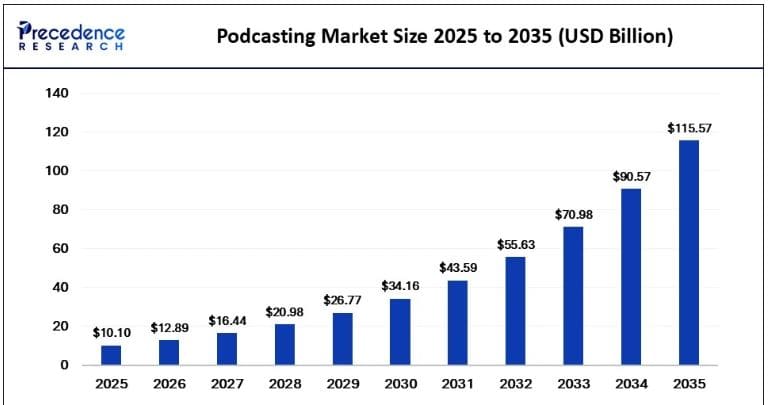
- The global podcasting market is projected to expand from USD 12.89 billion in 202, to USD 115.57 billion by 2035. That’s a 27.6% CAGR, which is kind of wild.
- Podcast advertising revenue should go beyond USD 5 billion worldwide in 2026, so podcasts are basically in the mainstream ad lane now.
- Advertising makes up 68% of all podcast monetization, but subscriptions, sponsorships, live events, and merchandise keep picking up steam.
- Worldwide, 672 million people tune into podcasts every month, and 464 million listen weekly, showing an audience size that feels exceptionally large.
- About 72% of podcast listeners finish entire episodes, so podcasts are among the top in retention when you compare them with other digital formats.
- Host-read podcast ads can drive up to 71% brand recall, which tends to beat a lot of more “traditional” digital ad setups.
- Mid-roll podcast ads pull premium CPMs around USD 25–50, and on the B2B side, certain niche shows can even exceed USD 100 CPM because the audiences are higher value.
- Dynamic Ad Insertion (DAI) now accounts for 93.6% of podcast advertising revenue, signaling AI-driven monetization is becoming the industry standard.
- Spotify Premium Podcasts has 8.4 million paid subscribers, while 14,200 Patreon podcast creators earn over USD 1,000 per month.
- AI-assisted ad insertion increased from 11% in 2023 to 38% in 2026, highlighting rapid adoption of intelligent advertising optimization.
Podcasting Market Growth Globally
(Source: precedenceresearch.com)
- The global podcasting market moved from USD 10.10 billion in 2025 to USD 12.89 billion in 2026, and then the forecast gets wild; it’s expected to climb up to USD 115.57 billion by That implies a strong 27.60% CAGR across 2026–2035.
- North America basically led early, taking about a 40% share in 2025, while Europe had 30% and is forecast to rise at a 25.2% CAGR over the same time window.
- On the content side, news and politics grabbed the biggest slice at 25% in 2025, and it should keep growing around a 6.5% CAGR. Meanwhile, music sits at 18% of the overall market.
- Revenue-wise, advertising stayed the top driver, making up 50% of total market income, whereas subscriptions accounted for 20% and are projected to expand at a 15% CAGR all the way through 2035.
- Looking at it by industry application, media and entertainment takes the lead at 45%. Education trails with 15% and is anticipated to grow at a 9.2% CAGR during the forecast period.
- Podcasting is quickly turning into a major digital media ecosystem, with mixed content styles, multiple monetization paths, and broader use across industries, kind of like it’s spreading everywhere at once.
Global Podcast Advertising Revenue
| Year | US Ad Spend | Global Ad Spend |
| 2022 | $1.8B | $2.9B |
| 2023 | $2.1B | $3.4B |
| 2024 | $2.4B | $4.0B |
| 2025 | $2.7B | $4.5B |
| 2026 | $3.0B+ | $5.0B+ |
(Source: digitalapplied.com)
- The chart shows a pretty strong, steady rise in podcast advertising revenue, like it’s really starting to matter more as a digital marketing channel, even if it still feels a bit under the surface.
- From the data, U.S. podcast advertising spend went from USD 1.8 billion in 2022 to USD 2.1 billion in 2023, then climbed again to USD 2.4 billion in 2024.
- After that, it kept going up to USD 2.7 billion in 2025, and it’s projected to go beyond USD 3.0 billion in 2026, which suggests advertisers still have plenty of confidence in podcast-driven campaigns.
- Worldwide podcast advertising spend jumped from USD 2.9 billion in 2022 to USD 3.4 billion in 2023, then moved to USD 4.0 billion in 2024 and USD 4.5 billion in 2025.
- In 2026, global podcast advertising revenue is expected to top USD 5.0 billion, which makes the whole commercialization of podcast platforms look even faster.
- A widening revenue base seems tied to higher audience engagement, better advertiser trust, and wider adoption of podcast advertising across different sectors. And since investment is still speeding up in both the U.S. and the global markets, podcast monetization should become an even bigger piece of the digital media economy, overall.
Podcast Monetization is Diversifying Beyond Traditional Advertising
- Podcast monetization in 2026 is kind of a multi-revenue ecosystem now, so creators are not stuck on ad money only.
- Traditional ads, like host-read and programmatic formats, still bring in the biggest part, around 68% of revenue, but the other ways to earn are slowly becoming more important.
- Branded and sponsored content adds 11%, while subscriptions and premium memberships make up 9% of total revenue.
- On the side, live events and tours contribute 6%, and then merchandise plus licensing, and also syndication, each sits at 3%, overall showing creators are trying to build steadier businesses with diversified models.
- Branded podcasts are now a pretty serious marketing tool too, with about 3,100 active branded podcasts in production worldwide during 2026. A typical premium production runs roughly USD 18,000 to USD 42,000 per episode, which matches the newer level of investment from brands.
- 34% Listeners more inclined to think about the sponsoring brand, and 22% are more likely to buy from it.
- Avg episode length is 28 minutes, and active brand exposure is about 21 minutes per episode, so engagement ends up feeling similar to almost 42 standard 30-second ads.
- Most campaigns usually stretch across 8–12 episodes per season, and there are often two seasons each year, plus the median cost per branded listener lands somewhere between USD 0.28 and USD 0.65, which makes branded podcasts an efficient channel.
- Subscription-based podcasting is also growing pretty quickly; if you look at it in the same way, Spotify Premium Podcasts has about 8.4 million subscribers worldwide.
- Meanwhile, Apple Podcasts Subscriptions sits at around 6.1 million paid listeners.
- On Patreon, 14,200 podcast creators bring in more than USD 1,000 each month, and that’s about 21% year-over-year growth.
- The typical subscription ARPU lands near USD 5.80 per month, though the market is still pretty lopsided, with the top 1% of subscription shows collecting 63% of all subscription income.
Podcast Creator Economy Statistics
- The podcast creator economy is sliding into a high-growth phase, and creators seem to have more avenues for income than ever.
- Traditional advertising stays the main money engine, with podcast ad spend expected to climb by 12% and reach roughly USD 2.6B–USD 3.0B this year.
- At the same time, ad playbooks are shifting, since 61% of podcast advertising is now aimed at brand-building instead of only direct-response.
- It’s also getting more tech-heavy, because 72% of advertising buyers say they plan to boost investment in programmatic podcast ads during 2025, which hints at stronger trust in automated, data-guided placements.
- Beyond ads, creators are also spreading their earnings across direct support platforms, premium memberships, and newer payment formats.
- One of the more rapidly expanding chances is video podcasting, which has already pulled in about USD 1.4 billion, showing that visual content is turning into a real extension of the audio business.
- About 46% of podcast listeners say advertisements are “not intrusive at all”, while 70% recall the audio ads they hear, which points to high engagement and, pretty cleanly, strong advertising effectiveness.
- The above statistics feel like podcasts are oddly well positioned to deliver both worthwhile audience experiences and sustained, long-run revenue growth for creators
Global Podcast Audience Reach
(Source: searchlab.nl)
- Podcasting, in 2026, has pretty much locked in as a mainstream media channel, pulling in audiences at a size that can rival older outlets.
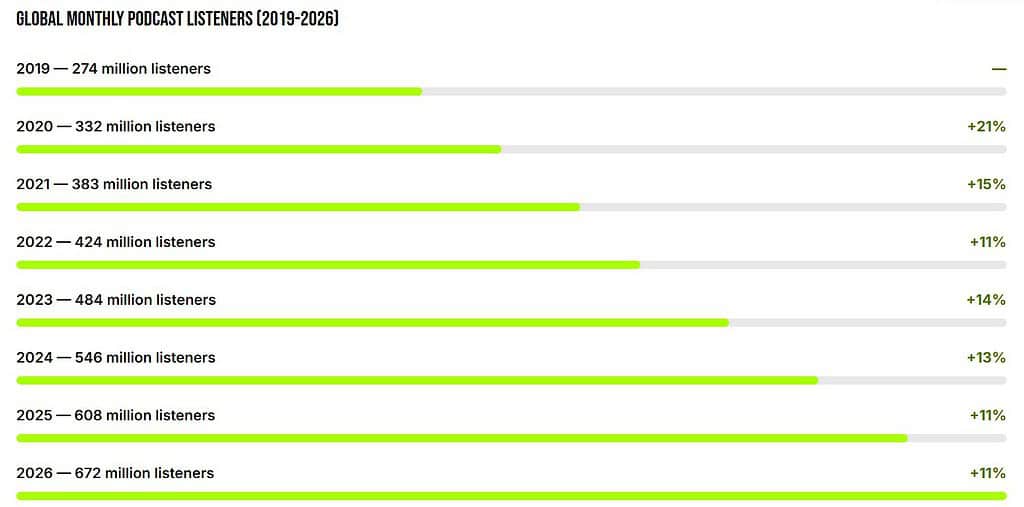
- Edison Research reports 672 million people worldwide listen to podcasts at least once a month, and 464 million tune in weekly. That includes 135 million weekly listeners in the United States.
- Daily engagement is also notable, with 168 million global daily listeners, and 26% of the U.S. population listening every day.
- Global monthly podcast listeners grew from 274 million in 2019 to 332 million in 2020 (+21%), 383 million in 2021 (+15%), 424 million in 2022 (+11%), 484 million in 2023 (+14%), 546 million in 2024 (+13%), 608 million in 2025 (+11%), and 672 million in 2026 (+11%). Overall, that’s a 145% increase since 2019.
- About 72% of listeners stick around and finish entire episodes, and that really does beat most other digital media in terms of focus and retention.
- Podcast adoption is still widening, even across different demographics. For example, 67% of Americans who are 12 and up listen to podcasts every month, which is up from 62% in 2025, while one in three people who don’t listen right now say they want to start during 2026.
- Language habits kind of underline the global reach, with English taking 62% of listening time, followed by Spanish at 8% and Portuguese at 6%.
- Podcasting has moved past early-stage growth, into something mature, consistently engaging, and able to scale worldwide, with real long-run upside.
Podcast Monetization Tools and Platforms
The industry is now supported by more specialized platforms that help creators branch out income, beyond just the old style of advertising. Effective podcast monetization is leaning on a mix of content-making plus technology that helps simplify subscriptions, sponsorships, ecommerce, and audience engagement. These tools lower day-to-day complexity, while also helping creators form sustainable income, the kind that repeats over time.
Hosting platforms with built-in monetization
- Podcast hosting services like Buzzsprout, Castos, Spreaker, and Spotify for Creators have brought monetization features right into the platform.
- You get things such as dynamic ad insertion, listener subscription tools, and audience analytics so creators can essentially automate ad placements, post premium material, and track how each episode is doing with a bit more control.
Membership platforms
- There are membership platforms including Patreon, Supercast, Memberful, and Ko-fi. They kind of smooth out recurring income because they handle subscriber payments, unlock premium content access, and keep communication organized with paying listeners.
Affiliate and sponsorship marketplaces
- At the same time, sponsorship and affiliate programs are getting easier to tap into through services such as Podchaser Pro, Audacy Creator Lab, Spotify Partner Program, ShareASale, Impact, and PartnerStack, which connect podcasters with brands plus a lot of affiliate programs across many product categories.
Newsletter and community tools
- To keep audience engagement strong, creators also rely on Mailchimp, Kit, Beehiiv, Circle, Discord, and Shopify Messaging.
- These tools support promotions for exclusive content, memberships, affiliate campaigns, live events, and email or SMS marketing efforts.
Ecommerce infrastructure
- If someone is selling merchandise, digital products, or even subscriptions, Shopify brings scalable ecommerce features, including secure checkout, payment processing, subscription billing, digital product delivery, print-on-demand fulfilment, and keeping ownership of customer data.
Podcast Advertising ROI and CPM Rates
- Podcast advertising has basically turned into a premium performance marketing channel, where higher pricing is kinda justified by tighter audience interaction and also by business results you can actually measure.
- According to the Castos Monetization Guide, Springcast 2026 CPM Analysis, Mid-roll ads still feel like the best spot, with typical CPM ranges sitting around USD 18 to USD 45–USD 50.
- Meanwhile, host-read mid-roll spots usually land at about USD 25–USD 50 CPM, which sounds almost high, but it matches the engagement lift.
- Pre-roll advertisements, in comparison, often cost USD 18–USD 30 CPM.
- Post-roll ads range from USD 15–USD 25 CPM, and programmatic or announcer-read insertions are usually in the USD 18–USD 25 CPM neighbourhood too.
- Wildcast 2026 Analysis states that Niche B2B podcasts often reach USD 80–USD 100+ CPM, and a few independent business shows go past USD 100 CPM even while they stay under 5,000 downloads, so it basically reflects the commercial weight of the executive and decision-maker audience.
- Across different content areas, business podcasts lead at about USD 30 CPM, then health sits around USD 27 and technology roughly USD 26, so it kinda confirms that industry-specific listeners create stronger monetization pathways.
- As Magellan AI notes, host-read advertisements deliver roughly 31% higher purchase rates than producer-read placements, and UK-based B2B podcast efforts tend to run £14–£37 CPMs and bring an average 4.9× return on ad spend ROAS.
- Podcast advertising can have premium CPMs, but the recall is stronger, the involvement is deeper, and conversions tend to be better. So it becomes one of the more efficient channels for brands that want long-term marketing momentum and higher-value customer acquisition.
Future Of Podcast Monetization
- The future of podcast monetization is kinda being pulled forward by automation, artificial intelligence (AI), and programmatic ad buying, so that creators and advertisers can squeeze more revenue out of basically every single episode.
- Dynamic Ad Insertion (DAI) is now more or less the main monetization mechanism; it takes up 93.6% of podcast advertising revenue in 2026, even though a few industry snapshots put its number closer to 84% of total podcast ad revenue.
- AI-assisted ad insertion climbed from 11% in 2023 to 38% in 2026, and that helps tune ad placement, audience targeting, plus brand safety controls.
- Looking at advertising overall, 71% of total ad spend is expected to be algorithmically guided by 2026, then that rises to 76% by 2028, which really points to a heavier reliance on AI-driven advertising tooling.
- In the U.S., programmatic digital audio spending is forecast to reach USD 2.26 billion, and programmatic transactions are expected to represent about 30% of all digital audio advertising spend.
- Meanwhile, podcasts are being rolled into omnichannel marketing plans alongside connected TV, display, and social media, and that’s why they’re pulling in bigger ad budgets while also helping advertisers do more refined audience targeting.
Conclusion
Podcast monetization has, kind of, shifted into a diversified creator economy where advertising, subscriptions, branded content, live events, affiliate marketing, and AI-powered monetization all play together to push revenue higher. Solid audience growth, more money moving into ads, and stronger premium engagement metrics keep drawing brands and creators at the same time.
Tools like Dynamic Ad Insertion, programmatic advertising, and AI-driven targeting are making podcast ads feel more personal and practical, while also lifting overall campaign ROI. And as global podcast listening keeps expanding, the creators who mix multiple income routes with audience-first storytelling and modern monetization tools will likely be in the best spot for sustainable progress and longer-term profitability, across the wider digital media world.
FAQ
The global podcasting market is valued at USD 12.89 billion in 2026 and is projected to reach USD 115.57 billion by 2035.
Advertising is still the biggest revenue source, making up 68% of total podcast monetization.
About 672 million people listen to podcasts every month, and 464 million listen weekly.
Host-read advertisements can reach up to 71% brand recall, and they drive 31% higher purchase rates compared to producer-read ads.
Dynamic Ad Insertion automatically delivers targeted ads to listeners, and it accounts for 93.6% of podcast advertising revenue in 2026.

Sources