









Overview
Webinar Statistics: Webinars have emerged as a pivotal component in contemporary marketing strategies, offering a cost-effective and engaging means to connect with audiences. In 2025, 91% of B2B professionals identified webinars as their preferred content format, underscoring their significance in professional development and lead generation. The average cost per lead through webinars stands at USD 72, which is substantially lower compared to traditional channels like trade shows, where costs can exceed USD 800 per lead.
Attendance metrics reveal that 40% to 50% of registrants typically attend live sessions, with smaller webinars (fewer than 100 registrants) experiencing a 10.3% higher live attendance rate. Notably, 63% of webinar views occur on-demand, highlighting the importance of providing flexible viewing options.
Timing plays a crucial role in maximizing engagement. Most registrations are recorded on Tuesdays (21%), while Thursdays boast the highest live attendance rates at 41.5%. Webinars scheduled at 11:00 AM or 2:00 PM tend to attract more attendees, aligning with peak productivity periods.
In terms of content strategy, 73% of B2B marketers consider webinars their most effective channel for generating high-quality leads. Furthermore, each webinar can yield an average of 6.3 new content assets, enhancing the return on investment.
These statistics underscore the efficacy of webinars as a dynamic tool for audience engagement, lead generation, and content repurposing in the evolving digital marketing landscape.
Best In The Editor’s Eye
- Webinar Statistics show that the valuation of the webinar software market has reached an impressive USD 4.79 billion in 2024.
- Around 91% of B2B professionals prefer webinars as their primary content format.
- A significant 83% of webinars report having fewer than 50 attendees participating in the live event.
- Around 63% of all webinar views occur through on-demand (replay) access rather than during the live session.
- Webinars with fewer than 100 registrants tend to have live attendance rates that are 10.3% higher.
- Additionally, the majority of webinar registrations take place on Tuesdays, accounting for 21% of the total registrations.
- It is observed that 9% of webinar registrations take place on the same day as the webinar itself.
- Business-to-business (B2B) marketers can derive, on average, 6.3 new pieces of content from each webinar they conduct.
- Marketers can greatly benefit from using AI repurposing features, as this not only saves them 4 to 10 hours per webinar but also assists in creating approximately 20% more content.
- The best time to register for a webinar is between 8 AM and 10 AM.
- Webinar Statistics indicate that the average attendance rate across all sectors is 46%.
- Around 89% of attendees will visit the vendor’s website to explore additional content.
General Webinar Statistics
- The webinars and virtual events market is expected to grow in value and be valued at 4.4 billion US dollars by 2025.
- In 2024, about 77% of the revenue collected from webinars comes from the North American region.
- Over 83% of webinars get less than 50 attendees in attendance during the session.
- But, only 69% of webinars get less than 50 views overall, whether it is live or on-demand.
- Almost 81% of webinars incorporate Q&A sessions, which attendees highly value.
- The optimal duration for a webinar falls between 30 and 45 minutes.
- Notably, 44% of attendees favor webinars that last 45 minutes, while 41% prefer a 30-minute format.
- Webinar Statistics also show that B2B companies are hosting around 61% of webinars.
- One out of three webinars use live polls to interact with their attendees, with the top 5% getting 70% poll completion.
- A significant 78% of webinars host 50 or fewer attendees.
- The technology and SaaS (Software as a Service) industries host 29% of marketing webinars.
Importance of Webinars In Marketing
- Around 85% of marketers who incorporate webinars into their strategy regard them as an essential component of their overall marketing efforts.
- Meanwhile, around 15% of marketers claim that webinars could be more effective.
Webinar Engagement Statistics
(Source: blog.getcontrast.io)
- On average, 40-50% of webinar registrants attend the webinar.
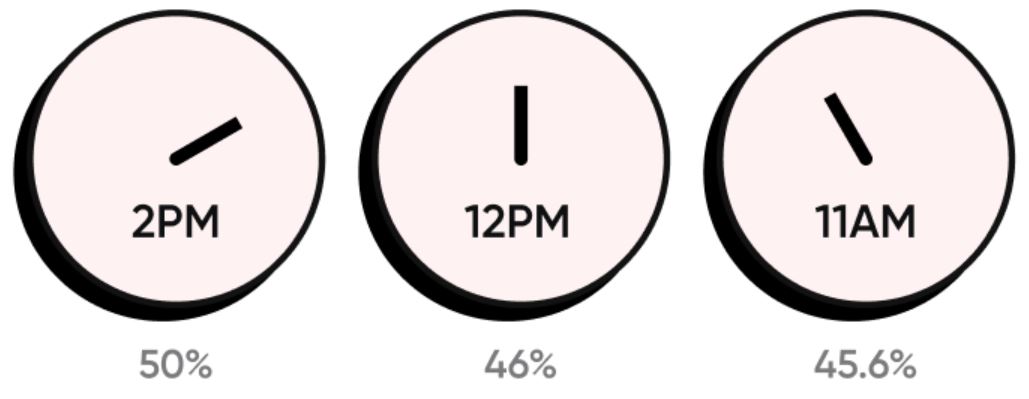
- The highest attendance rates are seen for webinars scheduled at optimal times, like 2 PM (50%), followed by noon (46%) and 11 AM (45.6%).
- Webinars with video content are highly rated, with an average score of 7.8 out of 10, though 32% of hosts do not use videos due to various barriers.
- Live Q&A sessions are a staple, with 81% of webinars incorporating them and 92% of attendees expecting them.
- Polls, used in 34% of webinars, are known to boost engagement and focus significantly.
- As of Webinar Statistics, 60-minute webinars attract more attendees than shorter sessions, and 90-minute webinars perform even better in terms of registrations.
- Email marketing is the most effective channel for driving registrations, accounting for 57% of the total.
- Webinar Statistics also state that 47% of webinar views occur within the first ten days following the actual webinar event.
Similarly, other details about the webinar views shared over time are detailed in the table below:
| Time | Views |
| After 20 days | 24% |
| After 30 days | 10% |
(Reference: demandsage.com)
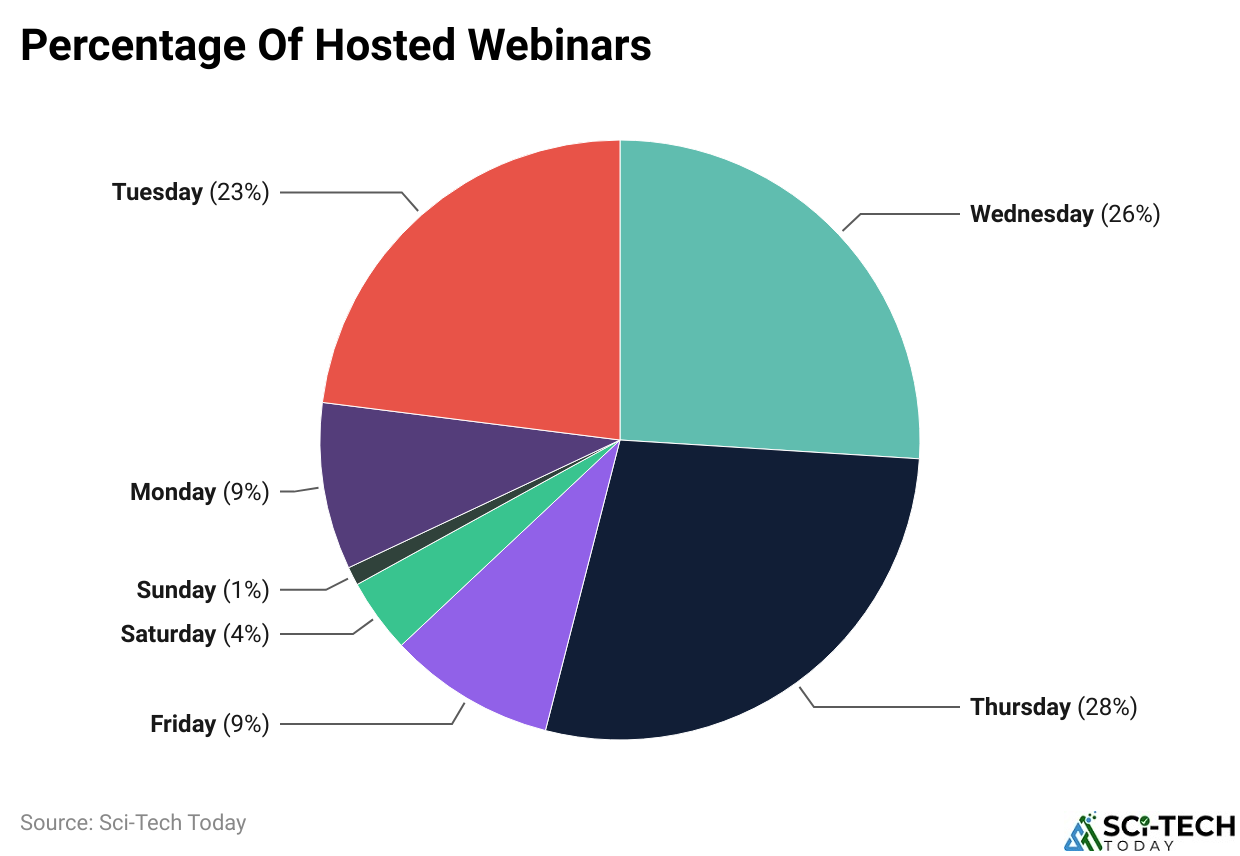
- Webinar Statistics further show that Thursdays host 28% of all webinars, while Wednesdays host 26%.
- Furthermore, other weekdays shared to host webinars are followed by Tuesday (23%), Monday (9%), Friday (9%), Saturday (4%), and Sunday (1%).
Webinar Registration Statistics
(Source: demandsage.com)
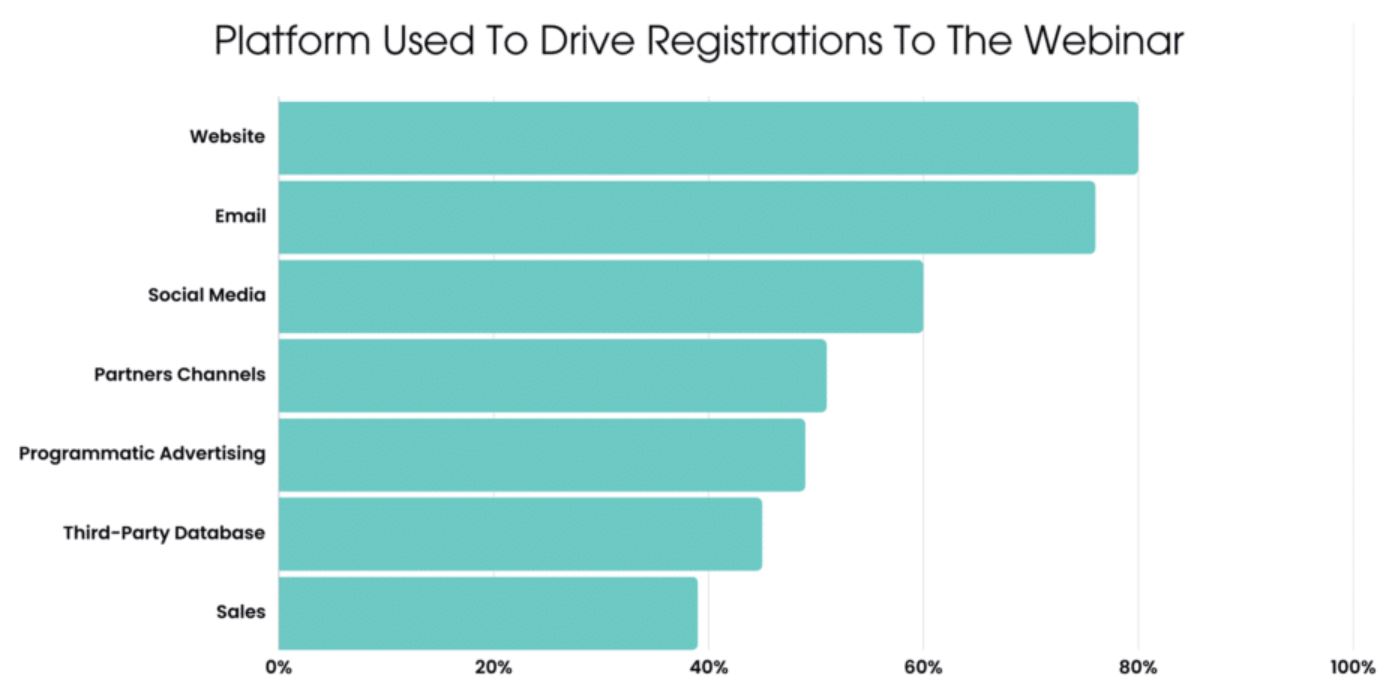
- Webinar Statistics further show that around 80% of marketers reported driving virtual event registrations primarily through their business websites.
- Meanwhile, other platforms used to drive registrations to the webinar by businesses share are followed by by email (76%), social media (60%), partners channels (51%), programmatic advertising (49%), third-party database (45%),and sales (39%).
- Nearly 29% of webinar participants complete their registration on the day of the event.
The table below illustrates the percentage of registrations occurring within various time frames leading up to the webinar.
| Registration Time Frame | Registration share |
| Less than a week | 59% |
| Between 1 to 2 weeks of webinar | 16% |
| Between 2 to 4 weeks of webinar | 13% |
| four weeks before the webinar | 12% |
(Reference: bloggerspassion.com)
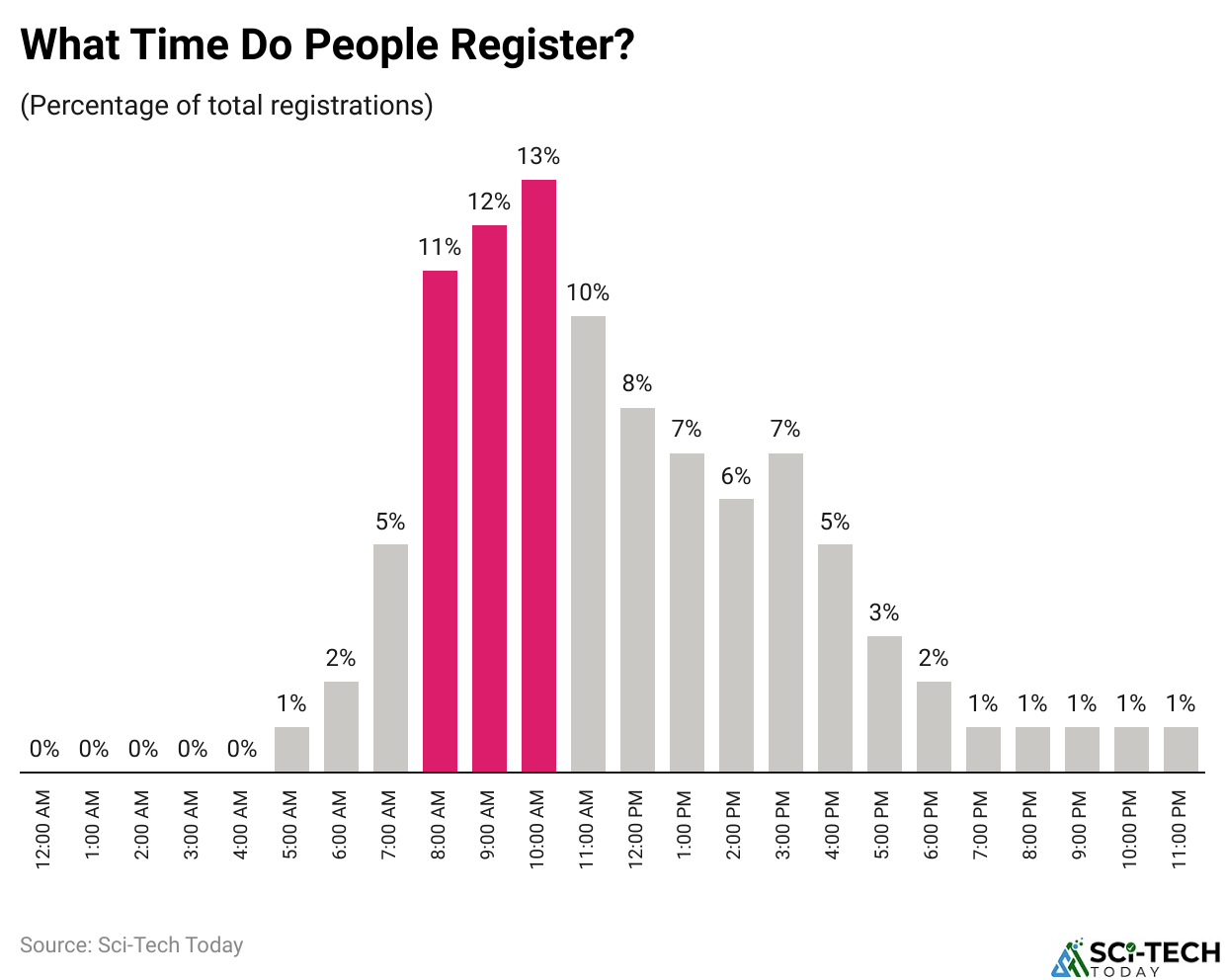
- Webinar Statistics 2024: The best time to register for a webinar is between 8 AM and 10 AM. Of these, 13% of participants registered at 8 AM, followed by 12 percent (9 AM) and 11 percent (8 AM).
- Webinar registration time by people shares includes 11 AM (10%), 12 PM (8%), 1 PM (7%), 2 PM (6%), 3 PM (7%), 4 PM (5%), 5 PM (3%), 6 PM (2%), 7 PM (1%), 8 PM (1%), 9 PM (1%),10 PM (1%), 11 PM (1%), 5 AM (1%), 6 AM (2%), and 7 AM (5%).
B2B Webinar Statistics
- The use of webinars is mostly for B2B marketing efforts, where webinars are being held by B2B companies at 61%.
- 61% of marketers use webinars as one of the forms of distributing their content.
- 54% of B2B professionals join or participate in a webinar either on a weekly or even daily basis.
- 51% of B2B marketers think that webinars are the second-most efficient distribution channel after live events (52%).
- Webinars have been used as one of the distribution channels by 55% of B2B marketers in the past year.
- Virtual product launches and virtual training events are expected to boost their market share up to USD 52.2 billion and USD 26.6 billion, respectively, by 2032.
- On average, morning webinars are 93% more effective than evening webinars.
Webinar Lead Generation Statistics
- The first priority of conducting a webinar is that it helps in producing good quality leads, as 35% of respondents have pointed out.
- As per 89% of marketers, webinars proved better than other marketing tools in terms of generating qualified leads.
- 73% of B2B marketers and sales managers are convinced that webinars help in producing good quality leads.
- 52% of marketers have rated the quality of leads generated via webinars as “above average” or “excellent.”
- Webinars conducted mid-week produce the maximum lead conversion.
Webinar Length Statistics
(Source: demandsage.com)
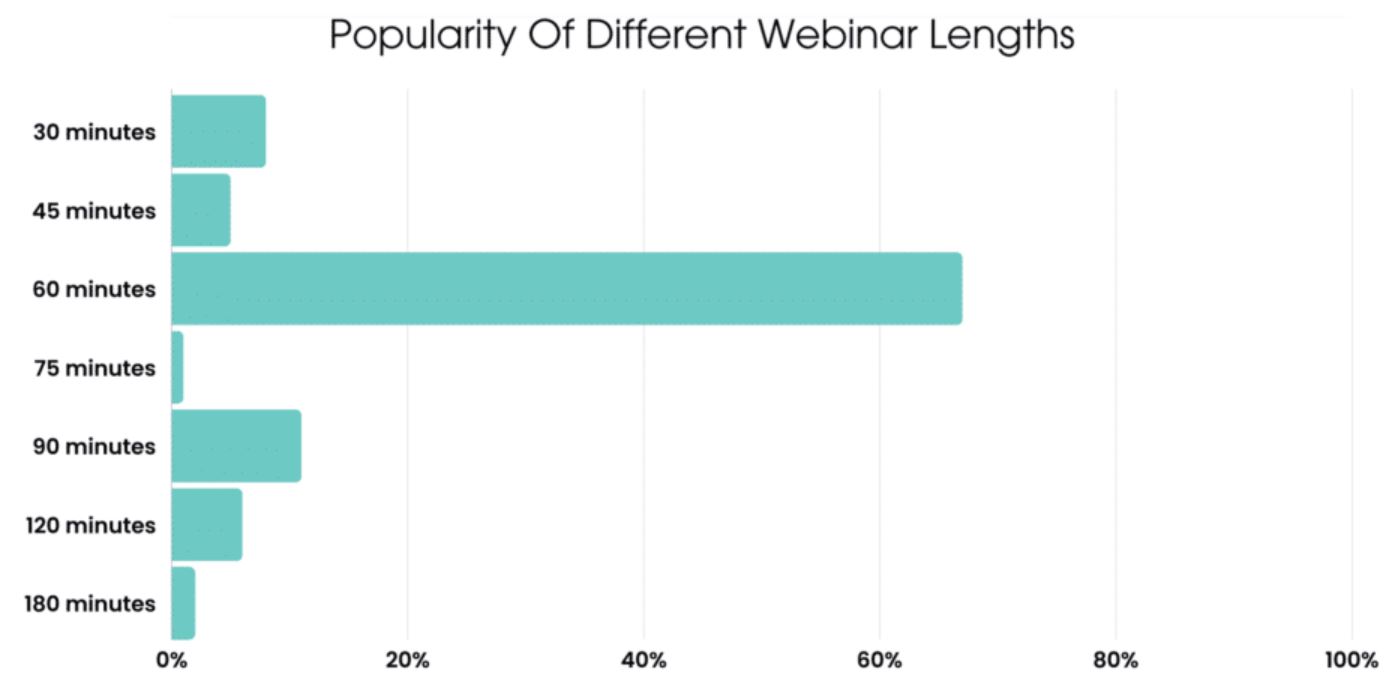
- Based on Webinar Statistics, the typical webinar duration is approximately 60 minutes in recent years, holding a share of 67%.
- The above graph, published by Demand Sage, also depicts the other popularity share of different webinar lengths, followed by 90 minutes (11%), 30 minutes (8%), 120 minutes (6%), 45 minutes (5%), 180 minutes (2%), and 75 minutes (1%).
Webinar Attendees – Attend Statistics
- On average, webinar attendees watch only 42 minutes of a webinar that is 60 minutes long.
Furthermore, the table below elaborates on the average attendance length of attendees in a webinar by different lengths.
| Webinar Length | Average Attendance Length |
| 180 minutes | 111 minutes |
| 160 minutes | 96 minutes |
| 140 minutes | 89 minutes |
| 120 minutes | 73 minutes |
| 100 minutes | 64 minutes |
| 80 minutes | 56 minutes |
| 70 minutes | 49 minutes |
| 50 minutes | 35 minutes |
| 40 minutes | 28 minutes |
| 20 minutes | 14 minutes |
B2B Businesses Usage By Webinars
- As per Webinar Statistics, 92% of B2B businesses incorporate social media content into their content marketing strategies.
- On the other hand, different types of content marketing tactics preferred by B2B companies are followed by Newsletters (83%), Website Content (81%), Blogs (80%), In-person Events (77%), Videos (77%), Illustration/Photos (76%), White Papers (69%), Online Presentation (68%), Infographics (62%), Webinars/ webcasts: (61%), Research Reports (48%), and Micro Sites (47%).
By The Software And Technology Industry
(Reference: demandsage.com)
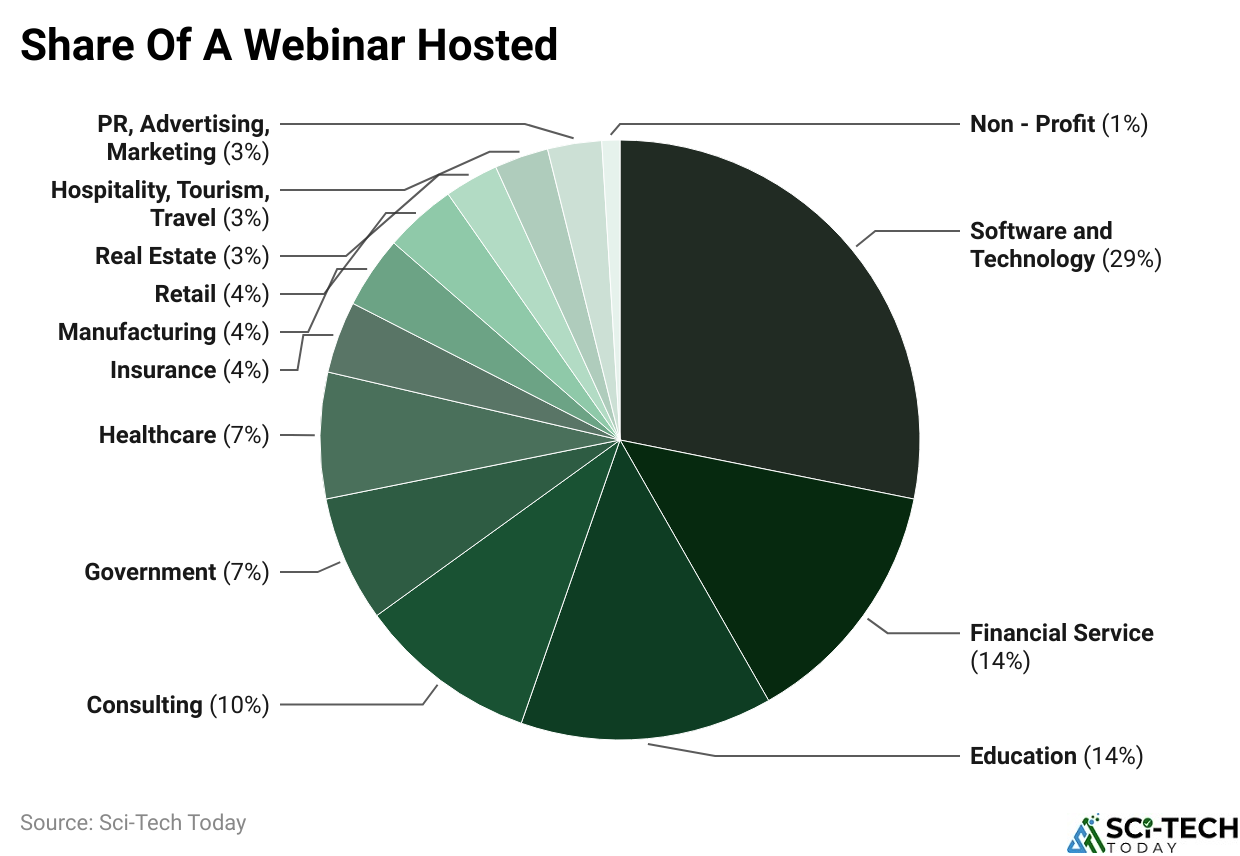
- As of 2024, the software and technology industry hosts around 29% of webinars, resulting in the highest webinar share.
- The financial service and education segments both secured a 14% share, each securing the second position.
- Furthermore, webinar share captured by other Software and Technology Industries is consulting (10%), government (7%), healthcare (7%), insurance (4%), manufacturing (4%), retail (4%), real estate (3%), hospitality, tourism & travel (3%), PR, advertising, and marketing (3%), and non-profit (1%).
B2B Marketers Rank Webinar by Content Format
 (Reference: blog.getcontrast.io)
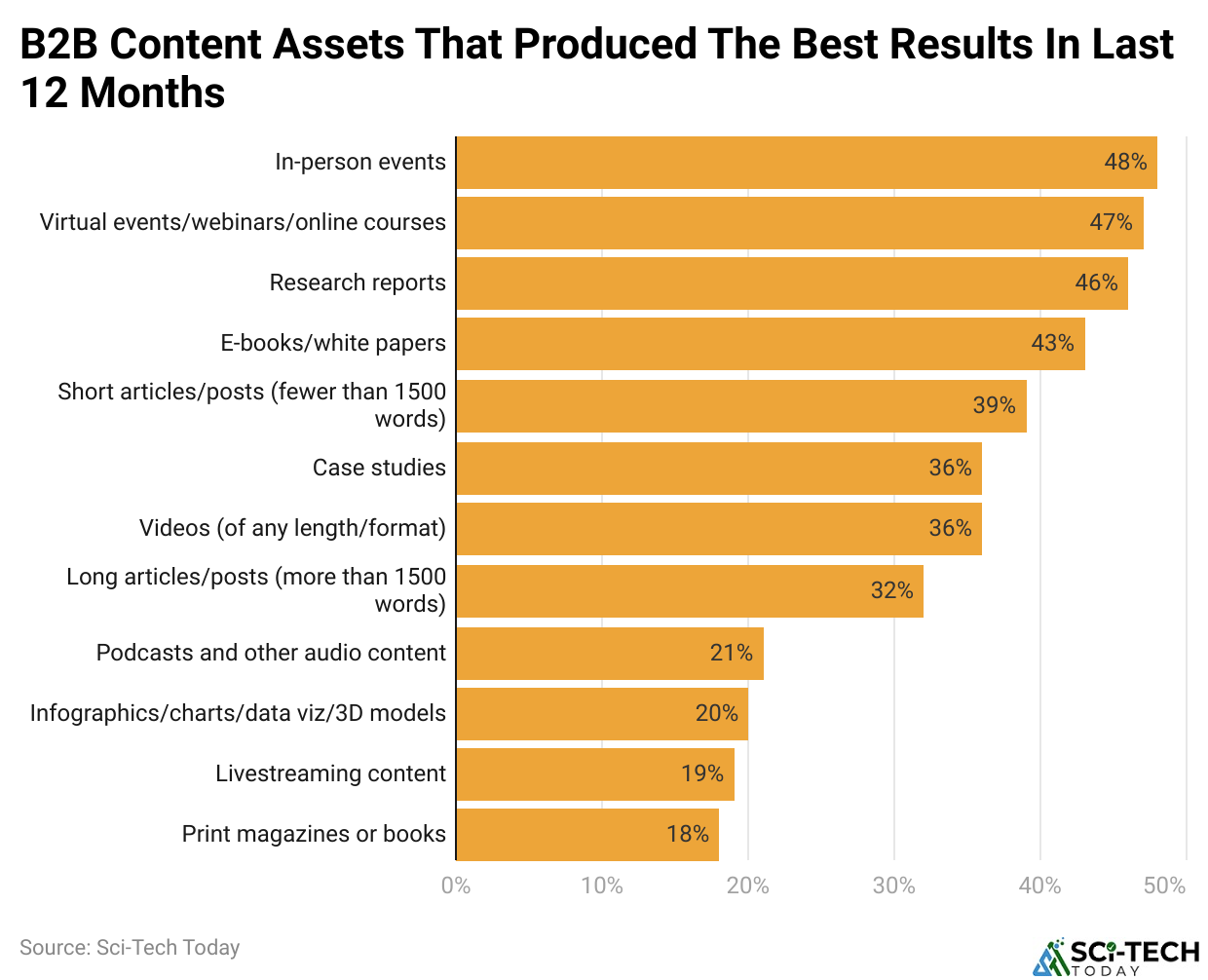
- Over the past 12 months, 48% of B2B marketers have hosted a webinar, making it the most frequently created content format for in-person events.
- As mentioned in Webinar Statistics, during the same period, other best-performing content by B2B marketers are virtual events/ webinars/ online courses (47%), research reports (46%), E-books/ white papers (43%), short articles/posts (39%), case studies (36%), videos (36%), long articles/posts (32%), podcasts and other audio content (21%), infographics/charts/data viz/ 3D models (20%), live streaming content (19%), and print magazines or books (18%).
Webinar Content Statistics Used for Creating Engagement
- Webinar Statistics also reports that Live Q&A sessions are a staple, with 81% of webinars incorporating them and 92% of attendees expecting them.
- Furthermore, webinar content shared by marketers to create engagement includes resources for download (69%), surveys (36%), social (25%), polling (22%), and group chat (10%).
Webinar Repurposing Statistics
- Marketers repurpose 65% of their webinar content to save time and money and increase the number of people who see their content.
- An average webinar is able to create four short video clips that can be posted on social media sites, blogs, and other marketing materials.
- Webinar Statistics reveal that the use of AI technology to repurpose webinar content helps marketers save 4-10 hours per webinar.
- AI technologies help to create 20% more content out of each webinar, increasing productivity and efficiency.
- The use of video integration and recording is very important, as 58% of webinar organizers use these two approaches.
Webinar Costs Statistics
- Hosting a webinar can cost anywhere between USD 100 to 3,000, depending on various factors such as the technology used, the scale of the event, and marketing efforts.
- A webinar might even range from USD 3,500 to USD 5,000 when considering all expenses, including promotion.
- Webinar Statistics also represent that the average cost per lead generated through webinars is approximately USD 72.
- The average monthly cost for a webinar hosting platform can range from USD 150 to 500.
- The global webinars and virtual events market is projected to reach USD 800 million in 2024.
Webinar Attendance Rate by Industry
(Reference: 99firms.com)
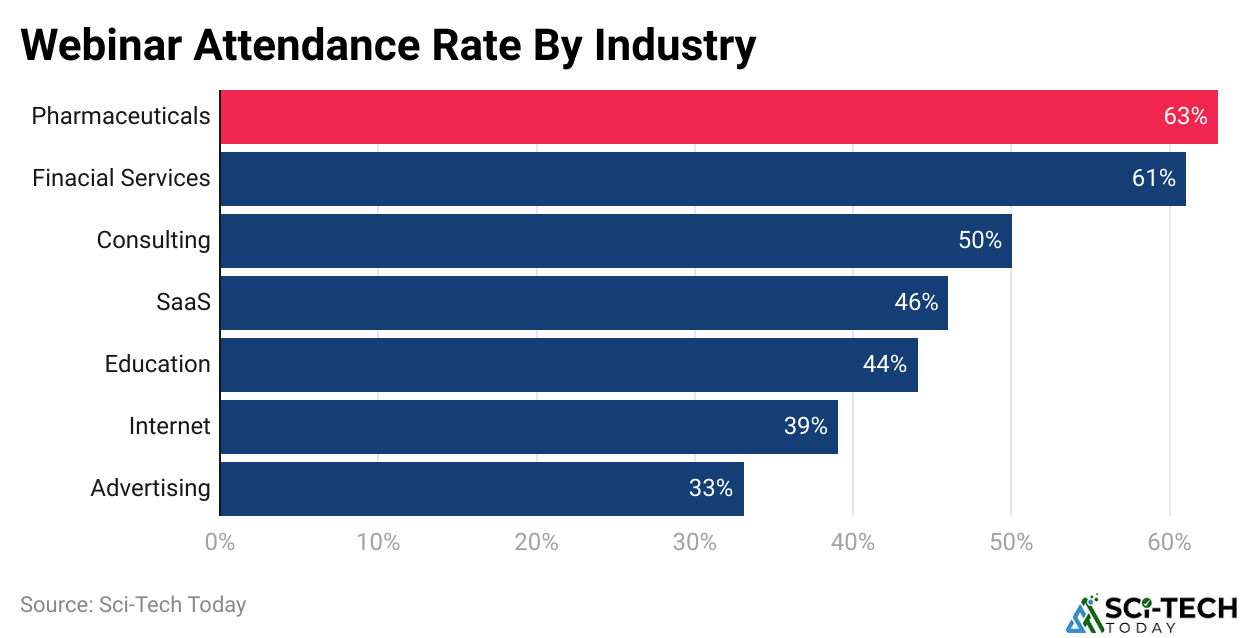
- Webinar Statistics indicate that the average attendance rate across all sectors is 46%.
- Notably, the financial services sector boasts a robust attendance rate, nearly matching the pharmaceutical industry’s impressive 61%.
- The consulting industry also demonstrates strong engagement, with a 50% attendance rate.
- Meanwhile, the SaaS sector aligns with the overall average at 46%.
- In contrast, the advertising industry lags significantly, with a participation rate of just 33%, positioning it near the bottom of the spectrum.
Attendance Rate by Types of Webinars
(Reference: cdn.prod.website-files.com)
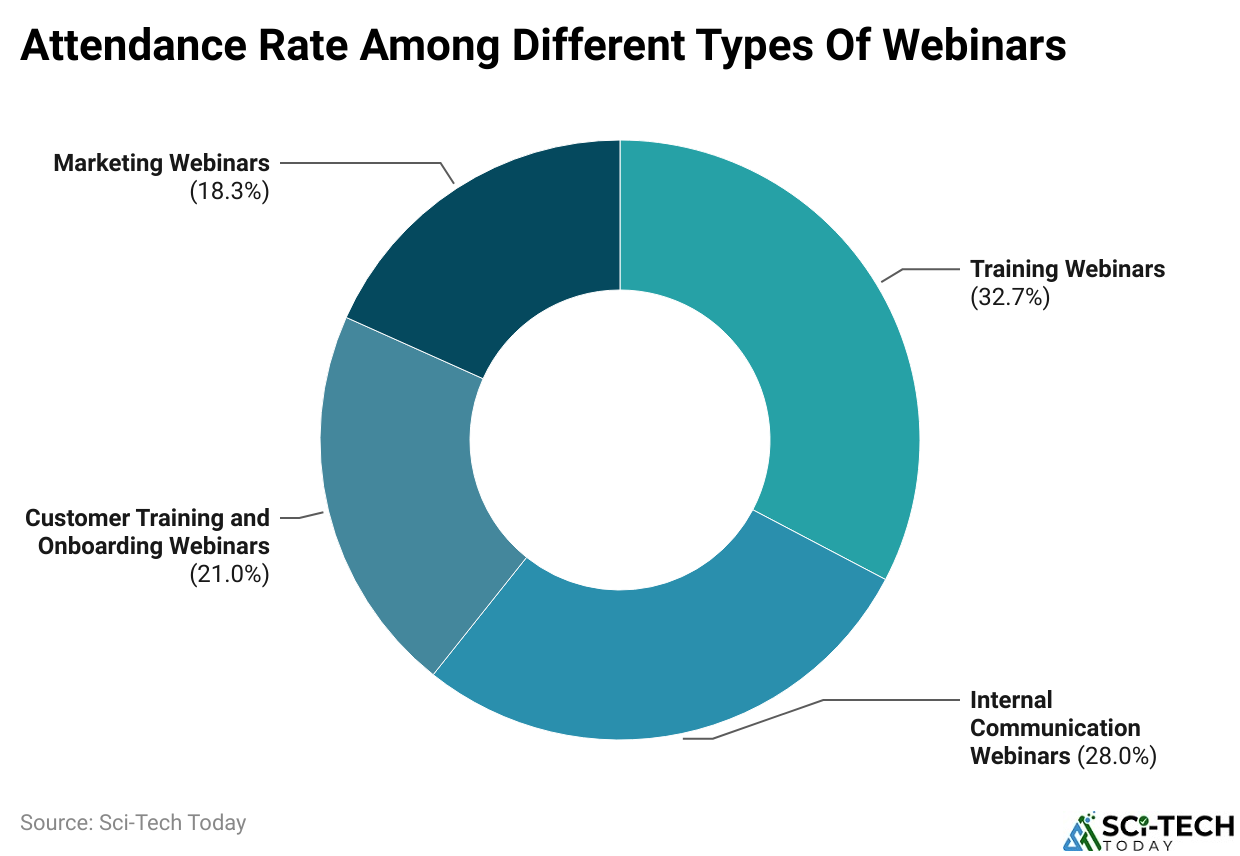
- Webinar Statistics further state that the training webinars captured the highest attendance rate, resulting in 32.7%.
- Moreover, other types of webinars by attendance rate are followed by Internal Communication Webinars (28%), Customer Training and Onboarding Webinars (21%), and Marketing Webinars (18.3%).
Webinar Conversion Rates by Industry
(Source: bloggerspassion.com)
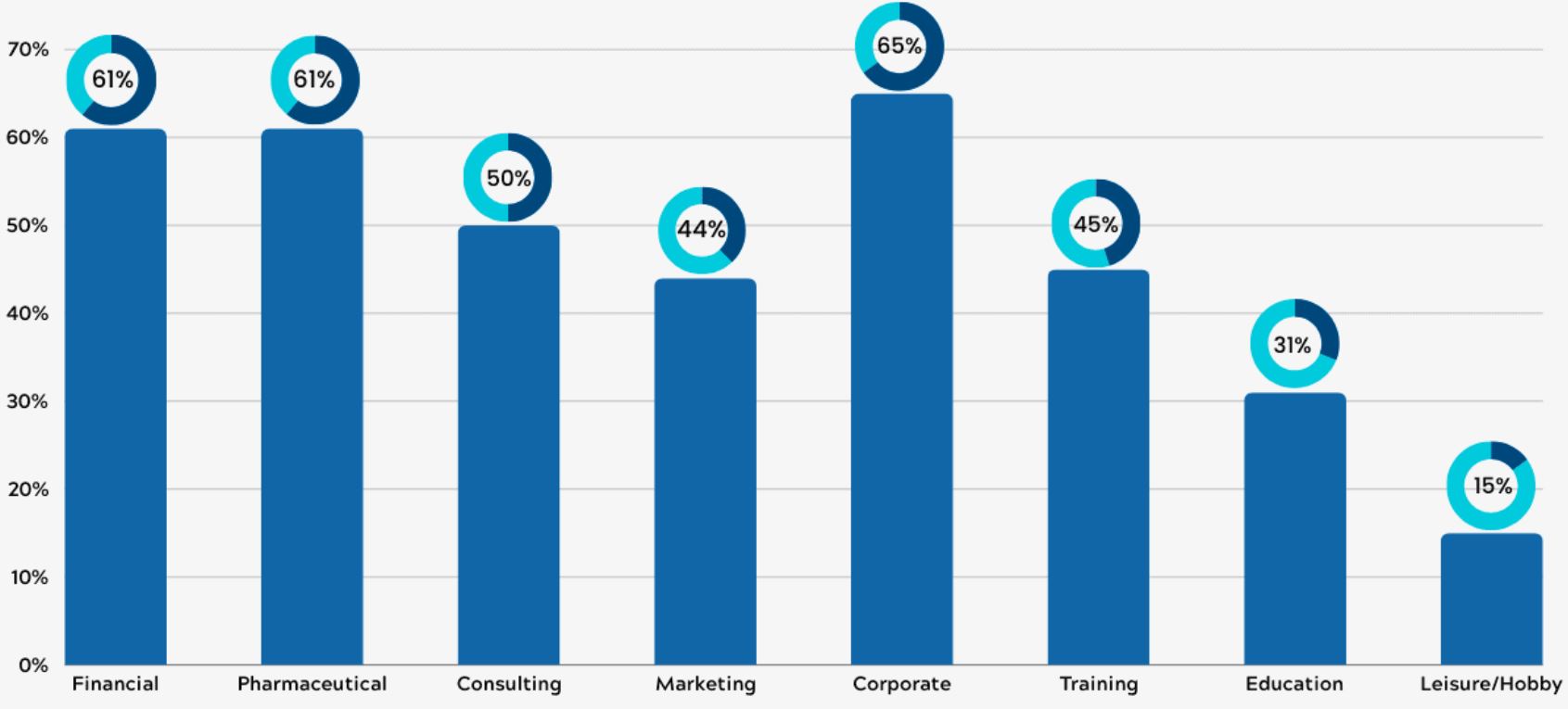
- Webinars achieve an average conversion rate of 55%, indicating their effectiveness in turning attendees into leads or customers.
- In 2024, the corporate sector accounts for the highest webinar conversion rate, resulting in 65%.
- Other industries’ conversion rates are followed by financial (61%), Pharmaceutical (61%), Consulting (50%), Training (45%), Marketing (44%), and education (31%).
Current Effectiveness of Webinars
(Source: bloggerspassion.com)
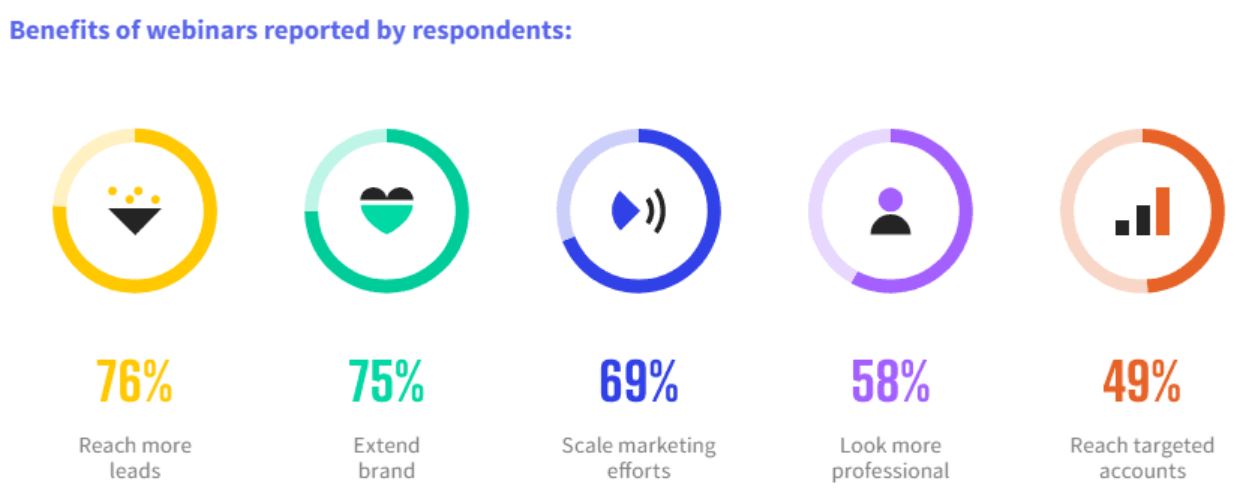
- According to a recent study, 76% of respondents have claimed that webinars help generate more leads.
- Meanwhile, other benefits of using Webinars, as shared by respondents, include extending brand awareness (75%), scaling marketing efforts (69%), looking more professional (58%), and reaching targeted accounts (49%).
Action Buyers Take After Watching Webinars
(Reference: 99firms.com)
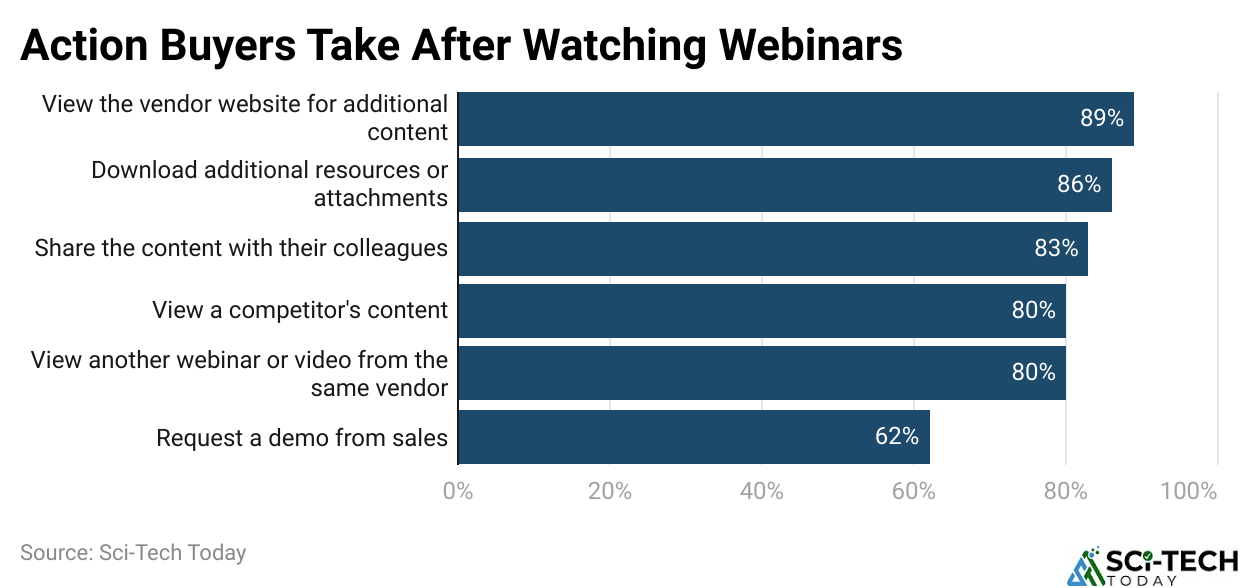
- After reviewing a webinar, 89% of attendees will visit the vendor’s website to explore additional content.
- Additionally, 86% are inclined to download resources or attachments provided, and 83% will share the webinar content with their colleagues.
- However, 80% will also check out content from competitors, according to Webinar Statistics.
- After participating in a webinar, 62% of buyers are inclined to request a product demonstration from the sales team.
Conclusion
In summary, webinars have established themselves as a powerful marketing tool, with high engagement and conversion rates, effective content delivery, and significant ROI. As businesses continue to refine their webinar strategies, these statistical insights offer valuable guidance for maximizing their impact.
FAQ
A webinar (a blend of “web” and “seminar”) is an interactive, online video presentation or workshop. It allows a host or a group of speakers to share information, teach concepts, or demonstrate products with a virtual audience located anywhere in the world.
Many webinars are completely free to attend, as they are often used by businesses or educators for marketing and lead generation. However, whether a webinar is free depends on the specific host. Paid webinars are also common and usually feature premium training, coaching, or specialized content.
Webinar software pricing generally scales with audience capacity and features. Basic plans for up to 100-500 attendees range from $39 to $99 per month, while advanced enterprise suites with marketing automation can cost $200 to $400+ per month.

Sources