








Brief Overview
Memes Statistics: A Meme is a unit of cultural details spread by emulation. The term “meme,” derived from the Greek word “meem,” which means “to imitate,” was introduced by the British evolutionary biologist Richard Dawkins in his work The Selfish Gene. Internet memes can be videos, GIFs, images, and other viral sensations. The attribute of memes involves their vulnerability to parody, their use of interrelatedness, their propagation in a viral way, and their advancement over time.
Memes are stated as the main part of Internet culture, and they have also developed in all areas. We can see them in a range of marketing, economics, finance, social movements, politics, and religion, as well as healthcare. Let’s shed more light on the meme statistics.
Key Choices By The Editor
- Millennials share 20 to 30 memes daily. About 55% of people aged 13-35 share memes weekly, and 30% share them daily.
- Instagram users share one million memes daily. Among young adults aged 18-24, 71% use Instagram, and 65% use Snapchat for memes.
- 57% of males and 50% of females in the US use memes. Males prefer funny and reaction memes, while females often share cute and reaction memes.
- Meme marketing campaigns have a 19% click-through rate (CTR), higher than the typical 6% for other marketing efforts, showing memes are highly effective in engaging audiences.
- Memes can influence stock prices and product sales. For example, Tesla’s stock rose after a meme tweet by Elon Musk. Meme-based cryptocurrencies like Dogecoin have seen significant growth.
- Memes are a favorite among Generation Z, with 77% using them to communicate. Memes related to hobbies amuse 61% of young people, and 64% find them amusing.
- Some popular memes in early 2024 include “I wouldn’t tell anyone I won the lottery, but there will be signs,” “Just ate half an X, saving the rest for later,” and “Dry January” memes.
- In South Africa and Nigeria, 81% and 79% of social media users, respectively, shared memes in the previous month, highlighting the global popularity of memes.
- In 2021, “Shiba Inu (Shib)” was the most famous meme crypto, with almost 43 million views, surpassing Bitcoin.
- The worldwide meme market had a revenue of USD 2.3 billion in 2020 and is estimated to increase to USD 6.1 billion by 2025, with a 21.6% CAGR as of 2023.
- 64% of meme content is generated by the industry, while 36% is user-generated.
- The ‘One does not simply’ meme, featuring Boromir from The Lord of the Rings, had almost 50,000 shares on Instagram.
- 74% of people send memes to make others laugh or smile, whereas 53% share memes to make others react.
- In China, 63% of participants aged 20-29 watched memes, while 40% of those aged 30-39 did the same.
General Memes Statistics
- It is projected that branded posts based on memes will have an engagement rate of 58.7% organically in 2026, compared with traditional branded graphics at an engagement rate of only 6.1%.
- Meme-driven social campaigns will have a projected CTR of 8.9% in 2026, compared with 7.1% for email campaigns, showing how relatable humor can drive users to click more often.
- Marketing campaigns have traditionally delivered CTR rates of 6%, while in 2026, short-form campaigns based on memes will deliver CTRs of 21.3%.
- In the initial statistic, the account had 16.8 million followers, and the 2026 estimate has f**ckjerry with around 18.9 million Instagram followers, maintaining its position among the biggest meme media brand accounts on social media.
- Pew Research Centre reports that almost 81% of the United States population aged 18 to 29 uses social media. Social media users generally make and share memes as an inherent part of online culture.
- The image macros that connect a comedic or provocative image with text are the most acknowledged type of meme, even though other famous types like GIFs, videos, and text messages are memes.
- As per the Morning Consult, in 2021, almost 63% of the American population of internet users between 18 and 29 shared online memes. These memes are generally very popular among teenagers.
- Pop culture is generally spotlighted extensively in memes, especially TV shows, music albums, movies, and celebrities, which are famous choices for memes. Memes also spread political or current affairs commentary.
- Almost 60% of the population stated that they would be more likely to buy from an organization that uses memes in its marketing.
- The click-through rate (CTR) of a meme campaign is almost 14% higher than that of email marketing.
- The Memes have almost ten times more reach, with nearly 60% current organic commitment than the regular marketing graph.
- The median millennials look at almost 20 to 40 memes in one day.
- The worldwide meme market had revenue of USD 2.3 billion in 2020 and is expected to grow to USD 6.1 billion by 2026.
- Roughly 75% of people between 13 and 36 years old share memes.
- According to Memes Statistics, 29% of people share memes on social media.
- Almost 74% of people send memes to make others laugh or smile, whereas 53% share memes to make other people react.
- Virtually 38% of people follow meme-sharing accounts to get daily meme updates on social media.
- The Saint Hoax is among the most famous meme accounts on Instagram.
- The image of “Disaster Girl” has generated more than $573,000 at an auction and is one of the most profitable meme NFTs to date.
- In 2021, “Shiba Inu (Shib)” was the most famous meme crypto, with almost 43 million views and more views than BTC.
Meme Marketing Insights Statistics
- Social media has become a hotspot for brands to connect with consumers, especially the younger crowd. Memes—those funny, often relatable images or videos—are taking over the internet, and brands are starting to take notice.
- Research shows that people aged 16 to 34 are spending a big chunk of their media time on social platforms, way more than on TV. Plus, sharing memes has become a daily ritual for many, especially among the 13 to 35 age group. Instagram and TikTok are leading the pack when it comes to sharing memes, with millions being exchanged daily.
- TikTok is a prime spot for meme marketing. Its algorithm makes it easy for memes to go viral, and with millions of users spending hours on the app every day, it’s a goldmine for brands looking to reach a massive audience.
- The organic engagement rate of memes is 60% higher than other marketing images.
- The click-through rate (CTR) of meme campaigns is 19%, which is 6% for regular marketing campaigns.
- The CTR of meme campaigns is 14% higher than that of email marketing.
- Over 60% of participants are interested in buying brands that use memes in their marketing campaigns.
- 41% of American consumers want brands to be involved in meme culture/trends.
- 80% of participants think that meme usage by brands makes them relatable.
- The ROI of meme marketing is reportedly 60% (by the beginning of 2025).
- Remember when viral videos were all the rage on YouTube? Well, times have changed. Creating a video that goes viral isn’t as easy as it used to be. Brands need help to make content that gets shared organically. But here’s where meme marketing comes in.
- Memes are like little cultural nuggets that people love to share. They’re short, funny, and speak to what’s happening right now. Brands that tap into meme culture can grab attention and get people talking.
- Tesco, a supermarket chain, recently ran a campaign on TikTok to find the voice of their self-checkout machines. They asked users to create their versions of the self-checkout script. The response was huge, with millions of views and tons of media coverage.
- Brands are always looking for ways to stand out and get noticed. Meme marketing offers a unique opportunity to create buzz and generate excitement. By creating meme-worthy moments, brands can boost their fame and drive growth.
- Meme marketing isn’t just a passing trend it’s a powerful tool for brands to connect with consumers in the digital age. By embracing meme culture and creating shareable content, brands can increase their visibility and drive success.
Digital Engagement Activities
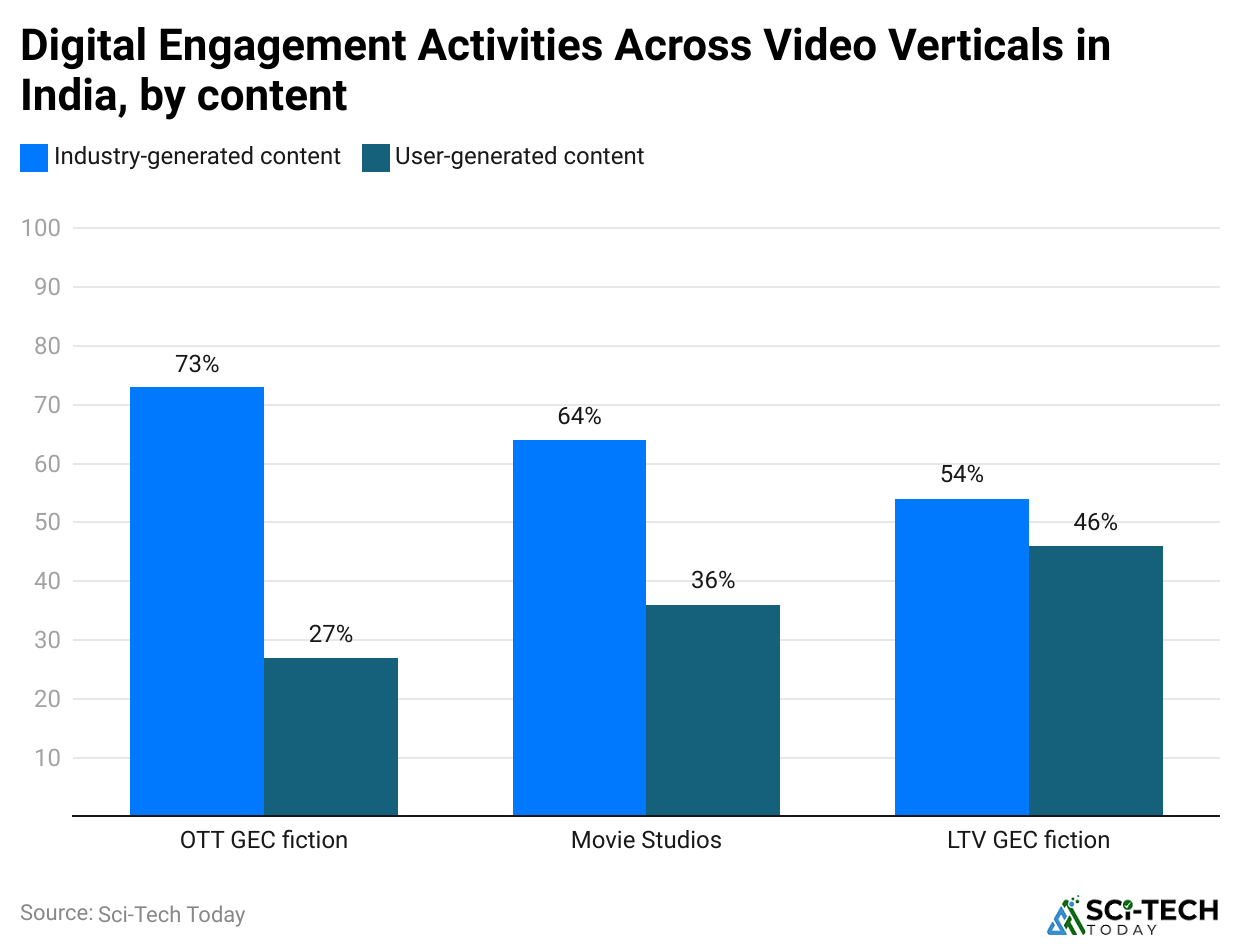
(Reference: enterpriseappstoday.com)
- In the above chart, we can see that digital engagement activities around video verticals in India.
- We can observe that light blue colors show industry-rated content and dark blue colors show user-generated content.
- As seen, the OTT GEC fiction was 73% of the industry’s content, and only 27% was user-generated content.
- Movie Studios show that 64% of content was generated by the industry, and users generated 36% of the content.
- The LTV GEC fiction was 54% of the industry-industry content, and 46% was user-generated content.
Social Media Network Usage in India
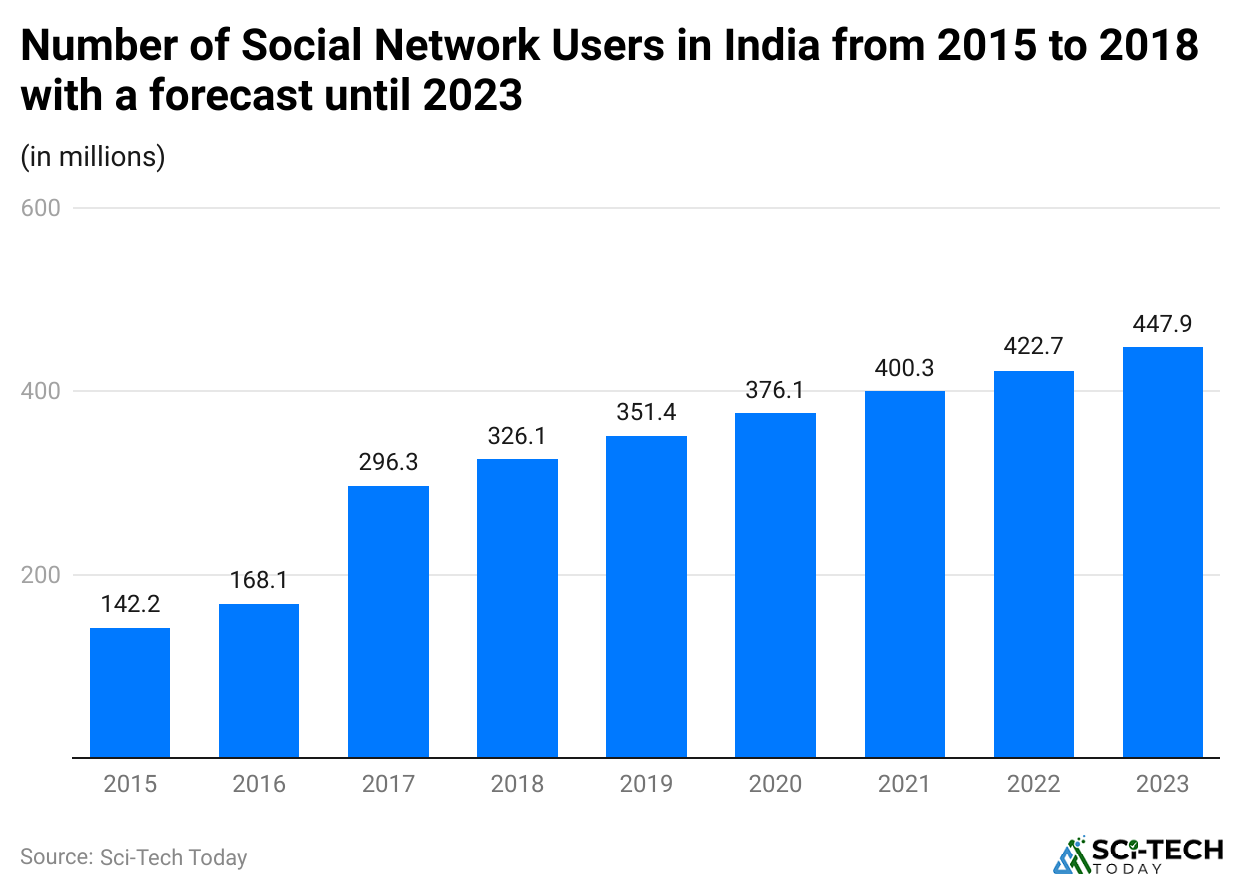
(Reference: enterpriseappstoday.com)
- In the above chart, we can see the number of social media network users in India between 2015 and 2026.
- Global social media users grew from about 2.1 billion in 2015 to roughly 4.9 billion in 2023, and have further increased to around 5.5-5.8 billion users as of 2025-2026.
Meme Usage Statistics
- In another study by New York University, it was discovered that memes spread up to 10 times more than regular marketing visuals.
- Furthermore, it was noted that memes also have 60% higher organic interactions. The Netflix US accounts tweet memes related to one of its episodes once a week or more.
- The tweet related to the invention of brunch received over 10,000 likes and 2,000 retweets. As stated by Forbes, over 60% of the customers were likely to purchase products from companies utilizing memes in their marketing strategies. Moreover, as per the Forbes article, millennials usually see about 20 to 30 memes daily.
- As per the latest survey by YPulse, 74% of respondents shared memes in order to make other people laugh.
- Moreover, 53% of respondents reported that they share memes as a response to something.
- Also, 35% of people share memes as a code for someone else to get.
- 28% shared memes as a replacement when words couldn’t convey their emotions.
- It was noted that the majority of people engaged in conversations through memes on the internet. As per Forbes, 38% of internet users follow meme accounts.
The Popularity of Memes Statistics
- As per the Visual Objects poll, nearly 44% of social media users between 18 and 34 generally share memes online.
- Memes have also become very famous on social network websites like Instagram, Reddit, and Twitter. Reddit’s subreddits, which are marked to various meme subgenres and cultures, are often credited with publicizing some of the best-known memes.
- One of the most common forms of memes is the use of images or videos that contain comical or sarcastic images along with some text.
- Next is the memes or videos containing a short video from some TV episodes or movies with some funny captions or other such text.
- These memes are connected with famous cultures including movies, music artist, celebrities, and TV series. But many of them are not famous in the industry but have featured an iconic person like any movie actor.
- Memes have always been a trend in the world as an effective means of entertainment and satire in the world of politics and advertising.
- The researchers are examining the effect of memes on society through their study. Other researches are also being conducted to explore the use of memes in conveying emotions or messages in society.
- Sometimes these memes are used to provoke the people and the society against some party.
- Memes have become very famous over time, and new ones are continuously being created. Social media networks and online communities give users a limitless platform on which to create, develop, and share their views.
Most Iconic Memes
- The ‘Bad Luck Brain’ meme has almost 50,000 variations on the Meme generator website.
- The ‘YUNO’ meme is the most widely spread meme on Tumblr.
- The ‘Kermit sipping tea’ meme is one of those memes that are used for almost 800,000 tweets.
- The ‘Most Interesting Man in the World’ meme has almost 500,000 shares on Instagram.
- The ‘One does not simply’ meme meme that involves the still image of Boromir from ‘The Lord of the Rings’ had almost 50,000 shares on Instagram.
- The ‘Crying Jordan’ meme created almost 2 million tweets.
- ‘The Cat memes’ is one of the top 20 meme types searched online, with a monthly number of searches reaching 1 million.
- The ‘Sad Keanu Reeves’ meme has been shared almost 1 million times on Facebook.
- The ‘Hide the Pin Harold’ meme had almost 400,000 mentions on Twitter.
- The ‘Expanding Brain’ meme has almost 20,000 posts on Instagram.
- The ‘This is Fine’ meme of Dog has been created using the “Gunshow” comedy show and was shared almost 200,000 times on Twitter.
- ‘Dank Memes’, which has almost 5 million subscribers, is one of the most popular memes.
- ‘Rickrolling’, which also involves the song “Never Gonna Give You Up” by Rick Astley, has almost 1 billion views on YouTube.
- ‘Arthur Fist’ meme has been posted almost a million times on Instagram.
- ‘Distracted Boyfriend’ meme, which has been largely created using a stock image posted by Antonio Guillemin, has been remade in almost 1 million different ways.
- The meme of ‘Pepe, the Frog’ has been posted in almost 12,000 different items on eBay.
- ‘Mocking SpongeBob SquarePants’ meme has been tweeted in almost 2.8 million tweets.
- The GIF of Michael Jackson eating popcorn from the “Thriller” video has almost 6 million shares on Twitter.
Meme Dark Side
- Memes, those funny pictures or videos we see online, are more than just entertainment. They spread like wildfire on the internet, evolving as people share them.
- But memes aren’t always harmless. They can also be used to spread false information, causing problems in the market.
- Just like viruses, memes can infect our minds and change our behavior. This is because of the power of the internet and advanced AI technology.
- Memes can be engineered to trick people into believing and sharing false information, affecting society and even elections.
- Biologist Richard Dawkins introduced the concept of memes in 1976. He compared memes to genes, saying they replicate and spread through human culture.
- Back then, the internet was less advanced than it is today. But now, with social media and AI, memes can spread faster and have a bigger impact. The rapid spread of memes is similar to how viruses spread. The more people share them, the more successful they become.
- Social media platforms like Facebook and Twitter have made it easy for memes to reach a large audience quickly. Deepfakes, which are realistic but fake videos, are also becoming more common. They can be used to spread false information and manipulate people.
- Detecting deep fakes is difficult, and trying to regulate social media may not be enough to stop them.
- One solution could be to educate people about internet literacy and how to spot false information. Just like with vaccines for viruses, we need to build immunity against harmful memes.
- Folklorists who study stories and legends can help us understand how memes spread and why people believe them.
- They use techniques like the SLAP test to determine if a story is true or not.
- In market research, it’s important to be aware of the influence of memes and false information. People may believe rumors or conspiracy theories that could affect their buying decisions.
- By understanding how memes spread and why people believe them, market researchers can better navigate the digital landscape.
- Overall, memes can significantly impact society and the market. It’s essential to be aware of their influence and take steps to combat false information.
- By building immunity against harmful memes and educating ourselves about internet literacy, we can protect ourselves and make more informed decisions in the market.
By Region and Demographic
(Reference: enterpriseappstoday.com)
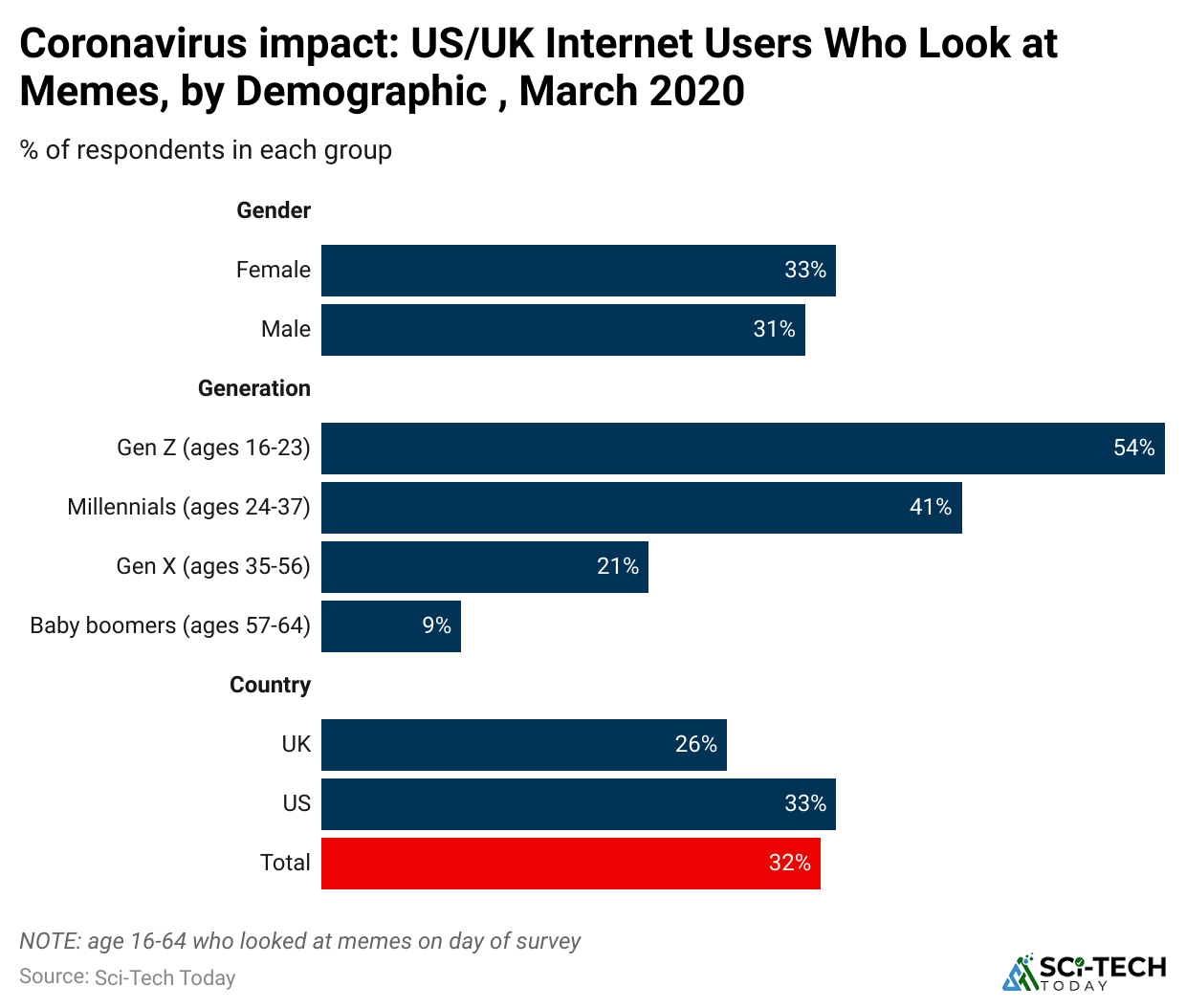
- In the above chart, we can see the impact of the coronavirus on internet users in the United States and the United Kingdom who looked at memes.
- We can see that if we consider the gender of the population, almost 33% of females and 31% of males watched memes in March 2020.
- Further, it is shown that almost 54% of the population between 16 and 23 years old were Gen Z generation who watched memes in 2020.
- Almost 41% of Millennials between 24 and 37 years old watch memes, and 21% of Gen Z between 35 and 56 years old watch memes.
- On the other hand, just 9% of the baby boomers between 57 and 64 years old watch memes.
- According to a count conducted in 2022 by the YouGov market, the memes market is famous among a range of European countries. 51% of the participants are from the United Kingdom, 47% from France, and 42% from Germany.
- According to a survey by Hootsuite, memes are popular in Latin America, specifically in Mexico and Brazil. Almost 86% of Brazilians and 85% of Mexican participants have used them within the last few months.
- The Chinese participants in the survey who were between 20 and 29 years old used to watch memes 63% of the time, whereas those who were 30 to 39 years old watched memes 40% of the time.
Wrapping Up
The article has outlined some important meme statistics for 2025-2026, and we saw that memes are becoming a very big business to work with. These are the two major factors that are likely to shape the future. At first, the traditional social media platforms of Twitter and Instagram were newer, and they were focused networks like Snapchat.
This is run by the younger generation, which increases the gravity of the platforms. In the second place, we can state the increase in the number of ‘ad-memes’ that are branded content designed to go viral.
FAQ
An excellent meme should stand out but still incorporate all the latest trends, jokes, and ideas. The meme should not be too long with a very brief text and an attention-grabbing picture or video. Incorporate humor that will speak to your audience. Add social media sharing buttons to enable people to share your meme.
Whereas memes can be videos, memes tend to use texts mostly. GIFs are mostly images based and they are used for various things such as humor, communication, marketing, and even humor.
The Memecoin price today is USD 0.0005568 and its trading volume is USD 10.36M. The 24h change of MEME is +2.31%.

Sources