









Opening
Online Payment Statistics: Online Payments have become a part of everyday life. People now use their phones, cards, and digital wallets to shop, pay bills, book tickets, and send money within seconds. Fast, easy, and secure payment methods have changed how consumers and businesses handle transactions. As online shopping and mobile banking continue to grow, digital payments are replacing cash in many parts of the world. At the same time, companies are improving payment security and adding new features to make transactions safer and smoother.
This article highlights the latest online payment statistics, market trends, user behavior, and key developments that are shaping the future of digital payments across the globe.
Premium Pick
- The global digital payments market is projected to reach USD 112.15 billion in 2026 and grow at a 22.1% CAGR through 2033.
- Digital wallets account for 56% of global online purchases, making them the world’s most popular payment method.
- Consumers are 180% more likely to use digital wallets than any other online payment option.
- UPI powers 85% of India’s digital transactions and supports nearly 50% of global real-time payments.
- The number of digital wallet users exceeded 5.2 billion worldwide in 2026.
- QR code payments reached 380 billion transactions, representing over 40% of wallet transaction volume.
- Asia-Pacific leads digital wallet adoption, with wallets handling 74% of online transactions.
- Global digital transaction value increased to USD 13.17 trillion in 2026.
- More than 2 billion people worldwide actively use mobile payment services.
- Retail and e-commerce remain the biggest users of digital wallets, with wallet payments expected to exceed 60% of global e-commerce transactions by 2026.
What is Mobile Payment?
Mobile payments are digital transactions made using smartphones or other mobile devices. Often called “m-payments,” they usually use digital wallets like Google Pay and Apple Pay. These wallets store payment information electronically, letting users pay for goods and services with a tap without needing physical cards.
Mobile payments are considered faster, more convenient, and more secure than other payment methods, which explains their rapid growth in recent years. Businesses can easily start accepting mobile payments—all they need is a standard POS setup or a simple contactless payment reader.
Digital Payments Market Key Insights
- Coherent Market Insights estimates that the global digital payments market will reach USD 112.15 billion in 2026 and is projected to grow to USD 453.74 billion by 2033.
- The market is expected to expand at a 22.1% CAGR between 2026 and 2033.
- By payment mode, Point of Sale (POS) is expected to hold the largest market share of 29.7% in 2026.
- By enterprise size, large enterprises are projected to account for 63.9% of the market.
- By end user, the BFSI sector is expected to capture 47.8% of the market.
- North America is expected to lead the market with a 39.2% share in 2026.
Key Milestones of Online Payments Statistics
- 2014: Global digital payments were valued at USD 1.7 trillion, while cash remained the dominant payment method and mobile wallets were still in their early stages.
- April 2016: India launched the Unified Payments Interface, which processed 2 crore transactions in its first full year.
- November 2020: Brazil introduced the PIX instant payment system, capturing 42% of e-commerce payments and 34% of POS transaction value within 3 years.
- 2022: Global digital payments reached USD 15.4 trillion, and cash accounted for less than 50% of global payment volume for the first time.
- July 2023: The U.S. Federal Reserve launched FedNow, supporting 3.5 billion real-time transactions, equal to 2% of the global total.
- April 2024: Global real-time payments reached 266.2 billion, up 42.2% YoY, while India’s UPI processed 129.3 billion transactions, representing 49% of the global total.
- 2026: According to axis-intelligence.com, digital wallets reached 56% of global e-commerce payments, UPI exceeded 640 million daily transactions, digital payment fraud was projected to increase from USD 40 billion (2024) to USD 100 billion by 2029, and digital wallets absorbed 2.1 percentage points of cash’s 4% decline between 2023 and 2025.
Global Payment Mix Trends (2025 vs. 2026)
- According to Clearly Payments, Digital wallets remained the most popular payment method worldwide. They accounted for around 50% of global payment methods in 2025 and increased to 53% of global online purchases in 2026, driven by the growing use of services such as PayPal, Apple Pay, and Google Pay.
- Credit and debit cards continued to play a major role in digital payments. They represented about 25% of global payment methods in 2025. In 2026, credit cards accounted for 20% of online purchases, while debit cards contributed 12%, resulting in a combined share of approximately 32%.
- Bank transfers and account-to-account payments, including ACH, UPI, and SEPA, made up around 15% of global payment methods in 2025. Their share was estimated at 7% of global online purchases in 2026.
- Buy Now, Pay Later (BNPL) represented approximately 5% of global payment methods in 2025. In Europe, BNPL accounted for 9% of e-commerce transactions in 2023, highlighting continued growth through the mid-2020s, although a confirmed global 2026 share is not yet available.
- Cash, including cash on delivery, accounted for around 3% of global payment methods in 2025. In the Middle East and Africa, cash on delivery represented about 9% of e-commerce transactions in 2023, compared with the global average of approximately 2%, indicating stronger regional demand.
- Cryptocurrency represented less than 1% of global payment methods in 2025. Its share reached around 2% of global digital payments in 2024, suggesting gradual adoption through 2025-2026.
- Checks accounted for less than 1% of global payment methods in 2025 and remained largely phased out, with only a negligible role in online payments through 2026.
Most Popular Online Payment Methods
- Digital wallets are currently the most widely used online payment method in both the U.S. and global markets, according to research conducted by Capital One Shopping.
- In the U.S., digital wallets account for 40% of online transactions and are projected to reach 44% by 2030.
- Globally, digital wallets are used for 56% of online purchases, and their share is expected to increase to 63% by 2030.
- Consumers worldwide are 180% more likely to use a digital wallet than any other online payment method.
- Digital wallet adoption increased 34.0% between 2019 and 2025 and is projected to grow by another 12.5% from 2025 to 2030.
- Credit card payments for global online sales declined 9.09% from 2023 to 2025. In North America, credit cards accounted for 33% of online purchases in 2025, down 3.13% YoY.
- Debit cards represented 10% of global online purchases in 2025. In North America, debit cards accounted for 15% of online purchases, declining 16.7% YoY.
Global Transaction Value by Online Payment Methods
(Source: imagedelivery.net)
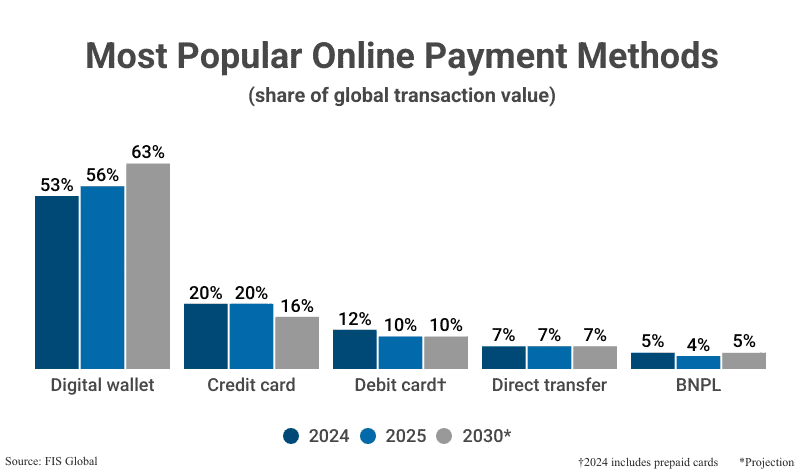
- Digital wallets are expected to remain the leading online payment method, increasing their share of global transaction value from 56% in 2025 to 63% by 2030, reflecting continued consumer preference for fast and convenient digital payments.
- Credit cards are projected to decline from 20% of global transaction value in 2025 to 16% in 2030, as more consumers shift to digital wallets and alternative payment methods.
- Debit cards are expected to maintain a stable 10% share of global transaction value in both 2025 and 2030.
- Direct transfers, including account-to-account and bank transfer payments, are also forecast to remain steady at 7% of global transaction value throughout the period.
- Buy Now, Pay Later (BNPL) is expected to grow from 4% of global transaction value in 2025 to 5% in 2030.
Digital Payment Landscape in Asia-Pacific and India
- Merchantsavvy.co.uk report further stated that Asia-Pacific continues to lead the global shift toward digital wallets. Digital wallets processed 70% of e-commerce transactions in 2023, almost double North America’s 37% share.
- In India, UPI handled 83% of total digital payment volume in 2024, making it the country’s most widely used digital payment method.
- By July 2026, UPI accounted for 85% of all digital transactions in India. The platform served 491 million individuals and 65 million merchants while enabling nearly 50% of global real-time digital payments, according to pib.gov.in.
North America and Europe
- Clearly Payments report also mentioned that in the United States and Canada, credit and debit cards continued to dominate consumer payments, accounting for more than 65% of all transactions in 2025.
- At the same time, over 50% of consumers in these markets regularly used mobile wallets, including Apple Pay and Google Pay, for both in-store and online purchases.
- Capital One Shopping report also mentioned that globally, credit cards represented 20% of online purchases in 2026, while debit cards accounted for 12%.
- Apple Pay and Google Pay together captured a 17% share of global online payments in 2026.
Digital Wallet Payment Statistics
- A blog published by Guul. games shows digital wallets remained the leading online payment method in 2026, accounting for 53% of global online purchases. Apple Pay, Google Pay, and PayPal continued to lead digital wallet adoption worldwide.
- Apple Pay and Google Pay together held a 17% share of global online payments,
- According to a report shared by Mastercard, the number of digital wallet users worldwide exceeded 5.2 billion in 2026, representing more than 60% of the global population.
- QR code payments became the most popular wallet transaction type, reaching 380 billion transactions and accounting for more than 40% of all digital wallet transactions by volume.
- The global mobile and digital wallet market reached USD 3,635.3 billion in 2026, reflecting strong growth in transaction value. Another estimate valued the digital wallet market at USD 287 billion in 2026, based on market revenue rather than transaction value.
- Asia-Pacific remained the largest regional market, with digital wallets accounting for 74% of online transactions.
Adoption by Geography
| Region/country | E‑commerce wallet share | In‑store wallet share | Notes |
| Asia‑Pacific | 77% | 63% | World’s highest wallet penetration; wallets dominate online and POS. |
| China | 89% | 87% | Alipay + WeChat Pay effectively complete the consumer wallet stack. |
| India | 68% | 61% | UPI‑driven; wallets forecast to overtake cards by 2030. |
| Western Europe | 52% (Germany, e‑com) | Rising | PayPal dominant in Germany, used by around 70% of online shoppers. |
| United States | 40% (e‑com) | 17% (in‑store) | Structural lag vs global average in both channels. |
| Global average | 56% (e‑com) | 33% (in‑store) | Wallets now the leading global payment method across channels. |
Digital Payment Security Statistics
- Users Are Concerned: 69% of people who use digital payments worry that these methods might not be as safe as other payment options.
- Experts Have Mixed Opinions: 47% of cybersecurity experts need clarification on the security of mobile payments.
- Public Wi-Fi Seen as a Major Risk: The biggest security risk for mobile payments is using public Wi-Fi, according to 26% of experts. Lost or stolen devices are also a concern, affecting 21%.
- Public Remains Doubtful: 70% of Americans are hesitant to switch to mobile payments because of security worries.
- Hacking is a Major Concern: Among those who doubt the security of digital payments, 41% are most worried about being hacked, while 16% are concerned about fraud, and 12% about theft.
UPI Top 10 Remitter Member Performance (February 2026)
| UPI Remitter Member | Total Volume (Million) | Approved | BD Share | TD Share | Total Debit Reversal Count (Million) | Debit Reversal Success Rate |
| Bank of Baroda | 1,460.03 | 89.37% | 10.62% | 0.01% | 6.43 | 98.45% |
| Canara Bank | 1,029.34 | 91.63% | 8.22% | 0.15% | 4.01 | 86.78% |
| Axis Bank Ltd. | 934.11 | 94.09% | 5.91% | 0.00% | 2.35 | 96.48% |
| Airtel Payments Bank Limited | 680.62 | 77.78% | 21.97% | 0.25% | 5.28 | 89.92% |
| Bank Of India | 644.12 | 91.74% | 7.69% | 0.57% | 3.65 | 86.20% |
| Bank of Maharashtra | 229.72 | 92.28% | 7.71% | 0.01% | 0.73 | 91.34% |
| BANDHAN BANK LIMITED | 92.43 | 94.94% | 4.80% | 0.25% | 0.55 | 88.10% |
| AU Small Finance Bank | 81.88 | 88.00% | 12.00% | 0.00% | 0.42 | 52.09% |
| Baroda U.P. Bank | 75.30 | 88.41% | 4.33% | 7.26% | 1.74 | 38.99% |
| Chaitanya Godavari Grameena Bank | 41.70 | 86.75% | 11.64% | 1.61% | 0.34 | 48.07% |
Online Payment Application Revenue and Usage Statistics
- More than 2 billion people worldwide use mobile payments, with millions more starting each year.
- In countries like India, Southeast Asia, and South America, younger people are ditching credit and debit cards and using mobile apps.
- The adoption of mobile payments could be faster in developed countries like Germany and France, where cash and cards are still preferred.
- In the US, despite having over 50 million users, Apple Pay is only sometimes used in stores.
- Mobile payment systems outside China and India often use near-field communication (NFC) to allow digital payments through card readers.
- According to Online Payment Statistics, mobile payments have quickly become part of daily life in China, with QR codes being the main method.
- Alibaba and Tencent, the two biggest companies in China, offer the main payment services: AliPay and WeChat Pay.
- AliPay is the standard for Alibaba’s Tmall and Taobao, while WeChat Pay is used with WeChat, the country’s most popular social app.
| Title | Description |
| PhonePe | Flipkart has joined mobile payment services, which have almost 300 million users in India. |
|
Paytm | Paytm is India’s most famous payment platform, and it accounts for almost 75% of smartphone transactions across the nation. |
| Wise | The money service Wise has flipped the industry on its head with very cheap international transactions. |
|
WeChatPay | WeChatPay is the second biggest payment platform in China, and it is the default payment method on WeChat. |
| AliPay | AliPay is the biggest online payment platform worldwide, processing almost USD 17 trillion in transaction volume. |
|
Samsung Pay | Samsung Pay is third in comparison to Google Pay and Apple, but it is related to Samsung online owners, mainly in South Korea. |
| Zelle | Zelle is a collaborative effort by US banks mainly to curtail the growth of Cash App and Venmo. |
|
Venmo | Venmo started as an online application when online payment was nonexistent in the United States. |
| CashAPP | CashApp is Square’s payment application, which began with sending money to friends on mobile. |
|
PayPal | An online mobile payment super application launched a payment super app that combines savings deals and crypto. |
| Google Pay | Android’s default online payment application has an annual run of USD 110 billion. |
|
ApplePay | Other than China, Apple Pay has the biggest transaction volume of any online payment service. |
- In India, there is strong competition among Paytm, PhonePe, and Google Pay. Paytm has the most users and transactions, but PhonePe and Google Pay handle more UPI payments.
- Worldwide, Apple Pay and Google Pay are the leading payment services, with Samsung Pay further behind.
- PayPal, known from the eBay era, has created a super-app to compete with new mobile payment services like Cash App, and also owns Venmo, according to Online Payment Statistics.
- Several regional mobile payment services have grown quickly in recent years, such as GrabPay in Southeast Asia, SadaPay in Pakistan, and Mercado Pago and PicPay in Brazil.
- This growth suggests that global brands like Apple and Google may face challenges expanding outside their main markets, similar to how Uber struggled in Asia.
- With mobile payment use expected to reach 4.8 billion users by 2025, leaders in specific regions or countries could see significant revenue growth.
- Many of these apps are also deeply linked with other financial services offered by the same companies.
- Online Payment Statistics stated that China’s two mobile payment services, AliPay and WeChat Pay, are very popular, though mostly in China.
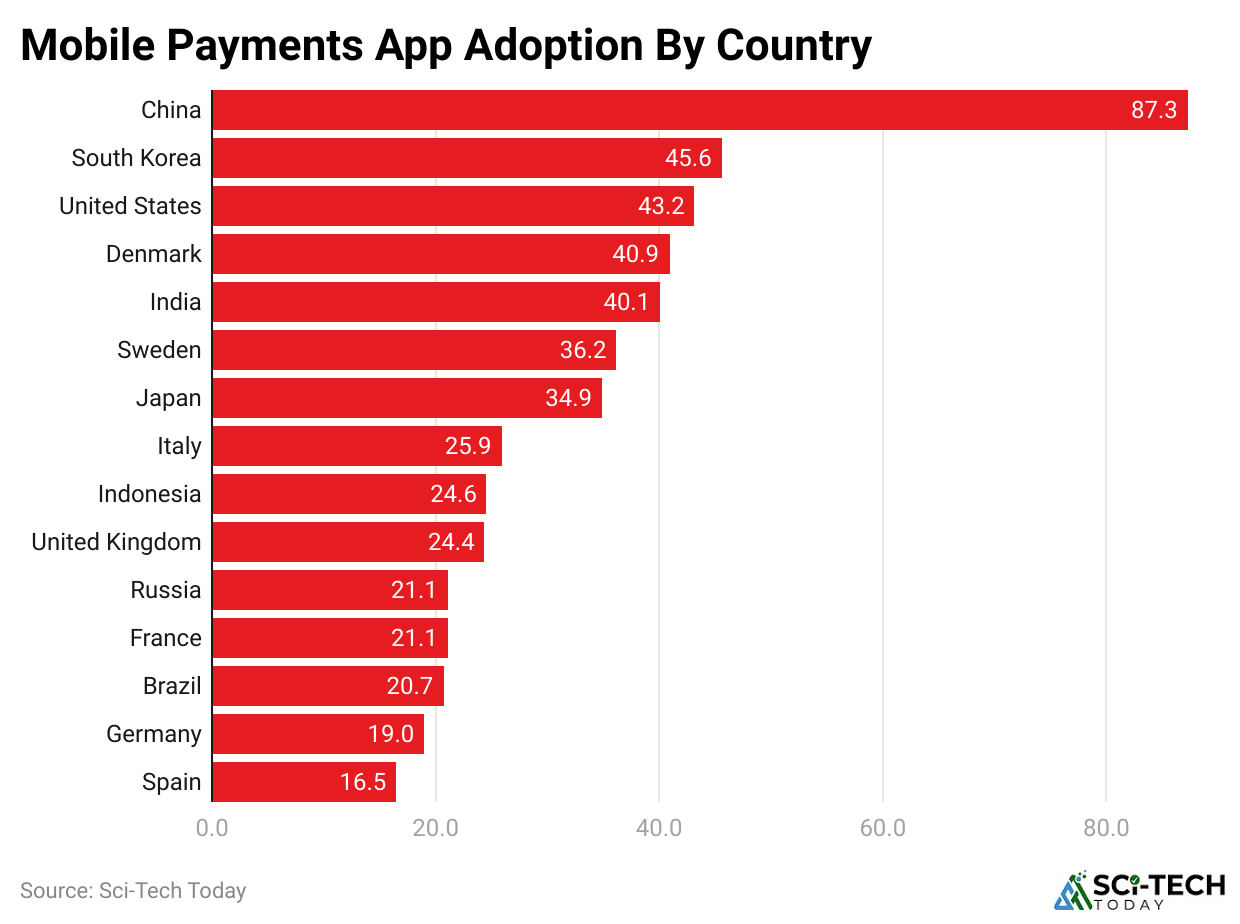
- Apple Pay is widely used in all the countries where iPhones are sold, but it has yet to be very successful in China.
(Reference: businessofapps.com)
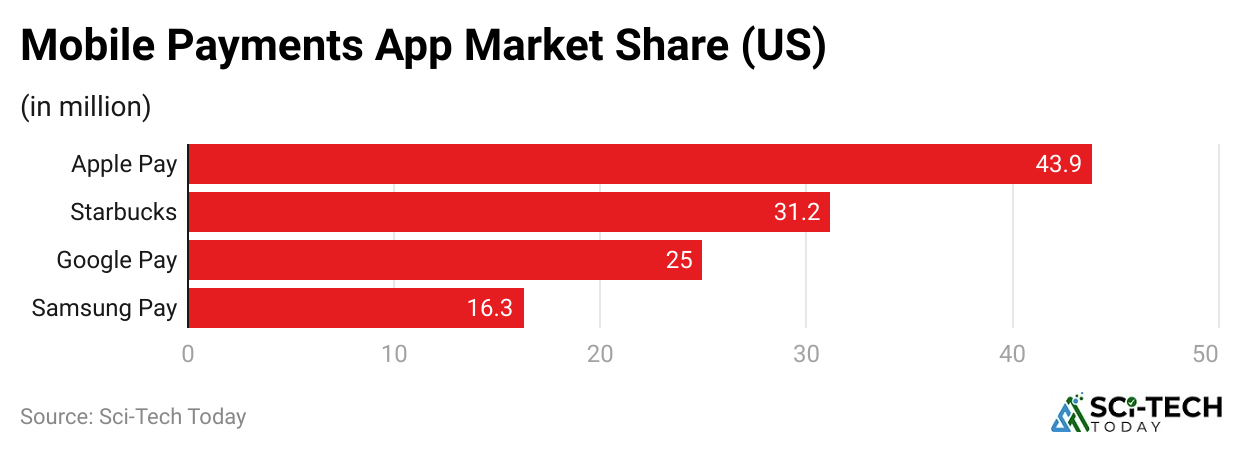
- Apple Pay is the top mobile payment service in the US, with 43.9 million people having used it at least once.
- Surprisingly, Starbucks is second, with 31.2 million users in the US, more than Google Pay.
(Reference: businessofapps.com)
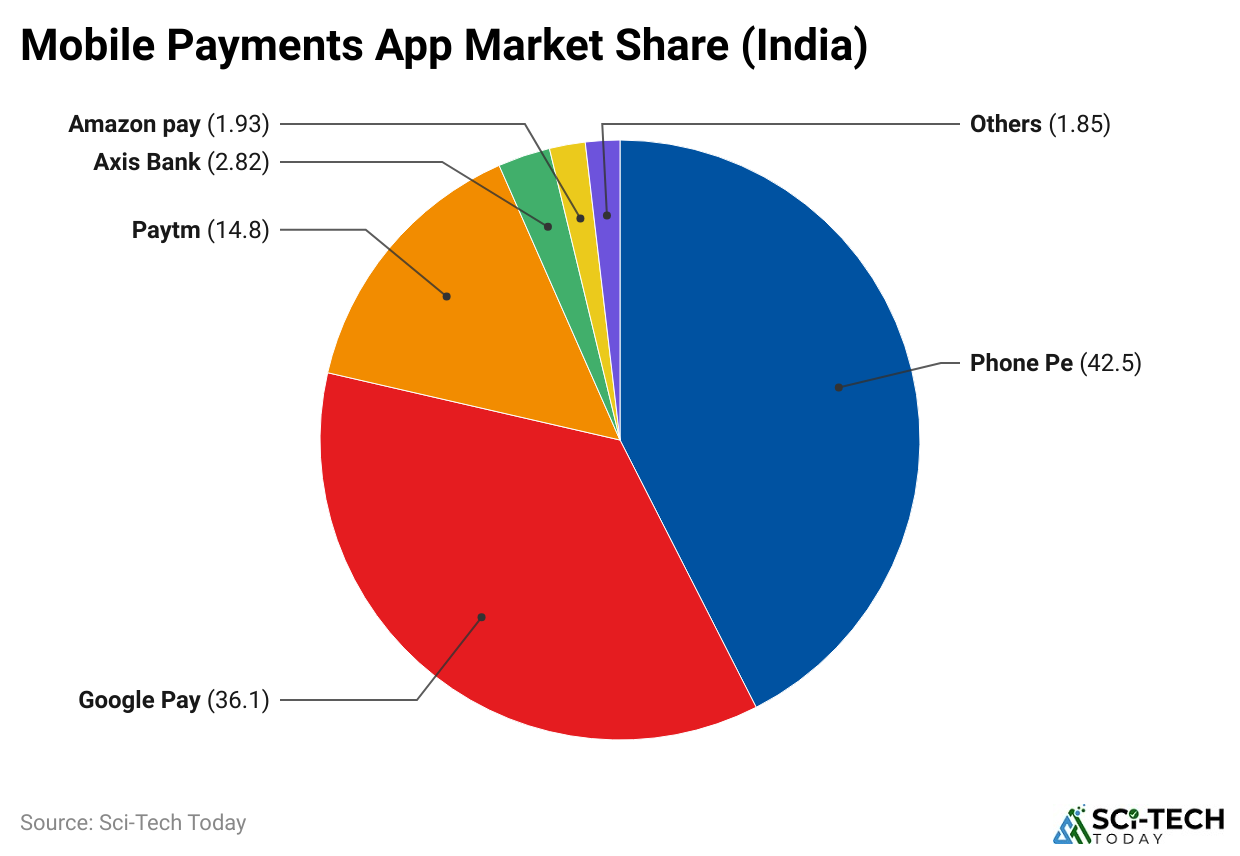
- Mobile payments in India are set up differently. The National Bank of India created the Unified Payments Interface (UPI), which is now a popular way to make transactions on mobile phones.
- PhonePe and Google Pay are the top services in this market, but according to Online Payment Statistics, Paytm has the most transactions overall in the country.
(Reference: businessofapps.com)
Digital Audience Demographics
- According to GWI, Baby Boomers are less likely to use the Internet for online shopping than Gen Z and Millennials.
- Among Baby Boomers, 75.6% of women and 71.9% of men shop online. In comparison, 77.7% of Gen Z women and 72.6% of Gen Z men use the Internet for shopping, while 79.9% of Millennials aged 25 to 34 and 35 to 44 shop online, with similar rates for men.
- E-commerce attracts users of all ages and genders, and online shopping offers opportunities for nearly all providers.
- However, different age groups have different online shopping habits.
- 63% of female users aged 16 to 24 use mobile e-commerce, while 55.8% of males in the same age group do.
- Among users aged 25 to 34, 58.1% of women use mobile e-commerce, compared to 58.1% of men.
- According to Online Payment Statistics, 40.5% of women and 55.4% of men aged 35 to 44 use mobile e-commerce.
- Among women aged 45 to 54, 51% use mobile e-commerce, compared to 46.9% of men.
- Finally, 38% of women aged 55 to 64 use mobile e-commerce, while 35.8% of men in that age range do.
Digital Transaction Value by Segment
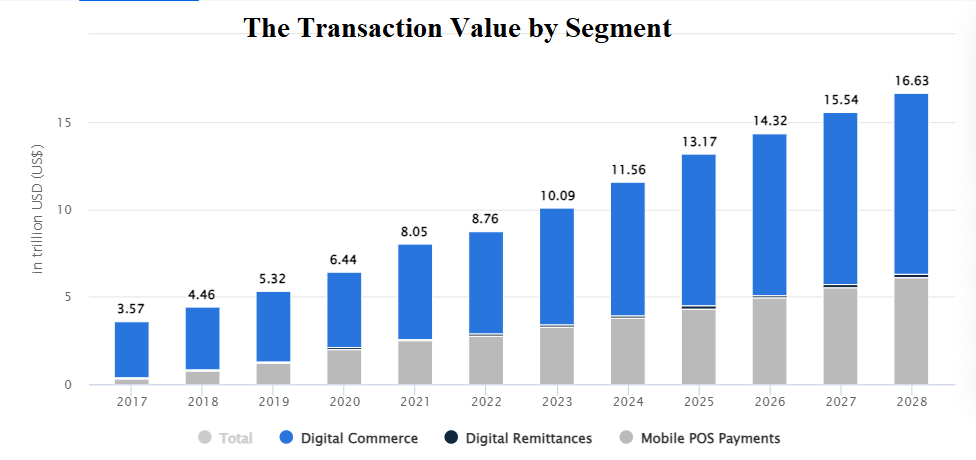
(Source: statista.com)
- Global digital transaction value rose from 11.56 trillion USD in 2025 to 13.17 trillion USD in 2026.
- It is projected to reach 14.32 trillion USD in 2027 and 15.54 trillion USD in 2028.
Average Transaction Value Per User
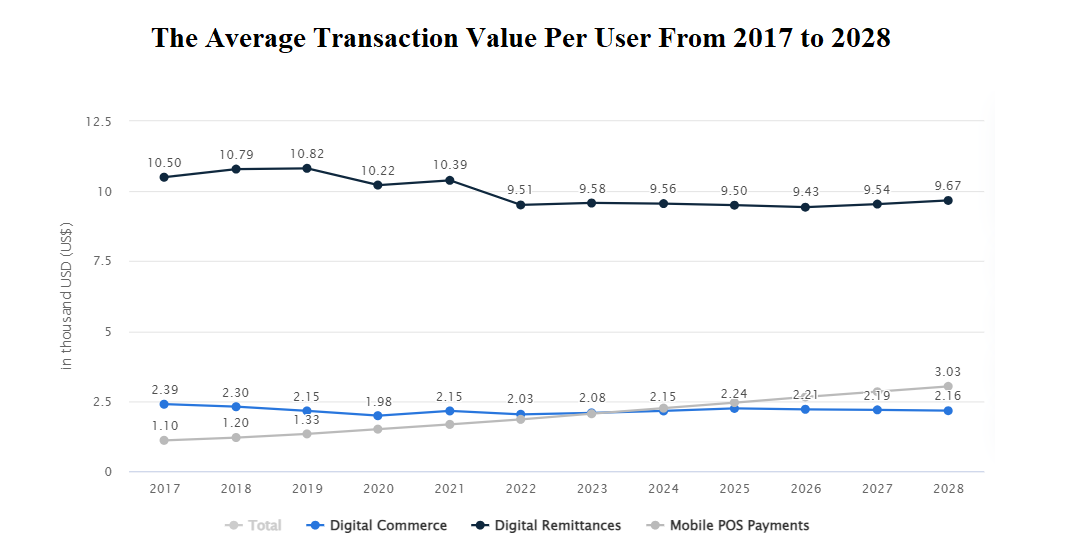
(Source: statista.com)
- In 2026, average transaction value per user is 9.50 thousand USD, rising to 9.67 thousand USD in 2028.
- Digital commerce climbs from 2.41 thousand USD per user in 2026 to 3.03 thousand USD in 2028, while mobile POS increases from 2.09 thousand USD to 2.16 thousand USD over the same period.
Online Payment Users by Segment
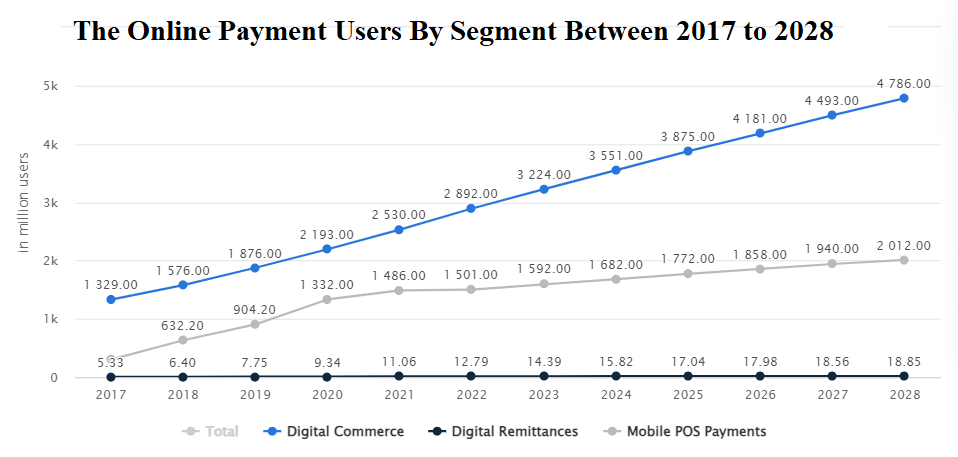
(Source: statista.com)
- In 2026, total online payment users reach 17.58 billion, including 4,493.00 million in digital commerce and 1,858.00 million in mobile POS payments worldwide.
- Digital remittances serve 18.85 million users in 2026.
Top Industries and Their Preferred Online Payment Methods
- Retail and e-commerce: Digital wallets, cards, and BNPL remained the preferred payment methods. Digital wallets accounted for 50% of global e-commerce payments in 2023 and were expected to exceed 60% by 2026.
- Travel and hospitality: Cards and digital wallets processed more than 80% of online bookings, while bank transfers and BNPL were commonly used for expensive travel purchases.
- Food delivery and QSR: In Asia-Pacific, digital wallets and QR code payments handled over 70% of online food orders and quick-service restaurant transactions.
- Streaming, gaming, and digital content: According to a JP Morgan report, digital wallets and cards powered more than 75% of recurring subscription payments worldwide.
- Mobility and ride-hailing: Super-app wallets accounted for over 70% of ride-hailing payments in Asia-Pacific, while UPI became the default payment option in India.
- Healthcare: Digital wallets processed 30–40% of teleconsultation and diagnostic bookings in developed markets.
- Entertainment and ticketing: Digital wallets and cards handled over 70% of online ticket purchases, with BNPL gaining popularity for premium event packages, as per a report shared by Merchant Savvy.
- Cross-border e-commerce and remittances: Digital wallets, bank transfers, real-time payments, and cryptocurrency supported a market projected to grow at a 7% CAGR, reaching USD 3.2 trillion by 2027.
Final Remarks
Online payments have changed how people shop, pay bills, and send money. They offer speed, convenience, and better access to digital services for both consumers and businesses. As mobile payments, digital wallets, and real-time transfers continue to grow, online payments will become even more common.
While security and fraud remain concerns, stronger technology and better protection are making digital payments safer. In the coming years, online payments will play an even bigger role in the global economy.
FAQ
The most common online payment methods are Credit and debit cards, UPI (Unified Payments Interface), Digital wallets (PayPal, Apple Pay, Google Pay), Net banking, Buy Now, Pay Later (BNPL), and Bank transfers.
Online payments offer convenience, faster transactions, 24/7 availability, lower cash handling, improved security, automatic payment records, and support for global commerce
Most online payments are completed instantly, while some bank or international transfers take up to five business days.

Sources