








Starter
Motorola Statistics: When we mention smartphone brands, everyone immediately thinks of Apple, Samsung, or Xiaomi. But what a lot of people forget is that Motorola has been there way before most of them and helped shape the industry. In today’s post, I’ll guide you through a commonly missed gem: Motorola statistics.
I know, I know, numbers are dull, but believe me, Motorolas do a fascinating job of painting a story. From its beginnings in the 1920s to the current division between smartphones and public safety solutions, this brand is data-driven in every sense.
I’ve done the digging, pulled in all the figures, and distilled it down into 10 major categories. Whether you’re into tech, marketing, or just curious, this deep dive into Motorola statistics will tell you how the company remained relevant even in a hyper-competitive space. Let’s break it down.
Top of the Line
- Mobility growth moderated to 7% in 2025, with 39.1 million units shipped, still showing solid global momentum in LATAM, India & U.S.
- ASP (average selling price) increased about 10–12% YoY in 2025, driven again by Moto Edge and Razr foldables as they pushed further into the mid‑premium segment.
- Brazil possessed 31% smartphone share nationally. India was 13% of global Moto shipments, 82% YoY growth share rebounded to 11 %.
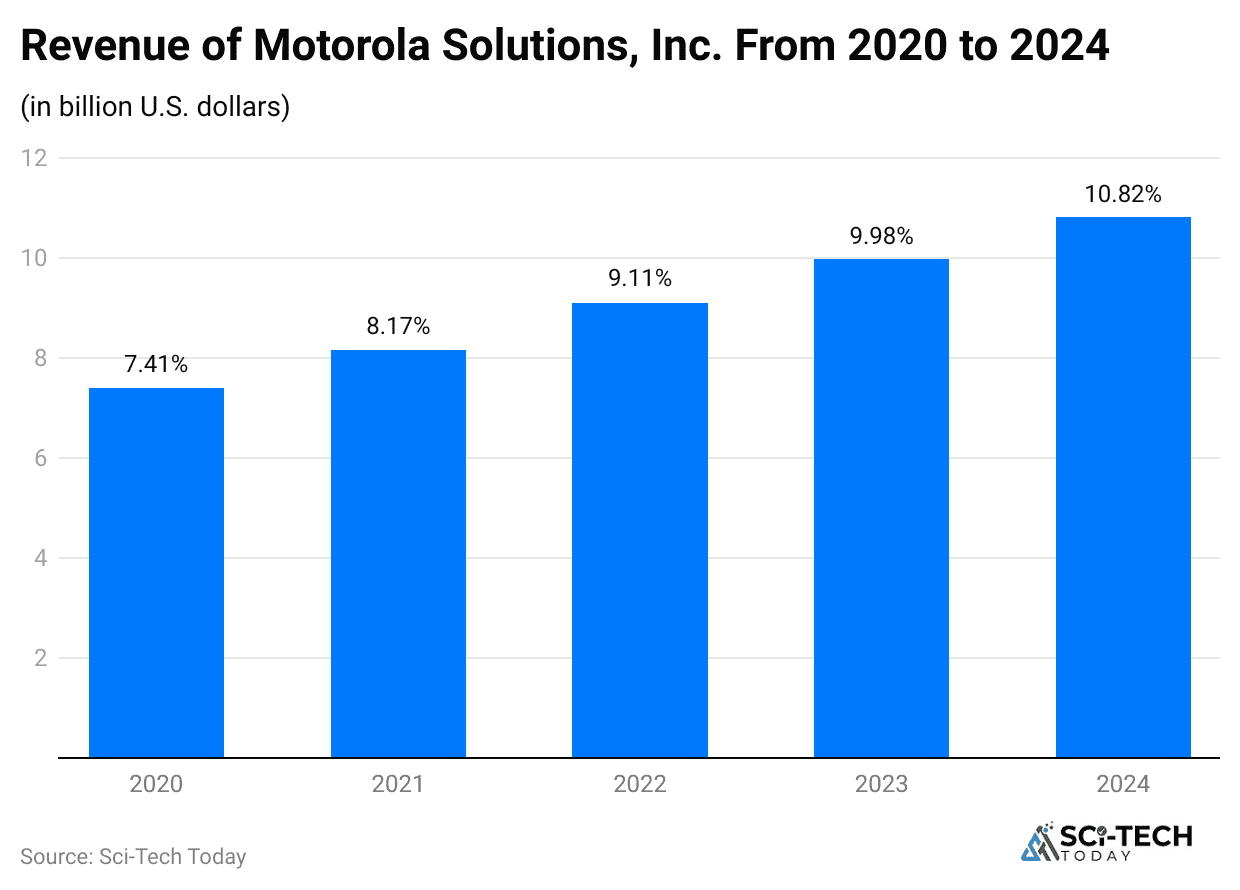
- Motorola Solutions’ enterprise arm had USD 10.8 bn revenue in 2024; Q4 was USD 3.01bn; operating cash flow was USD 2.4 bn; backlog ended USD 14.7bn.
- Q1 2025 brought solid results: revenue USD 2.53 bn (+6 % YoY); non‑GAAP EPS USD 3.18 (+13 %); operating cash flow USD 510 m (+160 bps margins).
- Mgmt reiterates 2025 guidance: 5% CAGR; adj EPS of USD 14.64 to USD 14.74. Q2 guidance lowered to EPS USD 3.32 to USD 3.37, reflecting tariffs and backlog softness.
- Recently deployed SVX device (body camera + radio + AI Assist) cut officers’ report writing by 40 %; trialed by 150 users in collaboration with 32 public safety organizations. Over 60% of US 911 calls flow through Moto gear.
- Acq play: RapidDeploy (NG911), Theatro (AI flow), InVisit (visitor mgmt), Silvus (defense/public safety mesh, USD 4.4 bn). These transform Moto into AI-powered experiences.
- The global tariffs (USD 100M cost impact), backlog dropped to USD 14.1 bn (-2%), integration risks, competition, dependence on LATAM/India markets.
- Strong Buy ratings, USD 505 to USD 507 PTs (20% upside), RS rating ticked up but is still under 80.
| Topic | Key Takeaway | Relevant Stats / Data |
| Motorola’s Origin & Evolution | Founded in 1928 as Galvin Manufacturing, Motorola shaped the mobile industry early on. |
Founded: 1928 · First Phone Call: 1973 |
|
Market Share & Global Presence | Motorola has rebounded in select markets with strong mid-range offerings. | 3.5% global smartphone market share (Q1 2025) |
| Financial Performance Over the Years | Parent company Lenovo’s mobile revenue grew steadily after the acquisition. | USD 8.2 billion Motorola mobile revenue in FY 2024 |
|
Product Line-Up and Flagships | Popular Edge and Razr series drive Motorola’s premium and foldable segments. | Razr 2023 shipped 1.3M units globally |
| Foldable Phones & developments | Razr foldables gained popularity; upcoming versions will focus on durability and slimness. |
40% YoY growth in the foldable segment |
|
Consumer Demographics & Reach | Motorola appeals to budget-conscious Gen Z users in Asia, South America, and Eastern Europe. | 65% of Motorola users are under 35 |
| Brand Partnerships & Collaborations | Working with Google, Qualcomm, and Lenovo for software, SoC, and hardware synergy. |
3+ major global partnerships ongoing |
|
Software & OS Support Stats | Offers a clean Android with faster updates, improving long-term software support. | 3 years OS + 4 years security updates for Edge series |
| Motorola Solutions Division Growth | Separate from consumer phones, this division leads in safety and enterprise communication. | USD 9.5 billion in revenue FY 2024 |
|
Future Roadmap & developments | Focused on AI, 6G, eco-friendly design, wearables, and expanding to emerging markets. | USD 500M R&D in AI & Foldables, 3 new factories underway |
Origins and Early History of Motorola Statistics
(Source: computerweekly.com)
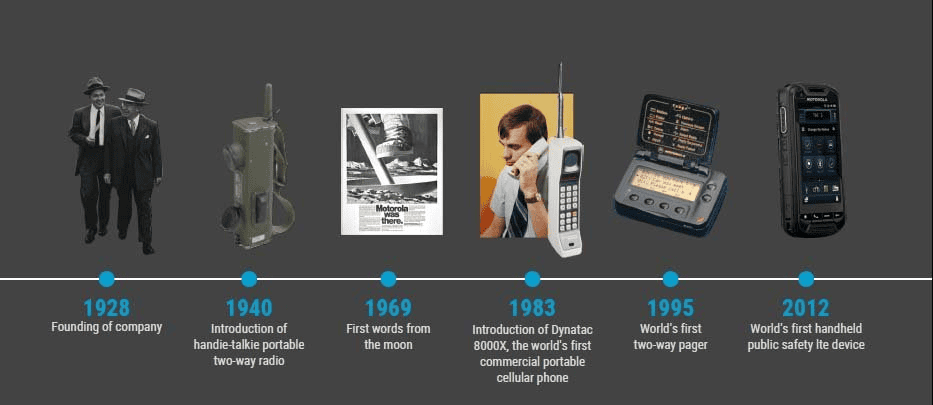
- Motorola began life in 1928 as Galvin Manufacturing Corporation and later changed its name in 1947 when the radio business grew. It’s the start of the story that shapes Motorola Statistics.
- In 1973, Martin Cooper at Motorola made the first handheld mobile phone call, showing the development early in the Motorola timeline.
- The DynaTAC 8000X was launched in 1983, priced at USD 3995, which was huge money back then. That early milestone is key in Motorola’s Statistics.
- By the late 1990s, mobile devices contributed around two-thirds of total Motorola revenue, indicating a shift into the mobile era in Motorola’s Statistics.
- Motorola RAZR V3 rolled out in 2004 and became a cultural icon, selling tens of millions, marking the peak of Motorola’s Statistics in the flip phone era.
- At RAZR’s peak, Motorola held roughly 13% global phone market share, showing dominance in the early 2000s Motorola Statistics.
- On January 4, 2011, Motorola split into Motorola Mobility and Motorola Solutions, marking a major turning point in Motorola’s timeline.
- Google bought Motorola Mobility in May 2012 for USD 12.5 billion but sold it to Lenovo in October 2014 for about USD 2.9 billion, a puzzling chapter in Motorola’s history.
- Moto G launched in November 2013 and quickly became the top seller in markets like Mexico and Brazil, sparking a new era in Motorola’s Statistics.
- Since Lenovo took over, focus has been on affordable Android devices, entry-level 5G, foldables, and emerging markets volume under the Motorola Statistics framework.
| Event | Year | Significance in Motorola Statistics |
| First mobile call | 1973 | Mark’s mobile development origin |
| DynaTAC launch price | 1983 | Set benchmark cost for early smartphones |
| RAZR peak market share | 2007 | 13% share globally |
| Moto G bestseller launch | 2013 | Drove the new growth phase in Moto volumes |
Smartphone Shipments and Sales Trends in Motorola Statistics
(Source: linkedin.com)
- In 2025, Motorola achieved record smartphone shipments globally, growing around 12% YoY, well above the market average. That’s a major highlight in Motorola Statistics.
- According to Counterpoint, Motorola unit growth was 21% while the global market grew 6.4%, showing Motorola outperformed the average.
- Motorola’s average selling price (ASP) increased around 15% YoY in 2025, continuing to boost revenue per device, but at a slower pace than the 17% ASP jump seen in 2024.
- Latin America accounted for under 50% of shipments for the first time, reflecting regional diversification per Motorola Statistics.
- Total units shipped around 36.6 million, roughly 3% global share under “Others”, captured under Motorola Statistics.
- India remained a key growth engine in 2025, accounting for around 15% of Motorola’s global shipments and the fastest regional growth in Motorola’s Statistics.
- Motorola doubled global smartphone shipments from 2020 to 2025 under the Lenovo period, a doubling trend in Motorola’s Statistics.
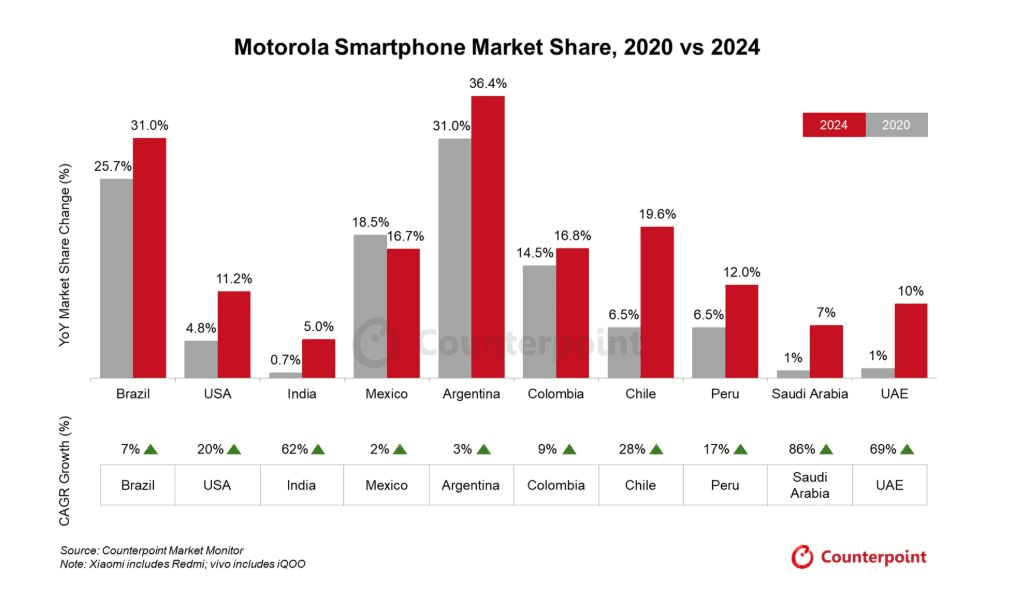
- U.S. market share rose from 4.8% in 2020 to about 11% in 2025, showing a comeback story in Motorola’s statistics.
- In March 2025, Motorola nearly tripled exports from India to the U.S. due to tariff timing shifts, noted within the Motorola Statistics context.
- S. smartphone surge in March 2025 was a 30% jump from the prior year as brands rushed imports, including Motorola, adding nuance to Motorola’s Statistics.
| Metric | 2025 Value / Change |
| Unit growth | 21 % YoY |
| Global market growth | 6.4% |
| Average selling price | 15 % |
| Total units shipped | 36.6 million units (3 %) |
| India’s share of Moto shipments | 15% |
Motorola Revenue in 2026
- Sales were USD 2.7 billion, an increase of 7% versus last year’s corresponding quarter, with the primary growth coming from International.
- Acquisition-related revenue was USD 219 million, while foreign currency gains contributed USD 60 million for the quarter.
- The Products and Systems Integration segment increased 1%, benefiting from growth in Video Security and Access Control (“Video”) but offset by declines in Mission Critical Networks (“MCN”).
- The Software and Services segment increased 18% benefitting from growth in MCN, Command Center and Video.
Regional Breakdown in Motorola Statistics
(Reference: statista.com)
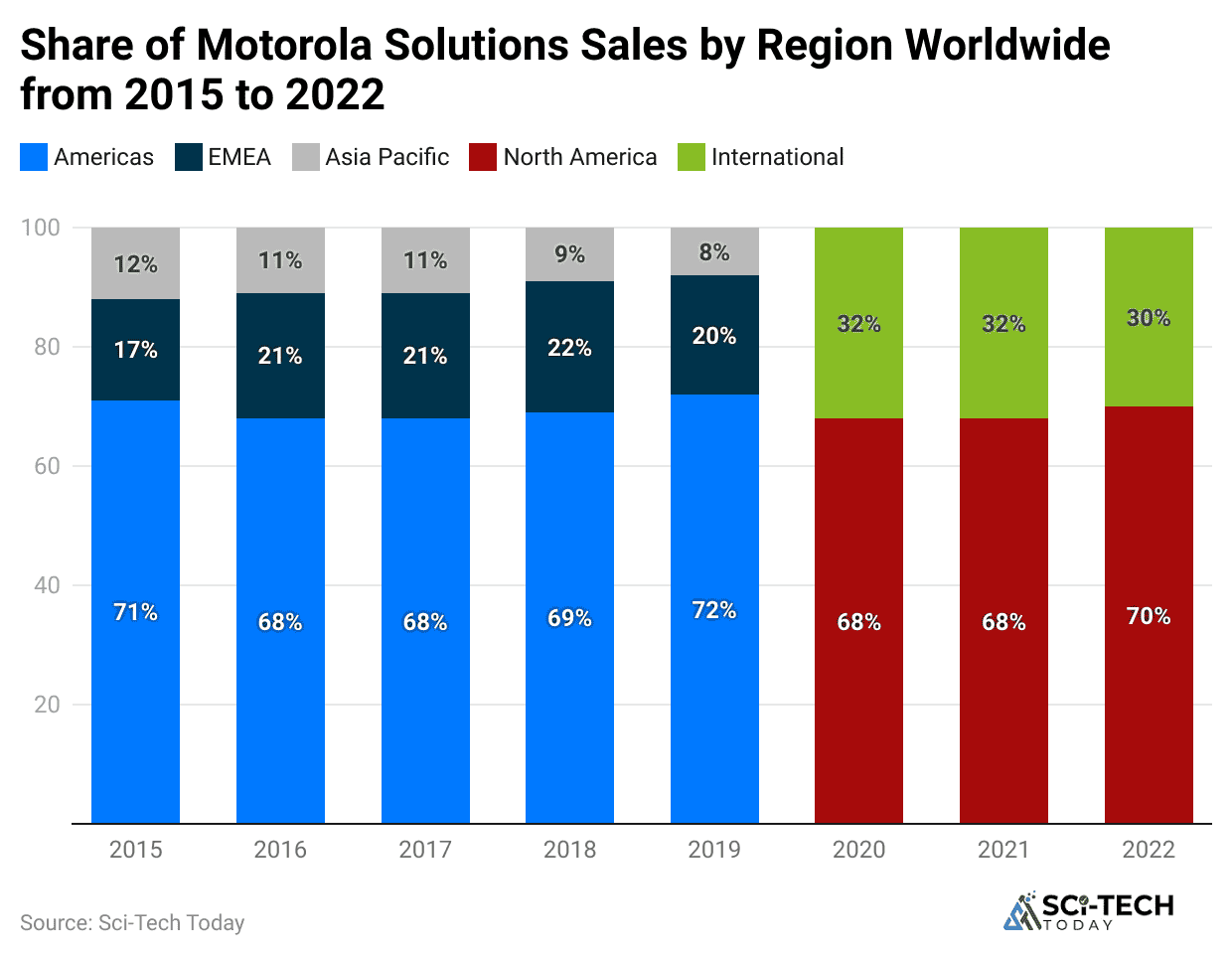
- Latin America, especially Brazil and Mexico, remained a major volume base for Motorola, but the share dropped below 49% in 2025, showing diversification.
- Brazil held around 25% of the Brazilian smartphone market for Motorola in 2025, keeping it one of Motorola’s strongest countries even as Samsung widened its lead.
- Mexico was an early stronghold for Moto G post-2013 launch, setting the tone in Motorola’s Statistics for Latin America.
- India’s share rose sharply from near zero in 2020 to around 15% of Motorola shipments by 2025, remaining the fastest growth region in Motorola’s statistics.
- U.S. market share climbed from 4.8% in 2020 to 12% in 2025, showing a recovery in Motorola’s Statistics.
- North America gains partly from electronics channel expansion and budget 5G push under Motorola’s strategy.
- EMEA and Asia‑Pacific also contributed incremental growth through a smaller base in Motorola Statistics.
- China’s presence is negligible. Motorola has virtually no footprint there, consistent across Motorola Statistics.
- Emerging market focus remains entry tier sub-USD 250, but shifts towards USD 250‑399 mid‑premium starting in 2025, according to Motorola Statistics.
- Regional diversification reflects strategic channel expansion in India, offline, prepaid channels in the U.S., and retail expansion in Motorola Statistics.
| Region | Approx 2025 Share | Growth / Notes |
| Latin America | 49% of Moto | Diversifying region |
| Brazil | 25% national | Top country share |
| India | 15% of Moto | Fastest regional growth |
| U.S. | 11% national | Recovered share since 2020 |
| China | 0% | Virtually no presence |
Product Lines and Flagships in Motorola Statistics
(Reference: gadgets360.com)
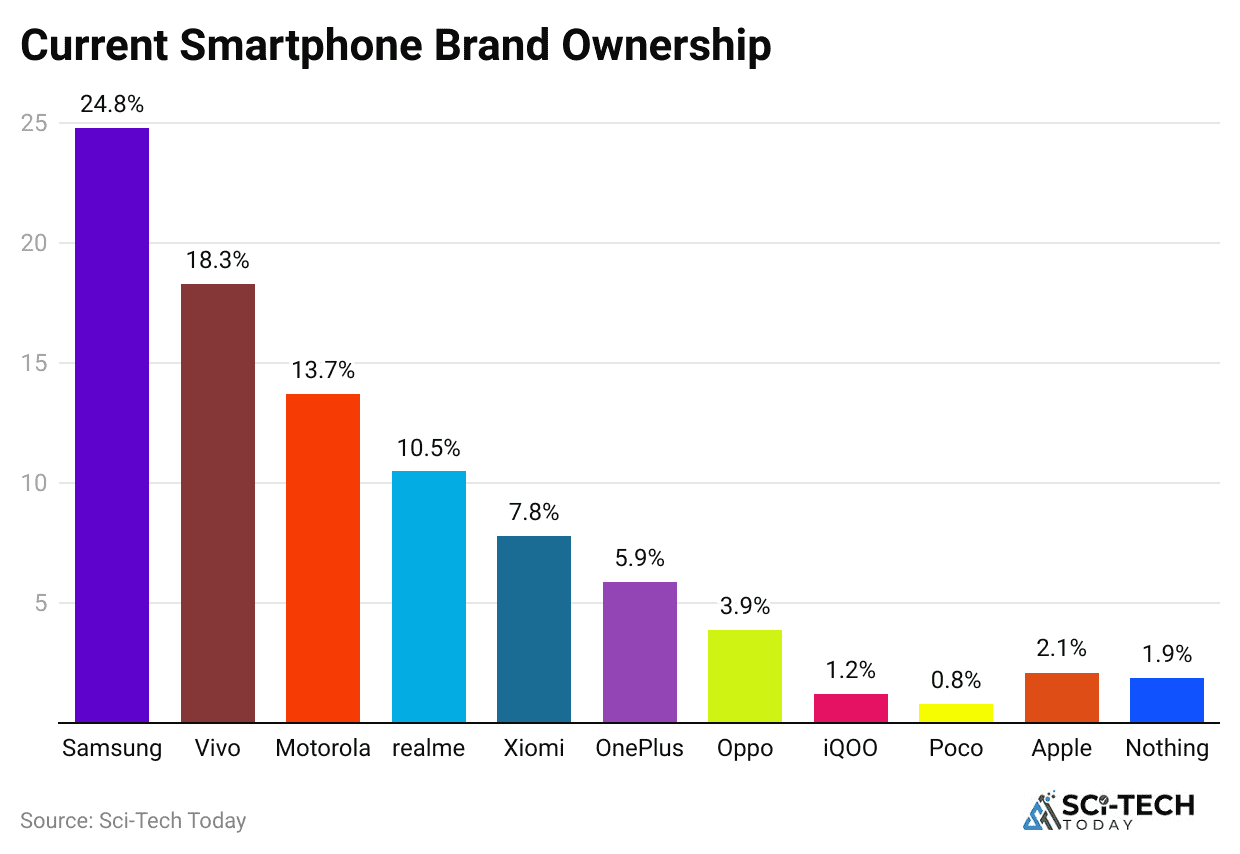
- Moto G series remains the core driver of unit volumes with a strong presence in Brazil, Mexico, and India in Motorola’s Statistics.
- Moto E serves the ultra‑budget segment in emerging markets, offering basic 5G and durability under tight pricing, according to Motorola Statistics.
- Motorola Edge 60 series launched in 2025, adding mid‑premium tier options like Edge 60, Edge 60 Pro and Edge 60 Ultra with expanded Moto AI features and upgraded triple 50MP camera systems and quad‑curved pOLED displays.
- Edge series ASP boosts the overall average selling price in the Motorola Statistics narrative.
- Razr foldables reintroduced in 2024‑25 with AI-added features like Catch Me Up and a design push in the premium space in Motorola Statistics.
- Software across all lines is near stock Android with a pledge of 3‑4 year updates, setting the user experience metric in Motorola Statistics.
- Accessories like the Moto Tag tracker, tablets, laptops, and wearables extend the ecosystem under Motorola Statistics expansion.
- Edge 50 Ultra specs include Snapdragon 8 Gen 3, 1 TB storage, and 16 GB RAM, showing a feature leap in Motorola’s Statistics.
- Focus on color design with Pantone tie‑ups and scented packaging indicates lifestyle branding in Motorola Statistics.
- Channel partnerships, offline reach, prepaid channels in the U.S. and India enable scale across product series under the Motorola Statistics strategy.
| Product Series | Segment | Highlight Features |
| Moto G | Entry-Mid | Volume driver, 5G options |
| Moto E | Ultra-budget | Basic specs, high durability |
| Edge 50 Pro/Ultra | Mid-Premium flagship | AI features, high ASP & premium design |
| Razr Foldables | Premium foldables | AI tools, stylish design |
Motorola Solutions Financials in Motorola Statistics
(Reference: statista.com)
- Motorola Solutions made USD 11.7 billion in revenue in 2025, up 8% versus 2024, remaining one of the main pillars in Motorola’s Statistics.
- In Q4 2025, the company had USD 3.4 billion in sales, a 12% rise year over year, showing steady demand in enterprise tech.
- Products and Systems Integration revenue grew 10% for the year, while Software and Services rose 5%, both boosting Motorola Statistics’ relevance.
- The full‑year GAAP operating margin was 24.8%, with a non‑GAAP margin of 29.0%, strong levels in the Motorola Statistics frame.
- For 2025, the company generated a record USD 2.8 billion in operating cash flow (up 19% YoY) and free cash flow of USD 2.6 billion (up 21% YoY).
- Backlog ended 2025 at USD 15.7 billion, up USD 1.0 billion (about 7%), giving future visibility in Motorola Statistics.
- In Q1 2025, sales were USD 2.5 billion (+6% YoY) and non‑GAAP EPS USD 3.18 (+13%), showing early-year momentum.
- Q1 2025 backlog fell slightly to USD 14.1 billion (‑2%), signalling some order recognition but still a solid pipeline.
- Acquisitions in Q1 included RapidDeploy and Theatro, costing USD 414 million, part of Motorola’s Statistics narrative on growth moves.
- Motorola Solutions forecasts full-year 2025 revenue growth at around 5.5% and adjusted EPS between USD 14.64 and USD 14.74.
| Metric | 2025 Value | YoY Change / Notes |
| Full‑Year Revenue | USD 11.7 billion | +8% |
| Q4 Revenue | USD 3.4 billion | +12% |
| Operating Cash Flow | USD 2.8 billion | +19% |
| Backlog | USD 15.7 billion | +7% |
| Q1 2025 Revenue | USD 2.5 billion | +6% YoY |
Acquisitions and Strategic Moves in Motorola Statistics
(Reference: startuptalky.com)
- Motorola Solutions made a series of acquisitions in 2024‑25, from Noggin to 3tc Software, then Theatro, RapidDeploy, and InVisit to expand AI and cloud capabilities.
- The Theatro acquisition, announced in January 2025 and closed in March, adds AI voice‑driven workflow tools for frontline workers under Motorola Statistics’ forward trend.
- Rapid Deploy was acquired in February 2025, adding cloud‑native 911 emergency response solutions to the portfolio.
- In March 2025, Motorola agreed to acquire InVisit, a visitor management platform, strengthening command centre offerings.
- In May 2025, they announced a USD 4.4 billion acquisition of Silvus Technologies, a leader in mobile ad-hoc mesh networks for defense and public safety.
- The Silvus deal is the second largest in company history, expected to close in Q3/Q4 2025, a significant asset in Motorola’s Statistics growth phase.
- These moves show a shift from hardware‑only to AI-enabled software and mission‑critical communications under the Motorola Statistics expansion chapter.
- Integration challenges are real, but the company cites a strong backlog and synergy expectations when combining product lines.
- Together, these acquisitions position Motorola as a platform provider for frontline voice, video, analytics, and connectivity.
- Competitive advantage in mesh networks gives an edge amid defense modernization and smart city trends.
| Acquisition | Date | Core Capability Added |
| Noggin, 3tc | 2024 | Cloud event management & command center |
| Theatro, RapidDeploy | Q1 2025 | AI workflow & cloud-native 911 tools |
| Silvus Technologies | May 2025 | Mobile ad-hoc mesh networking for defense |
Motorola Business Outlook
- Q2 FY2026, the company anticipates revenue growth of roughly 8.5% from Q2 FY2025 and non-GAAP EPS of USD 3.82 to USD 3.88.
- This outlook considers approximately 168 million fully diluted shares outstanding, and non-GAAP effective tax rate of about 23%.
- FY2026 full year, the company now anticipates revenues of roughly USD 12.8 billion, an increase from the previous estimate of USD 12.7 billion, and non-GAAP EPS of USD 16.87 to USD 16.99, an increase from the previous estimate of USD 16.70 to USD 16.85 per share.
- This outlook considers approximately 168 million fully diluted shares, and non-GAAP effective tax rate of around 22.5%.
Development and Product Development in Motorola Statistics
(Reference: statista.com)
- In April 2025, Motorola Solutions launched the SVX device, integrating a body camera, speaker mic, and AI assistant Assist, reducing patrol officers’ report time by 40%.
- The SVX works with APX NEXT radios and a real‑time Assist data entry workflow, expanding smart public safety tech under Motorola’s Statistics development story.
- More than 60% of U.S. 911 calls flow through Motorola systems, showing market dominance in public‑safety communications.
- Assist was developed with feedback from 32 agencies and 150 user testers, an example of user‑centric development in Motorola Statistics.
- On the Motorola Mobility side, the Razr foldable and Edge series with AI features pushed up ASPs and device capabilities significantly.
- Motorola Mobility now offers 5G devices across the Moto G, E, and Edge lines at accessible price points in emerging markets.
- They maintain near-stock Android with 3‑4 years of updates for usability and trust in Motorola. Statistics highlights.
- Lifestyle branding efforts like Pantone colours, scented packaging, and prepaid skins show the evolution of the Moto brand.
- Connectivity development is expected with the integration of Silvus mesh tech for future enterprise networks under Motorola Statistics’ horizon.
- AI integration extends to command centre analytics and edge devices via command software from acquisitions.
| Development Area | Description |
| SVX & Assist AI tool | AI-assist body cam & mic for faster response |
| 911 system dominance | 60% of U.S. 911 calls are routed via Moto |
| 5G devices at a low price | Expanded coverage of 5G in emerging markets |
| Mesh network tech | Silvus acquisition adds tactical communication |
Growth Outlook and Forecasts in Motorola Statistics

(Source: canalys.com)
- Motorola Solutions expects full-year revenue growth of about 5.5% in 2025, driven by public safety and enterprise demand.
- They forecast adjusted EPS of USD 14.64 to USD 14.74, above the prior estimate, given strong backlog and integration plans.
- In Q1 2025, non‑GAAP EPS of USD 3.18 beat estimates, an early signal of growth momentum in the Motorola Statistics story.
- Backlog remains high, though down slightly: USD 14.1 billion in Q1 versus USD 14.7 billion year-end 2024, backing revenue pipeline.
- For full‑year 2024, growth guidance was raised mid‑quarter, from 8% to 8.25%, showing demand resilience.
- Trade and tariff uncertainty is expected to weigh on margins, especially in materials‑intensive segments, in 2025.
- Growth in enterprise imaging, video analytics, and land mobile radios is expected to continue, feeding Motorola Statistics’ growth scope.
- The Silvus acquisition expected in Q3/Q4 2025 should open defense and smart‑city markets to Motorola.
- Analyst sentiment remains positive with a consensus rating of “Strong Buy,” and price targets of USD 505 to USD 507, implying a 20% upside.
- The relative strength rating improved from 66 to 71 in April 2025, though still below the 80 thresholds, watch chart patterns in the stock context.
| Forecast Metric | 2025 Estimate / Trend |
| Revenue Growth | 5.5 % |
| Adjusted EPS | USD 14.64 to USD 14.74 |
| Stock RS Rating | 71 (up from 66) |
| Analyst Price Target | USD 505 to USD 507 |
| Market Risk | Macro, tariffs, margin compression |
Challenges and Risks in Motorola Statistics
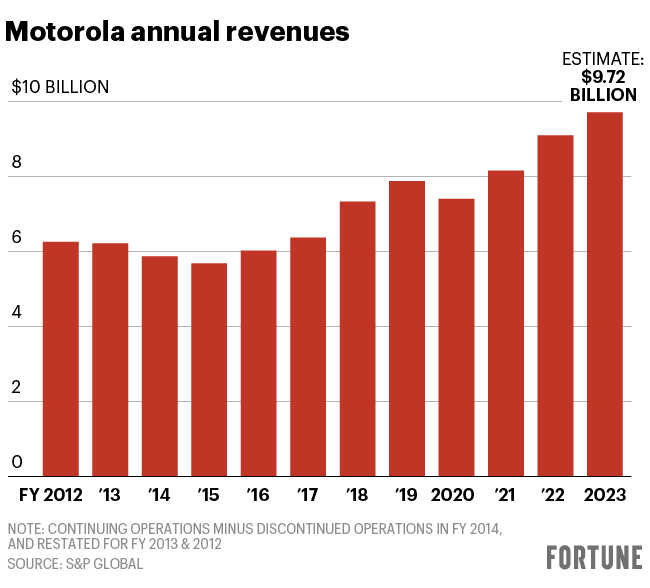
(Reference: fortune.com)
- Tariff volatility remains a core concern for Motorola Solutions; rising material costs are projected to pressure margins.
- The backlog dropped from USD 14.7 billion to USD 14.1 billion in Q1, showing some future revenue risk if orders slow.
- Integration of major acquisitions like Silvus (USD 4.4 billion) and earlier buys introduces execution risk.
- Competition in public safety comms from Airbus, Hytera (though legal wins), and Harris remains intense.
- Motorola Mobility is still small in the premium handset space versus Apple and Samsung, limiting brand presence.
- Reliance on Latin America and India for Moto volumes poses a risk if economic or policy shifts occur.
- Lack of presence in China means missing major smartphone growth regions, noted in the Motorola Statistics context.
- Software update delays historically have hurt user trust in Moto’s past launches.
- Economic slowdown or government budget cuts could impact enterprise orders, especially in public safety.
- Stock remains below key moving averages, and the RS rating is still below the top threshold, indicating stock performance risk.
| Risk Category | Description |
| Tariff & supply chain | Cost volatility affecting margins |
| Backlog decline | Future revenue under pressure |
| Acquisition integration | Execution risk from mergers like Silvus |
| Competitive environment | Strong rivals in enterprise comms |
Recent Developments
- Since February 2025, the U.S. has implemented a series of trade actions on Motorola, imposed new tariffs and increased existing ones on imports from multiple countries, including measures under the International Emergency Economic Powers Act (IEEPA), contributing to a shifting global trade landscape.
- On February 20, 2026, the U.S. Supreme Court ruled that tariffs imposed under IEEPA were invalid, marking a significant legal setback for the trade policy, though the ruling did not directly address the issue of refunds for affected importers.
Closure
Right, so that’s pretty much the big picture when it comes to Motorola Statistics. I know it’s a lot of numbers, but every stat we looked at says something real about the brand, where it came from, where it stands, and where it could be heading next. From their early radio days to now, making budget-friendly smartphones and public safety gear, Motorola’s journey is kinda wild if you think about it.
What I found interesting is how Motorola still manages to survive in a market where brands come and go so fast. Like, it’s not on top like it once was, but it’s also not irrelevant. That balance is what makes the data worth looking at. It’s not just about phones anymore; the company has smartly spread out into different segments.
So yeah, these Motorola Statistics are proof that even old giants can stay in the game if they know how to shift and evolve. Hope you got a better view of how Motorola’s been doing all these years. If you have any questions, kindly let me know in the comments section.
FAQ
Yes, Motorola’s smartphone division (Motorola Mobility) is owned by Lenovo, a multinational technology company based in China. Lenovo acquired the brand from Google in 2014.
Yes, Motorola has already launched and announced several new phones for 2026, including the Motorola Razr 2026 flip phone, the compact Motorola Edge (2026) mid-ranger, and the budget-friendly Moto G Power.
Motorola smartphones generally cost between USD 150 and USD 1,300 when purchased unlocked, depending on whether you want a budget-friendly starter device, a sleek mid-range model, or a high-end foldable flip phone.

Sources