








Introduction
Optical Character Recognition Statistics: The history of digital processing systems (DPS) is inextricably linked with the development of optical character recognition (OCR). Far from being a niche tool, OCR is now the backbone of global digital transformation, driving efficiency across massive, paper-intensive industries.
I’d like to discuss further in this analysis about the data, facts, and figures that define the optical character recognition landscape, from its multi-billion dollar market valuation to the accuracy rates that determine its real-world utility. Let’s get started.
Editor’s Choice
- The global OCR market was valued at approximately $17.06 billion in 2025 and is projected to reach over $38.32 billion by 2030, a vigorous CAGR of 17.57%.
- This expansion is driven by the need to digitize unstructured data, which accounts for roughly 80% of all enterprise data.
- North America remains the largest regional market, holding nearly 40% of the revenue share in 2024.
- The Asia Pacific region is projected to exhibit the highest growth rate, with an anticipated CAGR of 17.7%.
- Cloud-based OCR solutions dominate deployment, representing over 66% of all deployments in 2024, favored for their scalability and reduced capital expenditure.
- High-end OCR systems achieve accuracy rates of 98% to 99% on clear, typed documents, enabling the automation of up to 90% of document workflows.
- The industry standard for precision is the Character Error Rate (CER), with top commercial systems reporting a CER below 1%, translating to fewer than 10 errors per 1,000 characters.
- Improving accuracy from 95% to 99% results in a 5x reduction in the number of “exceptions” that require costly human intervention and manual verification.
- For complex, cursive, or handwritten text, advanced Intelligent Character Recognition (ICR) models can achieve accuracy levels in the range of 85% to 95%.
- The technology segment known as ICR is the fastest-growing area, with a projected 4% CAGR.
- The BFSI (Banking, Financial Services, and Insurance) sector is the leading vertical, commanding approximately 26% of the total market share in 2024.
- Healthcare is the fastest-growing vertical, with a projected CAGR exceeding 20.2%. The Software component segment is the revenue leader, holding about 78% of the total market share.
- The B2B (Business-to-Business) segment accounts for the vast majority of consumption, securing over 9% of the market revenue.
- Services related to OCR, including integration and consulting, are expected to grow at a faster rate, around 9% CAGR.
Optical Character Recognition Market Valuation and Growth Analysis
 (Source: market.us)
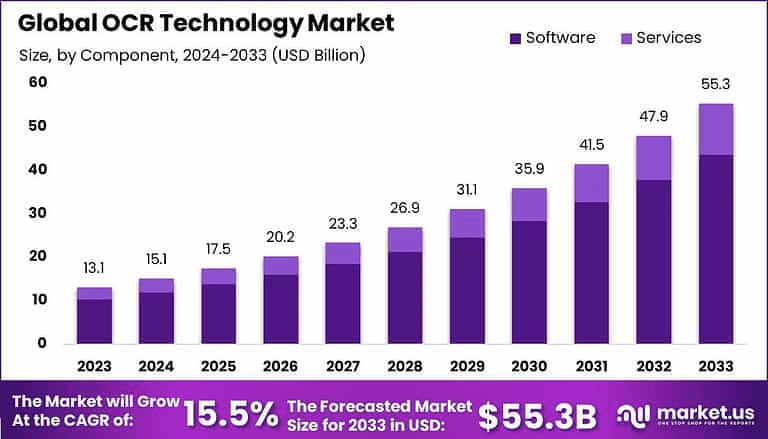
According to Market.us, the OCR market is experiencing explosive, sustained growth, transitioning from a simple text-digitization utility into a core component of Intelligent Document Processing (IDP) systems powered by Artificial Intelligence (AI).
- The global OCR market size was recently valued at approximately $17.06 billion in 2025 and is projected to skyrocket to over $38.32 billion by 2030, reflecting a substantial CAGR of 17.57% over that period.
- This rapid expansion is fueled by the growing necessity for businesses to process unstructured data, which represents roughly 80% of all enterprise data.
- The drive for digital efficiency means that 85% of organizations have either started or are planning digital transformation initiatives.
- Market forecasts indicate that the market for intelligent document processing solutions, heavily reliant on advanced OCR, is set to exceed $5.3 billion by 2027.
- The accelerating adoption of cloud-based OCR solutions is a major driver, with cloud deployments over 66% of the market share in 2024.
| Metric | Current Data (2025/2024) | Projected Data (2030/2033) |
|
Market Value (2025) |
$17.06 Billion | $38.32 Billion by 2030 |
| Growth Rate (CAGR) | 17.57% (2025 to 2030) |
15.5% (2024 to 2033) |
|
Market Leader by Revenue |
North America (approx. 40% share) | North America (projected continued lead) |
| Fastest Growth Region (CAGR) | Asia Pacific (approx. 17.7% CAGR) |
Asia Pacific (highest growth forecast) |
|
Dominant Component |
Software (approx. 78% share in 2024) |
Software (projected continued dominance) |
Granular OCR Accuracy Metrics
 (Source: roboflow.com)
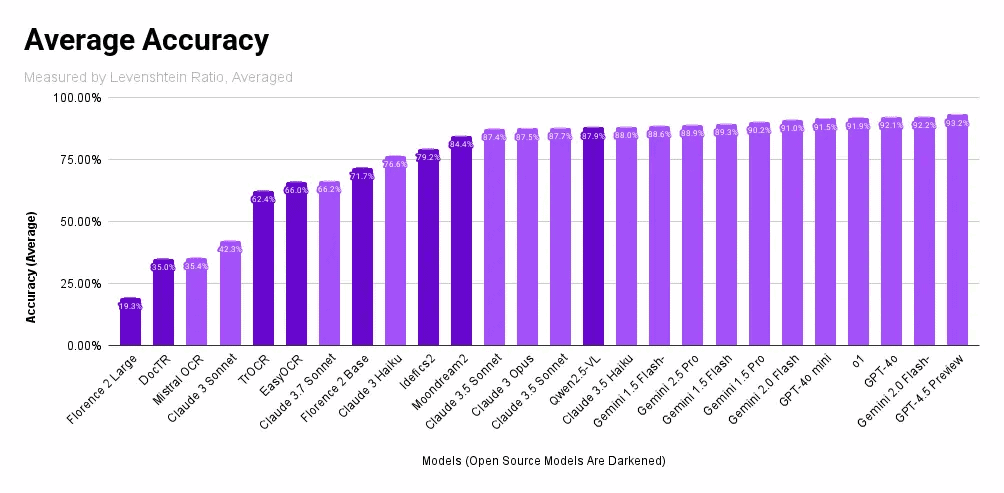
- Industry-leading OCR engines, particularly those utilizing deep learning, achieve excellent accuracy rates of 98% to 99% on clear, typed documents, enabling companies to automate up to 90% of their document processing.
- A key performance indicator is the Character Error Rate (CER), where top-tier commercial solutions report a CER below 1%, translating directly to fewer than 10 errors per 1,000 characters in scanned text.
- The move from a 95% accuracy rate to a 99% accuracy rate is statistically immense, reducing the number of “exceptions” or documents requiring human review by a factor of 5 (from 1 in 20 documents to 1 in 100 documents).
- For complex, handwritten documents, often found in healthcare or legal archives, modern Intelligent Character Recognition (ICR) models powered by AI are achieving accuracy levels around 85% to 95%.
- Specialized OCR platforms focused on specific document types, such as financial statements, claim to reach ultra-high accuracy of up to 99.5% by training their models on a narrow dataset.
- Errors are often measured as a Word Error Rate (WER), where systems designed for printed text aim for a WER below 2%, meaning that over 980 out of 1,000 words are converted perfectly.
| Accuracy Metric | Benchmark for Typed Text | Benchmark for Clear Handwriting (ICR) | Actual Impact |
| Page/Document Accuracy | 98% to 99% | 85% to 95% | Enables 90% automation of document workflows. |
| Character Error Rate (CER) | Less than 1% | Varies, but rapidly improving | Fewer than 10 errors per 1,000 characters processed. |
| Error Reduction | 99% vs 95% | 5x reduction in documents requiring manual verification. | Substantially reduces labor costs and processing delays. |
| Industry Specialist Accuracy | Up to 99.5% (e.g., financial docs) | N/A | Essential for documents where financial or legal precision is paramount. |
OCR Adoption by Industry Vertical
 (Source: indatalabs.com)
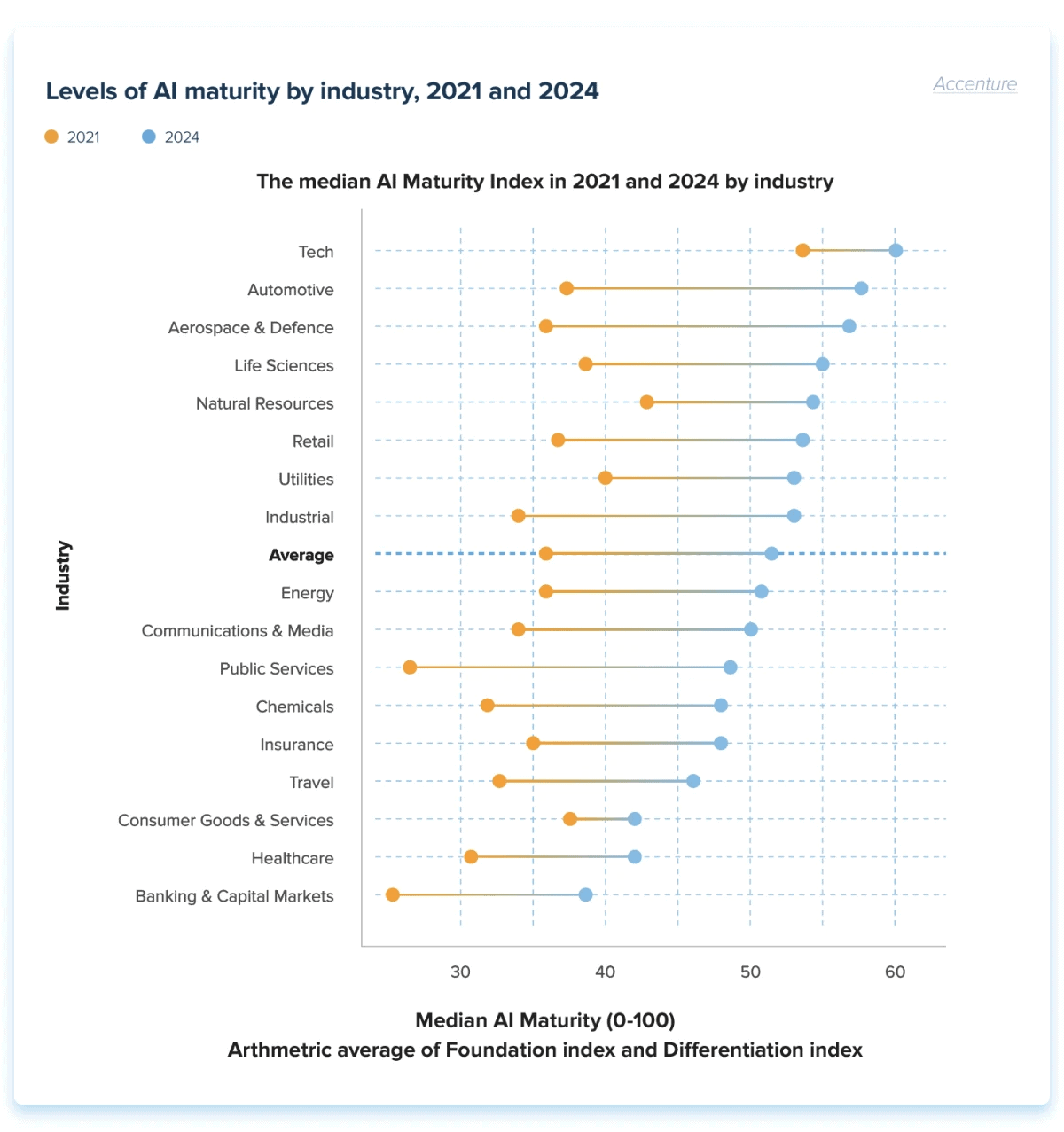
- The BFSI (Banking, Financial Services, and Insurance) sector remains the largest consumer of OCR, holding a dominant market share of around 26% in 2024.
- Healthcare is emerging as the fastest-growing vertical for OCR, with a projected CAGR of over 20.2%.
- The Government and Public Sector use OCR extensively for archival and record management projects, such as the Digital India initiative, which is aimed at digitizing over 4 billion government records.
- In the Retail and E-commerce segment, OCR is increasingly used for automating the processing of paper receipts and invoices, with solutions often integrated into expense management apps to achieve a reduction in processing time by up to 80%.
- The Logistics and Transportation sector utilizes OCR for automated container identification and tracking, with systems capable of reading up to 2,000 pages per minute to process customs documents, bills of lading, and shipping manifests rapidly.
- The IT and Telecommunications vertical leverages OCR for contract lifecycle management and customer onboarding, with automation of text extraction from agreements reducing the cycle time for new customer activation by an estimated 30 to 40%.
| Industry Vertical | Market Share (2024) | Projected Growth (CAGR) |
| BFSI | 26% (Dominant Share) | Steady, High |
| Healthcare | Significant, but less than BFSI | 20.2% (Highest CAGR) |
| Government/Public Sector | Major Contributor | High |
| Logistics/Transportation | Strong Presence | High |
Key Market Segmentation and Technology
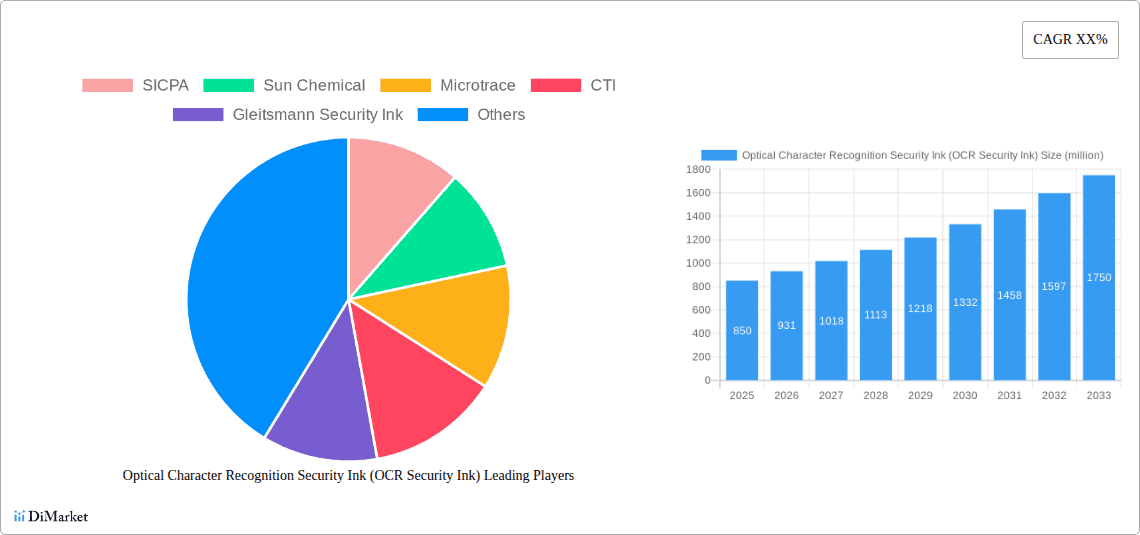 (Source: datainsightsmarket.com)
Component and Deployment Trends
- Software remains the leader in component revenue, capturing approximately 78% of the market share in 2024.
- Cloud-based OCR accounted for roughly 66% of all deployments in 2024, making the market’s preference for flexible, pay-as-you-go models that offer high scalability and automatic feature updates without on-premise infrastructure constraints.
- The Services component, which includes consulting, integration, and managed OCR operations, is projected to grow at a slightly faster rate of 17.9% CAGR than the software segment.
- The B2B (Business-to-Business) end-use segment is the market giant, commanding over 75.9% of the revenue share.
Technology and Development
- Intelligent Character Recognition (ICR) is the technology segment advancing most rapidly, with its market share forecast to grow at an aggressive 19.4% CAGR.
- The integration of Natural Language Processing (NLP) with OCR has increased the system’s ability to not just read text, but understand its context and extract structured data fields with accuracy rates exceeding 90% on forms like invoices or contracts.
- The use of Synthetic Data for training OCR models is an ongoing trend; it’s estimated that using synthetically generated, diverse document images can improve the model’s robustness against practical imperfections like skew and blur by up to 15%.
| Segment Breakdown | Dominant Market Share (2024) | Projected Growth Rate (CAGR) |
| By Component | Software (78.8% share) | Services (17.9% CAGR) |
| By End-User | B2B (75.9% share) | B2C (Fastest Growth) |
| By Deployment | Cloud (66% share) | Cloud |
| By Technology | Conventional OCR (71% share) | ICR (19.4% CAGR) |
OCR Leaders and Recent Achievements
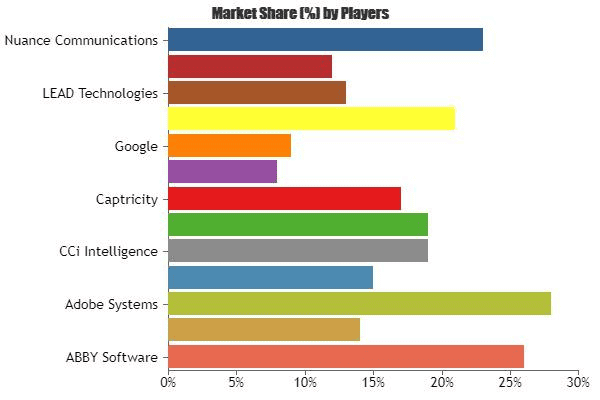 (Source: openpr.com)
- ABBYY, a long-time specialist in document intelligence, maintains a strong position due to its high-accuracy FineReader product, which supports text recognition in over 198 languages.
- Google LLC leverages its massive infrastructure, with its Cloud Vision API providing OCR services that process almost 10+ million images daily, offering one of the lowest latencies and highest capacity text extraction services in the cloud market.
- Adobe Inc. continues to solidify its market position by embedding advanced, AI-driven OCR capabilities directly into its ubiquitous Acrobat Pro DC suite, ensuring that scanned PDFs are instantly searchable and editable for its user base of millions.
- IBM Corporation made a move by releasing an upgraded version of its OCR technology, integrated with IBM Watson Discovery, specifically targeting improvements in handling low-quality and natural-scene image documents for better enterprise document management.
- Ricoh strategically enhanced its portfolio in 2024 by acquiring a specialist AI-enabled intelligent capture startup.
- The development of open-source projects, such as Tesseract OCR, demonstrates the widespread accessibility and adoption of the technology.
| Key Market Player | Focus/Flagship Product |
| ABBYY | FineReader PDF |
| Google LLC | Cloud Vision API |
| Adobe Inc. | Acrobat Pro DC |
| IBM Corporation | Watson Discovery Integration |
| Ricoh Co., Ltd. | Corporate Acquisition (natif.ai) |
Conclusion
Overall, these stats data are unequivocal: Optical Character Recognition (OCR) is a vital, rapidly evolving market force. Its success is increased by the engagement of classic character recognition algorithms with new-gen AI and ML, allowing systems to understand context and handle the complexity of current documents.
The multi-billion dollar valuation and the ever-higher accuracy rates, from 99% on printed text to highly functional rates on handwriting, confirm that OCR will continue to serve as the critical bridge between the physical world of paper and the digital future of enterprise data. I hope you like this article. If you have any questions, let us know, we will try to answer you ASAP thanks for staying till the end.