








Introduction
First-Party Data Strategy Statistics: In 2026, first-party data has kinda become the unquestionable foundation of modern digital marketing as brands shift because of stricter privacy regulations, the third-party cookie decline, and customers wanting more clarity. Unlike third-party data, first-party data is gathered straight from customers via websites, apps, loyalty programs, actual purchases, surveys, and other owned channels, so it stays more precise, more compliant, and more usable in practice.
Because of this, many organizations are putting real money into customer data platforms (CDPs), consent management systems, AI-enhanced analytics, and personalization engines, basically trying to pull maximum value out of their own data. So the whole first-party data strategy has moved from being a simple marketing move into something closer to a core business asset.
The article below on first-party data strategy statistics will present the marketing strategies, adoption rates, and top channels.
Editor’s Choice
- 87% of marketers are now leaning on first-party data as their main audience targeting source, which basically confirms its dominance in privacy-first marketing.
- Companies that use first-party data well see 25% higher conversion rates on average, suggesting owned data improves campaign performance in a direct way.
- 72% of organizations are actively gathering first-party data across multiple channels, showing this is already widespread enterprise adoption.
- Businesses that run unified first-party data strategies report up to 35% stronger campaign results, which reinforces the value of connected customer data.
- The Customer Data Platform (CDP) market is forecast to reach USD 10.3 billion in 2026, pushed by the growing need for centralized customer intelligence.
- By the end of 2026, it’s expected that more than 70% of digital advertising spend will be fueled by first-party data strategies.
- 62% of enterprises raised investment in first-party data infrastructure during 2024 2025, showing an even faster privacy-first transformation.
- 75% of brands are planning to cut back or fully drop third-party data by 2026, and that kinda seals the move toward owned customer data, more or less.
- Zero-party data is also growing fast, showing 36.8% CAGR inside Customer Data Platforms, which pairs up nicely with first-party personalization.
- Email still leads the first-party data channels, with 63% of advertisers running newsletters, while advanced email analytics can drive 73% better campaign results.
First-Party Data Statistics Highlight The Shift Toward Privacy-First Marketing
- First-party data has basically become the base layer of modern digital marketing as companies adjust to tougher privacy rules and the way customers expect things to work.
- In 2025, Google confirmed the rollout of the Privacy Sandbox, but it also delayed the full phase-out of third-party cookies.
- At the same time, Apple’s App Tracking Transparency (ATT) reduced cross-app tracking by more than 40% worldwide.
- So, as a consequence, 80% of marketers are now prioritizing first-party data over third-party options, which feels like a clear pattern.
- During 2024-2025, data clean rooms adoption went up by 70% year over year, suggesting more emphasis on privacy-safe data collaboration.
- According to eMarketer estimates, retail media networks powered by first-party data added USD 45 billion globally in 2025.
- Meanwhile, Customer Data Platform (CDP) adoption hit 78% across enterprise organizations.
- More than 65% of global data strategies were influenced by GDPR and CCPA, and AI-driven personalization built on first-party data lifted campaign ROI by as much as 30% in 2025.
- The numbers also show why first-party data feels like the go-to marketing asset these days, like it’s just quietly better. 91% of marketers say it’s the most reliable data source.
- Website analytics bring in over 60% of first-party data capture, and 77% of brands lean on email subscription data for audience targeting.
- Meanwhile, CRM systems keep as much as 85% of structured customer information. On top of that, mobile applications end up generating around three times more behavioral data per user than desktop platforms do, and first-party datasets are 2-3 times more accurate than third-party data.
- Then there’s the loyalty programs angle: 68% of companies use them to gather useful customer insights.
- Putting together these figures suggests first-party data is now the central engine behind privacy-compliant personalisation, customer engagement, and long-term marketing success.
First-Party Data Adoption Statistics
(Reference: techrt.com)
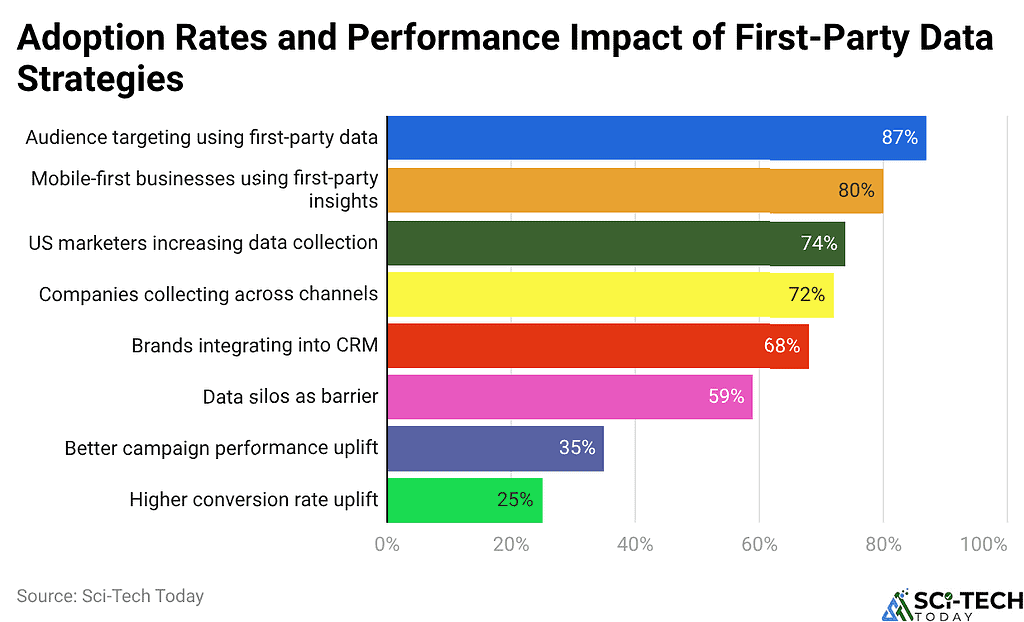
- First-party data has become the backbone of modern marketing, as organizations try to stay privacy-compliant while still getting useful customer insights.
- Around 87% of marketers now see first-party data as their main source for audience targeting, and 72% of companies are collecting it on purpose across several channels.
- About 25% higher conversion rates, which really ties back to stronger marketing performance.
- At the same time, integration is getting more advanced, with 68% of brands linking first-party data into their CRM platforms, so they can form more complete customer profiles.
- For mobile-first businesses, more than 80% of user insight is coming from first-party data, and that basically underlines why owned digital channels matter more every year.
- Still, 59% of marketers say data silos are a big roadblock when they try to stretch the value of first-party data to its limits.
- On the other hand, organizations with one unified first-party data strategy report up to 35% better campaign performance, and 74% of U.S. marketers increased their collection activity after tighter privacy rules came in.
First-Party Data Market Statistics Reflect Rapid Investment and Industry Growth
- The first-party data market is clearly moving fast, since businesses are putting money into privacy-first tools and better customer data capabilities.
- The global Customer Data Platform (CDP) market is heading toward USD 10.3 billion by 2026, which suggests a strong appetite for centralized customer data management.
- Meanwhile, first-party data-driven ads are expected to make up over 70% of digital ad spend by the end of 2026, so there’s a noticeable shift away from third-party data.
- The data analytics market, powered mostly by first-party data, reached USD 150 billion around 2025, and 62% of enterprises said they raised their budgets for first-party data infrastructure during 2024-2025.
- Also, retail media networks that lean on first-party data are widening too, and they’re posting over 20% annual growth like it’s a steady rhythm.
- On top of that, Customer Data Platforms (CDPs) hit a solid 34% CAGR from 2022 through 2025, which really shows strong enterprise uptake.
- If we look forward, 75% of brands plan to phase out their dependence on third-party data by 2026.
- At the same time, spending on data privacy and compliance tools has climbed 28% year over year, reinforcing the whole sector’s long-term focus on secure, privacy-first data approaches.
First-Party Data Dominates Marketing Strategies Across Every Budget
(Reference: techrt.com)
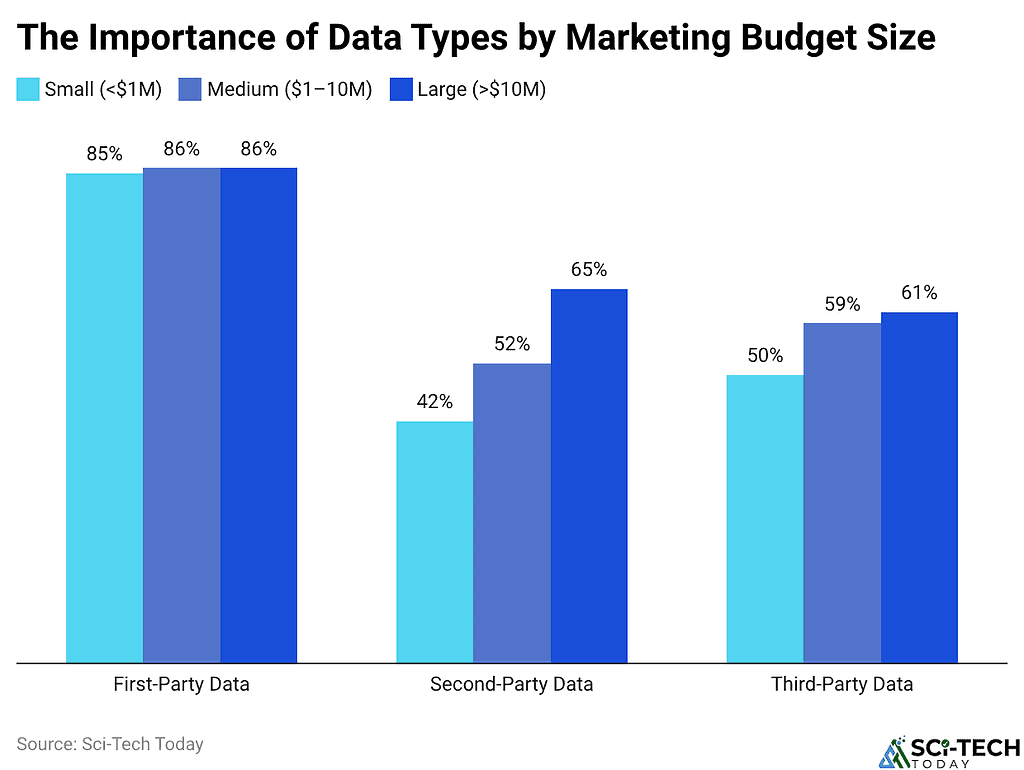
- First-party data still ends up being the most valuable marketing stuff, no matter the company size or how much ad budget they’re throwing at it.
- Around 85% of marketers working with small budgets, 86% with medium budgets, and 86% even with large budgets, say first-party data is highly important, which basically shows it stays the bedrock of data-driven marketing.
- Meanwhile, the “second-party” angle seems to get louder as budgets get bigger, jumping from 42% for small-budget marketers to 52% for medium-budget orgs and then up to 65% for large-budget organizations.
- Overall, that works out to a 23-percentage-point lift, sort of matching the idea that as companies grow, they also widen their data collaborations.
- Third-party data also keeps showing up as relevant, rising from 50% in small-budget businesses to 59% for medium budgets and 61% for large budgets. Still, it stays a little behind first-party data.
- The separation between first-party and second-party data gets smaller too, going from a 43-point gap (85% versus 42%) for small-budget marketers down to a 21-point gap (86% versus 65%) for large-budget ones, which suggests more money is going into diversified data strategies.
- Likewise, first-party data is ahead of third-party data by 35 percentage points for small-budget businesses and by 25 percentage points for larger companies.
- Mid-sized organizations sitting in the USD 1-10 million marketing budget range seem to use everything in a more even, balanced way, with 86% using first-party data, 52% using second-party data, and 59% relying on third-party data. That pattern feels like a more grown-up and more diversified approach to customer data management.
First-Party Vs. Zero-Party Data: Understanding The Difference
- First-party and zero-party data have kind of become the two most valuable things in privacy-first marketing now, with companies combining both so they can boost customer engagement while still following the changing data rules.
- Even though both types basically come from owned customer interactions, Statista and MarketsandMarkets, as described in the Customer Data Platform (CDP) Market Report 2025-2030, say that zero-party data is the fastest-growing data bucket inside Customer Data Platforms (CDPs), growing at about 36.8% CAGR, which is pretty notable.
- A bunch of major vendors, like Salesforce, Braze, Bloomreach, Zuora, QuestionPro, CapillaryTech, DataGuard, and CDP.com, keep highlighting that organizations are mixing explicit customer preferences with observed behavioral signals to build sharper customer personas.
- In practice, this means they take action-based context from websites, mobile apps, CRM systems, loyalty programs, and transactions, and then connect it with preference info people share on purpose through surveys, quizzes, and those preference center tools.
- The Markets and Markets research also suggests modern CDPs are being built to take in both behavioral first-party data and neatly structured zero-party data, so marketers can do more advanced personalization but still stay aligned with regulations like GDPR and CCPA.
- As per Braze and Bloomreach, when you mix first-party data with zero-party data, you often get more resilient personalization than if you lean on just one type of info by itself.
- QuestionPro mentions that when teams connect explicit customer replies with day-to-day behavioural activity, segmentation gets sharper, and customer profiling becomes more accurate.
- CapillaryTech adds that by matching CRM identity fields with preference signals, brands can get a clearer view of future buying intent, and they can anticipate customer expectations better.
- In general, the figures point toward privacy-first marketing moving into a fresh, faster growth stage. Zero-party data is forecast to rise at a 36.8% CAGR in CDPs, as more orgs adopt unified customer data approaches, plus improved regulatory compliance.
- The combined research from Statista, MarketsandMarkets, Salesforce, Braze, Bloomreach, Zuora, QuestionPro, CapillaryTech, DataGuard, and CDP.com indicates that companies using both first-party behavioral activity and zero-party customer preferences will likely deliver the most effective, highly personalized, privacy-compliant experiences.
Top Channels For First-Party Data Collection
- In 2026, the most successful first-party data approaches are kinda built around a few strong, opt-in (consent-driven) collection routes that help companies sharpen personalization, while still staying privacy compliant.
- As per Omnibound’s 2026 First-Party Data Statistics, 63% of advertisers name email newsletters as their main first-party data collection channel, so email ends up being the most common way to grab customer details and those engagement signals.
- Then, 60% of advertisers also lean on website and app behavior tracking, such as page views, clicks, scroll depth, session duration, product interactions, and feature usage, to assemble more complete customer profiles.
- As per R-Advertising’s 2026 Email Marketing Trends, organizations that use thorough email analytics see 73% better campaign performance, which basically shows how first-party behavioral insights help with audience segmentation and more tailored messaging.
- Shopify adds that browsing history, purchase history, geographic location, and engagement behavior gathered through owned channels directly fuel automated email programs and personalized recommendations.
- StackAdapt, citing eMarketer, reports that 45% of U.S. adults are actively using a loyalty application with their main grocery retailer, which shows how comfortable people are trading personal information for rewards and sort of exclusive perks.
- More recent industry trends also suggest advertisers are moving spend toward owned channels now that third-party cookies are disappearing.
- According to Omnibound, marketers are putting email newsletters (63%) and site/app behavioral tracking (60%) ahead of other first-party data collection options, while StackAdapt, Shopify, InsiderOne, and CDP.com recommend tying those efforts together with Customer Data Platforms (CDPs) so you end up with one unified view of customers.
- The above statistics sorta indicate that first-party data gathering is getting more and more pulled by high-value owned channels.
- Like 63% of advertisers leaning on email newsletters, 60% using behavioral tracking, 73% seeing campaign performance improvements via email analytics, and 45% of U.S. adults taking part in loyalty programs.
Conclusion
In 2026, first-party data really turns into the cornerstone of digital marketing, because it helps organizations juggle personalization with the rising privacy expectations, plus regulatory compliance stuff. Companies are pouring into Customer Data Platforms, AI-powered analytics, consent management, and unified customer profiles, so the owned data actually pays off more.
Meanwhile, as third-party data keeps sliding, marketers are leaning harder on email, behavioral tracking, CRM systems, and loyalty programs to tighten customer connections and boost campaign results. Firms that blend first-party with zero-party data, while also staying transparent and building trust, should see a noticeable competitive edge—higher engagement, better conversions, and more sustainable growth over time.
FAQ
First-party data is the info collected straight from customers through owned channels like websites, applications, CRM systems, and loyalty programs.
It supports privacy-compliant personalization, lifts marketing performance, and reduces reliance on third-party cookies.
Businesses using unified first-party data strategies can achieve up to 35% better campaign performance and 25% higher conversion rates.
Email newsletters, website and app behavioral tracking, CRM systems, loyalty programs, surveys, and preference centers are the leading channels.
The global CDP market is projected to reach USD 10.3 billion in 2026, driven by growing enterprise adoption.