









Overview
Debt Financing Statistics: Raising funds is an important part of running and growing a business. Debt financing allows companies to secure the funds they need by borrowing from banks, financial institutions, or other lenders. Instead of selling ownership shares, businesses agree to repay the borrowed amount with interest within a fixed period.
These funds can support business expansion, new projects, equipment purchases, and everyday operations. Although borrowing provides access to capital, it also entails repayment obligations and interest costs. If debt is not managed properly, it can affect a company’s financial stability.
Therefore, understanding how debt financing works, along with its benefits and risks, is essential for making sound business decisions.
Curated Choice
- The global debt financing market is projected to increase from USD 31.6 billion in 2025 to USD 35.1 billion in 2026.
- In 2026, North America accounts for 34% of the global debt financing market.
- Global corporate borrowing reached a record USD 13.7 trillion in 2025.
- By the end of 2025, half of all outstanding investment-grade corporate debt carried interest rates above 4%.
- In 2026, companies need to refinance 24% of their outstanding investment-grade debt during the three years following 2025.
- Global borrowing is projected to reach USD 29 trillion in 2026.
- Nine major AI firms raised USD 122 billion through bonds in 2025.
- Global sustainable finance bond issuance reached C$725 billion in H1 2026, up 2% from C$714 billion in H1 2025.
- The sustainable debt issuance is forecast to rise from USD 1,539 billion in 2025 to USD 1,621 billion in 2026, an increase of 5.3%.
- France’s government debt rose to 119.0% of GDP in June 2026, from 115.7% in December 2025.
- Developing countries’ external debt reached USD 12.3 trillion in 2025, increasing by USD 508 billion year over year.
- Privately held U.S. nonfinancial companies carried approximately USD 1.4 trillion in private-credit debt in Q1 2026.
- On October 26, 2026, Meta reported USD 84 billion in outstanding debt and USD 11.22 billion in cash.
Global Debt Financing Market Size
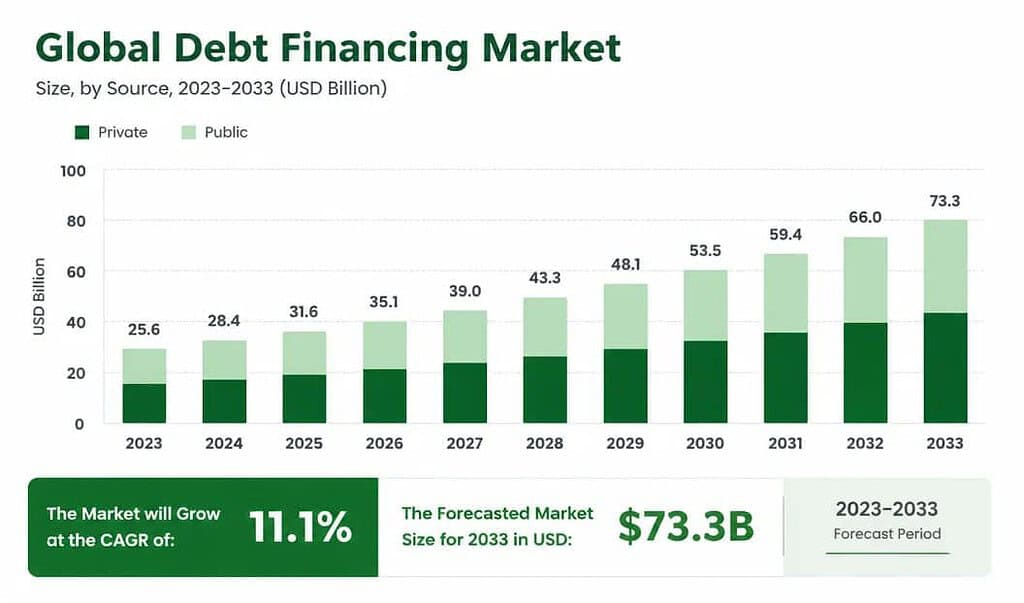
- The global debt financing market is projected to increase from USD 31.6 billion in 2025 to USD 35.1 billion in 2026.
- By 2033, the market is forecast to reach USD 73.3 billion, with a compound annual growth rate of 11.1% from 2023 to 2033.
Regional Distribution
- In 2026, North America accounts for 34% of the global debt financing market, driven by strong investments in energy, oil, gas, and infrastructure.
- Asia Pacific holds 27%, followed by Europe (17%), the Middle East and Africa (15%), and South America (7%), according to Fortune Business Insights.
Debt Financing Statistics by Source
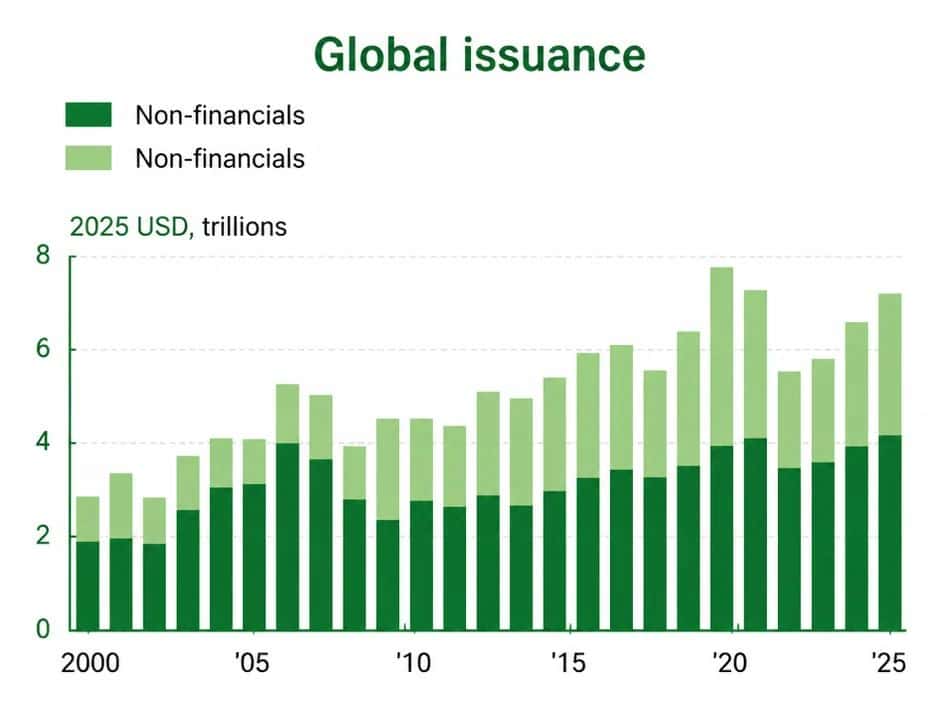
- The global corporate borrowing reached a record USD 13.7 trillion in 2025.
- Private credit assets under management reached USD 1.8 trillion in June 2025, representing 1% growth compared with 2024.
- Uninvested private credit funds fell to 28% in 2025, down from 59% in 2018.
- Investment-grade companies recorded USD 768 billion in net corporate bond issuance during 2025.
By Type
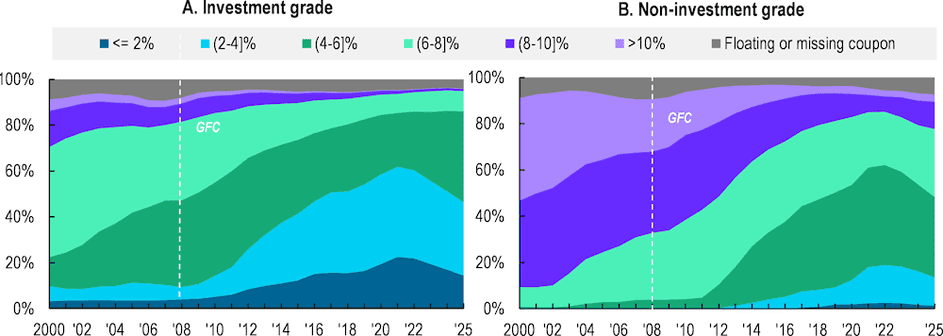
- By the end of 2025, half of all outstanding investment-grade corporate debt carried interest rates above 4%.
- Corporate bonds with interest rates of 2% or less accounted for just 14% of investment-grade debt in 2025, down from nearly 25% in 2021.
- The share of non-investment-grade corporate debt with interest rates of 8% or higher increased to 15% in 2025, up from 9% in 2022.
By Duration
- According to the OECD’s Global Debt Report 2026, companies need to refinance 24% of their outstanding investment-grade debt during the three years following 2025.
- Non-investment-grade companies face greater refinancing pressure, with 31% of their outstanding debt due for refinancing over the same three-year period.
- Of the investment-grade corporate debt maturing between 2026 and 2028, 65% carries existing interest rates of 4% or less.
- Among non-investment-grade corporate bonds maturing between 2026 and 2028, 67% currently carry interest rates of 6% or less.
Global Debt Borrowing Report
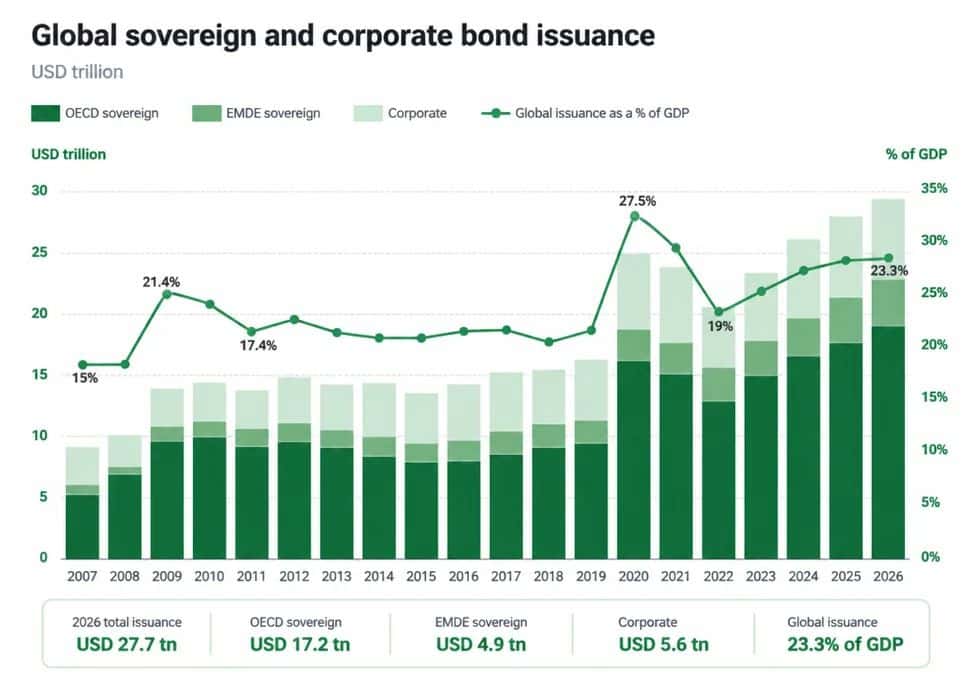
- Global borrowing is projected to reach USD 29 trillion in 2026, marking a USD 4 trillion (17%) increase from 2024.
- In 2025, OECD central government borrowing stood at USD 17 trillion, while corporate borrowing reached USD 6.8 trillion.
- Meanwhile, global bond issuance is expected to account for 23.3% of GDP in 2026, below the 2020 peak of 27.5%.
- OECD governments are expected to allocate 78% of their 2026 borrowing to refinancing existing debt.
AI Borrowing Outlook
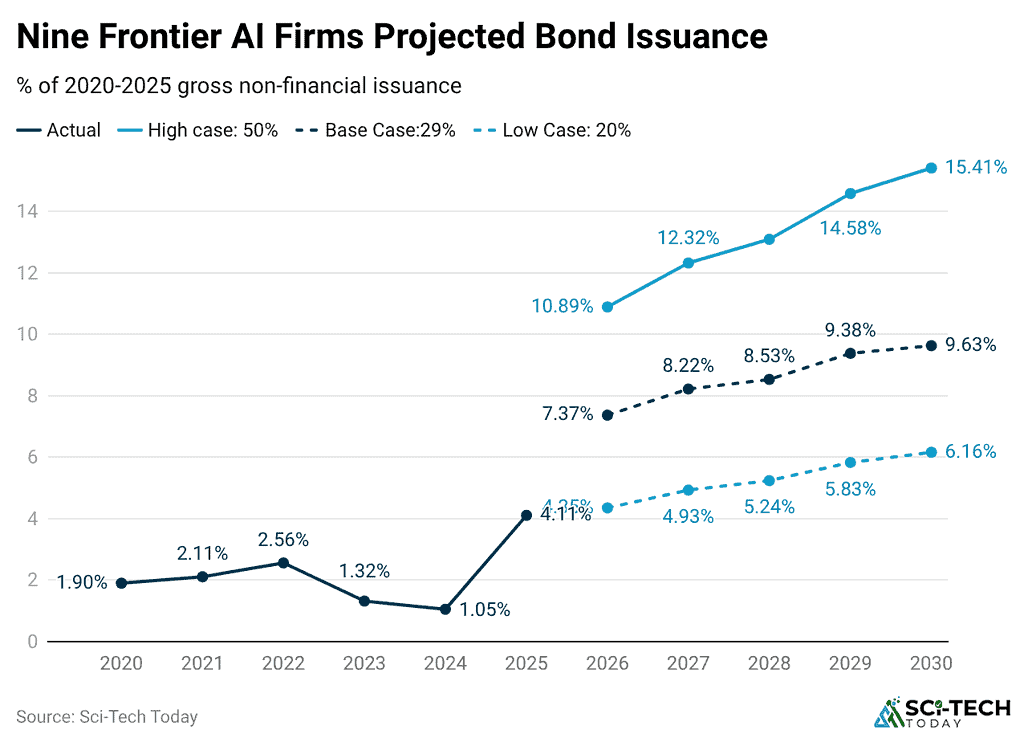
- Nine major AI firms raised USD 122 billion through bonds in 2025.
- Their planned spending totals USD 4.1 trillion for 2026–2030, signaling greater financing needs.
The State of the Sustainable Debt Market
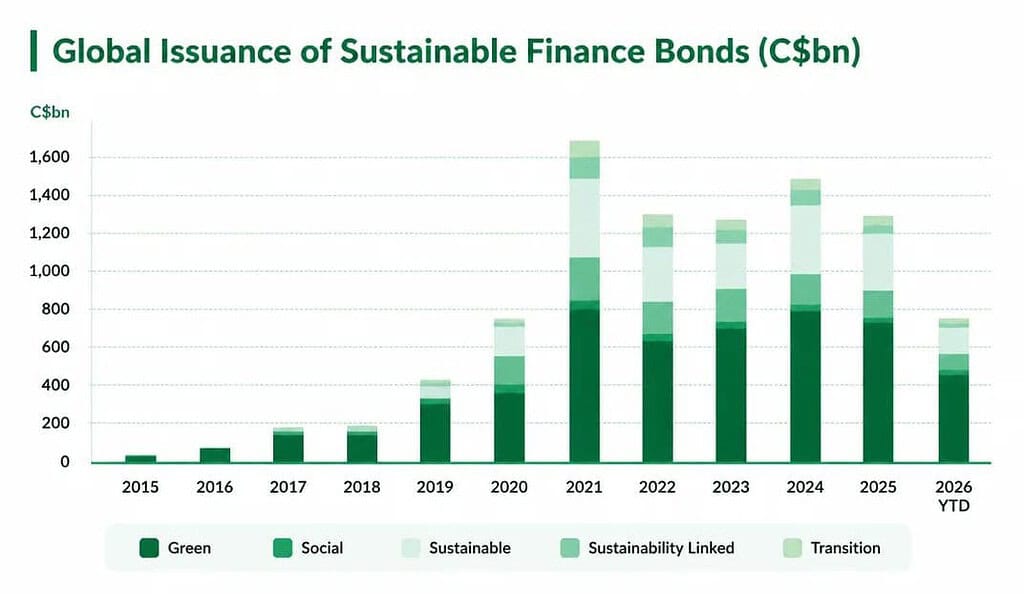
- Global sustainable finance bond issuance reached C$725 billion in H1 2026, up 2% from C$714 billion in H1 2025.
- Issuance is on track to exceed the 2025 total of C$1.2 trillion.
- In May 2026, cumulative labeled bond issuance surpassed USD 7 trillion (C$9.6 trillion).
- Green bonds led the market with a 58% share, followed by sustainable bonds (25%), social bonds (15%), and sustainability-linked bonds (2%).
- Quasi-sovereign issuers accounted for 56% of issuance, followed by corporate issuers (33%), sovereign issuers (8%), and securitized bonds (3%).
Global Sustainable Finance Market Outlook
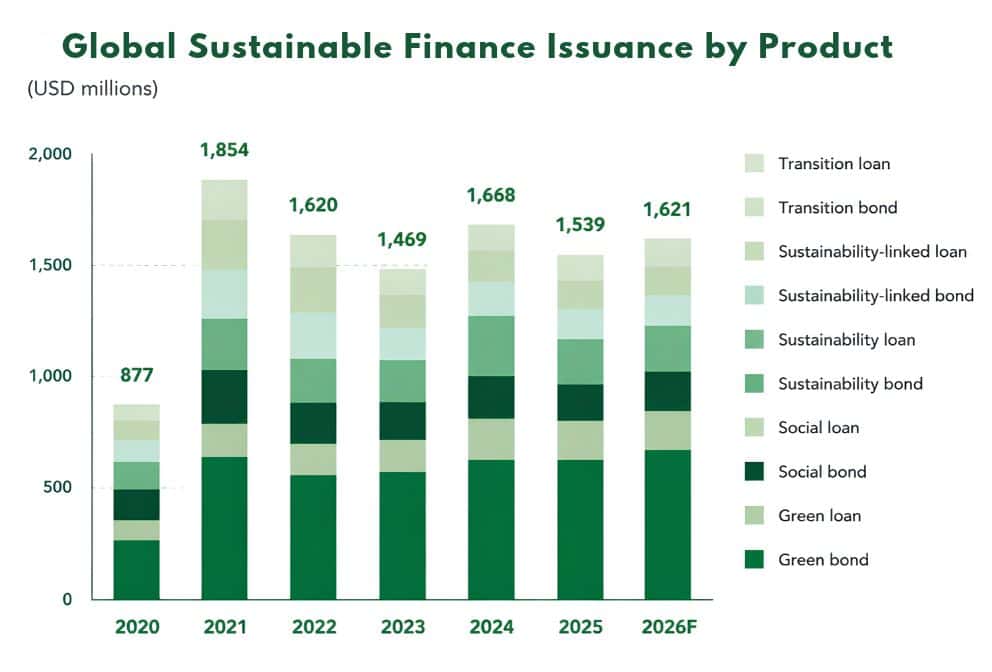
- The sustainable debt issuance is forecast to rise from USD 1,539 billion in 2025 to USD 1,621 billion in 2026, an increase of 5.3%.
- Green bonds and loans are expected to reach USD 700 billion and USD 255 billion in issuance, respectively, in 2026.
- Sustainable bond issuance is forecast to increase from USD 271 billion to USD 290 billion, while transition bonds and loans could reach USD 17 billion, up from USD 12 billion in 2025.
- According to ING Research’s report, sustainability-linked bond issuance is expected to remain weak at USD 25 billion, while sustainability-linked loans could rise to USD 160 billion from USD 139 billion.
- Non-financial corporate sustainable debt issuance is projected to reach USD 640 billion in 2026, up 10% from 2025.
- Regional corporate issuance is expected to reach USD 320 billion in EMEA, USD 190 billion in APAC, and USD 90-100 billion in the U.S.
- U.S. dollar-denominated corporate sustainable bonds could remain near USD 50 billion, while EUR-denominated issuance is forecast to reach USD 120 billion (approximately EUR 105 billion), up 25% year-over-year.
Global Public Debt
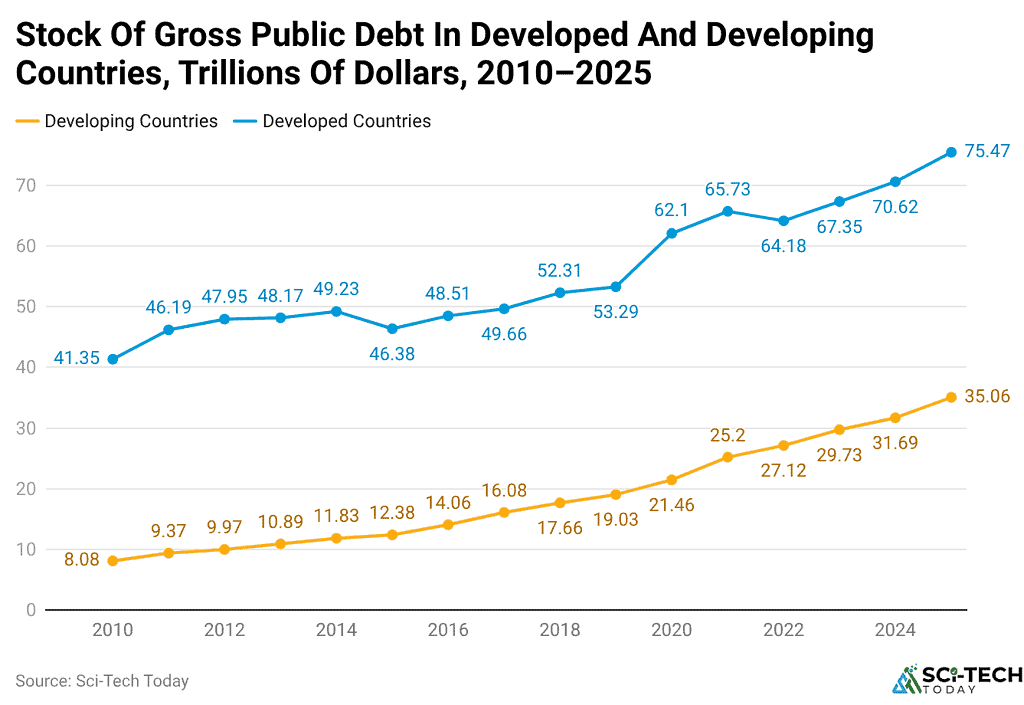
- The global public debt reached about USD 111 trillion in 2025.
- Developed countries accounted for USD 75.47 trillion in debt, compared with USD 35.06 trillion owed by developing countries.
Global Debt Levels Continue to Rise Across Major Economies
France
- According to IMI Daily, government debt reached 119.0% of GDP in June 2026, up from 115.7% at the end of 2025.
- The IMF projects it will rise to 123.6% by 2031.
- The budget deficit increased from 5.1% in 2025 to an expected 5.4% in 2026.
- Foreign investors held 58.4% of long-term government bonds.
Belgium
- Debt reached 108.1% of GDP in 2025, with the IMF projecting it to reach 122.1% by 2031.
- Its budget deficit was 5.2% in 2025.
Italy
- Government debt stood at 136.7% of GDP in 2025.
- The IMF expects it to decline to 135.6% by 2031.
- Italy recorded a primary budget surplus of 0.8% in 2025.
United States
- The IMF projects government debt to increase from 126.8% of GDP in 2026 to 145% in 2031.
- The budget deficit is expected to reach 8.5% in 2026.
- Interest payments could account for 5.7% of GDP by 2031.
United Kingdom
- Government debt is projected at 102% of GDP in 2026 and 100.2% in 2031.
- Debt interest costs GBP 110 billion from 2025 to 2026.
Greece
- Debt stood at 145.4% of GDP in 2025, with the IMF projecting a decline to 111.1% by 2031.
- Greece recorded a budget surplus of 2% in 2025.
Japan
- Government debt is projected at 199.4% of GDP in 2026, declining to 188.9% by 2031.
- The Bank of Japan held 46.7% of government bonds, while foreign investors owned 7.9%.
Singapore
- Gross debt is projected at 166.4% of GDP in 2026.
- However, the government reports no net debt because its financial assets exceed its liabilities.
Canada
- Gross debt is projected at 115.6% of GDP in 2026, while net debt is estimated at just 9.3%.
Austria, Finland, and Slovakia
- Their debt ratios are projected to range from 62.2% to 90.6% of GDP in 2026, with further increases expected by 2031.
Bahrain
- Government debt is projected to reach 162.8% of GDP in 2026, with a budget deficit of 11.4%.
- Its minimum property investment for golden residency was reduced to USD 345,000.
Romania
- The country recorded a budget deficit of 7.8% of GDP in 2025, the highest in the EU.
Developing Countries’ External Debt and Debt Servicing Statistics
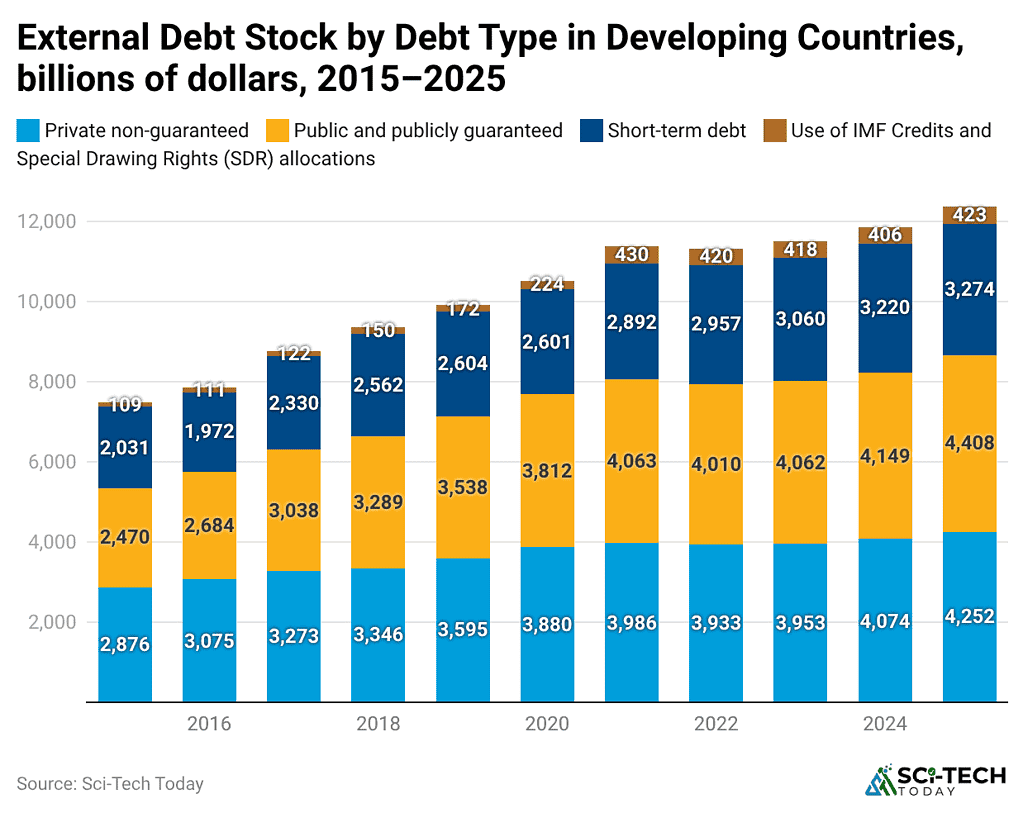
- Developing countries’ external debt reached USD 12.3 trillion in 2025, increasing by USD 508 billion year over year.
- Debt growth slowed from 7.2% (2015-2021) to 2.1% (2021-2025).
- Only USD 8 billion (7%) of the USD 114.7 billion in pledged rechannelled SDRs had been disbursed by March 2026.
- External debt payments fell to USD 1.6 trillion in 2025, but long-term interest costs increased nearly 14%.
- Debt servicing rose 81% between 2015 and 2025, compared with 65% growth in debt stocks.
- Least developed countries spent 18.2% of export earnings and 17.6% of government revenue on external public debt servicing in 2025.
United States Corporate Debt and Private Credit Statistics
- Federal Reserve data showed that privately held U.S. nonfinancial companies carried approximately USD 1.4 trillion in private-credit debt in Q1 2026.
- Their outstanding debt also included USD 1 trillion in leveraged loans and USD 3.2 trillion in other debt.
- Collateralized loan obligations backed by broadly syndicated loans accounted for 67.2% of leveraged-loan holdings.
- Loan mutual funds and ETFs held 10.6%, while other investors accounted for the remaining 22.2%.
Leveraged Loans and High-Yield Bond Market
- Leveraged-loan issuance reached USD 165.1 billion in Q2 2026, according to KPMG.
- High-yield bond issuance totaled USD 180.8 billion in H1 2026, marking an approximately 25% increase from H1 2025.
- High-yield bond issuance reached USD 101.1 billion in Q2 2026.
- The average quarterly yield on high-yield bonds stood at 7.41% in Q2 2026.
- Octus reported that high-yield bond issuance increased by 27% in H1 2026 compared with H1 2025.
Debt Financing Statistics: Major Technology Companies Increase AI Funding
- According to a Reuters report published on October 26, 2026, Meta reported USD 84 billion in outstanding debt and USD 11.22 billion in cash.
- It plans to raise up to USD 95 billion through equity offerings and share sales, with capital expenditure of USD 135-145 billion.
- SpaceX has USD 25.03 billion in debt and USD 51.29 billion in cash. Its USD 40 billion financing deal will support AI chip and server infrastructure.
- Amazon holds USD 162.60 billion in debt and USD 78.21 billion in cash, with multiple bond offerings planned.
- Nvidia: Plans a USD 25 billion bond issuance, with USD 32.50 billion in debt and USD 22.44 billion in cash.
- Salesforce issued USD 25 billion in debt to support its USD 50 billion share repurchase program.
- Oracle expects to raise USD 45-50 billion through debt and equity in 2026.
- Alphabet holds USD 126.12 billion in debt and USD 55.91 billion in cash, while expanding its bond and equity financing.
Final Thoughts
Debt financing gives businesses access to funds when they need capital for growth, expansion, or daily operations. It allows them to raise money while keeping ownership unchanged. However, taking on too much debt can increase financial pressure due to interest payments and repayment deadlines.
Businesses should borrow based on their financial capacity and future plans. A well-managed debt strategy can help maintain financial stability and support steady business growth.
FAQ
The main types of debt financing include bank loans, bonds, lines of credit, mortgages, debentures, and trade credit.
Debt financing requires repayment with interest, while equity financing exchanges ownership for investment.
Lenders assess credit history, income, cash flow, existing debt, collateral, and repayment capacity.

Sources