









Power Circuit Meter Market Size
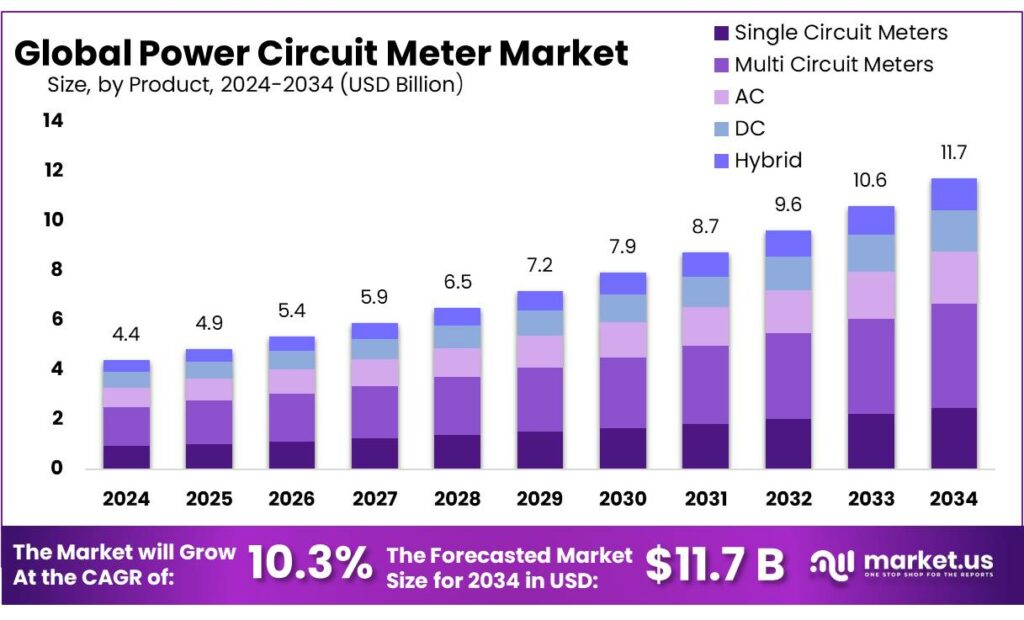
The global power circuit meter market is projected to reach about USD 11.7 billion by 2034, up from USD 4.4 billion in 2024, reflecting a strong CAGR of 10.3% between 2025 and 2034. North America leads today, holding roughly 37.4% share and around USD 1.4 billion in 2024 revenue.
Power circuit meters—also known as power/energy meters or multifunction power meters—are industrial devices that monitor real-time electrical parameters such as voltage, current, power factor, frequency, demand, and energy (kWh). They are typically installed in switchboards, MCCs, and panel boards to provide visibility at feeder, machine, or process level, which is increasingly critical as global electricity use continues to climb.
Get a comprehensive report summary that describes the value and forecast along with methodology. Download the PDF brochure
Demand is primarily driven by three needs: cost control through submetering and peak-demand management, improved reliability and safety via early detection of overloads and imbalances, and better auditability to qualify for energy-efficiency incentives. India’s PAT program illustrates this impact, with the first two cycles together saving over 22 MTOE and avoiding nearly 100 million tonnes of CO₂.
Government-backed grid and metering modernization is another powerful tailwind. In India, more than 20 crore smart meters have been sanctioned under RDSS, with several crore already installed, indicating rapid deployment. In Europe, an estimated €47 billion could be invested by 2030 to roll out 266 million smart meters, while in the U.S., federal programs like GRIP and IIJA are channeling many billions of dollars into grid resilience—indirectly boosting demand for advanced metering, monitoring, and protection equipment at the facility edge.
Get Customized Market Intelligence – Contact Our Team Directly at [email protected]
Key Takeaways
- Power Circuit Meter Market size is expected to be worth around USD 11.7 Billion by 2034, from USD 4.4 Billion in 2024, growing at a CAGR of 10.3%.
- Multi Circuit Meters held a dominant market position, capturing more than a 36.9% share.
- Digital Meters held a dominant market position, capturing more than a 47.2% share.
- Medium Density (17–48 Circuits) held a dominant market position, capturing more than a 41.6% share
- Wired held a dominant market position, capturing more than a 67.7% share.
- Indoor held a dominant market position, capturing more than a 72.1% share.
- Commercial held a dominant market position, capturing more than a 37.8% share.
- North America – 37.40%, valued at USD 1.4 Bn.
By Product Analysis – Multi Circuit Meters
Multi Circuit Meters accounted for over 36.9% of the market in 2024, underscoring their growing importance in modern electrical infrastructure. These devices enable simultaneous monitoring of multiple branch circuits from a single compact unit, making them ideally suited for commercial buildings, factories, data centers, and other multi-load environments. Their uptake has accelerated as facilities seek to curb energy waste, gain real-time visibility into consumption, and meet stricter electrical safety and energy-reporting requirements.
By Technology Analysis – Digital Meters
Digital Meters led the market in 2024 with a share exceeding 47.2%, reflecting a clear shift toward advanced monitoring solutions. They provide precise, real-time readings of multiple electrical parameters—including voltage, current, harmonics, and power factor—making them the preferred option for sites that depend on accurate energy intelligence. This trend is reinforced by rising focus on electrical safety, predictive maintenance, and regulatory reporting, all of which demand rich, digital data streams.
By Density Analysis – Medium Density
Medium Density meters in the 17–48 circuit range held a dominant 41.6% market share in 2024, highlighting their suitability for a wide range of commercial and industrial settings. They strike a practical balance between monitoring capacity and panel space, which is attractive for facilities with expanding loads such as mid-sized manufacturers, logistics hubs, and large commercial buildings. Their ability to fit both new projects and retrofit upgrades makes medium-density solutions a natural choice for power infrastructure modernization.
By Connectivity Analysis – Wired
Wired connectivity maintained a strong lead with more than 67.7% share in 2024, underlining its continued relevance in power circuit metering. Industrial and commercial users favor wired links because they deliver stable, uninterrupted data transfer with minimal interference and high accuracy. This reliability is especially vital for monitoring critical loads in factories, data centers, and large buildings, and for supporting compliance-related metering and reporting.
By Installation Analysis – Indoor
Indoor installations represented over 72.1% of the market in 2024, showing a clear preference for placing power circuit meters in protected electrical rooms and panels. Indoor environments offer more controlled conditions, limiting exposure to dust, moisture, and temperature extremes, which in turn extends meter lifespan and improves performance. As a result, indoor setups are particularly common in commercial premises, production facilities, hospitals, and data centers where centralized, closely managed electrical systems are the norm.
By Application Analysis – Commercial
Commercial applications captured more than 37.8% of the market in 2024, driven by rising demand for energy monitoring in modern buildings. Offices, retail spaces, hotels, hospitals, educational campuses, and mixed-use developments all feature varied and shifting loads—such as HVAC, lighting, elevators, refrigeration, and IT systems—which makes circuit-level metering increasingly essential. By deploying power circuit meters, these facilities can better track usage patterns, reduce peak-demand penalties, and align with tightening energy-efficiency standards set by cities and regulators.
Regional Analysis
North America is the leading regional market for power circuit meters, holding about 37.40% share and roughly USD 1.4 billion in value in 2024, driven by high electricity intensity, advanced building automation, and stringent uptime requirements in commercial and industrial facilities.
A vast commercial building base—millions of U.S. buildings with very high energy spend—encourages owners to invest in panel and branch‑circuit monitoring to control costs and verify savings. Growth is further boosted by the rapid expansion of data centers and other high‑density electrical loads, which require precise tracking of demand spikes, power quality, and panel capacity, especially as data center power use is expected to more than double by 2030
Key Players Analysis
Accuenergy’s expansion is tightly linked to large-scale submetering projects in commercial and industrial facilities, having shipped over 1,000,000 instruments to more than 170 countries, backed by 300+ employees across 4 global locations. These deployment figures highlight its strong presence in multi‑circuit and panel‑level metering programs.
Acrel, meanwhile, rides China’s rapid buildout of digital energy management, reporting 2024 operating revenue of 10.63 billion yuan and net profit of 1.70 billion yuan, which fuels ongoing innovation in metering, monitoring, and microgrid management solutions.
ABB leverages its global scale to drive circuit metering adoption across utilities, industry, and buildings, with 2024 revenues of $32.9 billion, $3.9 billion in free cash flow, and a workforce of about 105,000, giving it substantial resources to invest in grid and monitoring technologies while supporting a large installed meter base worldwide.
Top Key Players Outlook
- ABB
- Accuenergy
- Acrel
- Blue Jay Technology
- Camille Bauer Metrawatt
- Continental Control Systems
- Delta Electronics
- DENT
- Dranetz Technologies
- Ducab
Recent Developments
Acrel is riding China’s rapid buildout of digital energy management across factories and commercial buildings. In 2024, it reported operating revenue of 10.63 billion yuan and net profit attributable to shareholders of 1.70 billion yuan, giving it a solid financial base to keep advancing solutions for metering, monitoring, and enterprise microgrid management.
ABB’s global scale underpins widespread use of circuit metering in utilities, industrial facilities, and buildings. In 2024, the group generated revenues of 32.9 billion dollars and 3.9 billion dollars in free cash flow, alongside a workforce of about 105,000 employees, providing strong capacity to invest in grid and monitoring innovation while supporting a vast installed base of meters worldwide.
Key Market Segments
By Product
- Single Circuit Meters
- Multi Circuit Meters
- AC
- DC
- Hybrid
By Technology
- Analog Meters
- Digital Meters
- Smart Meters
By Density
- Low Density (2-16 Circuits)
- Medium Density (17-48 Circuits)
- High Density (49 & Above Circuits)
By Connectivity
- Wired
- Wireless
By Installation
- Indoor
- Outdoor
By Application
- Residential
- Commercial
- Data Centers
- Offices
- Retail & shopping Centers
- Hospitality
- Educational institutions
- Healthcare facilities
- Others
- Industrial
- Automotive
- Process plants
- Food & beverage
- Chemical
- Metals & mining
- Pulp & paper
- Others
- Utility
Report Scope
| Report Features | Description |
|---|---|
| Market Value (2024) | USD 4.4 Bn |
| Forecast Revenue (2034) | USD 11.7 Bn |
| CAGR (2025-2034) | 10.3% |
| Base Year for Estimation | 2024 |
| Historic Period | 2020-2023 |
| Forecast Period | 2025-2034 |
| Report Coverage | Revenue Forecast, Market Dynamics, Competitive Landscape, Recent Developments |
| Segments Covered | By Product (Single Circuit Meters, Multi Circuit Meters, AC, DC, Hybrid), By Technology (Analog Meters, Digital Meters, Smart Meters), By Density (Low Density (2-16 Circuits), Medium Density (17-48 Circuits), High Density (49 And Above Circuits)), By Connectivity (Wired, Wireless), By Installation (Indoor, Outdoor), By Application (Residential, Commercial, Industrial, Utility) |
| Regional Analysis | North America – US, Canada; Europe – Germany, France, The UK, Spain, Italy, Rest of Europe; Asia Pacific – China, Japan, South Korea, India, Australia, Singapore, Rest of APAC; Latin America – Brazil, Mexico, Rest of Latin America; Middle East & Africa – GCC, South Africa, Rest of MEA |
| Competitive Landscape | ABB, Accuenergy, Acrel, Blue Jay Technology, Camille Bauer Metrawatt, Continental Control Systems, Delta Electronics, DENT, Dranetz Technologies, Ducab |
| Customization Scope | Customization for segments, region/country-level will be provided. Moreover, additional customization can be done based on the requirements. |
| Purchase Options | We have three licenses to opt for: Single User License, Multi-User License (Up to 5 Users), Corporate Use License (Unlimited User and Printable PDF) |