









First Glance
Blogging Statistics: Blogging remains a pivotal element in digital content strategies, with over 600 million blogs among 1.9 billion websites globally. WordPress alone powers more than 44% of all websites, hosting over 60 million blogs and facilitating approximately 70 million new posts each month. In the United States, the blogging community has expanded to over 35 million active bloggers as of 2025. Globally, bloggers publish around 2.7 billion posts annually, equating to over 7.5 million posts daily.
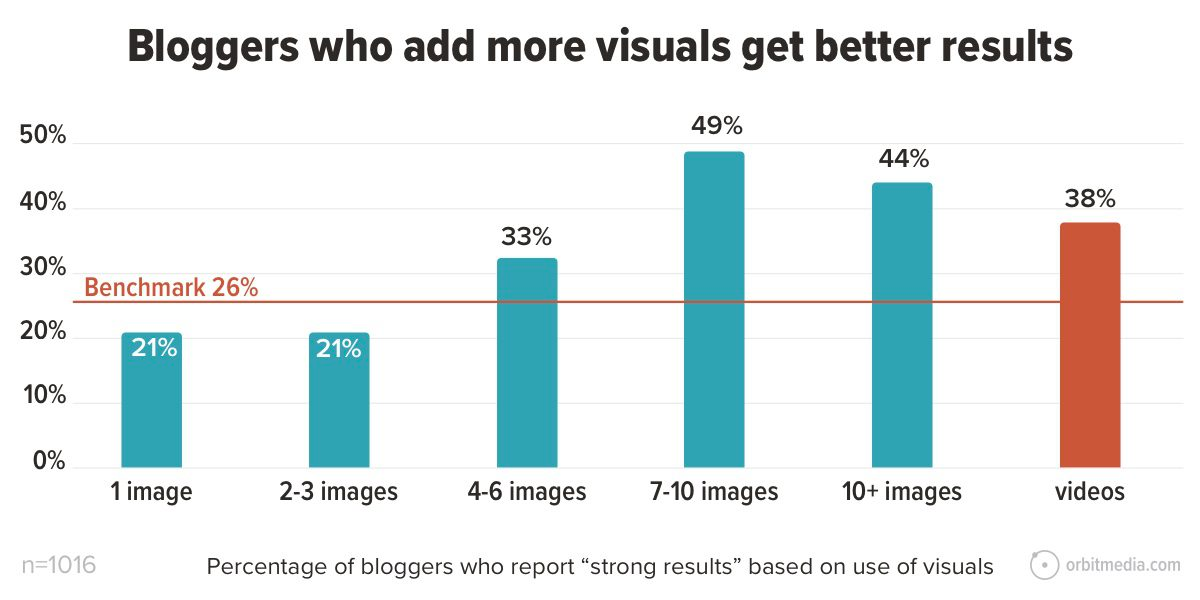
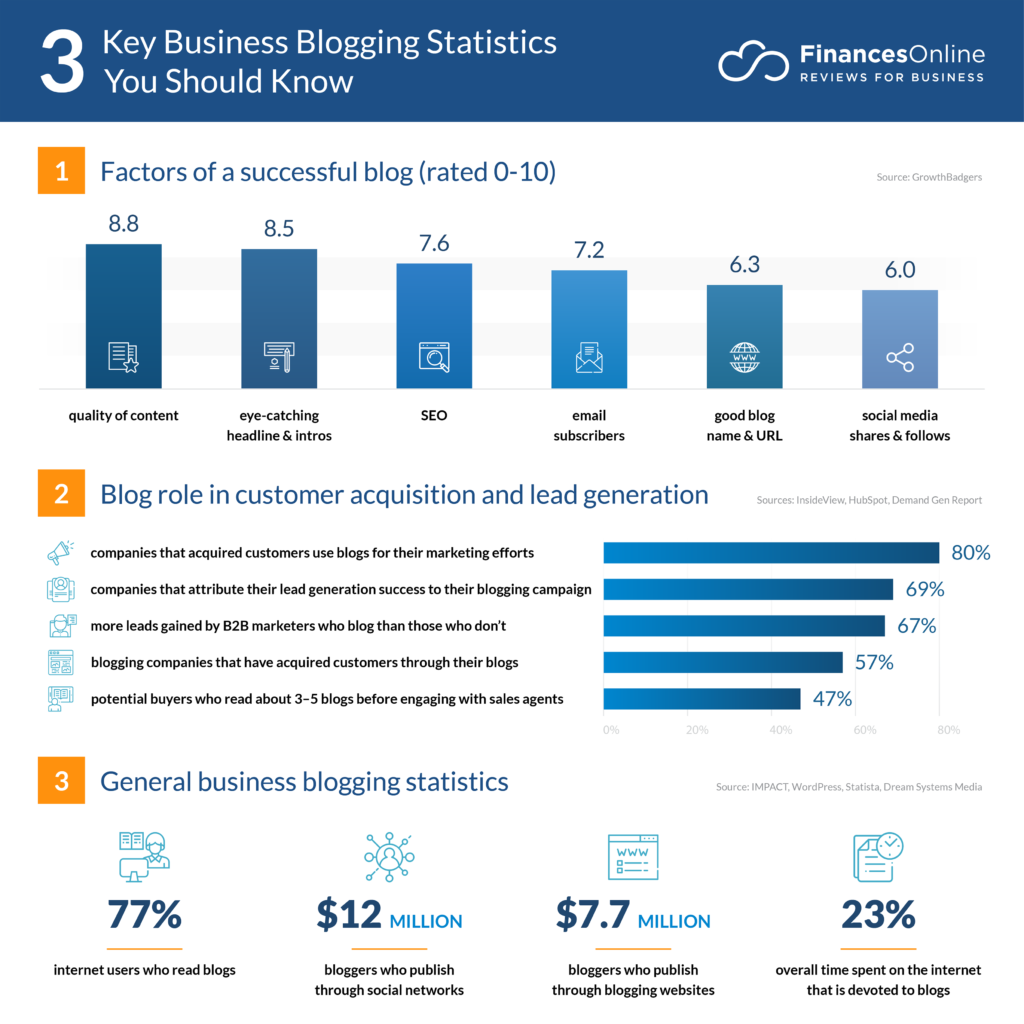
The influence of blogs is substantial, with 77% of internet users regularly reading blog content. Incorporating relevant images can enhance blog views by 94%, and posts with seven or more images are 2.3 times more likely to yield strong results. Furthermore, 70% of consumers prefer learning about companies through articles rather than advertisements, highlighting the trust and engagement blogs foster.
Blogging is extremely beneficial for businesses as well, since those companies which have blogs on their websites receive 55% more traffic to their sites, as well as 67% more monthly leads than other businesses that lack a blog. With internet access, anyone can start a blog and reach a global audience through social media. In this article, we’ll explore blogging statistics in more detail.
Chosen by the Editor
- Most bloggers are young, with over Half falling between the ages of 21 and 35. Men and women blog in nearly equal numbers.
- 16% of bloggers who post videos monthly report “strong results” based on frequency.
- As per RankIQ, food blogs state more than 1 in 10 new blogs.
- Longer blog posts get almost 80% more backlinks than shorter ones. How-to blogs are the most popular type among bloggers.
- According to Fit Small Business, bloggers can make around USD 2,500 per month in their first year.
- As per the Blogging Wizard, search engines are the traffic generators for the highest-ranked and highest-performing blogs.
- According to Ahrefs, there is a balanced relationship between content length and organic traffic, but only up to 2,000 words. For big posts that are more than 2,000 words, there is a balanced negative relationship between word count and organic traffic.
- The profitable days of the week to post blogs are Tuesdays and Wednesdays. The best time to post is between 9:30 a.m. and 11:00 a.m., as per USA East Coast time.
- According to GrowthBadger, 45% of bloggers earning more than USD 50,000 yearly sell their services and products.
- Around 76% of bloggers post educational content, according to the blogging statistics.
- Food blogging has the highest monthly income, USD 9169. During the COVID-19 pandemic, most people watched food blogs.
- Eventually, through podcast video, about 5% of the bloggers earn almost USD 50,000 per year, whereas 1% of the lower-income bloggers earn.
- Market research shows that blogging is a crucial aspect of the digital landscape. Currently, there are over 600 million active blogs worldwide, making up a significant portion of the 1.7 billion websites on the internet.
- Optimization and promotion are key factors in ensuring blog success, as active promotion via various channels is necessary to achieve the desired results.
- Around 37 seconds is the median time the viewers spend reading a blog post, and in addition, 43% of the viewers glide through content rather than reading it fully.
- Business-to-business organizations that have blogged 11 times or more have more than four times as many leads as those that publish just 4 to 5 posts each month.
- In short, the income of the bloggers starts from USD 34,000, but if the content is attractive, it can reach up to USD 362,000, as per Glassdoor.
- According to SEMrush 2024, “Comparison” and “Everything You Need to Know” attract traffic on average, but only 0.4% and 0.8% of articles adopt this content format.
- Companies with blogs receive 55% more website visitors than those without. This increased traffic translates to better visibility and potentially higher conversion rates.
General Blogging Statistics
- According to Blogging Statistics, 70 million new posts are posted on WordPress every month.
- As per a survey, more than 409 million people view almost 20 billion pages every month on WordPress.com.
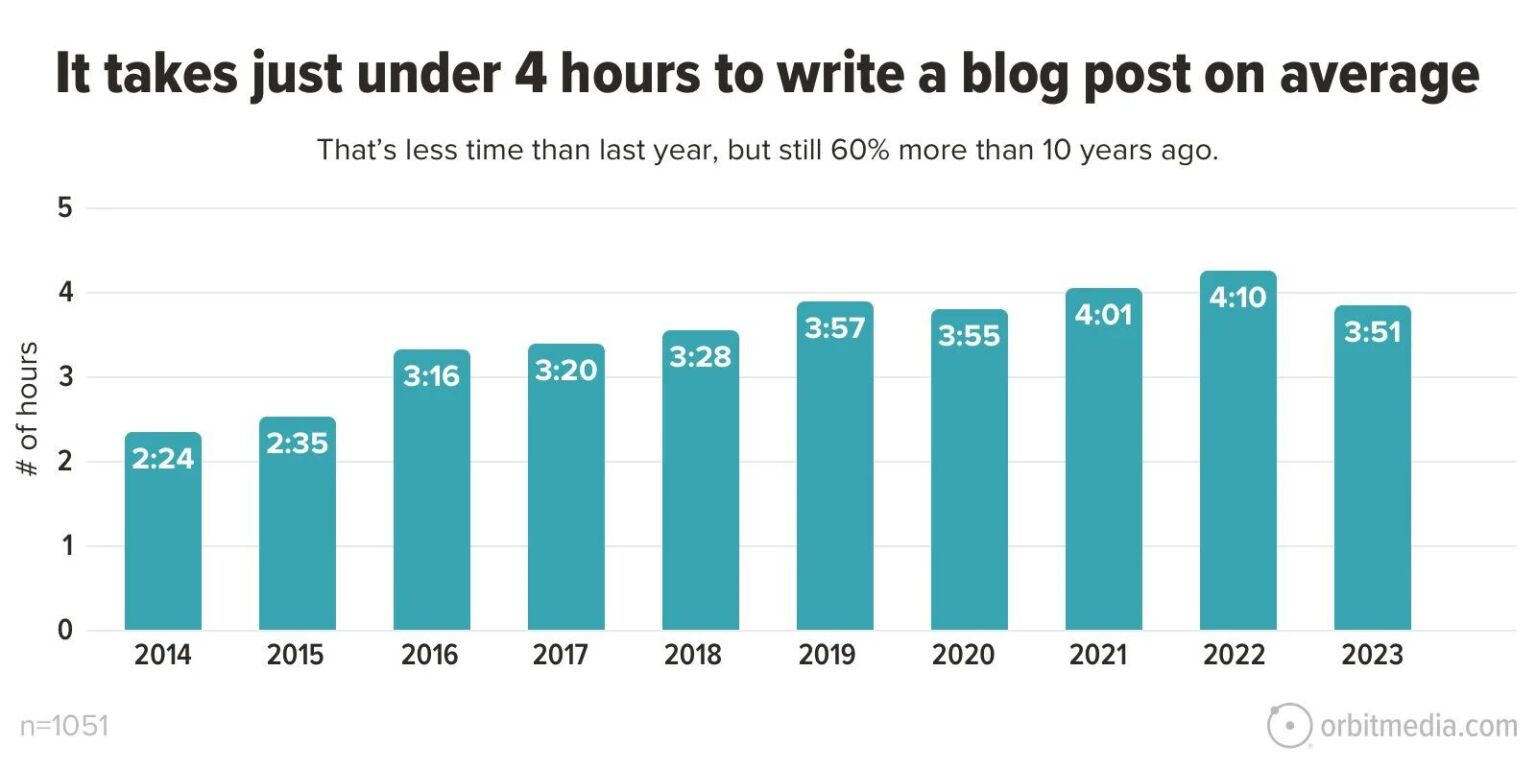
- In the median, it takes almost 3 hours and 48 minutes to write a blog post.
- The median reader spends almost 52 seconds reading a blog post. In 2025, there was almost 600 million blogs globally.
- In 2025, the median/average blog length fell to 1,333 words, down from 1,394 in 2024, continuing a two-year decline rather than holding steady.
- According to Blogging Statistics, 66% of bloggers now publish posts between 500–1,500 words.
- Around 69% of the bloggers state that they have a documented content strategy.
- Virtually 71% of business-to-business buyers have blog content during their customer journey.
- As per W3Techs, WordPress powers almost 43.4% of all websites as of April 2025.
- According to WordPress, around 70 million new posts are posted on WordPress every month.
- WordPress states that 77 million new comments are written in WordPress posts every month.
- According to the Web Tribunal, Tumblr hosts almost 518 million blogs, whereas WordPress has almost 60 million.
- Eventually, through podcast video, about 5% of the bloggers earn almost USD 50,000 per year, whereas 1% of the lower-income bloggers earn.
- Growth Badger states that 2.5 billion blog posts are posted every year globally.
- According to Statista, more than 31 million content creators are publishing at least once a month in the US.
- As per Adobe, 50% of the consumers would discontinue whatever they are doing if there is any trouble while viewing their content.
- According to the Demand Gen Report, 44% of the customers admit that they practically have about three to five blogs before dealing with the vendor.
- As per Report Linker, the global content marketing market is predicted to grow by around USD 584.02 billion from 2023 to 2027.
- According to the Chicago Tribune, around 59% of the links were shared without being read.
- About 74% of content creators use 1 to 3 images in every post, and 2% of bloggers add more than 10 pictures to a typical blog post.
- According to Orbit Media, the bloggers who post the most are likely to report “higher results.”
- Half of the bloggers post weekly or many times every month, as per Orbit Media.
- Almost 85% of the bloggers drive strong marketing results, as per Orbit Media.
- As per the data from Ahrefs, a balanced association exists between the number of words and organic traffic, but it is valid only until 2,000 words.
- If the blog posts are lengthy beyond 2,000 words, then a balanced negative association will exist between the two variables.
Bloggers Who Use Visuals
(Source: hubspot.com)
- In the above chart, we can see that the bloggers who publish more frequently get better results.
- From what we can see above, if the bloggers publish 2 to 6 posts every week, 42% of the bloggers state “strong results” concerning the frequency.
- Among the bloggers who publish videos every week, 29% of the bloggers state “strong results” concerning the frequency.
- 27% of bloggers publishing many videos each month state “strong results” concerning the frequency.
- 16% of bloggers publishing videos each month state “strong results” concerning the frequency.
- The bloggers publishing videos less often than once a month, 17% of the bloggers state “strong results” concerning the frequency.
- Among the bloggers publishing videos regularly, 20% of the bloggers state “strong results” concerning the frequency.
- According to Ahrefs, there is a very strong and positive correlation between the number of words and backlinks but only up to 1,000 words. If the posts are longer than 1,000 words, then there is a strong negative correlation between the number of words and the backlinks.
- According to the statistics, almost 28% of the population of the United Kingdom aged 5 to 18 is blogging.
- According to the Web Tribunal, out of 1.9 billion websites, 600 million of them are blogs.
- Almost 76% of the industries report that content marketing has become more important to their company in the last year.
Blogging Revenue Statistics
- According to Siege Media and Clearscope, almost 29% of businesses state that they are not excelling in content creation.
- Growth Badger states that the most common reason for the blog is to earn money.
- According to RankIQ, the food blog niche was the most profitable in 2022, with almost USD 9169 in revenue every month.
- According to GrowthBadger, 45% of bloggers earning more than USD 50,000 yearly sell their services and products.
- The bloggers earn almost 42.2% of their money from the affiliates.
- Common blog monetisation methods include Google AdSense and other display-ad networks, affiliate marketing, sponsored content, product sales, online courses, subscriptions, and professional services.
- According to GrowthBadger, the most popular monetization method for bloggers is Google AdSense, followed by marketing.
- Most bloggers earn money from advertisements, products, sponsored product reviews, selling their products, and online courses.
- In GrothBadger, 45% of the bloggers who make revenue of more than USD 50,000 each year sell their services or products, whereas just 8% of bloggers with low incomes do that.
Highest Earning Blog Niche Statistics
(Source: wpdeveloper.com)
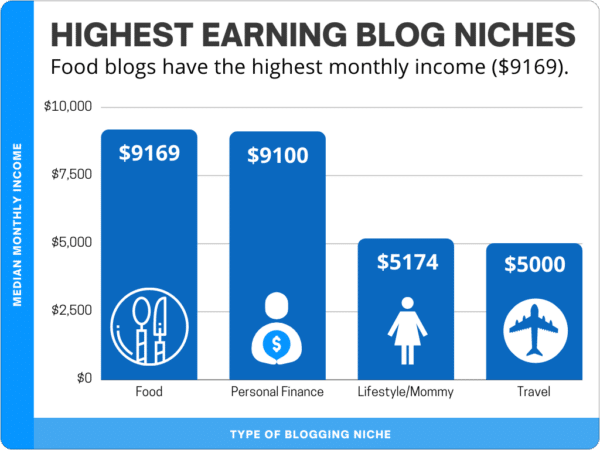
- The above chart shows the highest-earning blog niches, the types of blogging niches horizontally, and the average monthly income vertically.
- Food blogging has the highest monthly income, USD 9169. During the COVID-19 pandemic, most people watched food blogs.
- Personal Finance blogging-related videos earn around USD 9100 monthly, which is nearly equal to food blogging.
- The blogging related to Lifestyle and Motherhood has a revenue of USD 5174 monthly.
- Travel-related blogs earn a revenue of around USD 5000, as per the above chart.
- The different types of niches that have a high rate of blogs, with almost 50,000 sessions every month, are 42.8% food, 13.3% lifestyle, and 10% travel.
Higher Income vs Lower Income Bloggers
(Reference: wpdeveloper.com)
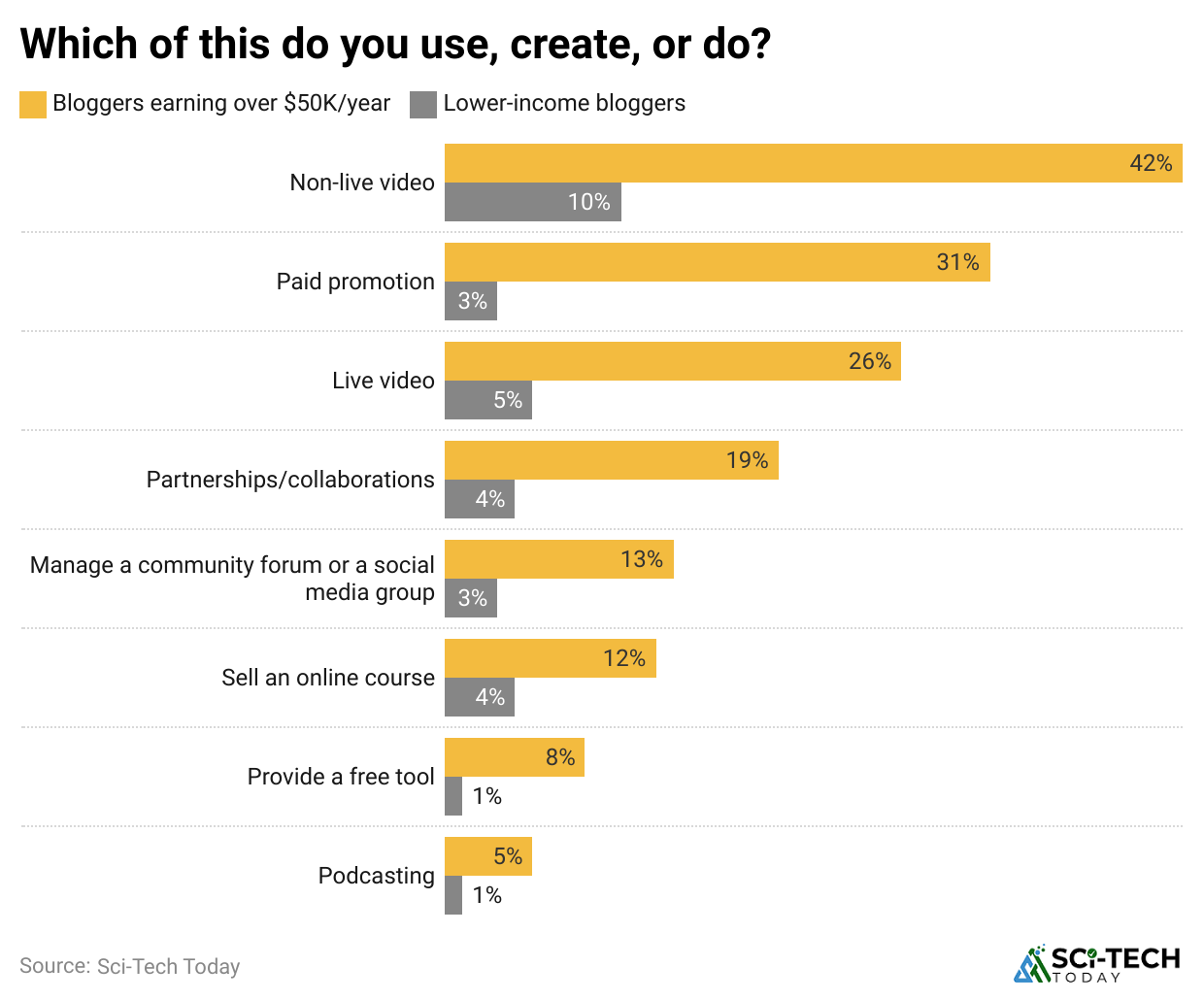
- In the above chart, we can see the difference between bloggers who earn more than USD 50,000 per year and lower-income bloggers, depending on how they are measured.
- Practically, through paid promotion video streaming, about 31% of the bloggers earn almost USD 50,000 per year, whereas 7% of the lower-income bloggers earn.
- About 31% of bloggers earn almost USD 50,000 per year, whereas 5% of the lower-income bloggers earn less.
- Virtually, through live video streaming, about 28% of the bloggers earn almost USD 50,000 per year, whereas 7% of the lower-income bloggers earn.
Average Monthly Income of Blog by Age
(Reference: productiveblogging.com)
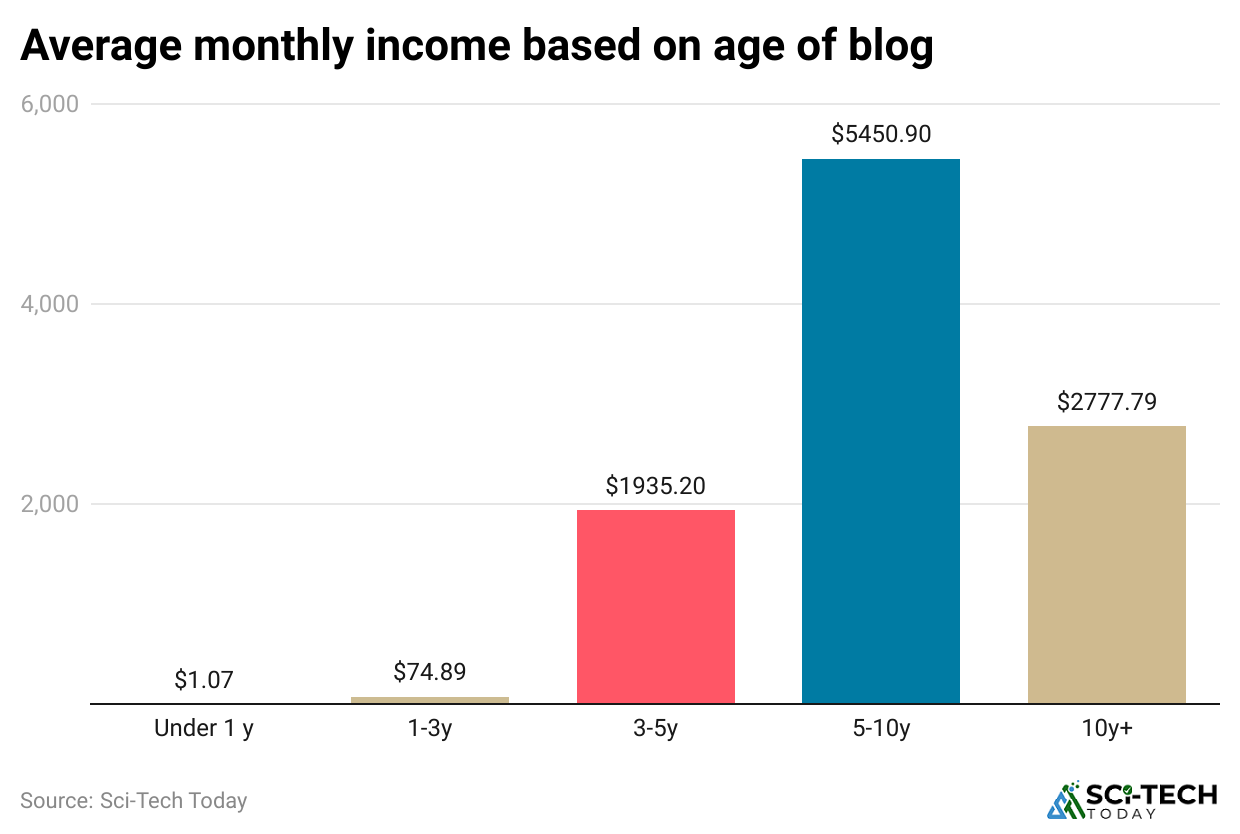
- The chart above shows the average monthly income based on the blog’s age.
- On the horizontal axis, we can see the age of the blog, whereas on the vertical axis, we can see the average monthly income.
- The average monthly income for one year of blogging is around USD 1.07.
- The average monthly income between 1 year to 3 years of blogging is around USD 74.89.
- The average monthly income between 3 years to 5 years of blogging is around USD 1,935.02.
- The average monthly income between 5 years to 10 years of blogging is around USD 5,450.90.
- The average monthly income with 10 years or above of experience is around USD 2,777.79.
- Actually, through partnership or collaboration video streaming, about 19% of the bloggers earn almost USD 50,000 per year, whereas 4% of the lower-income bloggers earn.
- As we can see through managing a community forum or a social media group video streaming, about 13% of the bloggers earn almost USD 50,000 per year, whereas 3% of the lower-income bloggers earn.
- Actually, through selling online course video streaming, about 12% of the bloggers earn almost USD 50,000 per year, whereas 4% of the lower-income bloggers earn.
- Practically, through providing a free tool for video streaming, about 8% of the bloggers earn almost USD 50,000 per year, whereas 1% of the lower-income bloggers earn.
- Eventually, through podcast videos, about 5% of the bloggers earn almost USD 50,000 per year, whereas 1% of the lower-income bloggers earn.
- As of 2025, around 33% of bloggers earned no revenue at all.
- Around 45% of bloggers made under USD 100 per month, while 21% earned between USD 100 and USD 1,000 monthly.
- As per ZipRecruiter, the bloggers make a median yearly salary of USD 62,272.
- According to Productive Blogging 2025, the online industry’s niche is the most profitable blogging category, and personal finance is the second most profitable.
- As per the First Site Guide, almost 38% of the bloggers stated that they had a bachelor’s degree.
Blog Content Statistics
- As per Orbit Media, the median blog post requires nearly 3 hours and 51 minutes for writing.
- As per Orbit Media, the 35% of bloggers spending more than six hours on the average blog post have “strong results.”
- The median length of blog posts is 1427 words, as per Orbit Media.
- Only 3% of the bloggers publish around 2000 words or more word blog posts while other bloggers write blog posts of 500 to 1500 words.
- As per Orbit Media, the longer the average blog post, the more the blogger needs to report.
- Around 76% of bloggers post educational content, according to the blogging statistics.
- Around 25% of bloggers use videos to communicate their messages.
- Nearly 47% of the bloggers are conducting actual research, as per Orbit Media.
- Almost 5 times more bloggers work with an editor currently in 2025.
- According to Siege Media, an organization that spends USD 4000 or more on each post is three times more likely to report its plan as “very successful” than companies spending USD 0 to USD 500.
- 3% of content marketers are creating interactive blogs as part of their advertising strategy.
Average Time Taken to Write a Blog Post
(Source: ahrefs.com)
- The above chart shows the average time taken to write a blog post. The statistics are less than last year’s, but still 60% more than ten years ago.
- The time consistently increased in the graph from 3:48 hours in 2024 to 2:10 hours in 2022.
- Writing time has declined for three consecutive years: to around 3:51 hours in 2023, 3:48 hours in 2024, and 3:48 hours in 2025.
Bloggers Who Use Formal Process to Edit Blogs
(Source: orbitmedia.com)
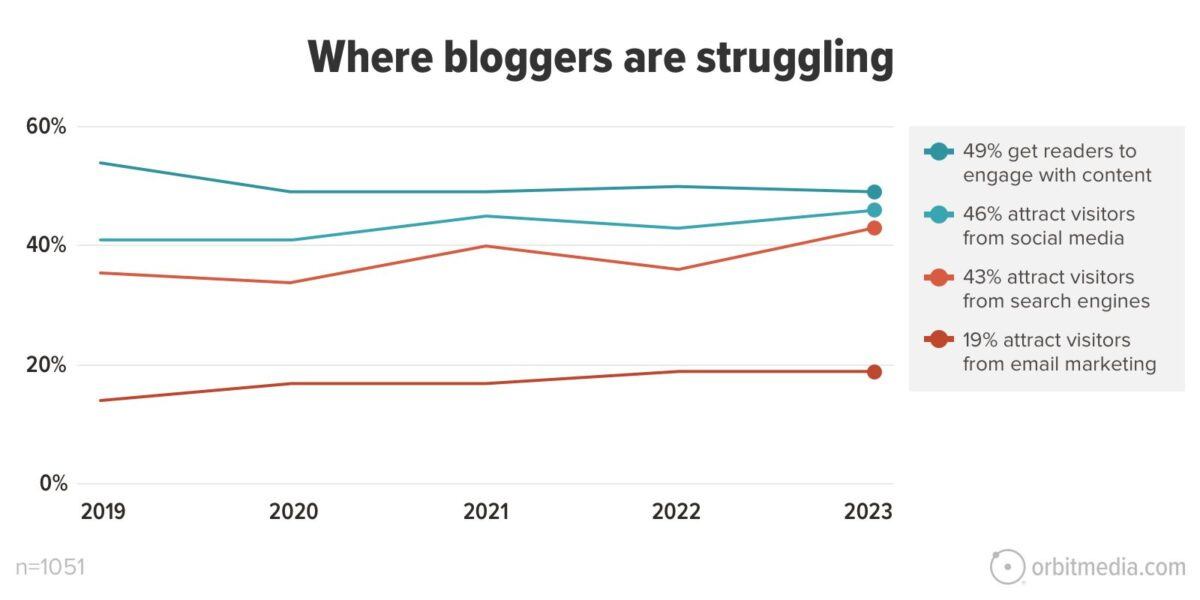
- Collaborating with an editor offsets all the losses. Many successful bloggers collaborate with editors on their blog content.
- But according to the above graph, those bloggers who edit their content using a proper procedure are bound to achieve success because editing plays a huge role.
- The above survey revealed that 57.14% of marketers recycle their blog content as per Right Source.
- According to Blogging Statistics and Findstack, growing brand awareness here, 8 out of 10 consumers think of promotion through their articles rather than advertisements.
Business Blogging Statistics
- Based on market research, blogging has proved to be an important element in the digital world today. At present, there exist over 600 million blogs across the globe. This constitutes a considerable number considering that there are over 1.7 billion websites online today.
- It has been noted that 54% of the Fortune 500 companies adopt blogging as part of their strategies in the business world. This implies that most big organizations recognize the importance of using quality content in building their brands.
- Furthermore, there has been an increase in popularity of blogging as a profession. For example, 32 million people in the United States consider themselves as bloggers. This number is expected to continue growing gradually.
- Blogging helps businesses gain a lot from it. It has been found that companies which blog have 67% more leads compared to those who do not blog.
- However, it’s essential to note that not all blog content receives equal attention. According to HubSpot’s ‘State of Marketing Report [2024],’ 68% of readers admit to skimming blog posts, emphasizing the need for businesses to stay updated on blogging trends to deliver engaging content.
- In terms of the financial aspect, blogging offers significant cost advantages over traditional marketing techniques. Maintaining a blog costs 62% less than traditional marketing methods. This makes it a cost-effective strategy for businesses aiming to reach and engage their audience.
- Furthermore, blogging has a direct impact on consumer behavior.
- Research shows that 60% of customers search for the product after being exposed to its content. Also, 70% of individuals like to learn about the business through the content rather than advertisements.
- Blogs of businesses experience tremendous increase in website traffic. It is seen that websites of firms having blogs get 55% more traffic compared to those without blogs.
(Source: financesonline.com)
- Moreover, blogging enhances lead-generation efforts. Companies that blog experience 126% higher lead growth compared to those that do not. Additionally, marketers who prioritize blogging are 13 times more likely to achieve a positive return on investment.
- Content marketing plays a pivotal role in boosting website conversion rates.
- The research shows that websites using content marketing are six times more likely to experience conversion than sites that are not using such techniques.
- Long-form content is becoming increasingly popular, with blogs of more than 1,500 words getting increased engagement on social media and higher SEO ranking. It is essential for the success of blogs to optimize and promote them through all possible means.
- Lastly, the trend of creating scannable content remains relevant. People prefer content that is easy to skim and digest, emphasizing the importance of structuring blog posts for readability and engagement.
- In summary, market research highlights the significant impact of blogging on businesses, from lead generation and cost-effectiveness to customer engagement and brand visibility.
- Staying abreast of blogging trends and implementing effective strategies is essential for businesses aiming to succeed in the digital landscape.
Blogging SEO Statistics
- According to BrightEdge, 68% of the online experience begins with an engine of search.
- Ahrefs reports that 96.55% of the pages do not generate any organic search traffic from Google.
- On the other hand, only 1.94% of the web pages of the website generate search traffic of one to ten months from Google.
- Top ranking pages generate nearly 49% of the most of the time of search traffic.
- According to Ahrefs, there is a positive correlation between the number of links to a page and the search traffic generated.
- Most companies, roughly 74%, are actively putting money into improving their online visibility through SEO.
- When people search online, they mainly click on the first few results they see. Around 68 cents of every dollar spent on clicks goes to the first five results, while only 4 cents go to results 6–10.
- Longer blog posts get more attention and links than shorter ones. For every 100 links a short post gets, a longer one gets about 77 more.
- Many people, about 60%, write guest blog posts regularly, with some writing as many as 100 posts every month.
- Certain types of content, like “what” and “why” posts and infographics, tend to attract more links than videos and “how-to” guides.
- On the internet, less than 2% of all the content receives links from more than one website, which proves the difficulty of creating quality content.
- The majority, nearly 53%, of the marketers’ efforts are made to feature their content as snippets on Google to make use of such an advantageous spot in search engine results.
- Noteworthy, 37% of the guest bloggers working with content creation are employed by the company while 8% work freelance.
- Just within a year after its publication, only 5.7% of pages on the website can get in top 10 search results.
- The median top-ranked pages are among the top pages in searches of nearly 1,000 other keywords as well.
- No correlation exists between the Flesch Reading Ease and the rank.
- About 68% of the SEOs use the content as a plan to build links.
- According to Orbit Media 2025, SEO has become a very popular way to increase blog traffic in the past years, with almost 71% of bloggers using it.
- According to the survey, almost 45% of bloggers believe that researching and adding keywords to their posts helps them rank their articles.
- According to SEMrush 2024, “Comparison” and “Everything You Need to Know” attract traffic on average, but only 0.4% and 0.8% of articles adopt this content format.
- Around 40% of marketers estimate that AI-commanded search will positively impact their blogs, whereas 68% think that it will help them attract more readers.
Blogging Length and Frequency Statistics
- According to Orbit Media, Blog posts of at least 2,000 words make a strong result for about 55% of bloggers.
- As per Backlinko, the blog posts they have made have up to 77.2% more inbound links compared to the short blog as per the blogging statistics.
- According to Express Writers, the best blog post headlines contain 6 to 13 words.
- The average time taken by the readers to read a blog post is 37 seconds, and in addition, 43% of the readers skim rather than reading the content fully.
- As per HubSpot, companies with at least 16 blog posts have higher traffic compared to those that have a low number of blog posts.
The following are the effectiveness of Publishing Blogs:
| Effectiveness | Value |
| Blog delivering strong results | 54% |
| Some results | 26% |
| Unsatisfied results | 11% |
| No idea if the blog delivers a result | 9% |
- As per Backlinko, the blogs are posted have up to 77.2% more inbound links than the short blog, as per the blogging statistics.
- According to Express Writers, the most successful blog titles are between 6 and 13 words.
- Around 37 seconds is the median time the viewers spend reading a blog post, and in addition, 43% of the viewers glide through content rather than reading it fully.
- According to HubSpot, organizations with about 16 or more blogs have more traffic than organizations with very few blog posts.
The following are the frequencies of Publishing Blogs:
| Frequency of Posting | Percentage |
| Daily | 2% |
| 2-6 posts every week | 12% |
| Weekly | 24% |
| Several per month | 24% |
| Monthly | 18% |
| Less than monthly | 6% |
| Irregular Intervals | 14% |
- According to Orbit Media, the average length of the blog post is close to 1376 words.
- Only 1% of bloggers publish posts multiple times per day, while 3% publish once per day and 61% publish once per week.
- According to Orbit Media, it takes the blogger nearly 4 hours to write a post and nearly 74% more.
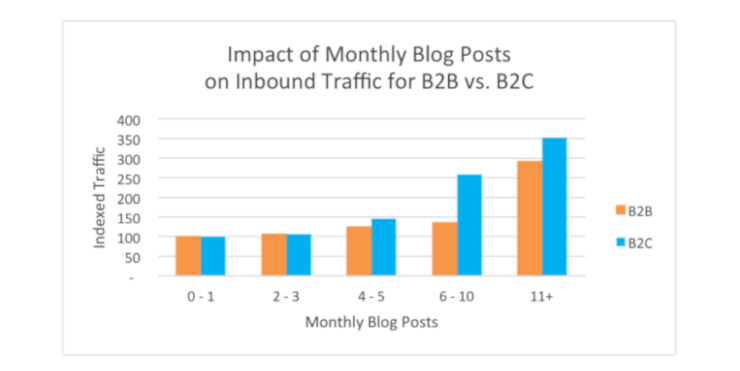
- The above graph indicates the effect of the blog post monthly on inbound traffic for B2B and business-to-customer.
- According to BlogTyrant, if you post a blog once or twice a week or even a month, you will write slightly in depth about the topic.
- HubSpot claims that B2B bloggers who blog at least 11 times or more each month get three times the amount of traffic and response compared to those B2B bloggers who blog once each month.
- B2B firms who blog 11 times or more have more than four times the leads than those B2B firms who publish 4 to 5 posts each month.
- The firms which blog at least 16 or more times each month receive 3.5 times more traffic compared to those which blog 0 to 4 times each month.
- Almost 69% of the bloggers generate their blog content during business hours and 76% of the bloggers generate their blog content from their home or home office.
- Wednesdays and Tuesdays are profitable days of the week for blogging. The optimum time for posting blogs is 9:30 a.m. to 11:00 a.m. according to East Coast Time USA.
- According to Monster Insights, Blog Reading Hours are 9:00 a.m. to 10:00 a.m.
(Source: isitwp.com)
Bloggers’ Demographics and Traffic Statistics
- According to First Site Guide survey, nearly 52.43% bloggers are male, whereas only 47.38% are female bloggers.
- As per Finances Online, nearly half of all bloggers are between 21 to 35 years of age.
- The bloggers above 50 years of age only constitute just 7.1%.
- According to Blogging Statistics, nearly 37.57% of bloggers hold a Bachelor’s degree.
- The median salary in the blogging market is around USD 79.833 every year.
- In short, the income of bloggers starts from USD 34,000, but if the content is attractive, it can reach up to USD 362,000, as per Glassdoor.
- Finances Online reports that about 16.8% of the readers belong to the age range of 25-30 years and about 29.4% are 31-40 years old. 24% of Generation X belonging to the age range of 41-50 years form the second largest group of blog readers.
- According to Conbert Kit, childless bloggers are 35% more likely to be self-employed.
- According to the statistics from Orbit Media, 54.2% of bloggers receive good advertising outcomes from blogging.
- As per Statistics, a great 90% of bloggers depend on social media to develop their posts.
How Bloggers Promote Blog Posts?
(Source: truelist.co)
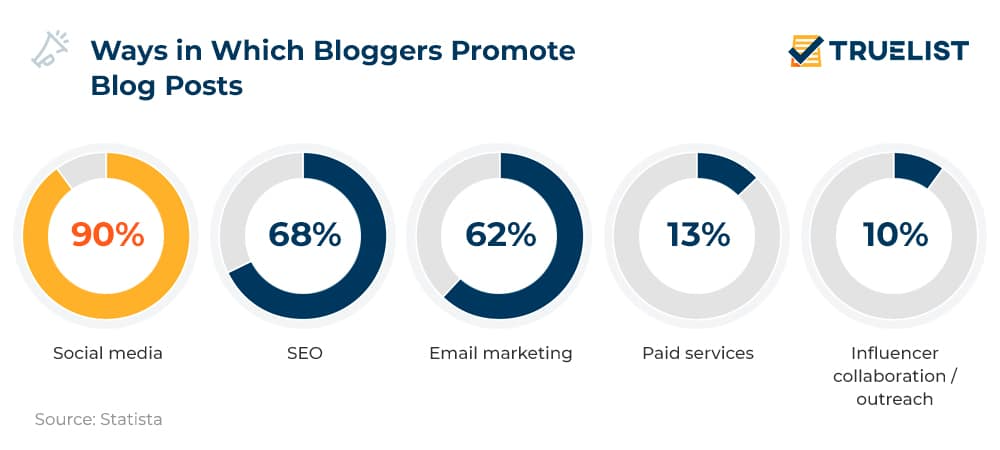
- According to the chart above, 90% of the bloggers advertise their blog posts via social media, 68% through SEO, 62% through email marketing, 13% through paid services, and 10% through influencer marketing.
- According to Ryan Robinson, blog traffic statistics reveal 30% growth after posting 12 to 54 blog posts.
- According to TechClient, the chances for a website with a blog to rank high in search engine results are almost 434%.
How Many Visits an Average Blog Get?
(Reference: truelist.co)
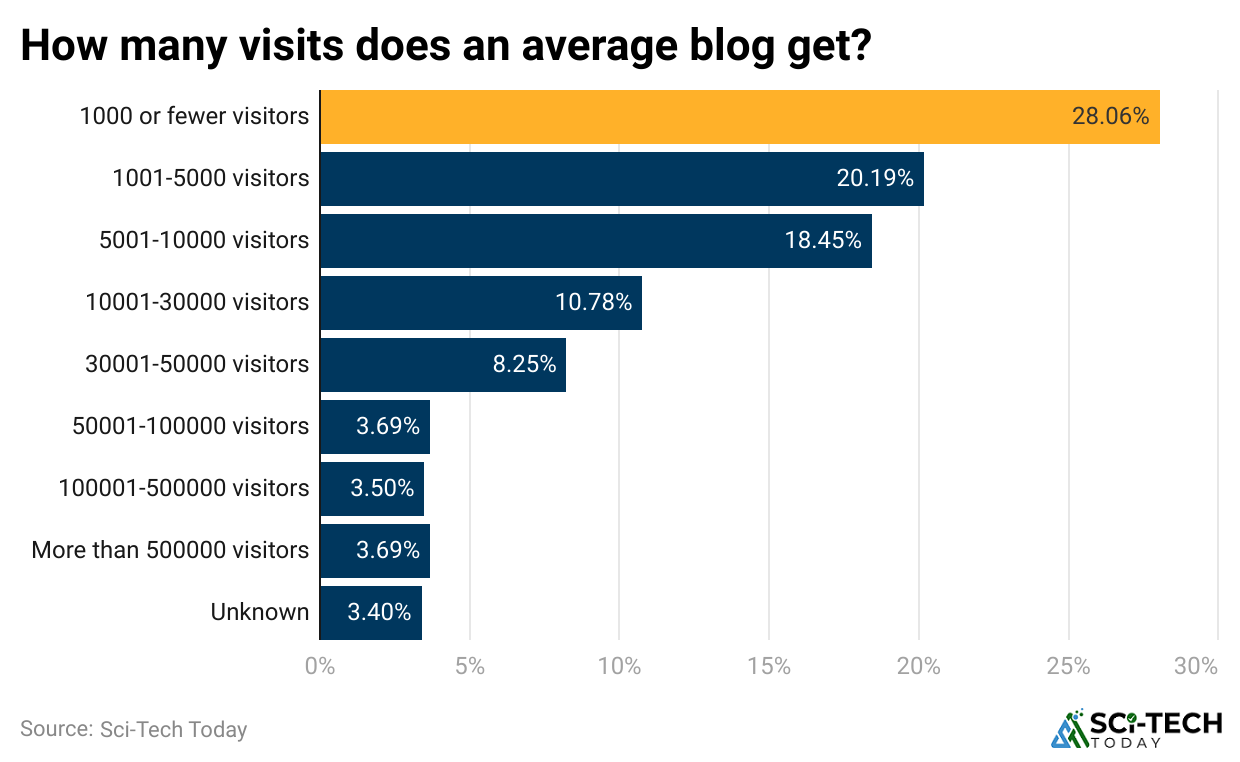
- In the above chart, we can observe how many visits an average blog gets.
- Some 28.06% of visits are performed by 1000 or less people.
- The blogging stats show that nearly 20.19% of visits are done by 1001 to 5000 visitors.
- Omni Monster has surveyed that the blog post titles should include words from 6 to 13 in order to generate lots of traffic.
- As per QuoraCreative, more than 40% of the blog traffic is generated by aggregating blog posts.
- As stated by Oberlo, 86% of buyers make use of blogs for purchasing content.
- According to Statista, some 32% of the bloggers constantly check out the analysis of their traffic.
- According to HubSpot, blogging 3 to 4 times in a week is one of the ways to grow your traffic and increase brand awareness.
- Just 3.69% of blogs have above 500,000 visits in a month, as per First Site Guide.
- According to the Blogging Wizard, the traffic sources like search engines are the most ranked ones for ranking blogs.
- According to TwinsMommy, knowing your target visitors may help you get 488% traffic increase.
What is the Rate of Successful Blogs?
- As many as 25% of the bloggers state that they make a full-time income, and many even claim to earn almost USD 100,000.
- According to Tech Jury, 33% of bloggers do not make any money from their blogging.
- Less than 1% of bloggers make more than USD 1 million every year.
- According to RankQI, the two most famous advertisement management organizations are Mediavine and Adthrive.
- According to Orbit Media, bloggers who work through editors are about 90% more likely to gain popularity and views.
- The food blog niches account for the majority of every monthly session, 42.8%, with almost 50,000. Lifestyle blogs are second with 13.3%, and travel blogs are third with 10%.
- According to RankIQ, food bloggers earn more money than bloggers in any other main niche, with an average monthly salary of USD 9,169.
- Personal finance bloggers have a median monthly salary of USD 9,100, which also adds around USD 109,200 each year.
- The Lifestyle and the motherhood blogs make around USD 5,100 every month.
- The travel bloggers have an average income of USD 5,000 to USD 60,000 every year.
- Among all the other blogs, Lifestyle blogs cost almost 25 USD for all the latest blogs.
- Travel blogs make up almost 1 out of 5 new blogs.
- As per RankIQ, food blogs state more than 1 in 10 new blogs.
- High-salary bloggers are four times more likely to use keyword research.
- The blogs can make almost USD 100 for every view of a page.
- The median bloggers earn almost USD 8,000 every month, as per Semrush.
- According to Fit Small Business, bloggers can make around USD 2,500 per month in their first year.
Statistics About Writing Blog Posts
- Many bloggers find it hard to maintain their content. Around 38% of them face this problem.
- Bloggers tend to be youthful, and around 50% of them belong to age groups ranging from 21 to 35 years old. Blogging does not depend on gender; men and women equally engage in this activity.
- Creating content becomes difficult for many bloggers, and almost half of the bloggers face this challenge. Webinars are not very popular among bloggers; only 25% of them create webinars in a year.
- All bloggers make use of social media platforms to generate readership. Almost half of the bloggers get other people to write guest blogs for them.
- Average time to write a blog post is slightly more than 4 hours.
- Long blog posts (more than 1,700 words) receive better results.
- However, most readers prefer to read shorter posts (less than 1,000 words). Traffic to the blog can increase by 94% by including photos in the blog posts.
- Posts with at least seven photos get over 100% more attention than those without. Many readers want to see more video content.
- Shorter headlines, around 6 to 8 words, can increase clicks by 21%. Three in five readers will share blog content on social media without reading it first.
- Blogs are shared nearly ten times more than those of businesses 30% of the readers like blog posts that have numerals in their titles.
- Question marks make titles get nearly 25% more shares. 32% of the readers consider accuracy of information important.
- Many people like blogs that are authored by several writers. Posting blogs frequently, that is, almost 16 times in a month can result in nearly five times more leads.
- Longer blog posts get almost 80% more backlinks than shorter posts. How-to blogs are the most liked blogs by bloggers.
The End
Most of the interest has been in blogging statistics. Now that we have the information about the challenges, the cost of preparing a blog, and also the views, we predict that we will all be able to craft an even more successful blog. The growth and loss of blogging have been a hard journey in a field with unknown ups and downs. Whether you are an experienced blogger or just a beginner, it’s essential to focus on providing high-quality content and also make use of modern techniques to deliver better video quality and attract the audience.
The blogging world is continuously experimenting, but if bloggers follow the correct approach, the sky is the limit for them.
FAQ
Blogging is the act of writing, updating, and publishing content on a digital journal or informational website. Posts usually appear in reverse chronological order, meaning the newest article shows up first on the page.
Yes, bloggers do get paid money, but earnings vary widely. While some treat blogging as a hobby, successful professional bloggers make money by driving large amounts of web traffic and using strategic monetization methods.
On average, bloggers earn between USD 2 and USD 25 per 1,000 views (known in the industry as RPM, or Revenue Per Mille) if they rely solely on basic display advertisements. However, depending on your niche and how you monetize, that number can range anywhere from USD 0.20 to over USD 200+ per 1,000 views.

Sources