





Introduction
Customer Relationship Management Statistics: For decades, Customer Relationship Management CRM platforms were viewed primarily as digital desktops. They were sophisticated databases for storing contact information and logging sales calls. Even 2 years back, I worked in sales and had fun with the CRM tools.
In 2025, that perception has become like a liability. The conversation around CRM has fundamentally changed. It is no longer a question of whether a business should adopt a CRM, but how it can use the platform’s capabilities to its competitive advantage.
Today’s CRM has evolved into the engine powering the world’s most successful businesses. It is the central nervous system that connects sales, marketing, and customer service, changing the numbers into insights.
The infusion of Artificial Intelligence AI has moved CRM from a passive tool to an active participant in the revenue-generation process for any business. So I’d like to discuss further about customer relationship management in this data-oriented article.
They highlight key areas of growth, the financial returns, and the critical challenges that organizations must navigate. So, let’s have a complete walk around of the stats.
Editor’s Choice
- The global market size is projected to surge from $75.1 billion in 2023 to an estimated $248.2 billion by 2033.
- This growth is driven by a powerful Compound Annual Growth Rate CAGR of 7% from 2024 to 2033.
- Cloud-Based CRM is the dominant mode, capturing over 3% of the market share in 2023.
- Large Enterprises account for the largest share of spending, capturing over 2% of all CRM spend in 2023.
- The BFSI Banking, Financial Services, and Insurance sector leads all end-use industries, securing over 23% of the market in 2023.
- Customer Service is the most dominant solution type, capturing over 5% of the market in 2023.
- North America remains the primary market, holding a dominant 9%+ share in 2023. The average ROI for CRM is $8.71 for every $1 spent.
- Businesses that effectively implement a CRM see an average 29% increase in sales revenue.
- A well-utilized CRM can increase lead conversion rates by up to 300%.
- Sales team productivity receives an average 34% boost from CRM adoption by automating administrative tasks.
- Sales cycles are typically reduced by 8% to 14% due to better data accessibility and intelligent conversations.
- Businesses that use generative AI in their CRM are 83% more likely to exceed their sales goals.
- 65% of businesses have already adopted CRM systems that incorporate generative AI features.
- AI-powered solutions lead to 30% to 50% faster response times to customer inquiries.
- Integrating AI leads to a 15% increase in repeat sales and customer retention by predicting churn and identifying upsell opportunities.
- The dedicated market for AI within CRM is expected to be an $11.04 billion market on its own in 2025.
- 65% of salespeople who use a mobile CRM achieve their sales quotas, compared to only 22% of those who do not.
- Businesses leveraging mobile CRM are 150% more likely to exceed their sales goals.
- 70% of businesses are actively using mobile CRM systems as a core part of their sales strategy.
- 81% of CRM users now access their system from multiple devices, demanding a seamless mobile experience.
- Over 68% of companies now report that they compete primarily based on customer experience.
- A CRM system can increase customer retention by up to 27%.
- 47% of CRM users report that their system has a significant impact on customer satisfaction.
- 79% of customers expect a consistent, seamless experience across all communication channels.
- 80% of consumers are more likely to purchase from a company that delivers a personalized experience.
- Between 30% and 50% of all CRM projects fail to meet expectations or fail.
- Less than 40% of companies have achieved user adoption rates of over 90%.
- 17% of salespeople cite manual data entry as their single biggest CRM challenge.
- 37% of CRM users reported losing revenue as a direct consequence of poor data quality.
The Growth of the CRM Market
 (Source: market.us)
CRM Market Forecast
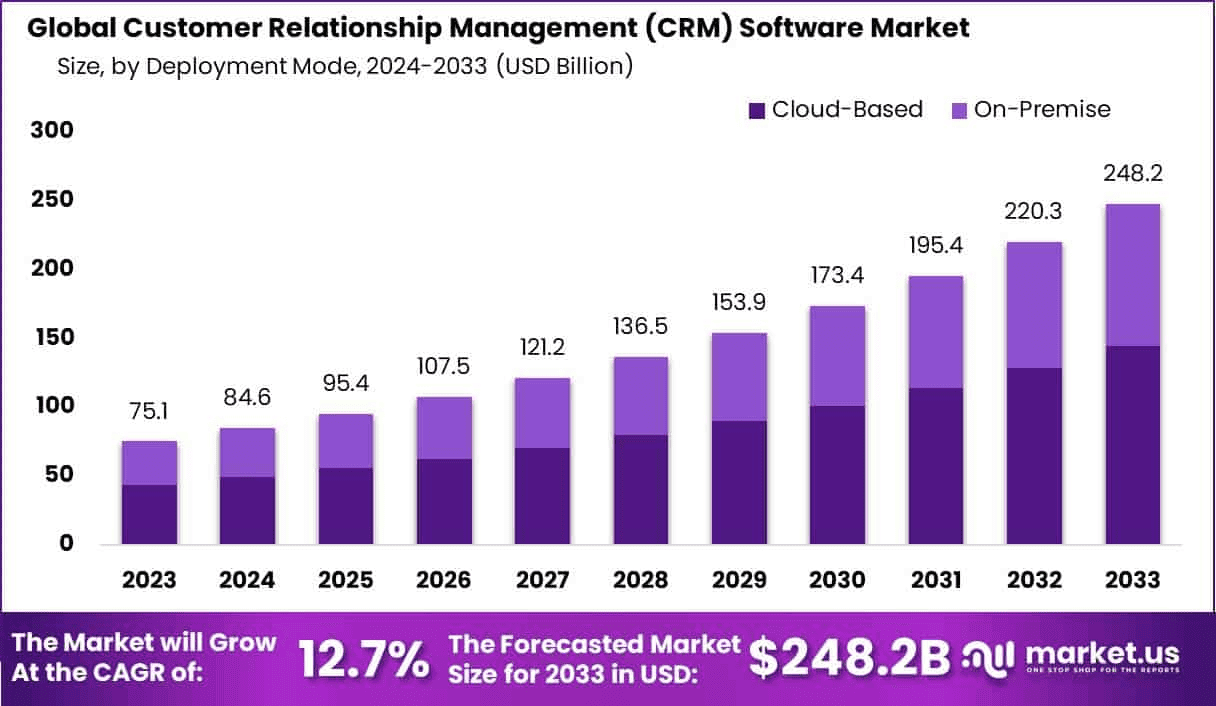
According to Market.us, the customer relationship management CRM software market is experiencing explosive growth. It’s on a clear path to more than triple in value over the next decade.
- The global market is projected to surge from $75.1 billion in 2023 to an estimated $248.2 billion by 2033.
- This rapid expansion is driven by a powerful and steady compound annual growth rate CAGR of 12.7%.
- In the immediate term, the market is expected to hit $84.6 billion in 2024, showing significant YOY
- At its heart, CRM software is the central tool businesses use to manage and analyze every customer interaction, streamlining sales, marketing, and service to boost satisfaction and retention.
2023 CRM Market Dominators
A quick look at the 2023 data shows a clear picture of what businesses are prioritizing right now:
- Customer Service was the most dominant segment, capturing over 24.5% of the market.
- Cloud-Based CRM is the undisputed king, holding more than 58.3% of the market share.
- Large Enterprises were the biggest adopters, accounting for over 63.2% of all CRM spending.
- The BFSI Banking, Financial Services, and Insurance sector led the charge, securing over 23% of the market.
Regional Dominance and Key Players
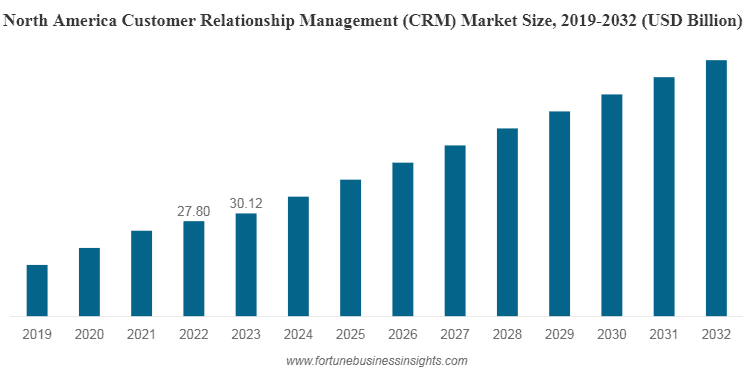
North America is the clear market leader, holding a dominant 37.9% share in 2023. This is driven by the region’s advanced technological infrastructure and the early, widespread adoption of customer-centricity by its highly competitive businesses.
The market is led by a mix of tech giants and specialized developers, including:
- Salesforce Inc.
- Oracle Corporation
- SAP SE
- Adobe Inc.
- HubSpot
- Freshworks Inc.
- Zendesk Inc.
- Zoho Corporation
| Key Market Data Point | Value / Finding |
| 2023 Market Size |
USD 75.1 Billion |
|
2033 Projected Size |
USD 248.2 Billion |
| Forecasted CAGR 2024 to 2033 |
12.7% |
|
Leading Regional Market 2023 |
North America $37.9%+ Share |
| Leading Solution Type 2023 |
Customer Service 24.5%+ Share |
|
Leading Deployment Mode 2023 |
Cloud-Based 58.3%+ Share |
| Leading Enterprise Size 2023 |
Large Enterprises 63.2%+ Share |
|
Leading End-Use Industry 2023 |
BFSI 23%+ Share |
ROI Driving Revenue and Productivity
 (Source: orgzit.com)
- The average ROI for CRM is $8.71 for every $1 spent. When properly implemented and adopted, this ROI can skyrocket, with some analyses showing returns as high as 245%.
- Businesses that effectively implement a CRM system see an average increase of 29% in sales revenue.
- A well-utilized CRM can increase lead conversion rates by up to 300%. Sales productivity gets an average 34% boost from CRM adoption.
- Teams using a CRM report that their sales cycles are reduced by 8% to 14%, as reps have a 360-degree view of the customer for more intelligent and timely conversations.
- A CRM moves sales forecasting from an art to a data-driven science. Companies using CRM report an average increase of 32% to 42% in sales forecasting accuracy.
- The people on the front lines agree. A significant 97% of sales teams in the US and Canada state that their CRM system is important or very important in their ability to close deals.
| Metric | Key Statistic |
| Average ROI | $8.71 per $1 spent |
| Sales Revenue | 29% average increase |
| Lead Conversion | Up to 300% increase |
| Sales Productivity | 34% average boost |
| Sales Cycle | 8 to 14% shorter |
Artificial Intelligence-Driven CRM
 (Reference: market.us)
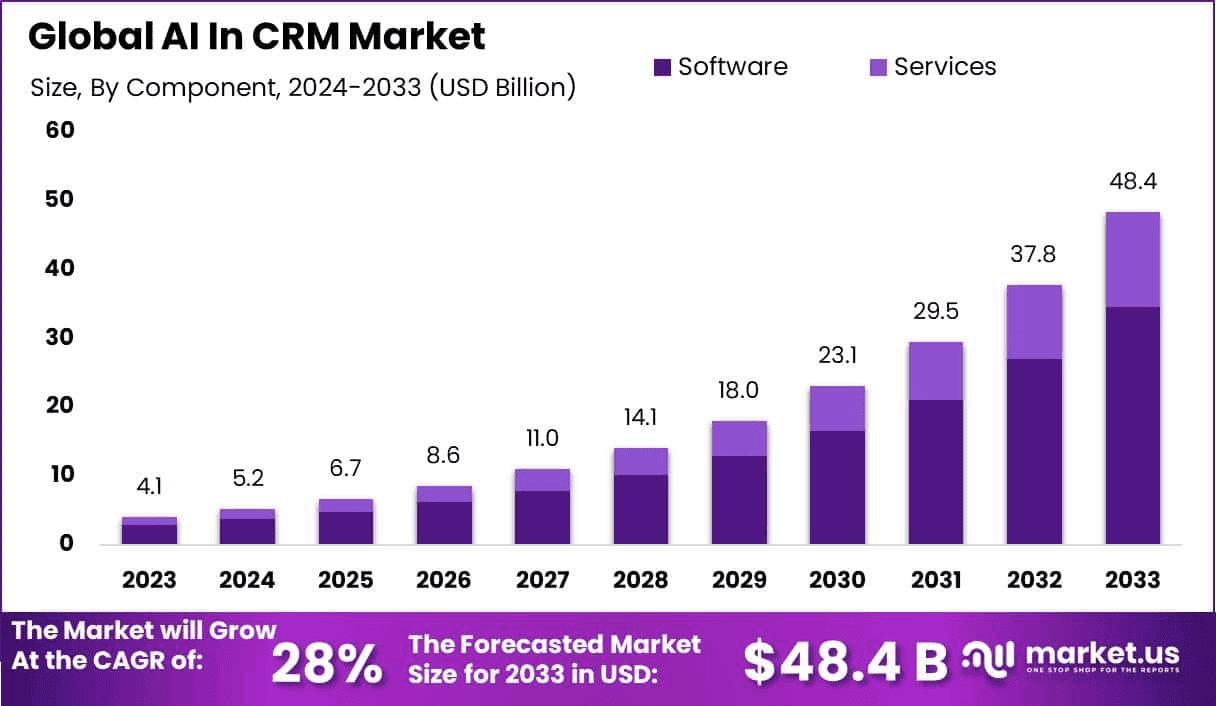
- The market for AI within CRM is a testament to this shift, expected to be an $11.04 billion market on its own in 2025.
- The adoption rate is, with 65% of businesses having already adopted CRM systems that incorporate generative AI features.
- Businesses that use generative AI in their CRM are 83% more likely to exceed their sales goals.
- AI-driven predictive lead scoring, which ranks leads based on their likelihood to convert, can increase conversion rates by up to 20% and improve forecast accuracy by over 40%.
- Companies using AI-powered CRM solutions report 30% to 50% faster response times to customer inquiries.
- Integrating AI and CRM leads to a 15% increase in repeat sales and customer retention, as AI can predict churn risk or identify the next best upsell opportunity.
- 61% of companies that do not currently use AI in their CRM plan to integrate it within the next three years, showing a clear consensus on its necessity.
- 65% of businesses report better engagement results with prospects and customers thanks to AI-powered virtual sales assistants that can draft emails and summarize meetings.
| Metric | Key Statistic |
| Impact on Sales Goals | 83% more likely to exceed quota |
| AI Adoption Rate | 65% of businesses |
| Service Response Time | 30 to 50% faster |
| Customer Retention | 15% increase in repeat sales |
| AI Market Size in CRM | $11.04 Billion in 2025 |
The Mobile-First Mandate CRM
 (Source: superoffice.com)
- The 65% vs. 22% statistic is the entire story: a sales rep with a mobile CRM is nearly three times more likely to succeed than one chained to a desktop.
- 70% of businesses are actively using mobile CRM systems as a core part of their sales strategy.
- Businesses that leverage mobile CRM platforms are 150% more likely to exceed their sales goals.
- 81% of CRM users now access their system from multiple devices, including laptops, smartphones, and tablets
- 50% of sales teams report that their productivity has improved significantly by using a mobile CRM.
| Metric | Key Statistic |
| Quota Attainment | 65% Mobile vs. 22% No Mobile |
| Likelihood to Exceed Goals | 150% more likely |
| Multi-Device Access | 81% of users |
| Reported Productivity | 50% of teams see improvement |
| Business Adoption | 70% of companies |
Enhancing Customer Experience and Retention
 (Source: keywordseverywhere.com)
- Today, more than two-thirds of companies, over 68% report that they now compete primarily based on customer experience. This is a dramatic increase from just 36% a decade ago.
- A CRM system can increase customer retention by up to 27%. It achieves this by unifying data from every touchpoint.
- 47% of CRM users say that a CRM system has a significant impact on customer satisfaction, with 75% of organizations using CRM reporting overall improvements.
- 79% of customers expect a consistent, seamless experience across all channels: web, social, email, phone.
- 80% of consumers are more likely to purchase from a company that delivers a personalized experience.
- 74% of CRM users say their system has given them improved access to customer data, allowing them to solve problems faster and without asking for information the customer has already provided.
| Metric | Key Statistic |
| Primary Basis of Competition | 68% of companies |
| Customer Retention | Up to 27% increase |
| Omnichannel Demand | 79% of customers |
| Personalization Impact | 80% more likely to buy |
| User-Reported Satisfaction | 47% see a significant impact |
CRM Overall Adoption and Challenges
 (Source: pipelinecrm.com)
- Depending on the study, between 30% and 50% of all CRM projects fail to meet expectations or fail.
- The number one reason for failure is low user adoption. While 91% of companies have a CRM, less than 40% of those companies have achieved user adoption rates of over 90%.
- In fact, 17% of salespeople cite manual data entry as their single biggest CRM challenge. This is a key reason reps stop using the system.
- A concerning 37% of CRM users reported losing revenue as a direct consequence of poor data quality.
- Over 50% of failed projects are attributed to a lack of cross-functional coordination and a failure by management to define why the CRM is being implemented.
- 31% of SMEs cite the cost of a CRM as a major challenge, while 27% point to user adoption issues and 30% struggle with data migration.
| Metric | Key Statistic |
| Project Failure Rate | 30% to 50% |
| Low User Adoption | 40% of companies have 90% adoption |
| Biggest Rep Complaint | 17% Manual Data Entry |
| Revenue Loss from Bad Data | 37% of users |
| Reason for Failure | 50% |
Key CRM Trends for 2026 and Beyond
 (Source: fortunebusinessinsights.com)
- This is about leveraging real-time behavioral data to trigger highly contextual outreach. Think automated emails when a prospect revisits a pricing page or onboarding flows based on specific feature discussions.
- Businesses are increasingly opting for CRMs pre-configured for their unique workflows, data models, and compliance.
- For example, HIPAA-compliant templates for healthcare or project-based CRMs for construction are growing much faster than generic platforms.
- This trend empowers non-technical users, like sales operations managers, to customize and extend their CRM.
- They can use intuitive drag-and-drop interfaces to build workflows, dashboards, and forms without coding, which reduces reliance on IT by over 50%.
- The scope of CRM is expanding to encompass the entire customer journey. This means integrating functionality for customer onboarding, support ticketing, success management, and renewals directly into the platform, creating a single source of truth for Customer Lifetime Value LTV.
| Trend | What It Is |
| Hyper-Personalization | Using behavioral data to automate highly relevant outreach. |
| Vertical CRM | Industry-specific platforms e.g., for healthcare, finance. |
| Low-Code / No-Code | Drag-and-drop tools to build custom workflows without coding. |
| Full-Lifecycle CXM | A single platform managing the entire customer journey, from lead to renewal. |
Conclusion
Overall, these customer relationship management statistics give us a clear picture. In 2025, a CRM is the command center for sustainable business growth. The market’s relentless expansion, now valued at over $112 billion, confirms its universal importance. The average ROI of $8.71 for every dollar spent proves its profound financial impact.
The fact that businesses using AI in their CRM are 83% more likely to exceed their sales goals is a clear signal that we have entered a new era. This is the age of the AI customer relationship.
Furthermore, the direct correlation between mobile CRM usage and a 65% quota attainment rate underscores that this intelligence must be accessible anywhere, anytime. Ultimately, these advancements all serve a single, timeless business principle: the customer comes first. So, I hope you guys like this piece of content. If you have any questions, kindly let us know in the comments section. Thanks for staying up till the end. We appreciate your effort.