








Introduction
Dodge Statistics: Dodge rolled into 2026 during one of the biggest shifts in its modern timeline. The American performance badge seemed to back away from the usual V8 muscle-car vibe, and sort of pivoted toward a fresher chapter that leans on electrification, turbocharged grunt, and a lot more smart-vehicle tech.
After the older Charger and Challenger wrapped up their run, Dodge’s lineup got pretty tied to three main players: the Durango SUV, the new Charger Daytona EV, and the Charger SIXPACK. Even so, 2025 volumes dropped pretty sharply, but Dodge still showed up as one of the more recognizable performance brands across North America.
In 2026, the plan is mostly about rebuilding market share, improving profitability, and trying to keep internal-combustion thrills in the mix while also pushing electric mobility, all while using Stellantis’ global tech and manufacturing muscle. This article will present the recent Dodge automotive statistics and its market trends.
Editor’s Choice
- Dodge moved 22,693 vehicles in Q1 2026, and the Durango did most of the heavy lifting with roughly 20,300 units.
- The Durango alone made up nearly 90% of Dodge’s Q1 2026 total sales.
- Durango sales were up 48% year-over-year in Q1 2026, which translated to about 6,600 more units.
- The redesigned Charger posted fewer than 1,700 sales in Q1 2026, even though it grew 59% YoY.
- Outside of the Durango, non-Durango models only added 2,393 sales, so, well under 10% of Dodge’s quarterly volume.
- Dodge’s estimated U.S. market share landed somewhere around 0.43% to 0.60% in early 2026.
- For the full year 2025, Dodge U.S. sales slid 28%, landing at 101,927 vehicles, down from 141,730 in 2024.
- In 2025, the Durango delivered 81,168 units, up 37% YoY, and it accounted for nearly 80% of all Dodge sales for the year.
- Charger sales took a hard tumble in 2025, down 94% to 2,141 units from 34,754 a year earlier.
- Challenger sales fell 93% to 1,800 units, effectively shedding more than 25,000 units in annual sales.
- The all-electric Charger Daytona kind of landed 7,421 sales in 2025, not enough, really, to cover the outgoing muscle-car numbers.
- Hornet sales fell by 54% to 9,365 units, showing weak demand across Dodge’s wider lineup, too.
- Stellantis pulled in €38.13 billion (USD 43.47 billion) in Q1 2026 revenue, up 6% year-over-year.
- Stellantis also returned to profitability with €377 million (USD 429.8 million) net profit, instead of the €387 million (USD 441.2 million) loss in Q1 2025.
- But the Charger Daytona EV really struggled, slipping to only 346 units in Q4 2025, down 82% sequentially, and then in January 2026, U.S. sales were just 80 vehicles.
Dodge’s Q1 2026 Sales
| Metric | Figure |
| Dodge Total Sales (Q1 2026) | 22,693 units |
| Dodge Durango Sales (Q1 2026) | 20,300 units |
| Durango Share of Dodge Sales | 90% |
| Durango YoY Growth | 0.48 |
| Additional Durango Units Sold | 6,600 units |
| Durango Q1 2021 Sales | 20,560 units |
| Charger Sales (Q1 2026) | <1,700 units |
| Charger YoY Growth | 0.59 |
| Non-Durango Dodge Sales | 2,393 units |
| Non-Durango Share of Sales | <10% |
(Source: wheelfront.com)
- Dodge’s Q1 2026 result shows the brand moved 22,693 vehicles, and roughly 20,300 of those were tied to the Dodge Durango.
- The Durango ends up covering close to 90% of all Dodge sales, which is basically the main cash and volume engine for the entire lineup.
- In early 2026, Dodge also sat at an estimated 0.43% to 0.60% market share.
- During the first quarter, it sold about 22,670 fresh vehicles, and that was a modest bump year over year.
- Again, the Durango SUV was responsible for nearly 90% of those totals, with the other models looking more like side contributors than real pillars.
- Durango sales climbed 48% year over year, and it added around 6,600 extra units vs the prior year. It also posted its strongest first-quarter showing since 2021, when it hit 20,560 units.
- The redesigned Charger rose 59% year over year, but the total still stayed under about 1,700 units. Because of that, all Dodge vehicles other than the Durango, taken together, contributed less than 10% of brand sales in the quarter.
- On the bigger picture, parent company Stellantis reported 305,000 U.S. vehicle sales in Q1 2026, which was about a 4% increase from the previous year.
- Still, that number is far from the 405,000 units Stellantis sold in Q1 2022, or the 330,000 from Q1 2024, so recovery clearly isn’t finished yet.
- In Q1 2021, the Dodge Charger and Challenger combined for more than 34,000 sales, and that amount alone beat the whole Dodge Q1 2026 volume.
- In that earlier stretch, the Durango carried most of Dodge’s sales momentum, while the rest of the lineup wasn’t so constrained.
- Dodge currently operates as one of the most concentrated automotive brands in the market, with a single model generating nearly all meaningful sales volume while the company works to rebuild its broader product portfolio.
Stellantis Q1 2026 Financial Results
(Source: stellantis.com)
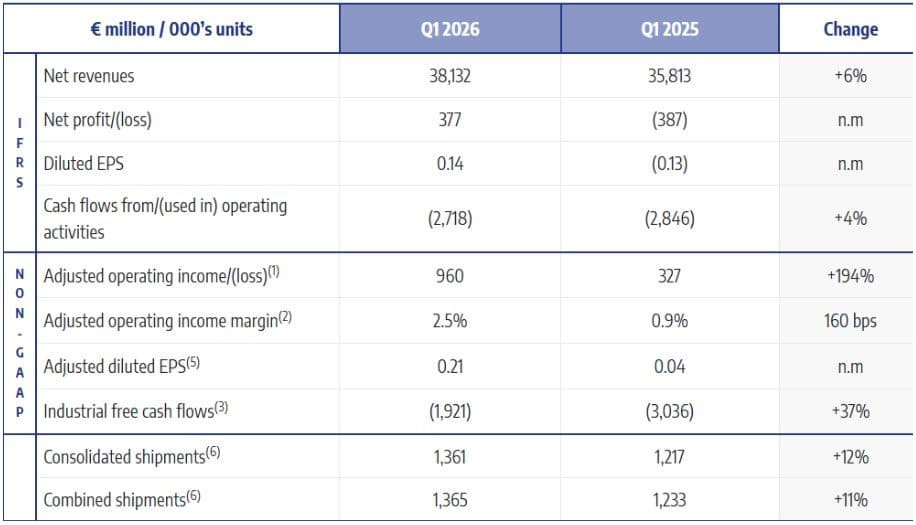
- Stellantis delivered a stronger financial performance in Q1 2026, noticeably so, and a few key numbers moved the proper way after that tougher prior year that everyone was talking about.
- In the period, the company posted €38.13 billion (USD 43.5 billion) in net revenue, versus €35.81 billion (USD 40.8 billion) in Q1 2025, which works out to a 6% year-over-year jump.
- On the profit side, things looked even better, at least on paper. Stellantis said it had a net profit of €377 million (USD 430 million), a kind of turnaround from the €387 million (USD 441 million) net loss logged in Q1 2025.
- Diluted earnings per share also improved, moving from –€0.13 to €0.14
- Adjusted operating income climbed to €960 million (USD 1.09 billion), compared with €327 million (USD 373 million) a year earlier.
- 194% increase, and the adjusted operating income margin expanded from 0.9% to 2.5%, up 160 basis points, basically a clean widening.
- Cash used in operating activities totalled €2.72 billion (USD 3.10 billion), vs €2.85 billion (USD 3.24 billion) in Q1 2025.
- Industrial free cash flow improved by 37%, sliding from –€3.04 billion (USD 3.46 billion) to –€1.92 billion (USD 2.19 billion).
- At the operating level, momentum also strengthened. Consolidated shipments reached 1.361 million vehicles, up 12% from 1.217 million a year ago.
- Combined shipments rose 11% to 1.365 million units, compared with 1.233 million units in Q1 2025, so overall volume looks healthier.
- Looking further, for the rest of the decade, Stellantis’ “Dare Forward 2030” strategy will roll out more than 60 new vehicle launches and 50 notable refreshes.
- The plan aims for a diversified line-up with 29 battery-electric vehicles (BEVs), 15 plug-in hybrids, 24 traditional hybrids, plus 39 internal combustion or mild-hybrid versions across its global brand universe.
- Overall, the numbers indicate a company that is steadily rebuilding volume, restoring margins, and returning to profitability, although cash flow remains an area that investors will continue to monitor closely.
Dodge Sales By Model In The USA In 2025
| Model | Sales 2025 | Sales 2024 | % Change |
| Dart | 6 | 1 | |
| Viper | 1 | 0 | |
| Hornet | 9,365 | 20,559 | -54% |
| Charger | 2,141 | 34,754 | -94% |
| Charger BEV | 7,421 | 0 | |
| Challenger | 1,800 | 27,056 | -93% |
| Journey | 17 | 0 | |
| Caravan | 9 | 2 | 350% |
| Durango | 81,168 | 59,357 | 37% |
| DODGE BRAND | 101,927 | 141,730 | -28% |
(Source: best-selling-cars.com)
- Dodge’s 2025 sales numbers show a brand that’s kinda, well, shifting gears hard. In the U.S., Dodge moved 101,927 vehicles total, which is down 28% from 141,730 units in 2024, so the overall volume took a pretty big step back.
- Dodge Durango landed at 81,168 units, up 37% from 59,357 units in 2024.
- In other words, the Durango alone made up close to 80% of every Dodge sale in 2025, so it’s basically the brand’s main sales engine right now.
- The Charger posted 2,141 sales, down 94% from 34,754 units the year before, and the Challenger slid 93% to 1,800 units from 27,056 units. Put together, those two famous nameplates shed nearly 58,000 units of annual volume vs 2024.
- Dodge’s electrification push had some early traction, especially with the Charger BEV, which contributed 7,421 sales during its first full year out on the market.
- Still, the count wasn’t enough to balance out the big fall in the outgoing gasoline-powered Charger and Challenger versions.
- Sales dropped 54% to 9,365 units from 20,559 units in 2024.
- The low-volume lineup, like the Dart, Viper, Journey, and Caravan, collectively only added a small number of registrations, nothing that truly changed the big picture.
- So overall, the numbers suggest Dodge is leaning more and more on the Durango, while the brand transitions away from its historical muscle-car vibe and toward a broader mix of SUVs, plus electrified options.
Dodge Position Inside Stellantis
- Dodge sales weakness showed up while Stellantis was dealing with a Stellantis net loss of €22.3 billion in 2025, and that was driven by €25.4 billion in EV-related writedowns.
- Restructuring costs, even though group net revenues hit €153.5 billion, which is down 2% compared with the year before, and weirdly shipments in the second half of 2025 actually climbed 11%.
- Quoted by CNBC and the Financial Times have pointed out that Stellantis basically overestimated how quickly the EV transition would happen, especially across North America.
- Whole mix, brands like Dodge, with its tightly focused lineup of performance cars and SUVs, ended up being among the most vulnerable to that misread, or miscalculation.
Dodge’s Sunset Of The Hemi V8 and The Hurricane ‘Sixpack’ Transition
- Dodge’s recent sales are tied to the end of its Hemi-powered Charger and Challenger story.
- The final Dodge Challenger rolled out of the Brampton Assembly Plant on December 22, 2023, which kind of closed the chapter on nearly 20 years of L-platform muscle car production, and kicked off a big product reshuffle.
- Car and Driver, and USA Today said the effects were fast. Dodge’s U.S. sales fell from 141,730 units in 2024 to 101,927 units in 2025, so that comes out to a drop of 28%.
- Even after the production run ended, the Charger and Challenger still pulled 61,810 combined sales in 2024, which showed that remaining inventory and customer demand still had some weight.
- In a widely shared H1 2025 sales analysis, during the first half of 2025, Dodge sales went from more than 92,000 units down to 47,481 units, and that’s nearly a 50% decline.
- S&P Global Mobility data, cited by ClubAlfa, suggests the new Charger Daytona EV couldn’t really plug the hole.
- Industry data showed only 80 Charger EVs sold in January 2026, so yeah, the replacement didn’t arrive with the kind of volume people hoped for.
- USA Today says the Durango racked up 81,168 units in 2025, sort of making up around 80% of Dodge’s yearly sales.
- In Q1 2026, the Durango showed up at nearly 90% of Dodge’s total quarterly volume, which kinda underscores how the brand is getting more reliant on one particular model.
- Engineering updates released by Stellantis and later summarized by SAE International spell it out that Stellantis is placing a wager on its fresh 3.0-litre Hurricane twin-turbo inline-six setup.
- The standard-output take pulls in more than 400 horsepower and 450 lb-ft of torque, while the high-output version goes past 500 horsepower and 475 lb-ft of torque.
- Stellantis also claims up to 15% better fuel efficiency than the outgoing Hemi V8 engines, even with the performance angle.
- The above figures hint that Dodge is stepping into one of the bigger pivots it has seen, swapping out the familiar V8 muscle vibe for a cleaner, more capable performance foundation. The idea is to build toward future growth from now through 2030 and beyond.
Dodge Market Friction – Retail Adoption Of The Charger Daytona BEV
- The Dodge Charger Daytona EV comes across as one of the sharper examples of the mismatch that can happen between bold electrification spend and real consumer pull.
- Even with billions of dollars poured into the platform and manufacturing, sales stayed well under the usual muscle-car expectations people remember from Dodge history.
- According to CarScoop, the numbers kind of say it pretty cleanly. Dodge reportedly moved 7,421 Charger Daytona EVs in 2025, which is a small amount compared with the brand’s older muscle-car style sales.
- Keeping the whole program alive meant heavy money upfront, like CAD 3.6 billion (roughly USUSD 2.6 billion) earmarked to retool the Windsor Assembly Plant, so it could build vehicles using Stellantis’ new STLA Large setup. On top of that, Stellantis says it put down more than €50 billion over the decade for electrification efforts.
- International Business Times and ClubAlfa, as well, both mention that the product development spend for the Charger Daytona project was estimated at USUSD 383.5 million to USUSD 951 million.
- By August 2025, cumulative Charger Daytona sales across the U.S. and Canada were only 4,299 units, not exactly a roaring start.
- Stellantis’s own U.S. sales paperwork, along with CarsCoops’s breakdown, suggests that in Q1 2025, Dodge sold 1,947 Charger Daytona EVs. That works out to about 22 cars per day, across the U.S. market.
- Meanwhile, dealers sold 1,052 discontinued gas-powered Chargers and 922 discontinued Challengers from leftover stock, which kind of underscores that the old school muscle-car appetite wasn’t gone, not really.
- CarScoops and motor1.com’s full-year review add that in Q4 2025, Charger Daytona EV sales dropped to only 346 units, an 82% sequential drop versus Q3.
- The momentum slid further into January 2026, with just 80 units moved in the U.S., and that helped push bigger dealer price reductions, in some cases up to USUSD 21,000 on certain cars.
- The STLA Large platform can stretch up to 800 km (500 miles) of range, and Dodge’s Fratzonic Chambered Exhaust system dishes out as much as 126 decibels of a kind of synthetic, performance-like sound.
- The market data looks like it wasn’t just advanced technology on its own that could recreate the kind of demand people historically showed for Dodge’s V8 muscle-car lineup.
Conclusion
Dodge came into 2026 during a big reshuffle, as it is moving away from its classic V8-powered muscle-car roots and toward electrification, plus turbocharged energy. The numbers point to a brand that is pretty much leaning on the Durango SUV, which now drives most of the sales volume. While Stellantis has improved profitability and keeps pouring billions into new vehicle platforms, Dodge is dealing with real issues trying to replace the demand that once flowed from the Charger and Challenger.
Early results for the Charger Daytona EV are coming in below what was hoped for, which also suggests some consumer hesitance in the shift. The next few years will be decisive for rebuilding growth, spreading sales across more models, and keeping the brand feeling relevant.
FAQ
In 2025, Dodge sold 101,927 vehicles in the United States, which is down 28% from 2024.
The Dodge Durango is the top seller, with 81,168 sales in 2025.
Dodge moved 7,421 Charger Daytona EVs during 2025.
The drop mostly ties back to ending the traditional Charger and Challenger muscle cars, plus the slower-than-expected uptake of the replacement vehicles.
The Durango made up about 80% of Dodge’s 2025 sales, and close to 90% of Q1 2026 sales.