








Introduction
Enterprise Resource Planning software Statistics: ERP has changed how businesses operate, transitioning from applications to an integrated platform that manages everything from core financials and human capital to complex supply chain logistics and manufacturing operations.
The importance of ERP systems in bringing digital transformation and maintaining a competitive environment is reflected in current market statistics, which showcase aggressive growth alongside persistent challenges in implementation and user adoption.
Understanding these deep insights behind the ERP software landscape is essential for executives, IT leaders, and business analysts looking to maximize their investment and navigate the complex vendor ecosystem.
While the rewards of improved efficiency and cost savings are significant, the data also reveals critical pitfalls in change management and project scope that CEOs and managers must heed to achieve successful outcomes, so let’s have a clear discussion on the ERP statistics.
Editor’s Choice
- The global ERP software market is demonstrating aggressive growth, projected to expand at a CAGR of 8% from 2024 through 2030.
- A decisive change is underway in deployment, with 78% of all new ERP software implementations being adopted as cloud or hybrid-cloud solutions.
- The financial stability of these projects is a concern, as a high 64% of ERP implementations statistically exceed their initial budget, often resulting in an average cost overrun that ranges between 25% and 40% of the original planned expenditure.
- Project success remains a challenge across the industry, with approximately 50% of all ERP systems implementations failing to fully achieve their stated objectives or being classified as a disappointment upon the first attempt.
- Small and mid-sized enterprises SMBs must plan for a time-to-value period, as these businesses report requiring an average of 11 to 14 months post-go-live to fully realize and measure the anticipated financial benefits and ROI from their ERP software.
- Efficiency is the core economic driver, with improved organizational efficiency and productivity cited by 57% of companies across all sizes as the primary factor for investing in and purchasing a new ERP software
- Despite immense hype surrounding advanced technology, only about 4% of currently deployed ERP solutions natively embed robust, advanced intelligent features like Artificial Intelligence AI and Machine Learning ML.
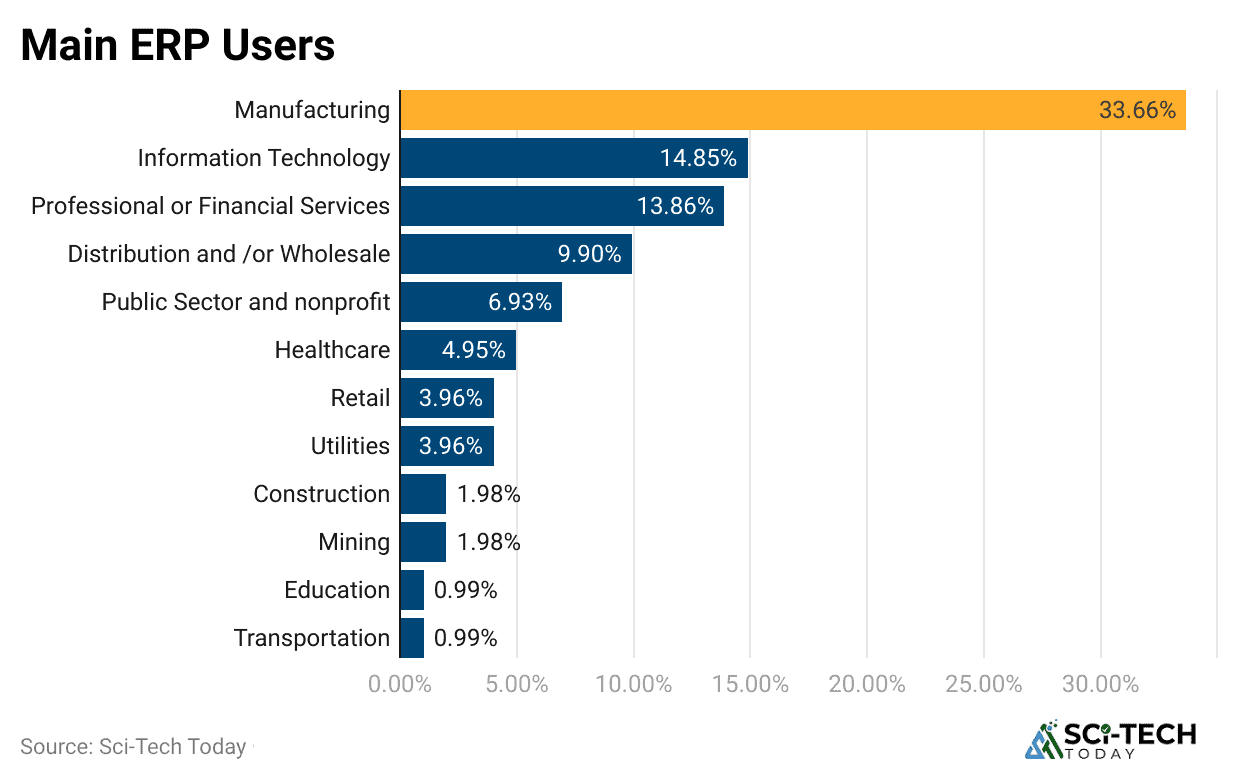
- The Manufacturing sector maintains its position as the foundational and largest consumer of these systems, consistently accounting for approximately 30% of the total revenue share generated within the overall ERP software market landscape.
The Growth and Scale of the ERP Software Market
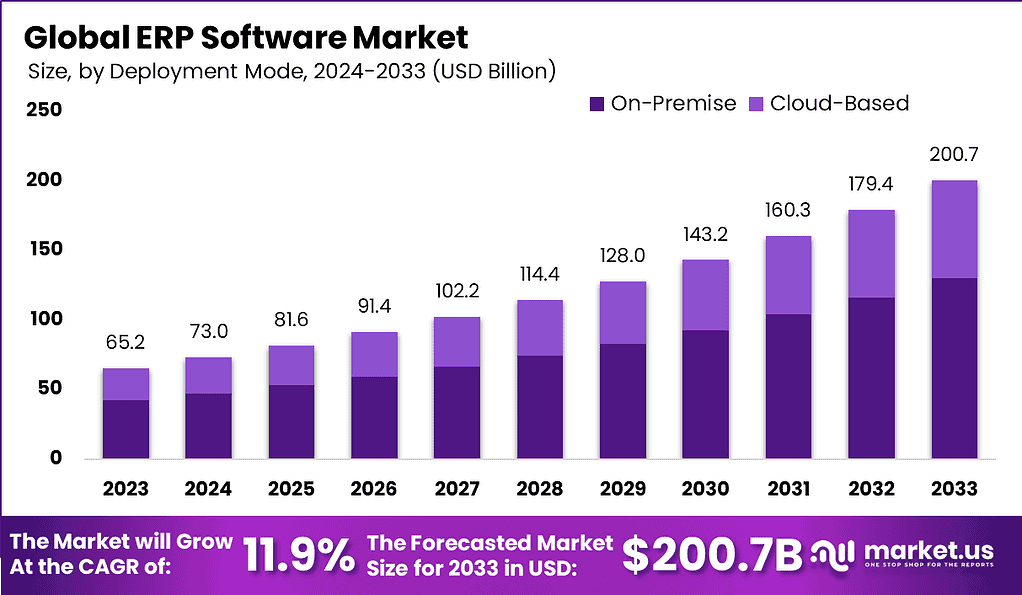 (Source: market.us)
According to Market.us, the overall market for ERP software within the broader enterprise application ecosystem, experiencing sustained and significant growth due to the integration of digital infrastructure and actual business intelligence across organizations.
- The global ERP software market size was valued at approximately $71.62 billion in 2023, and current projections forecast it to nearly double, reaching $147.7 billion by the year 2030.
- This massive expansion translates into an estimated CAGR of 13.8% over the forecast period.
- North America currently dominates the market share by revenue, holding approximately 34% of the global ERP software market.
- However, the Asia-Pacific APAC region is expected to be the fastest-growing market, projected to expand at an exceptional CAGR of up to 17.5% through 2030.
- The market for ERP software specifically for the Small to Mid-sized Business SMB segment is experiencing particularly high velocity, with an expected CAGR of over 11%.
- In terms of functional segments, the Finance and Accounting module consistently commands the largest revenue share within the overall ERP software market, representing about 29% of the total expenditure due to its foundational role in business operations and compliance.
| Aspect | Data Point |
| Market Value 2023 |
$71.62 Billion |
|
Projected Market Value 2030 |
$147.7 Billion |
| CAGR |
13.8% Forecast 2024 to 2030 |
|
Dominant Region by Revenue |
North America Approx. 34% Share |
| Fastest Growing Region CAGR |
Asia-Pacific Up to 17.5% |
|
Largest Functional Segment |
Finance and Accounting Approx. 29% Revenue Share |
ERP Implementation By Budget, Duration, and Project Outcomes
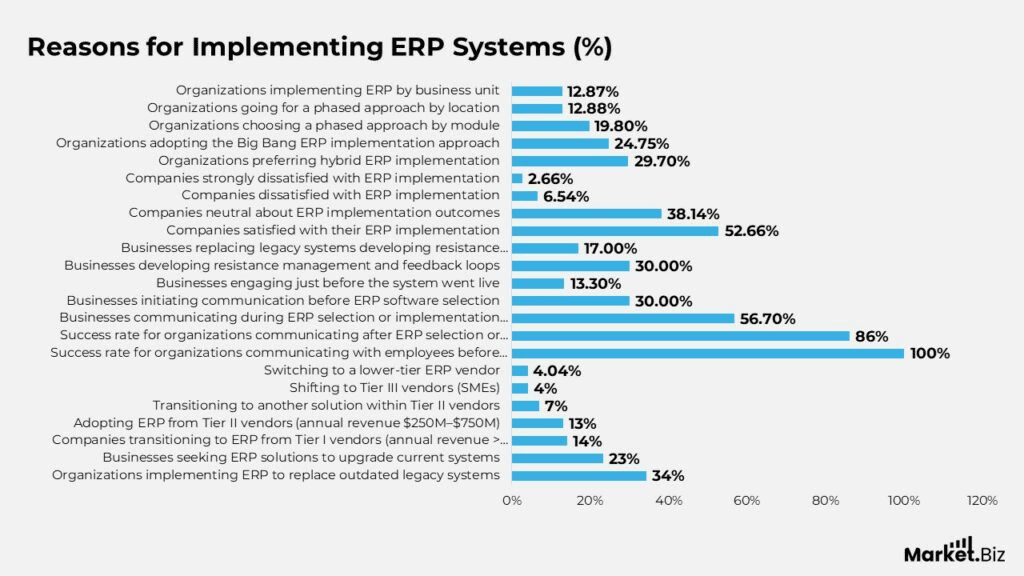 (Source: market.biz)
- A challenging 50% of all ERP software implementation projects are classified as either a complete failure, an outright abandonment, or a significant project disappointment on their initial attempt.
- A worrying statistic shows that 64% of organizations end up exceeding their originally allocated budget for the ERP system implementation, with the average cost overrun falling somewhere between 25% and 40% of the initial estimate.
- The average time required for a mid-market ERP software deployment typically takes around 18 months from start to finish, which is generally 30% longer than the initial project timelines companies often forecast internally.
- Research indicates that up to 75% of the financial benefits or expected ROI from a new ERP system are directly linked to effective organizational change management OCM, yet many companies allocate less than 10% of their total project budget to this critical area.
- One key challenge is scope creep, where 65% of organizations report that required customizations or modifications to enhance usability post-launch are the leading cause of massive budget spikes for their ERP software project.
- Operational disruption is a significant risk, as 51% of companies face major business disruption or temporary process halts when their new ERP system officially goes live.
- Insufficient testing and a failure to adequately re-engineer underlying business processes are cited as the top non-technical causes for disappointment in 45% of all failed ERP implementations.
| Implementation Metric | Data Point |
| Project Failure/Disappointment Rate | 50% on first attempt |
| Projects Exceeding Budget | 64% of all ERP projects |
| Average Budget Overrun | 25% to 40% beyond the initial estimate |
| Average Implementation Duration | 18 Months, 30% longer than planned |
| ROI Linked to Change Management | Up to 75% of the expected financial benefits |
| Leading Cause of Cost Spikes | 65% caused by post-launch customizations/modifications |
| Operational Disruption on Go-Live | Experienced by 51% of organizations |
ERP Adoption and Usage Statistics by Industry and Function
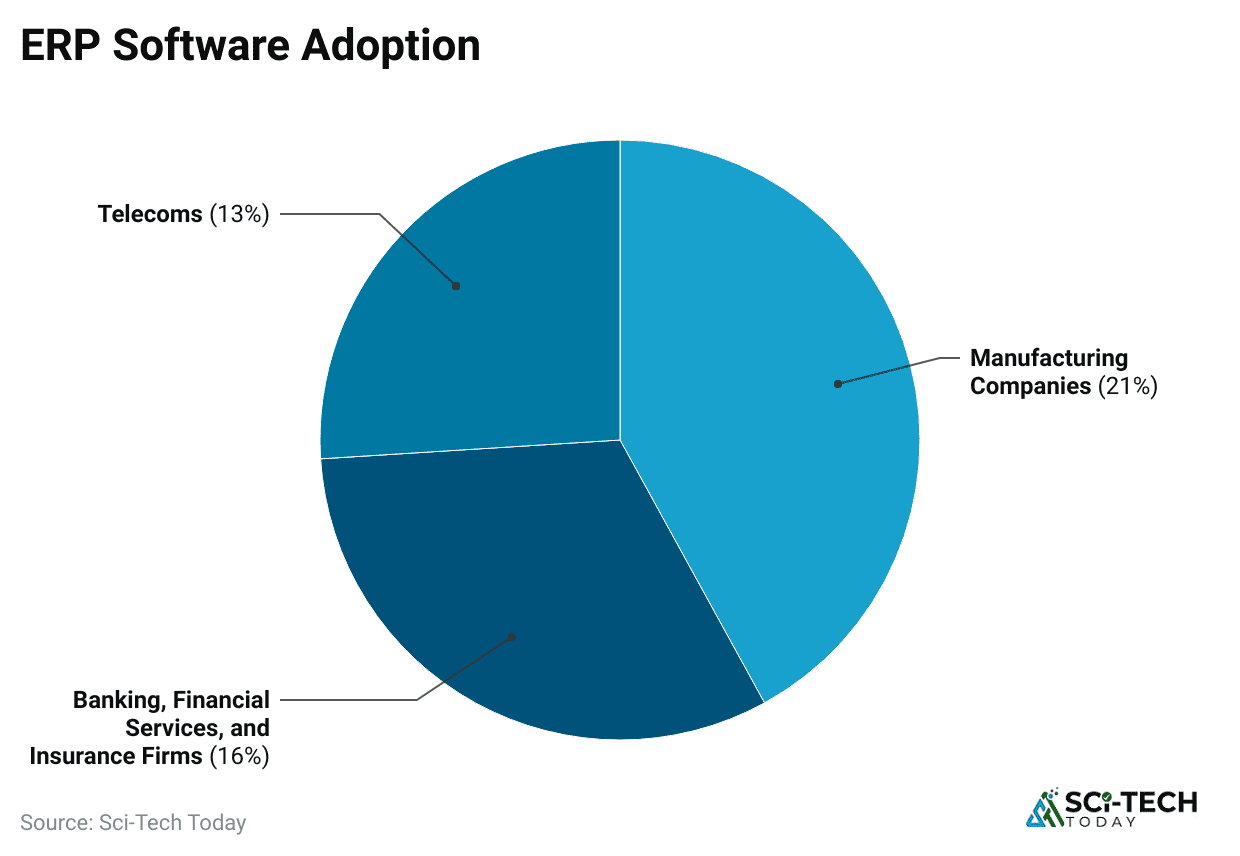 (Reference: scoop.market.us)
- The Manufacturing industry remains the most significant adopter of ERP software, with manufacturers representing approximately 47% of organizations actively searching to purchase a new or replacement ERP system today.
- Following manufacturing, the next largest groups of ERP software seekers are Distribution companies at 18%, Services organizations at 12%, and the Construction sector at 4%.
- Within organizations, the IT department 23% and the Finance and Accounting department 23% share the highest influence as the primary decision-makers or key influencers during the final selection of a new ERP software solution.
- When surveyed about the most important functions of their ERP software, an overwhelming 89% of businesses identify Accounting/Financial Management as the single most critical capability the system must deliver effectively.
- On average, a relatively low 26% of a company’s total employee base actively uses the ERP software on a regular daily basis.
- The need to completely replace outdated, legacy ERP systems is the single biggest catalyst for a new project, accounting for 34.24% of all reasons cited for initiating a new ERP software implementation project.
- A significant 77% of small and mid-sized businesses SMBs leverage their ERP systems primarily to standardize and streamline their back-office operations.
| Adoption Metric | Data Point |
| Top Industry Seeking ERP | Manufacturing 47% of searches |
| Second Top Industry Seeking ERP | Distribution: 18% of searches |
| Most Important ERP Function | Accounting/Financial Management 89% |
| Top Decision-Makers | IT 23% and Finance/Accounting 23% |
| Percentage of Employees Using ERP | An average of 26% actively use the system |
| Primary Driver for New ERP Project | Replacing Outdated Legacy Systems 34.24% |
| SMB Goal for ERP | Standardize Back-Office Operations 77% |
The Return on Investment ROI of ERP Software
 (Source: linkedin.com)
- Among organizations that diligently performed a formal ROI analysis before launching their ERP software project and have been live for over a year, a strong 83% reported that their projects either met or decisively exceeded their original ROI expectations.
- Cost savings are a major, measurable outcome, with 62% of survey participants reporting that their new ERP systems led directly to quantifiable cost reductions.
- The most frequently cited and significant single benefit, reported by 91% of companies who spent at least one year on their ERP software.
- A major change in business priority is evident, as 74% of ERP stakeholders now consider ROI a vital metric, a substantial leap from only 43% who gave it similar priority just one year prior, in 2022.
- Beyond inventory, other major benefits include improving overall productivity by 78%, enhancing supplier interactions by 76%, and the critical elimination of data silos by 77%.
- For midsize corporations, those with revenue below $1 billion, the annual cost of ownership for their ERP software typically ranges between 3% to 5% of their total annual revenue.
- In terms of data utilization, 71% of companies explicitly aim to use the centralized data housed within their ERP system to perform predictive analytics or more accurate future forecasting.
| ROI and Benefits Metric | Data Point |
| Projects Meeting/Exceeding ROI | 83% Formal ROI analysis conducted |
| Companies Achieving Cost Reductions | 62% Reported across purchasing and inventory |
| Most Significant Single Benefit | Optimized Inventory Levels: 91% of companies |
| Stakeholders Prioritizing ROI | 74% Significant increase from 43% in 2022 |
| Companies Improving Productivity | 78% |
| Cost of Ownership Midsize Corp. | 3% to 5% of Annual Revenue |
| Companies Using ERP Data for Predictive Analytics | 71% |
Technology Trends and Cloud ERP Software Migration
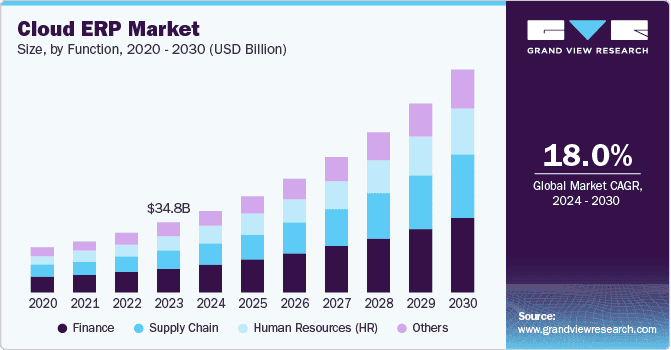 (Source: grandviewresearch.com)
- An impressive 76% of businesses have either already completed the transition or are currently in the process of migrating their existing on-premises ERP software systems to a Cloud or Hybrid Cloud environment.
- Gartner projects that global spending on public cloud services, which includes SaaS ERP solutions, will reach a massive $678.8 billion in 2024, a significant 20.4% growth from the previous year.
- The primary motivation for 39% of businesses choosing to move their core ERP software to the cloud is the expectation of benefiting from improved and standardized business processes.
- The key benefits driving the cloud migration wave are cited as scalability and flexibility, 32% of companies, and the potential for a higher Return on Investment ROI.
- Despite the push for modernization, only 4% of existing ERP software solutions natively support modern, comprehensive omnichannel capabilities or offer a highly intuitive, consumer-grade user interface UI.
- Only 15% of executives currently believe that the integration of Artificial Intelligence AI into their ERP software has the potential to fundamentally change their competitive landscape, which is a surprisingly low number given the technology’s broad potential.
- Following their cloud migration, a high 94% of businesses have reported significant improvements in system security.
| Technology/Cloud Metric | Data Point |
| Companies Migrating to Cloud ERP | 76% In progress or completed |
| Global Cloud Spending Growth 2024 | 20.4% growth to $678.8 Billion |
| Primary Cloud Motivation | Improved Business Processes 39% |
| Second Cloud Motivation | Scalability and Higher ROI 32% |
| ERP Systems with Omnichannel Support | Only 4% natively support this |
| Executives on AI’s Potential in ERP | 15% believe it will drastically change the landscape |
| Security Improvement Post-Cloud Migration | Reported by 94% of businesses |
ERP Consulting and Change Management Statistics
 (Reference: truelist.co)
- A substantial 90% of organizations choose to engage external consultants to assist with their ERP software implementation.
- Beyond simple technical deployment, the most requested consulting services are implementation assistance, requested by 90% and assistance with organizational change management, requested by 51%.
- The data clearly shows that only 33% of organizations that seek OCM consulting services perceive change management as difficult, compared to a much higher 67% of organizations that struggle when they attempt to handle OCM internally without external help.
- Only 30% of businesses proactively develop a resistance management plan and formal feedback loops during their ERP system roll-out.
- Customized user training is the most common change management activity employed during ERP software projects, being utilized by 73% of organizations.
- Successful ERP adopters report that beginning communication with employees before the software selection process even begins leads to a 100% project success rate, compared to only 86% success when communication starts later during the implementation phase.
- About 27% of companies admit to placing little to no emphasis on change management during the entire implementation lifecycle of their ERP software.
| Change Management Component | Data Point |
| Organizations Using Consultants | 90% of all ERP Implementations |
| Top Consulting Service | Implementation Assistance 90% Request |
| Second Top Consulting Service | Organizational Change Management 51% Request |
| CM Activity: Customized Training | Utilized by 73% of Organizations |
| CM Activity: Communication Plan | Utilized by 57% of Organizations |
| Success Rate w/ Early Communication | 100% Success Rate Communication initiated pre-selection |
| Companies Placing Low CM Emphasis | 27% of Organizations |
Conclusion
Overall, the landscape of ERP software is a market undergoing aggressive change, with growth and a decisive change toward cloud deployment. The data compels organizations to approach ERP initiatives not just as a technology upgrade, but as a comprehensive business transformation.
While the market is set to expand rapidly, due to the need for integration, efficiency, and the promise of AI, the high rates of budget overruns 64% and initial project failure 50% serve as a strong warning. Success hinges on a proven focus on organizational change management, comprehensive user training 73%, and setting realistic timelines.
Ultimately, the goal of ERP software, to unify operations and provide actual data visibility, translates directly into powerful financial gains, with 83% of well-managed projects achieving their ROI targets. I hope you like this article. If you have any questions, kindly let us know. Thanks for staying up till the end.

Sources