








Introduction
Workflow Automation Statistics: Workflow automation, which uses smarter technology like AI, Robotic Process Automation RPA, and low-code tools to execute business processes with minimal human input, has evolved into the foundational pillar of today’s modern operations.
For data analysts like you, understanding this change requires moving beyond just facts and digging into the data. How much are companies really saving? Which departments are seeing the biggest gains? And how is the integration of Artificial Intelligence changing the job market?
This deep dive into the latest workflow automation statistics provides a complete look at the global market, its departmental impact, and the future of intelligent process design. Let’s get started.
Editor’s Choice
- 8 million of the global workflow automation market is forecast to reach this valuation by 2032, expanding at a CAGR of 10.1% from its 2023 value of USD 20.3 billion.
- 87% of the proportion of workflow automation market revenue is commanded by large enterprises in 2024.
- 69% of the massive percentage of daily managerial operations is projected to be entirely automated by the close of 2024.
- 80% of the organizations will have adopted intelligent automation by 2025.
- The high percentage of IT leaders who credit automation with saving employees 10% to 50% of the time previously wasted on manual tasks.
- 90% of knowledge workers report that automation has actively improved their job quality and experience.
- 7% CAGR projected growth rate for the Cognitive Process Automation CPA market between 2025 and 2034, underscoring the change toward AI-driven, smart workflows.
- 60% percentage of organizations are achieving a positive ROI from their automation investments within just 12 months of implementation.
Global Market and Adoption Rates
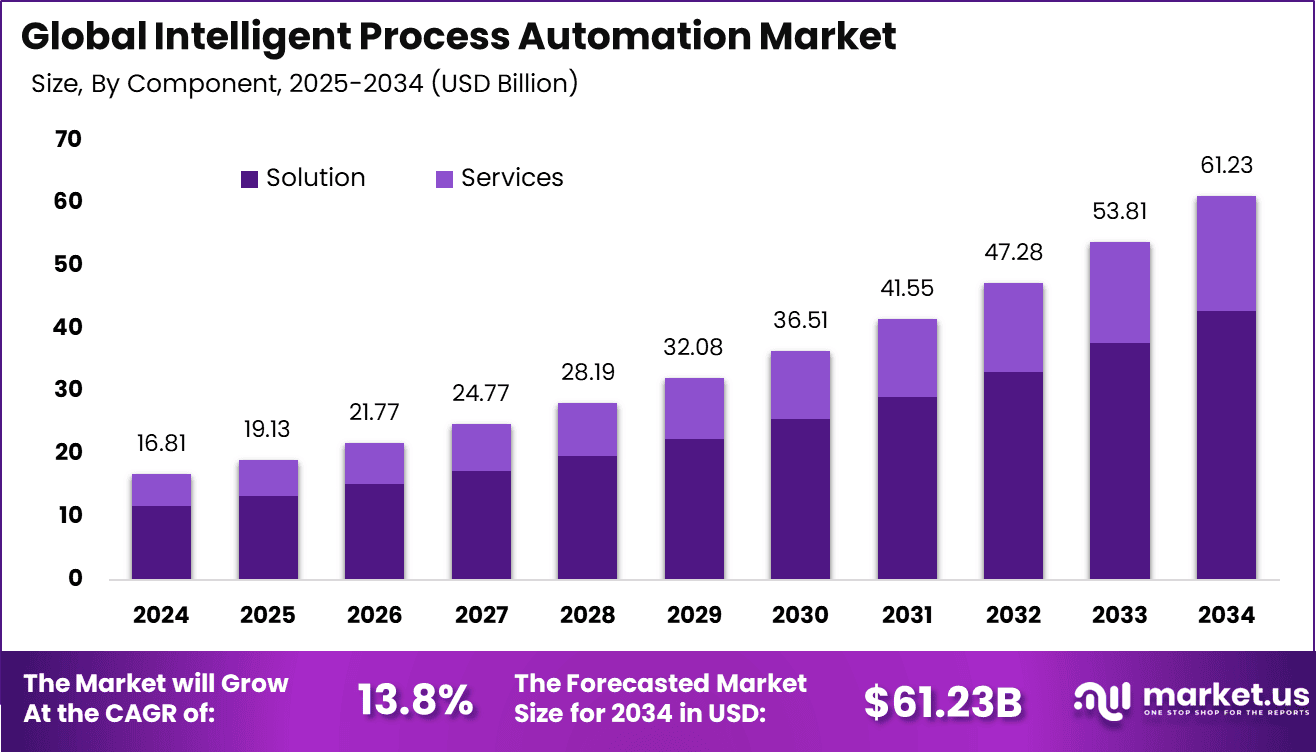
(Source: market.us)
According to Market.us, the market for automating business is growing, driven by the global push for digital transformation and cloud-based solutions. Investment decisions today are firmly rooted in these financial projections, highlighting automation as a crucial capital expenditure.
- The overall global market for workflow automation solutions is on track to surpass USD 37.45 billion by 2030, growing at a steady CAGR of 9.52% over the preceding five years.
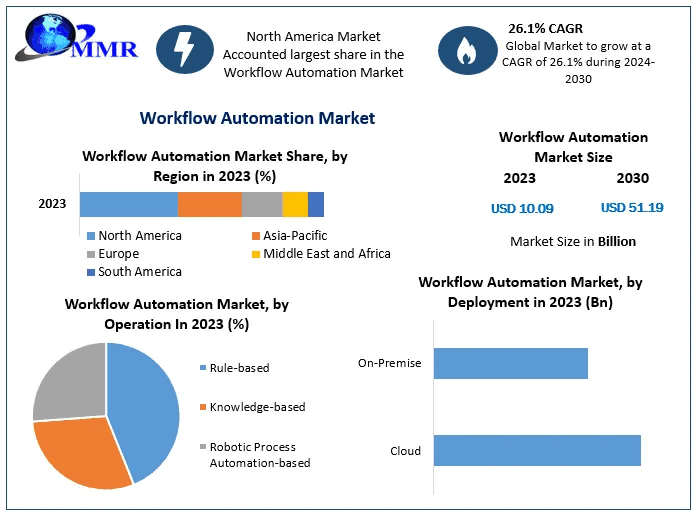
- Large enterprises held a commanding 71.87% of the total market revenue in 2024, and the complexity and scale of their operations make automation adoption an immediate necessity.
- The Small and Medium-sized Enterprise SME segment, while smaller in absolute revenue, is forecast to achieve a slightly higher CAGR of 10.31% through 2030.
- Cloud-hosted automation offerings generated 62.87% of the total market revenue in 2024, largely due to the flexibility, scalability, and lower upfront cost that cloud infrastructure provides to businesses worldwide.
- Dedicated software platforms, which bundle orchestration, RPA, and AI tools, accounted for 67.12% of all automation spending in 2024.
- The North American region contributed the largest share of global revenue, holding 34.68% of the market in 2024.
- The Asia-Pacific region is poised to exhibit the fastest regional growth, with an expected CAGR of 10.03% through 2030.
- Despite the major market valuation, only a mere 4% of businesses have fully embraced end-to-end workflow automation across their entire organization.
- The broader business process automation market is projected to increase by a total of USD 17.68 billion between 2024 and 2029, maintaining a robust CAGR of 18.4%.
| Global Market Statistics 2024 to 2030 | Data Point |
| Market Valuation 2030 | USD 37.45 Billion |
| Projected CAGR 2025-2030 | 9.52% |
| Large Enterprise Revenue Share 2024 | 71.87% |
| SME Growth CAGR | 10.31% |
| Cloud Deployment Share 2024 | 62.87% |
| North America Revenue Share 2024 | 34.68% |
| Asia-Pacific Projected CAGR | 10.03% |
| End-to-End Adoption Rate | 4% |
| Hyperautomation Investment Forecast | USD 720+ Billion |
ROI and Cost Reduction
(Source: blueprintsys.com)
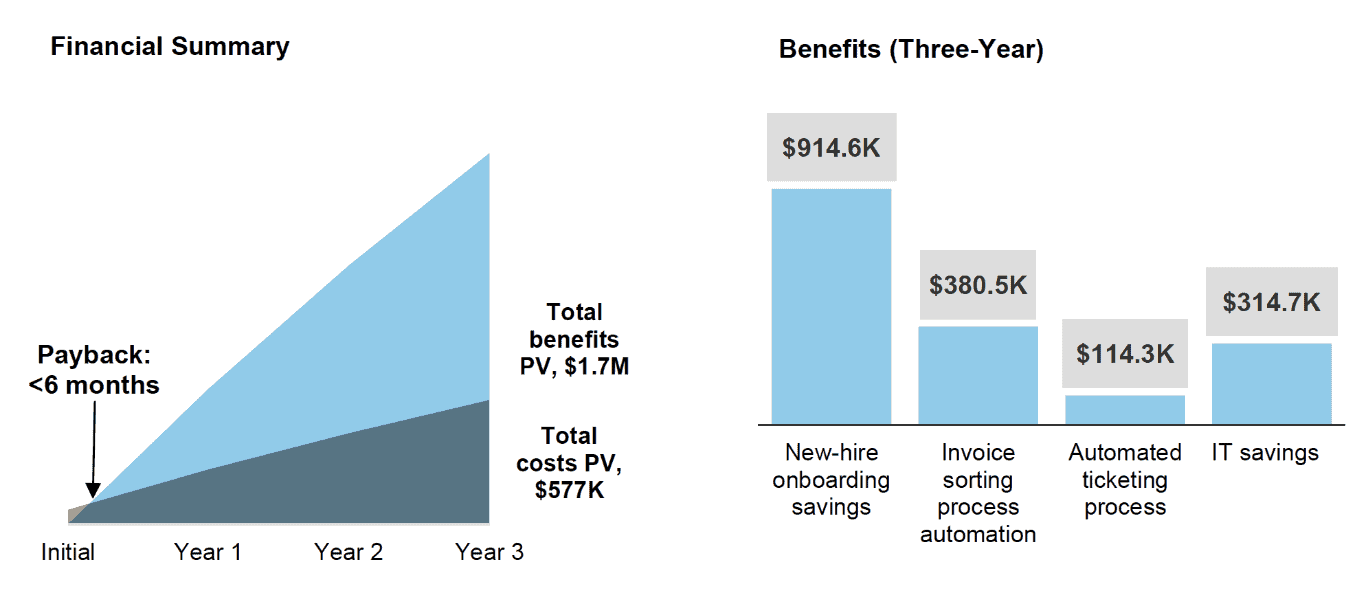
- Investments in automation are reported to deliver a substantial return on investment between 30% and 200% within the first year alone.
- Over half 51% of all business leaders, confirm that automation initiatives have successfully reduced their overall operational costs by a measurable range of 10% to 50%.
- A significant 31% of business leaders specifically cite reduced labor costs as a direct financial benefit from deploying automation software across various departments.
- Automating approximately 64% of the tasks within the manufacturing sector has the potential to save billions of working hours across the industry, freeing human capital for specialized production and oversight.
- Automation is directly linked to an error reduction rate spanning from 40% to 75% compared to traditional manual processes.
- A substantial 36% of surveyed banks reported achieving annual cost reductions exceeding 10% simply by adopting advanced automation and AI solutions within their core financial processes.
- Leading insurance companies utilizing AI to automatically extract and process information from documents have reported reducing their claims processing time by a remarkable 70%.
- McKinsey research suggests that the widespread adoption of automation has the potential to boost global annual productivity growth by an estimated 0.8% to 1.4%.
- Nearly three-quarters 73% of IT industry leaders report that automation has achieved measurable time savings of 10% to 50% in task performance for their employees, optimizing human effort.
- Poor data quality costs US businesses an estimated USD 3 trillion annually, a massive hidden expense that automated data validation workflows are designed to eliminate.
| Financial & Cost Savings Statistics 2024 | Data Point |
| Average First-Year ROI | 30% to 200% |
| Reported Operational Cost Reduction | 10% to 50% |
| Banking Annual Cost Cut | 10% |
| Insurance Claims Processing Reduction | 70% |
| Manufacturing Task Automation Potential | 64% |
| Global Annual Productivity Boost | 0.8% to 1.4% |
| IT Staff Time Savings | 10% to 50% |
| Error Reduction Rate | 40% to 75% |
Workflow Automation in Action
(Source: maximizemarketresearch.com)
Finance and Accounting
- As much as 80% of all transactional and repetitive data entry work within modern finance departments is currently eligible for complete automation.
- Businesses that successfully implement a comprehensive payment automation system report saving over 500 hours annually within their finance teams.
- Experts suggest that integrating financial automation can cut down the department’s operational costs by an astounding amount, potentially reaching up to 90% for certain highly repetitive processes.
- A large majority, 85% of financial institutions, have already integrated AI and Machine Learning ML into their systems.
- Compliance Automation: Automated compliance monitoring and reporting is used by 36% of organizations to standardize daily workflows.
Sales and Marketing
- Automation boosts overall lead volume by an average of 80% and increases final conversion rates by up to 75% for businesses leveraging comprehensive marketing automation platforms.
- Companies that automate their email workflows generate twice the number of leads and achieve 58% higher conversion rates when compared to manual email outreach efforts.
- A substantial 75% of all businesses currently use at least one type of marketing automation technology, cementing it as a standard tool in the modern sales pipeline.
- Sales departments specifically report an impressive 14.5% increase in overall productivity following the successful integration of advanced marketing and sales automation tools.
- B2B marketers who consistently utilize marketing automation report an average increase in their sales pipeline contribution rate of 10% YOY.
Human Resources HR
- The adoption of specialized HR automation solutions has experienced a monumental growth rate of 599% in recent years.
- Approximately 37% of all human resource job functions, such as onboarding, payroll processing, and time-off requests, are now frequently being automated to reduce administrative burden.
- Automation of the new employee onboarding process is linked to an impressive 16% increase in new hire retention rates.
- Over half of companies 56% are actively deploying AI in their HR functions, with the primary objective being to automate repetitive, high-volume tasks that consume employee time.
- A significant 57% of companies leverage HR automation specifically to improve the overall employee experience, freeing HR staff to focus on strategic development and complex employee relations.
| Departmental Workflow Automation Statistics | Data Point |
| Finance: Automatable Transaction Work | 80% |
| Finance: Annual Time Savings Payments | 500+ Hours |
| Marketing: Lead Volume Increase | 80% |
| Marketing: Email Conversion Rate | 58% Higher |
| Sales: Productivity Boost | 14.5% |
| HR: Automation Growth Rate | 599% |
| HR: New Hire Retention Increase | 16% |
| IT: Automation Responsibility Share | 40% |
AI, RPA, and Cognitive Automation
(Reference: scoop.market.us)
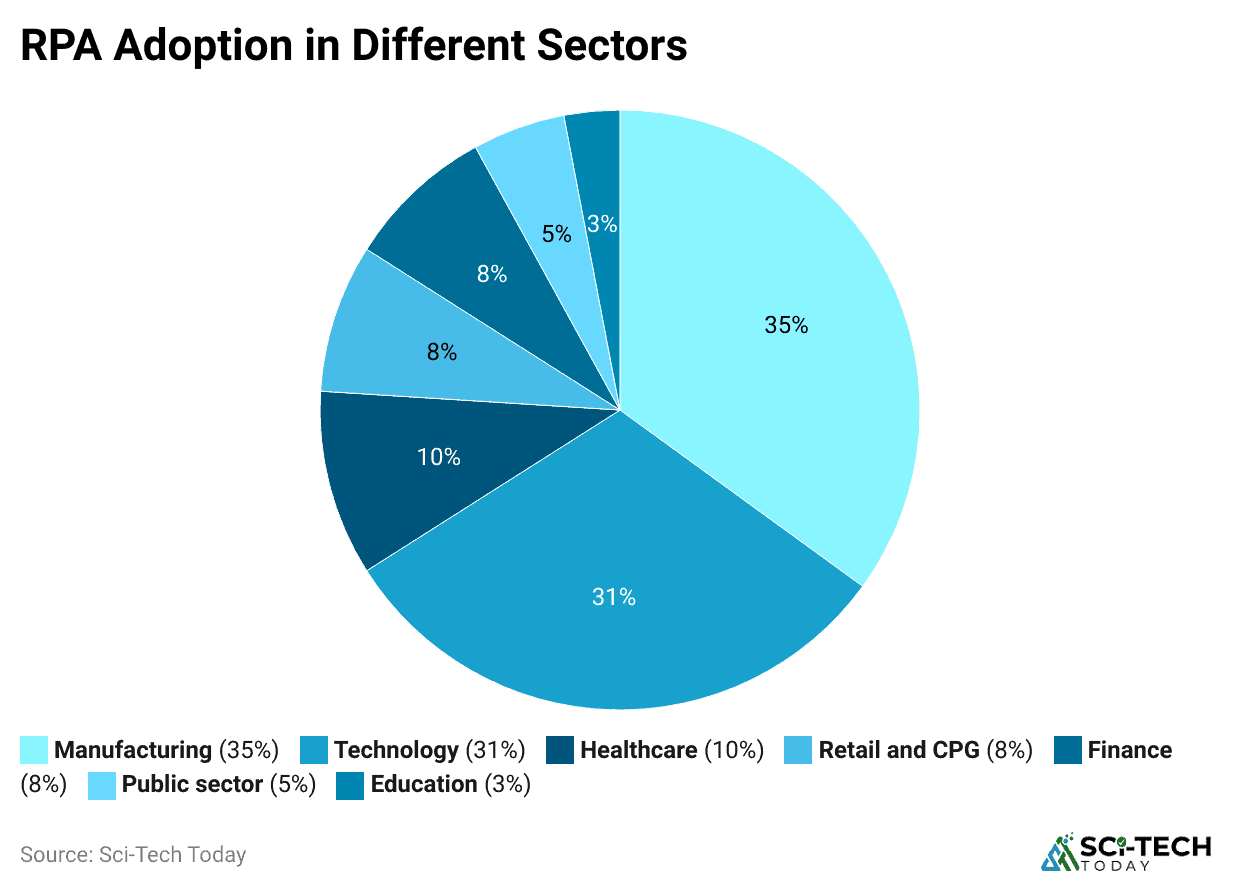
- The IPA market was estimated at USD 14.55 billion in 2024 and is projected to skyrocket to USD 44.74 billion by 2030, a powerful CAGR of 22.6%.
- The specialized Cognitive Process Automation CPA market is expected to surge from USD 10.0 billion in 2025 to USD 127.0 billion by 2034, expanding at an aggressive CAGR of 32.7%.
- Within the CPA market, the Robotic Process Automation RPA segment remains the most established, capturing a dominant share of over 65.7% in 2024.
- Machine Learning ML technology accounts for a significant 26.7% of the global CPA market in 2024.
- The cloud-based deployment segment holds the largest revenue share in the Intelligent Process Automation IPA industry, commanding a hefty 62.87% of the market in 2024.
- The BFSI sector is the most aggressive adopter of CPA, commanding a massive 68.4% of the global market share in 2024.
- Gartner predicts that by 2025, a stunning 70% of all newly developed enterprise applications will utilize low-code or no-code technologies, a dramatic increase from less than 25% in 2020.
- 92% of all corporate executives anticipate actively implementing AI-enabled automation solutions within their core workflows by the end of 2025.
| Cognitive & Intelligent Automation Statistics 2024–2034 | Data Point |
| Cognitive Automation CAGR 2025 to 2034 | 32.7% |
| Intelligent Automation Market Size 2030 | USD 44.74 Billion |
| RPA Market Share in CPA | 65.7% |
| Machine Learning Share in CPA | 26.7% |
| Low-Code/No-Code Adoption 2025 | 70% |
| BFSI Share of CPA Market | 68.4% |
| AI Integration Plan 2025 | 92% |
| North America CPA Revenue Share | 32.7% |
Employee Productivity and Job Impact
(Source: make.com)
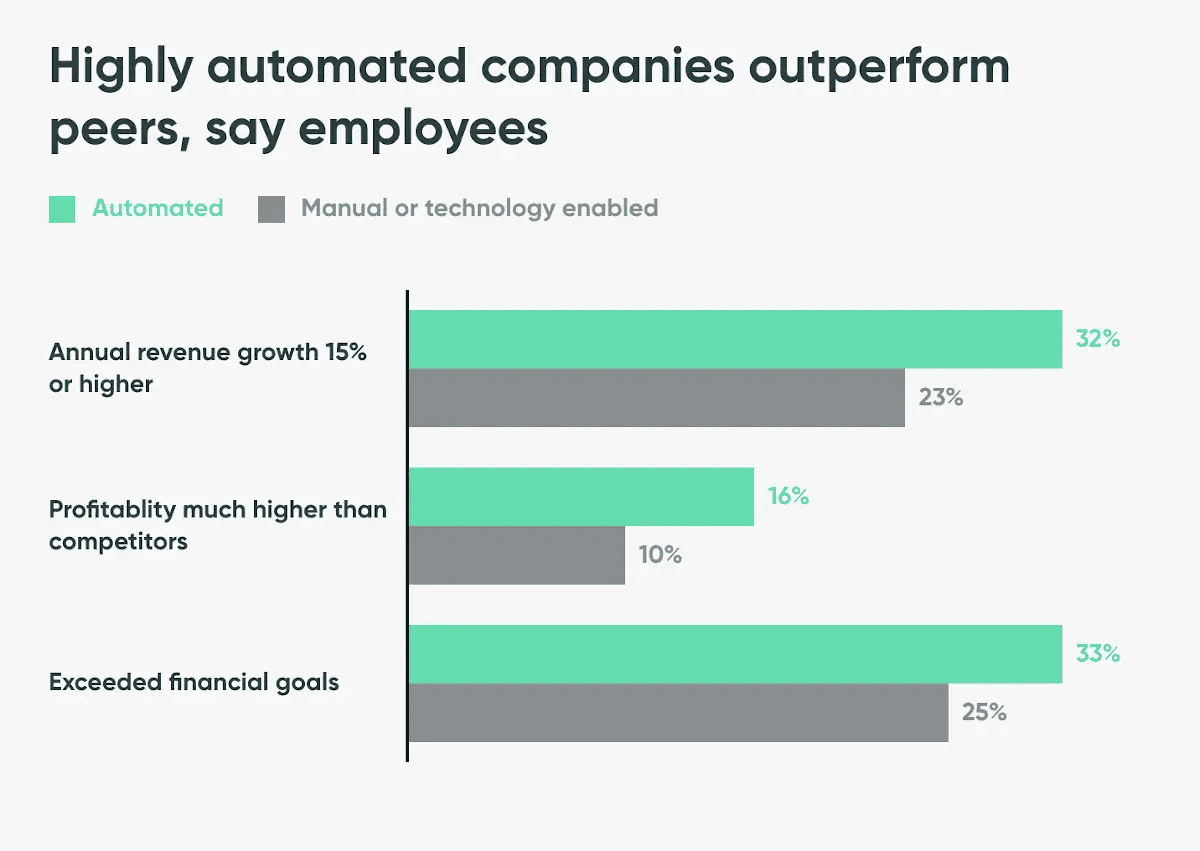
- A high majority of 90% of knowledge workers report that the introduction of automation has directly led to an overall improvement in their job quality and satisfaction.
- Among employees who use automated systems, 66% report experiencing a significant and measurable boost in their daily productivity.
- Over two-thirds of employees 68% report feeling consistently overwhelmed by their daily workload.
- A significant 85% of business leaders assert that automating repetitive tasks is important.
- A strong 74% of employees express their willingness to learn new skills or retrain entirely to remain employable.
- Nearly nine out of ten employees 88% who regularly use automation tools express a high level of trust in the accuracy and reliability of the automated outputs.
- Research by McKinsey estimates that roughly 50% of all work activities across the entire economy are technically automatable using currently existing technology.
- Employees lose as much as 40% of their total productivity due to constant task switching and context changing.
- Company leaders conservatively estimate that automating mundane tasks could save their employees an average of up to 360 hours annually, freeing up almost nine work weeks per person for high-value tasks.
- While generally positive, 37% of survey respondents express a legitimate worry that the increasing pace of automation may eventually put their current jobs at risk.
| Employee & Productivity Workflow Automation Statistics | Data Point |
| Knowledge Worker Job Quality Improvement |
90% |
|
Employee Productivity Boost |
66% |
| Activities Eligible for Automation |
50% |
|
Business Leader Focus change |
85% |
| Employee Willingness to Upskill |
74% |
|
Trust in Automation Accuracy |
88% |
| Annual Estimated Time Saved per Employee |
360 Hours |
|
Productivity Loss from Task Switching |
40% |
Key Trends and Future Projections – Hyperautomation and AI
(Source: colaninfotech.com)
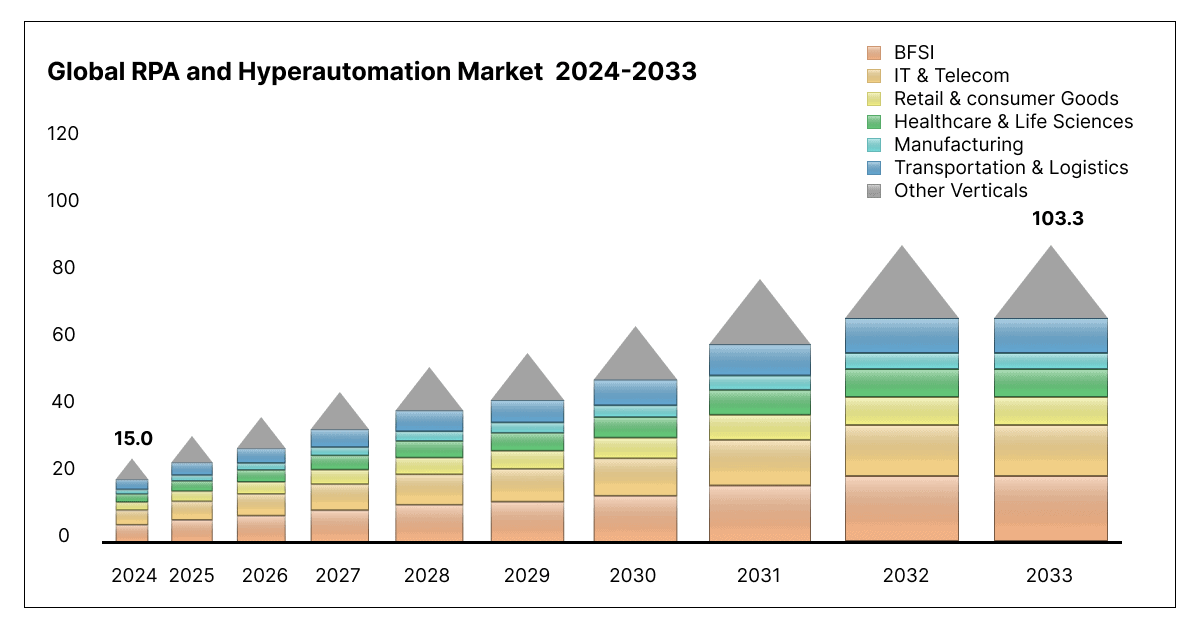
- Investment in specialized hyperautomation software solutions is projected to exceed a monumental USD 720 billion in the near future.
- The rise of Agentic AI, autonomous, self-learning software agents, is expected to drive broader adoption in areas like customer service routing and project management.
- Automation is becoming a critical tool in security, with a strong 68% of global businesses actively seeking ways to improve their overall cybersecurity posture through automated threat detection and response.
- Retail Automation Spending: Investment in retail automation, particularly for warehouse logistics and e-commerce fulfillment, is projected to reach USD 51 billion by 2030, growing at a powerful CAGR of 23%.
- The global Industrial Automation Services Market is forecast to grow from USD 147.06 billion in 2019 to USD 264.69 billion by 2026.
- A substantial 83% of IT industry leaders firmly believe that robust workflow automation is an absolute necessity for achieving any successful large-scale digital transformation within the modern enterprise.
- A massive 94% of corporate executives express a strong preference for using a single, unified platform for their app integration and process automation needs, rather than struggling with a complex patchwork of multiple, disparate systems.
|
Hyperautomation & Future Trend Statistics |
Data Point |
| Hyperautomation Investment Forecast |
USD 720+ Billion |
|
Retail Automation Market Size 2030 |
USD 51 Billion |
| Retail Automation CAGR |
23% |
|
Industrial Automation Market Size 2026 |
USD 264.69 Billion |
| IT Leader Belief in Automation Necessity |
83% |
|
Preference for Unified Platforms |
94% |
| Businesses Automating at Least Five Divisions |
33% |
|
Cybersecurity Improvement Focus |
68% |
Conclusion
Overall, these workflow automation statistics serve as a powerful, unified narrative. The data is clear: whether it’s the 32.7% CAGR of the Cognitive Process Automation market, the 70% reduction in claims processing time, or the fact that 90% of knowledge workers feel their job has been improved, the results are ly positive.
Companies that get the power of workflow automation are restructuring their operations to achieve efficiency, accuracy, and scalability that was impossible just a decade ago. I hope you like this article. Thanks for staying up till the end. If you have any questions, kindly let us know.

Sources