









Overview
Credit Card Ownership and Usage Statistics: Credit cards are now a common part of everyday spending. People use them to pay bills, shop online, cover emergencies, and manage monthly expenses. But how many people actually own a credit card, and how often do they use one? Credit card ownership and usage can vary widely based on age, income, location, and spending habits. At the same time, rising costs and changing consumer habits are influencing how people borrow and repay their balances. These trends offer a clear picture of how consumers use credit today. In this article, we explore key statistics on credit card ownership and usage, including card adoption, spending patterns, debt levels, and repayment behavior.
Featured Choice
- The global credit card payments market is valued at USD 623.3 billion in 2025 and is projected to reach USD 1.16 trillion by 2033, growing at an 8.07% CAGR.
- Digital payment adoption, contactless transactions, e-commerce, and reward-led spending are major drivers of market growth.
- U.S. credit card balances reached a record USD 1.233 trillion in Q3 2025.
- About 216.3 million U.S. adults hold a credit card, with roughly 1.30 billion cards in circulation.
- U.S. credit card accounts are forecast to rise from 658 million in 2025 to 731 million by 2027.
- Chase leads U.S. issuer purchase volume at USD 1.21 trillion, ahead of American Express at USD 1.02 trillion.
- Credit cards account for approximately 35% of U.S. retail transactions.
- Online purchases represent 44% of credit card transactions.
- Nearly 48% of U.S. cardholders carried a balance in 2025, underscoring rising affordability pressures.
- Global credit card fraud losses are projected to reach USD 43 billion by 2026.
Global Credit Card Payments Market Overview

(Source: market.us)
- The global credit card payments market was valued at USD 623.3 billion in 2025.
- It is projected to reach USD 673.6 billion in 2026, driven by rising adoption of digital payments.
- By 2033, the market is expected to grow to USD 1,159.7 billion.
- This growth reflects a strong compound annual growth rate of 8.07% between 2024 and 2033.
- The global payments market generated over USD 1.6 trillion in 2023 and is expected to reach USD 2.2 trillion by 2027, supported by rising transaction volumes and advances in payment technology.
- In the U.S., average credit card debt increased 10% to USD 6,360, while total debt reached USD 1.13 trillion. Delinquency rose to 3.1%, the highest since 2011.
- Canada, Israel, and Iceland recorded credit card ownership rates above 74%, while U.S. credit card balances exceeded USD 1.1 trillion in 2023. UK balances also continued to rise.
United States Credit Card Market Statistics
- According to Capital One Shopping, research is projected to hold 1.45 billion credit cards by 2030.
- About 216.3 million U.S. adults have a credit card account in their name.
- Active credit card accounts increased 44.3% between 2005 and 2025.
- The average number of credit accounts per cardholder rose 28.7% from 2.4 in 2020.
- About 30.1% of consumers apply for a new credit card each year, and 87.1% of applications are approved.
- The average total credit limit is USD 33,980 per consumer, while the average balance reached USD 6,768 in 2025.
- In the past year, 17.4% of cardholders requested higher limits, and 74.3% of those requests were approved.
Credit Card Usage And Account Trends In The U.S.
- Most American adults, around 81%, carry at least one credit card.
- Worldwide, about 1.25 billion people use credit cards, while the U.S. alone has 1.30 billion credit cards in circulation.
- On average, an American cardholder actively uses 3.0 credit cards.
- Credit cards account for 35% of all U.S. retail transactions, showing their major role in daily spending.
- Over 74% of American businesses hold at least one company credit card.

(Source: imagedelivery.net)
- The number of U.S. credit card accounts has grown steadily, rising from 617 million in 2024 to 658 million in 2025.
- This number is projected to reach 694 million in 2026 and further climb to 731 million by 2027.
Credit Score Trends
- The average U.S. credit cardholder makes up to 264 purchases per year.
- Consumers with credit scores of 680 or below are the most likely to apply for new cards, at 35.9% annually.
- Among consumers with scores between 681 and 759, 32.9% applied for a credit card in the past year.
- For consumers with scores of 760 or higher, 30.2% applied for a new card.
- The average consumer credit score reached 713 in 2025.

(Source: imagedelivery.net)
- Very good scores (740-799) account for 27.5%, followed by exceptional scores (800-850) at 22.8%.
- Good scores (670-739) account for 20.1%, while fair scores (580-669) account for 14.9%.
- Poor scores (300-579) account for the remaining 14.7% of cardholders.
Age-Based Credit Card Statistics
- Consumers aged 41 to 59 are the most likely to apply for credit cards, while those aged 40 and younger are most likely to request higher credit limits.
- 32.2% of consumers aged 40 and younger apply annually, 6.98% above the overall rate. Also, 25.7% requested a credit limit increase in 2025.
- Among consumers aged 41 to 59, 33.7% applied for a card, while 18.8% requested a limit increase.
- For consumers aged 60 and older, 24.7% applied for cards and 9.4% requested higher limits.
- Consumers aged 45 to 79 have an average of 4.4 active cards, compared with 3.4 for those aged 29 to 44 and 2.2 for those aged 18 to 28.
Global Payment Processor Market Statistics

(Source: fungies.io)
- The payment processor market grew from USD 63.87 billion in 2025 to USD 71.15 billion in 2026.
- It is expected to reach USD 122.08 billion by 2031, growing at an 11.4% CAGR.
- The broader payment processing solutions market is estimated at USD 173.38 billion in 2025 and USD 208.57 billion in 2026.
- It could reach about USD 1.05 trillion by 2035, representing a 19.76% CAGR.
- The global payments industry generated USD 2.2 trillion in revenue in 2022 and is forecast to reach USD 3.2 trillion by 2027, with a 7% CAGR.
- The real-time payments market is projected to grow from USD 34.16 billion in 2025 to USD 47.06 billion in 2026 and USD 498.99 billion by 2034, at a 34.3% CAGR.
Regional Market Trends
- According to fungies.io, North America remains the largest market, accounting for around 29.6% to 47% of global payment processing activity. U.S. payment processing solutions revenue could reach USD 36.75 billion by 2030.
- Asia-Pacific is growing the fastest, recording a 14.48% CAGR. The region generated about 47% of global payments revenue, or USD 1 trillion, while annual growth reached 25%, excluding China, which declined 3%.
- India processed more than 130 billion digital payment transactions in 2025. UPI handled over 75% of transaction volumes, exceeding 13 billion transactions each month.
- Europe’s payment gateway market is projected to grow at an 11% CAGR between 2023 and 2030, rising from USD 37.8 billion to USD 78.6 billion. Euro-area card payments reached 44 billion transactions in H1 2025, up 9.6% year over year.
- Contactless payments represented 83% of non-remote card transactions by volume and 67% by value in Europe.
- Latin America is also moving quickly toward digital payments. Brazil’s Pix usage increased by 74% in 2023.
Credit Card Ownership by State
| State | Average Cards per Cardholder | Estimated Total Credit Cards (millions) |
| California | 3.8 | 95.5 |
| Texas | 3.8 | 72.7 |
| Florida | 4 | 61.1 |
| New York | 3.9 | 50.2 |
| Pennsylvania | 3.8 | 32.2 |
| Illinois | 3.9 | 31.6 |
| Ohio | 3.8 | 28.7 |
| Georgia | 3.7 | 25.9 |
| New Jersey | 4.2 | 25.4 |
| North Carolina | 3.6 | 25.3 |
Average Credit Card Balances by U.S. State

(Source: coinlaw.io)
- Alaska tops the list with average credit card debt of USD 8,100 per consumer, followed closely by Washington, D.C., at USD 7,900.
- New Jersey, Hawaii, and Connecticut all report similar balances near USD 7,600, while Maryland and Colorado follow at USD 7,500 and USD 7,300.
- Texas and Virginia both average USD 6,500 in card debt, with Florida trailing slightly at USD 6,400.
By Age Group in the U.S.
| Age Group | Average Credit Card Debt (USD) |
| Gen Z | 3,493 |
| Millennials | 6,961 |
| Gen X | 9,600 |
| Baby Boomers | 6,795 |
| Silent Generation | 3,445 |
Credit Card Usage Statistics
(Reference: imagedelivery.net)
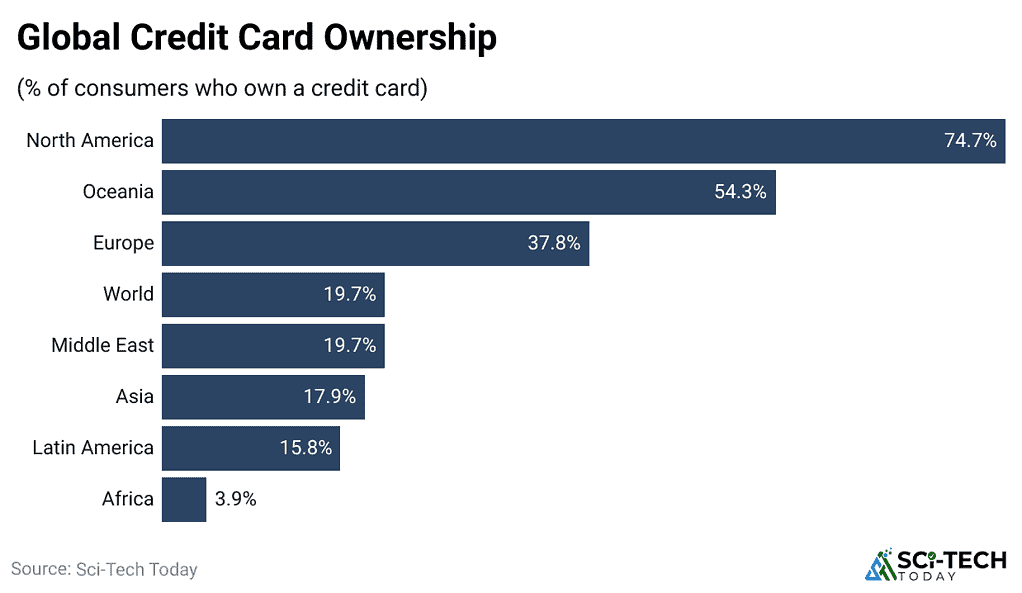
- North America leads with 74.7% of consumers owning a credit card, followed by Oceania (54.3%) and Europe (37.8%).
- Globally, the share of consumers who own a credit card is 19.7%, which is the same as in the Middle East (19.7%).
- Usage rates are lower in Asia (17.9%) and Latin America (15.8%), and are lowest in Africa (3.9%).
Credit vs Debit Card Usage Across U.S. Income Groups
| Income Group (USD) | Credit Card Usage | Debit Card Usage |
| Under 25,000 | 18.3% | 71.6% |
| 25,000-49,999 | 29.6% | 67.4% |
| 50,000-74,999 | 42.9% | 54.6% |
| 75,000-99,999 | 58.3% | 39.9% |
| 100,000-124,999 | 65.0% | 32.0% |
| 125,000-149,999 | 56.5% | 40.3% |
| 150,000-249,999 | 65.1% | 33.7% |
Americans Have At Least One Credit Card Statistics
(Reference: bankrate.com)
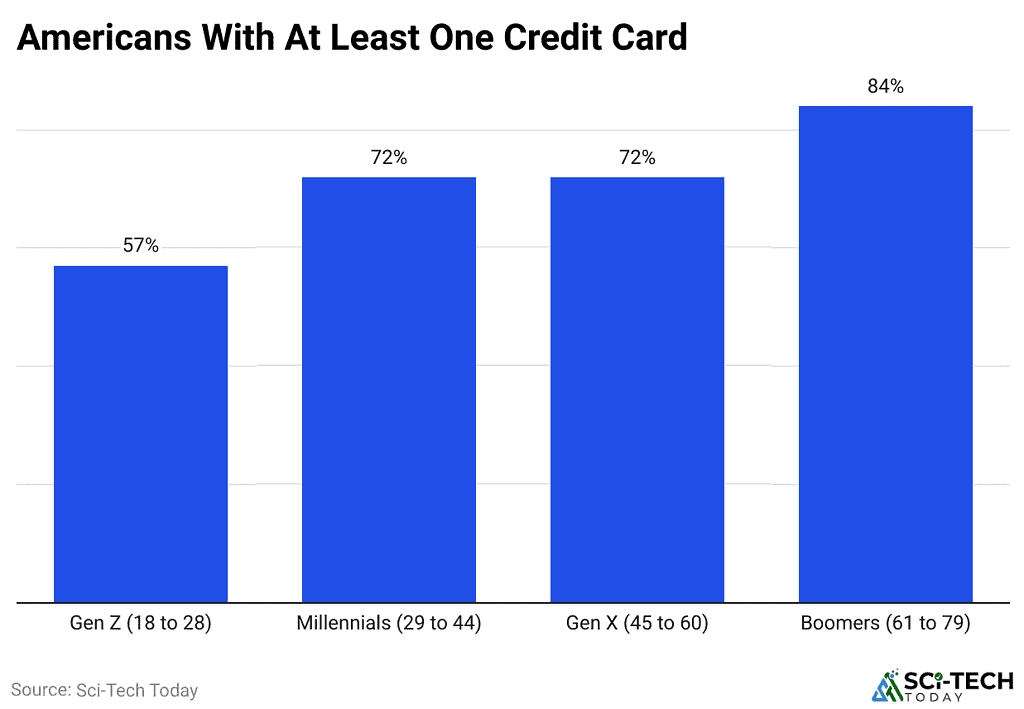
- Among boomers ages 61-79, 84% have at least one card; Gen X ages 45-60 and millennials ages 29-44 both sit at 72%, while Gen Z is lower at 57%.
- Card ownership is close between genders: 74% of men have cards, compared with 72% of women.
- 90% of people earn more than USD 100,000, followed by 88% (USD 80,000-USD 99,999), 83%(USD 50,000-USD 79,999), and 61% (under USD 50,000).
- Suburban residents lead at 77%, followed by city (73%), rural (69%), and town (66%). By race, rates are 77% White, 71% Hispanic, 56% Black, and 67% other races.
- In the U.S., the South has the highest credit card share at 52%, followed by the Midwest at 45% and the Northeast at 43%, whereas the West has the lowest share at 41%.
Number of Credit Cards Issued by Country (2024 vs. 2029 Forecast)
| Country | Credit Cards Issued 2024 (Millions) | Credit Cards Issued 2029 (Millions) |
| United States | 1,211.5 | 1,390.5 |
| China | 796.1 | 741.5 |
| Brazil | 543.6 | 611.1 |
| Japan | 318.7 | 336.2 |
| South Korea | 133.7 | 157.0 |
| Turkey | 125.2 | 197.6 |
| India | 109.0 | 201.2 |
| Canada | 77.2 | – |
| United Kingdom | 55.9 | 50.2 |
| Spain | 48.8 | 66.5 |
| Argentina | 48.5 | 50.6 |
| Mexico | 36.5 | 61.5 |
| Germany | 34.2 | 42.7 |
| France | 29.3 | – |
| Italy | 20.8 | – |
| Hong Kong | 19.5 | 20.0 |
| Indonesia | 17.4 | 18.8 |
| Australia | 16.5 | 12.8 |
| Singapore | 15.2 | 43.1 |
| Portugal | 12.6 | 3.9 |
| Switzerland | 9.0 | 10.7 |
| Netherlands | 7.4 | 5.9 |
| Sweden | 6.6 | 4.2 |
| Belgium | 6.0 | 9.4 |
| Poland | 5.3 | 8.5 |
| Finland | 5.0 | 6.5 |
| Saudi Arabia | 3.7 | 5.6 |
| Austria | 3.4 | 4.2 |
| Romania | 3.0 | 2.5 |
| Luxembourg | 2.9 | 4.4 |
| Greece | 2.3 | 2.9 |
| Ireland | 1.8 | 1.6 |
| Croatia | 1.6 | 1.4 |
| Bulgaria | 1.4 | 1.0 |
| Czechia | 1.3 | 0.8 |
| Hungary | 1.2 | 1.4 |
| Slovenia | 0.8 | 0.3 |
| Slovakia | 0.5 | 0.4 |
| Estonia | 0.4 | – |
| Lithuania | 0.4 | 0.7 |
| Latvia | 0.3 | 1.4 |
United States Credit Card Issuer Market Share
- Chase leads the U.S. credit card market, accounting for about 17.27% of purchase volume.
- American Express ranks second with a 12.31% market share.
- Citi holds approximately 10.94%, slightly ahead of Capital One at 10.74%.
- Bank of America represents around 9.23% of U.S. credit card purchase volume.
- Discover holds roughly 5%-8%, depending on the network coverage used for measurement.
- Wells Fargo and U.S. Bank each account for about 4%-5%, placing both issuers among the leading players.
Credit Card User Preferences
- Coin Law reports that in 2025, credit cards remained the main payment tool for 52.8% of U.S. adults.
- 91% of Millennials own at least one credit card, followed by 83% (Gen X) and 68% (Baby Boomers).
- Value drives selection. Among cardholders, 81% say cash back matters most.
- Credit cards linked to Apple Pay, Google Pay, and Samsung Pay are up 49% year over year.
- Online purchasing now accounts for 44% of credit card transactions.
- The average shopper holds 4.3 cards, but people earning over USD 150K often carry 6 or more to stack rewards.
- Additionally, 62% use card-linked loyalty programs, and 84% of them prioritise travel benefits.
Credit Card Issuers Statistics By Purchase Volume
(Source: coinlaw.io)
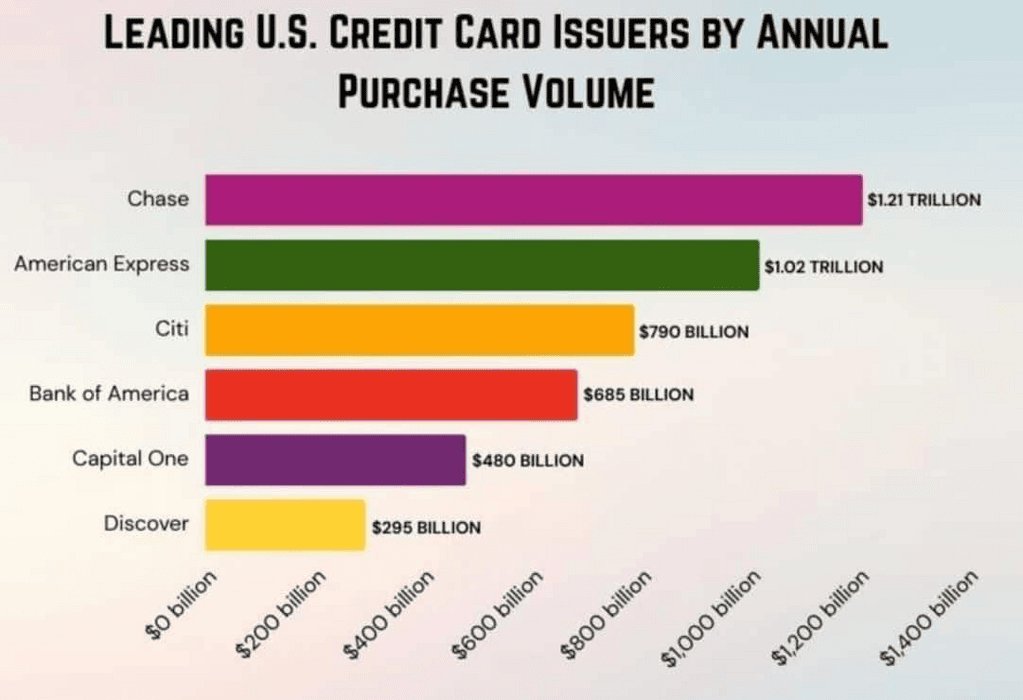
- In 2025, Chase led U.S. issuers in purchase volume, with USD 1.21 trillion in purchase volume.
| Company | Valuations of 2025 (USD) |
| American Express | 1.02 trillion |
| Citi | 790 billion |
| Bank of America | 685 billion |
| Capital One | 480 billion |
| Discover | 295 billion |
Reasons People Choose Credit Cards Over Other Payment Methods
- According to Expensify.com, tap-to-pay reduces checkout time by 63%, so payments are much quicker than using cash.
- Approximately 77% of shoppers choose credit cards primarily for better fraud protection than debit cards.
- Rewards typically return approximately 1.6 cents per dollar spent, and building credit matters to 41% of Gen Z and 40% of millennials who often use cards.
Credit Card Spending Habits Statistics
- Less than 50% of adult card users carried a balance during the last 12 months.
- Meanwhile, credit cards pay for 33% of restaurant purchases.
- Still, card users spend the most at restaurants, amounting to nearly USD 30 billion annually.
- In 2024, more than 80% of U.S. shoppers used credit or debt to finance the holidays.
- Online purchases account for 69%, and 32% are made via mobile devices.
Credit Card Usage Statistics By Demographics
- Approximately 60% of Gen Z reported having a credit card in their early 20s, whereas 54.5% of millennials reported having one at the same age.
- On average, an American carries about 3.9 active credit cards.
- Credit cards account for approximately 31% of total retail spending.
United States Credit Card Debt Statistics
- U.S. credit card balances reached a record USD 1.233 trillion in Q3 2025, up from USD 1.21 trillion in the previous quarter.
- Credit card revolving debt stood at about USD 1.21 trillion in 2025, showing continued reliance on credit.
- Nearly 48% of American cardholders carried balances from month to month in 2025, up from 44% a year earlier.
- Federal Reserve data showed that about 46% of adult cardholders carried a balance for at least one month during 2025.
- Around 47% of borrowers cited unexpected or emergency expenses as the main reason for their credit card debt.
- Overall household debt delinquency reached 4.5% in 2025.
By Age Group Analyses
| Age group (Years) | Typical (median) credit card debt (USD) | Average credit card debt (USD) | Share with credit card debt |
| 18-34 | 1,700 | 4,070 | 48.5% |
| 35-44 | 2,900 | 6,370 | 52.6% |
| 45-54 | 3,000 | 6,660 | 57.0% |
| 55-64 | 3,500 | 7,530 | 44.3% |
| 65-74 | 3,500 | 7,720 | 33.9% |
| 75+ | 1,700 | 3,990 | 29.8% |
States with the Highest Average Credit Card Debt

(Source: infogram.com)
| State | Avg. Credit Card Debt Q1 2026 (USD) | Avg. Credit Card Debt Q1 2025 (USD) | % Difference Q1 25 to Q1 26 |
| New Jersey | 9,733 | 9,346 | 4.1% |
| Connecticut | 9,645 | 9,172 | 5.2% |
| District of Columbia | 9,511 | 8,843 | 7.6% |
| California | 9,421 | 9,088 | 3.7% |
| Hawaii | 9,334 | 8,854 | 5.4% |
| Colorado | 9,319 | 8,597 | 8.4% |
| Maryland | 9,219 | 9,227 | -0.1% |
| Florida | 9,153 | 8,991 | 1.8% |
| Massachusetts | 8,888 | 9,124 | -2.6% |
| New York | 8,847 | 8,715 | 1.5% |
U.S. Credit Card Balance And Interest Rate Statistics
- According to the Federal Reserve’s May 2026 report using 2025 data, 45% of adult credit cardholders carried a balance for at least one month during the past year.
- In Q2 2026, the average APR for all current credit card accounts was 20.94%, while cards that charged interest averaged 22.15%.
- The average APR for interest-bearing cards increased from 21.52% in Q1 2026 to 22.15% in Q2 2026, while the average APR across all current accounts decreased slightly from 21.00% to 20.94%.
- The average APR on new credit card offers reached 23.80%, with typical offers ranging from 20.20% to 27.41%, according to LendingTree’s review of about 220 U.S. credit cards.
- Credit card APRs varied by category, with low-interest cards averaging 17.31%, airline cards 24.03%, and secured cards 26.09%.
Credit Cards Daily Spending Statistics By Industry
- Coinlaw.io reports that in 2025, retail accounted for 28%, while dining out and food delivery accounted for 23%, and travel and transport for 16%.
- Followed by Groceries (12%), Health (9%), Digital entertainment (11%), Education and child care (3%).
Credit Card Statistics By Application And Rejection Rates
- As of 2025, 27% of credit card applications were denied, and among people under 30, the primary reason was low scores.
- Approximately 43% of millennials applied for at least one new card, but credit and income checks resulted in an 18.5% rejection rate.
- If the score is below 600, denials exceed 42%.
- High-income homes saw only 6.5% denied.
- Premium rewards approvals now average 728, while prequalification cuts rejections by 13%.
- Men are approved at 73%, and women at 69%.
The Impacts of Economic Factors
- According to Expensify.com’s 2025 report, with inflation remaining high, middle-income families are using credit cards 18% more for daily expenses.
- By early 2026, total U.S. credit card debt had risen to more than USD 1.17 trillion, while average interest rates reached 22.8%.
- Emergencies account for 25% of surprise billing charges, primarily due to medical bills.
Credit Card Theft And Fraud Statistics
- Global credit card fraud losses are expected to reach USD 43 billion by 2026.
- Account takeover fraud has become the most common type, accounting for 33% of reported credit card fraud incidents.
- California, Florida, and Texas together account for 43% of reported fraud cases, making them the leading states in credit card fraud.
- Online shopping also carries significant risks, with 80% of consumers reporting that they were targeted by or became victims of fraud during the holiday season.
Why Consumers Prefer Credit Cards
- Tap-to-pay reduces transaction times by 63%, making checkout faster than cash, according to Expensify.
- About 77% of consumers prefer credit cards because they offer stronger fraud protection than debit cards.
- Credit card rewards provide general-purpose cardholders with an average return of 1.6 cents per dollar spent.
- About 41% of Gen Z and 40% of Millennials use credit cards regularly to build their credit history.
Wrap-Up
Contactless and tap-to-pay payments are becoming a common part of everyday spending. People prefer them because they are fast, simple, and convenient. At the same time, more businesses are adding contactless payment options to meet changing customer needs. As smartphones, digital wallets, and contactless cards become more popular, usage is expected to rise further. Better security and wider acceptance will also build user confidence, making tap-to-pay an important part of the future of payments.
FAQ
People use credit cards for convenience, rewards, security, and flexible payment options.
People own an average of about 3 credit cards, though ownership varies significantly by country and consumer group.
People use credit cards frequently, often for everyday purchases, bills, and online shopping.

Sources