









Introduction
Diversity In Tech Statistics: Technology is transforming the way we live, work, and connect, but is it providing everyone with a fair shot? Although the tech world leads in innovation, it still lacks diversity in areas such as race, gender, age, and background.
This gap doesn’t just hurt job seekers; it also impacts how products are developed, how teams operate, and how effectively companies perform. In this article, “Diversity In Tech Statistics “, you’ll find out which groups are still underrepresented and learn why building a more inclusive tech industry is important for future success, fairness, and fresh ideas.
Editor’s Choice
- In the United States, women represent only 26% of the computing workforce, while African American women hold just 3% of computing-related jobs.
- Software developer roles employ 343,889 women, accounting for 21% of the workforce.
- As of mid-2026, men continue to dominate the technology workforce, representing 70% of employees, while women account for the remaining 30%.
- Women in computer science roles earn about 94% of what men earn.
- Within the technology workforce, 58% are White, followed by 22% Asian Americans, while Latinx and Black professionals account for 9% and 7%, respectively.
- In many U.S. tech communities, only 11% of professionals report having a disability or being neurodiverse.
- LGBTQ+ employees are 20% less likely to receive promotions and are about 20% less represented in STEM roles than expected.
- Among Google, Facebook, and Microsoft companies, White and Asian employees together dominate 85%-87% of high-tech roles, while Hispanic and Black employees remain critically underrepresented, each consistently falling below 9%.
- Among all roles, the AI/ML Engineer commands the highest salary ceiling, with high-end starting compensation reaching approximately USD 220,000.
- around 67% of tech workers come from professional or managerial families, while only 19% come from working-class backgrounds, compared with 33.3% nationally.
Diversity, Inclusion, and Workforce Trends in Technology
- In the United States, women represent only 26% of the computing workforce, while African American women hold just 3% of computing-related jobs.
- Companies in the top quartile for racial and ethnic diversity are 35% more likely to achieve above-average financial performance.
- Key strategies for improving diversity include expanding recruitment pipelines, creating inclusive workplaces, and reducing unconscious bias.
- About 39% of Gen Z workers view the tech industry as male-dominated, although 80% are satisfied with pay transparency.
- Nearly 64% of Gen Z professionals found it harder than expected to secure their first tech job.
- Around 59% of companies struggle to retain diverse talent, even though 86% believe their DEI efforts are effective.
- Approximately 58% of employers are considering removing degree requirements, and 71% report positive diversity outcomes from anti-bias hiring practices.
- Nearly 47% of Gen Z tech specialists aspire to work in Big Tech companies.
Women’s Representation in U.S. Technology Jobs
(Reference: sqmagazine.co.uk)
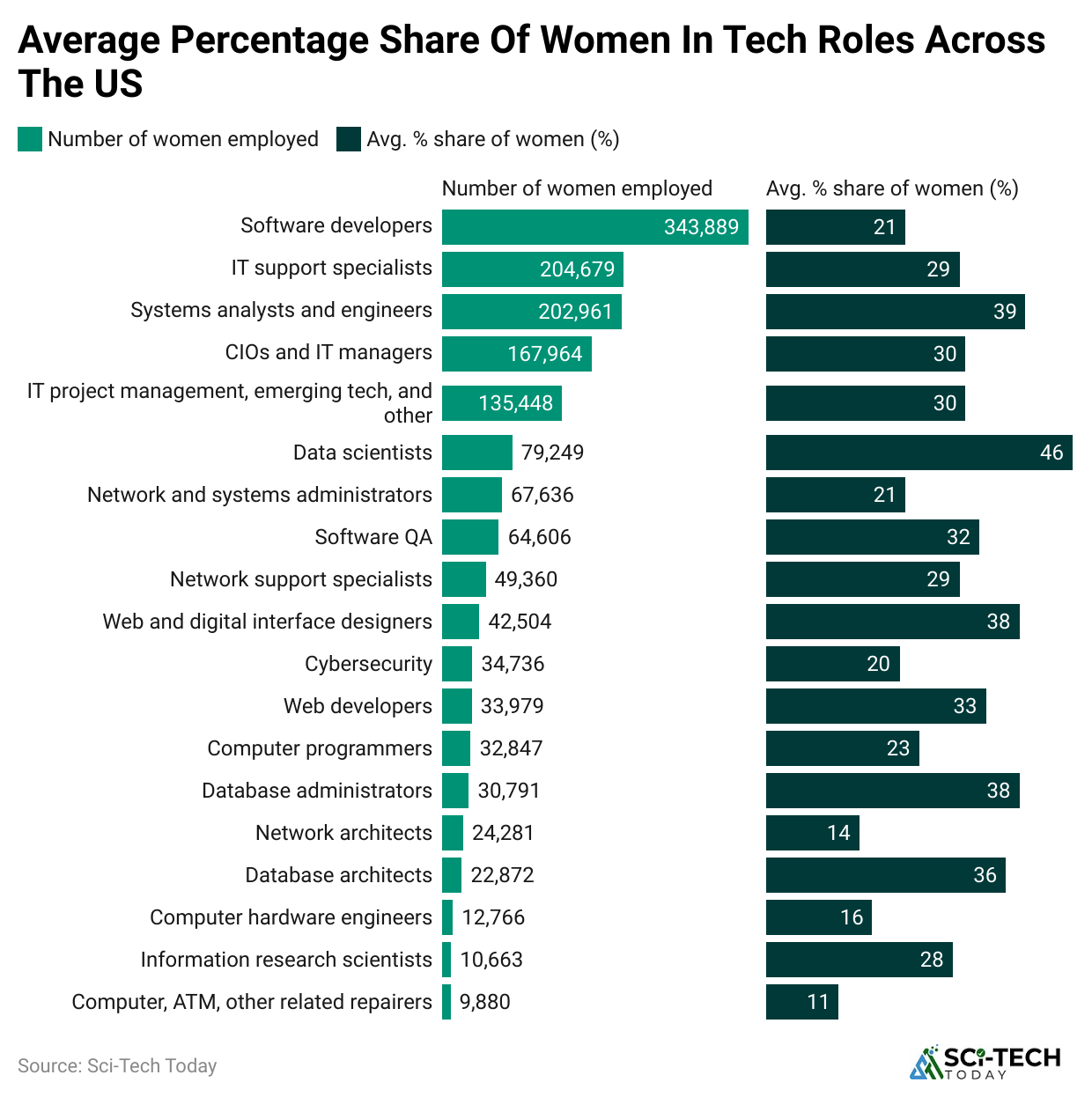
- The graphical representation above shows that software developer roles employ 343,889 women, accounting for 21% of the workforce.
- IT support specialist positions include 204,679 women, resulting in 29% of employees.
- Systems analysts and engineers have 202,961 women, representing a relatively high share of 39%.
- CIO and IT manager roles employ 167,964 women, making up 30% of leadership positions.
- IT project management and emerging technology roles include 135,448 women, accounting 30% of the workforce.
- Data science has the strongest gender diversity, with 79,249 women holding 46% of roles.
- Network and systems administration remained male-dominated, with 67,636 women representing 21% of workers.
- Software QA positions employed around 64,606 women (32%), while network support specialist roles include 49,360 women (29%).
- Women account for 42,504 web and digital interface designers (38%) and 33,979 web developers (33%).
- Cybersecurity has only 34,736 women (20%), while computer programmers include 32,847 women (23%).
- Database administrators employ 30,791 women (38%), database architects 22,872 (36%), network architects 24,281 (14%), hardware engineers 12,766 (16%), information research scientists 10,663 (28%), and computer and ATM repair workers 9,880 (11%), the lowest share among all roles.
Gender Diversity in the Tech Industry
- As of mid-2026, men continue to dominate the technology workforce, representing 70% of employees, while women account for the remaining 30%.
- Female participation is higher in design and UX roles, with representation ranging from 40% to 46%.
- Emerging fields remain male-dominated, with women comprising 22% of AI/ML specialists and 14%-18% of DevOps and cloud professionals.
- Women account for about 28% of tech workers in the U.S., 26% in the EU, and 34% in India.
- In major technology hubs such as the Bay Area and Austin, women represent only 28%-31% of tech employees.
- Women hold just 18% of technology leadership positions and only 11% of C-suite roles.
- By occupation, women represent approximately 22% of software engineers, 31% of data scientists, and 35% of product managers.
- Representation gaps are even wider for women of color; for example, Black women account for only 0.6% of UK IT specialists.
Diversity in Tech Statistics by Gender Gap
- SQ Magazine further mentioned that women in computer science roles earn about 94% of what men earn.
- In 62% of technology job postings, men are offered higher salaries measured in USD.
- Women are 65% more likely to be laid off during technology industry downturns.
- About 78% of women report working harder than their male coworkers to prove their abilities.
- Promotion rates are 15.9% for women compared with 13.6% for men.
- Burnout affects 57% of women versus 36% of men.
By Race and Ethnic
- According to Zippia, within the technology workforce, 58% are White, followed by 22% Asian Americans, while Latinx and Black professionals account for 9% and 7%, respectively.
- This indicates a wage gap of approximately 5.56% in favor of White employees.
- Asian American candidates are typically offered around USD 145,000 after salary negotiations, followed by White American candidates (USD 144,000) and Black American candidates (USD 134,000).
- As of 2026, 68% of technology companies have fewer than 5% Black employees
Disability and LGBTQ+ Representation in Tech
- In many U.S. tech communities, only 11% of professionals report having a disability or being neurodiverse.
- In the U.K., people with disabilities represent 16% of the overall workforce but only 11% of technology specialists.
- Around 88,000 people with visible or hidden disabilities are estimated to be missing from the tech workforce.
- Inclusive hiring initiatives have shown promise, with 10 new hires emerging from a pool of 50 disabled developers who participated in specialized hackathons.
- Only 2%-3% of tech workers openly identify as LGBTQ+.
- LGBTQ+ employees are 20% less likely to receive promotions and are about 20% less represented in STEM roles than expected.
- Approximately 20% report hiding their identity at work, while 65% have experienced verbal harassment or microaggressions.
- More than 40% of large technology companies now operate LGBTQIA+ employee resource groups.
Racial Demographics in High-Tech Companies
- In 2024–25, women comprised approximately 22% of all tech jobs in Europe. In the U.S., women held about 21% of software developer positions.
- The highest share of women in any U.S. tech role was in data science, where they comprised nearly 46% of the workforce.
(Reference: zippia.com)
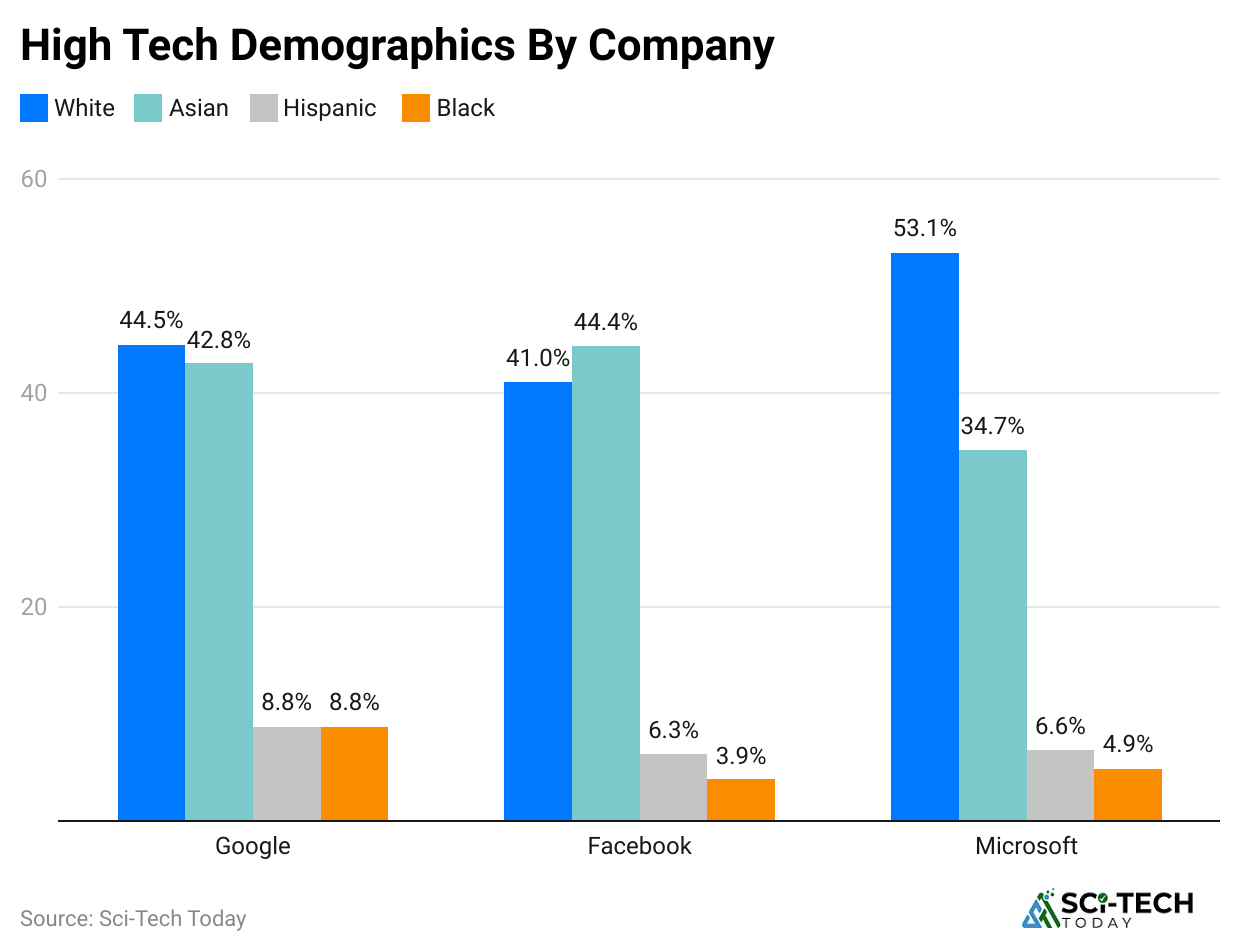
- At Google, White employees form the largest group at 44.5% of the high-tech labor force, closely followed by Asian employees at 42.8%, while Hispanic and Black employees each account for just 8.8%.
- At Facebook, Asian employees slightly lead at 44.4%, compared to White employees at 41%. Hispanic representation stands at 6.3%, and Black employees make up only 3.9%.
- Microsoft records the highest White representation at 53.1%, with Asian employees at 34.7%. Hispanic employees account for 6.6% and Black employees for 4.9%.
- Across all three above companies, White and Asian employees together dominate 85%-87% of high-tech roles, while Hispanic and Black employees remain critically underrepresented, each consistently falling below 9%.
Tech Industry Demographics by Location
(Source: aiprm.com)
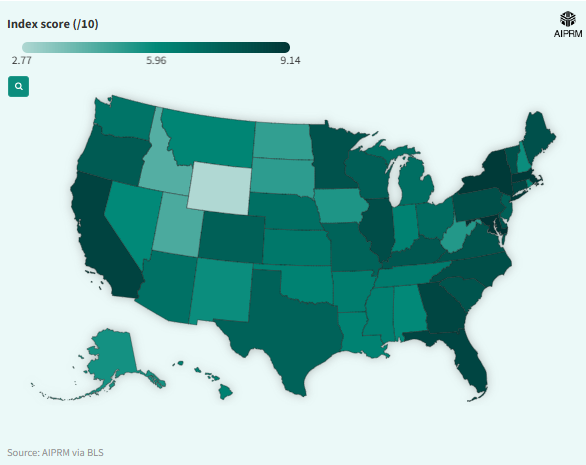
| State | Number of female tech workers (000s) | Median weekly earnings ($) | Women’s earnings as a percentage of men’s | Percentage change in employment (male vs. female) | Index score (/10) |
|
North Carolina | 1,853 | 904 | 85.8 | -12% | 8.17 |
| Illinois | 2,080 | 1,055 | 83.6 | -17% |
8.18 |
|
Illinois | 2,080 | 1,055 | 83.6 | -17% | 8.18 |
| Georgia | 1,810 | 976 | 88.5 | -16% |
8.46 |
|
Florida | 3,822 | 926 | 87.9 | -14% | 8.49 |
| Connecticut | 600 | 1,194 | 88.2 | -15% |
8.49 |
|
California | 5,839 | 1,118 | 89.9 | -24% | 8.58 |
| New York | 3,200 | 1,090 | 84.2 | -13% |
8.93 |
|
Massachusetts | 1,211 | 1,331 | 87.2 | -15% | 8.96 |
| Maryland | 1,142 | 1,296 | 88.5 | -12% |
9.14 |
Diversity in Tech Statistics by Regions / Countries
- In India, women account for 32%-36% of the tech workforce, yet only 7% hold executive positions, according to boundev.ai.
- spacelift.io also mentioned that in the United States, Black professionals occupy 7% of tech roles despite making up 14% of the population, while Asian Americans account for 22%-34% of tech workers.
- SQ Magazine stated that in the UK, 25% of tech employees come from ethnic minority groups, but only 5% identify as Black. Women in IT increased from 315,000 to 441,000, rising from 19% to 22%.
- Across the EU, women hold only 22% of ICT roles, and the tech gender pay gap stands at 26%, compared with 12.7% across industries.
- According to a report published by Computer Weekly, more than USD 600,000 in grants will support women in tech across 12 countries in Africa and the MENA region in 2026.
- APAC tech spending is expected to grow 9.3% to USD 437 billion in 2026, led by India at 13.4%.
Salary Ranges for the Most In-Demand Technology Professionals
(Source: roberthalf.com)
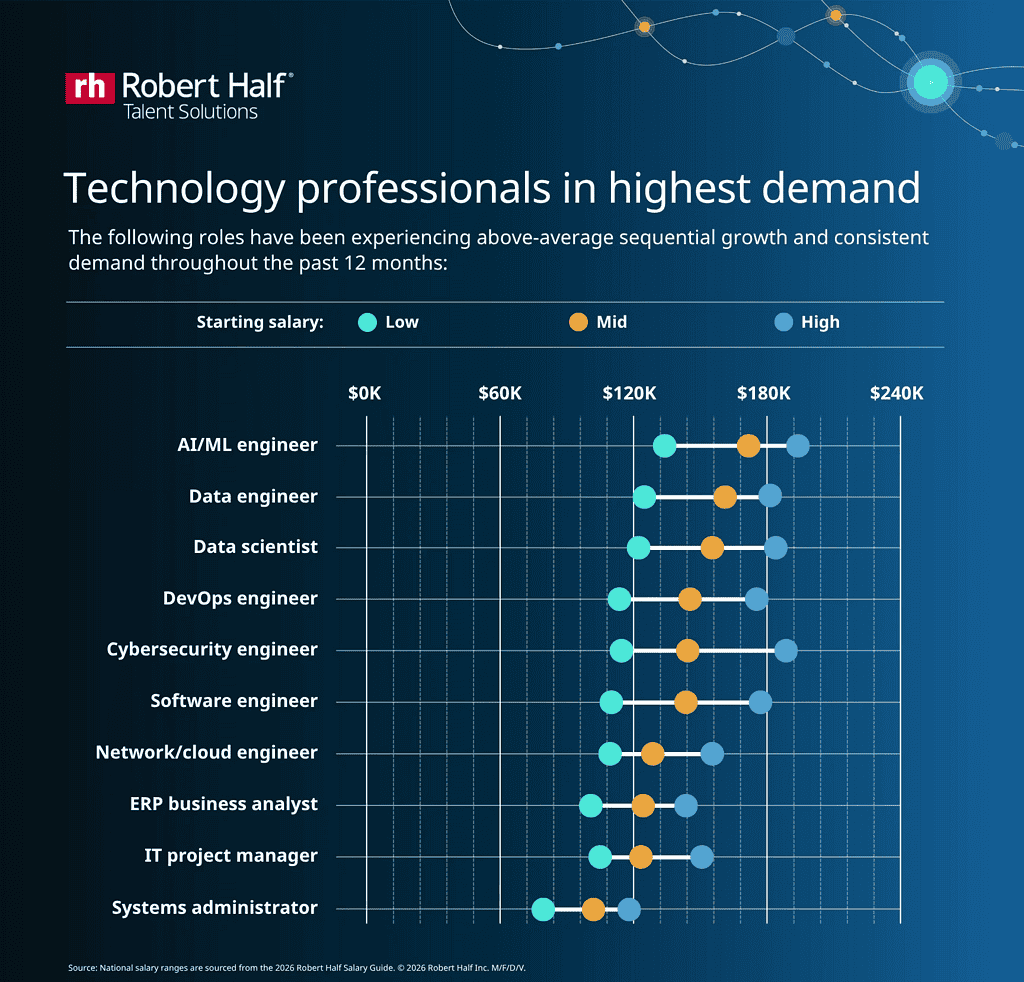
| Role | Low Starting Salary (USD) | Mid Starting Salary (USD) | High Starting Salary (USD) |
| AI/ML Engineer | 120,000 | 180,000 | 220,000 |
| Data Engineer | 110,000 | 160,000 | 200,000 |
| Data Scientist | 155,000 | 195,000 | |
| DevOps Engineer | 100,000 | 150,000 | 185,000 |
| Cybersecurity Engineer | 155,000 | 195,000 | |
| Software Engineer | 150,000 | 190,000 | |
| Network/Cloud Engineer | 95,000 | 145,000 | 180,000 |
| ERP Business Analyst | 90,000 | 130,000 | 165,000 |
| IT Project Manager | |||
| Systems Administrator | 60,000 | 100,000 | 130,000 |
Gender Pay Gap In Tech Statistics
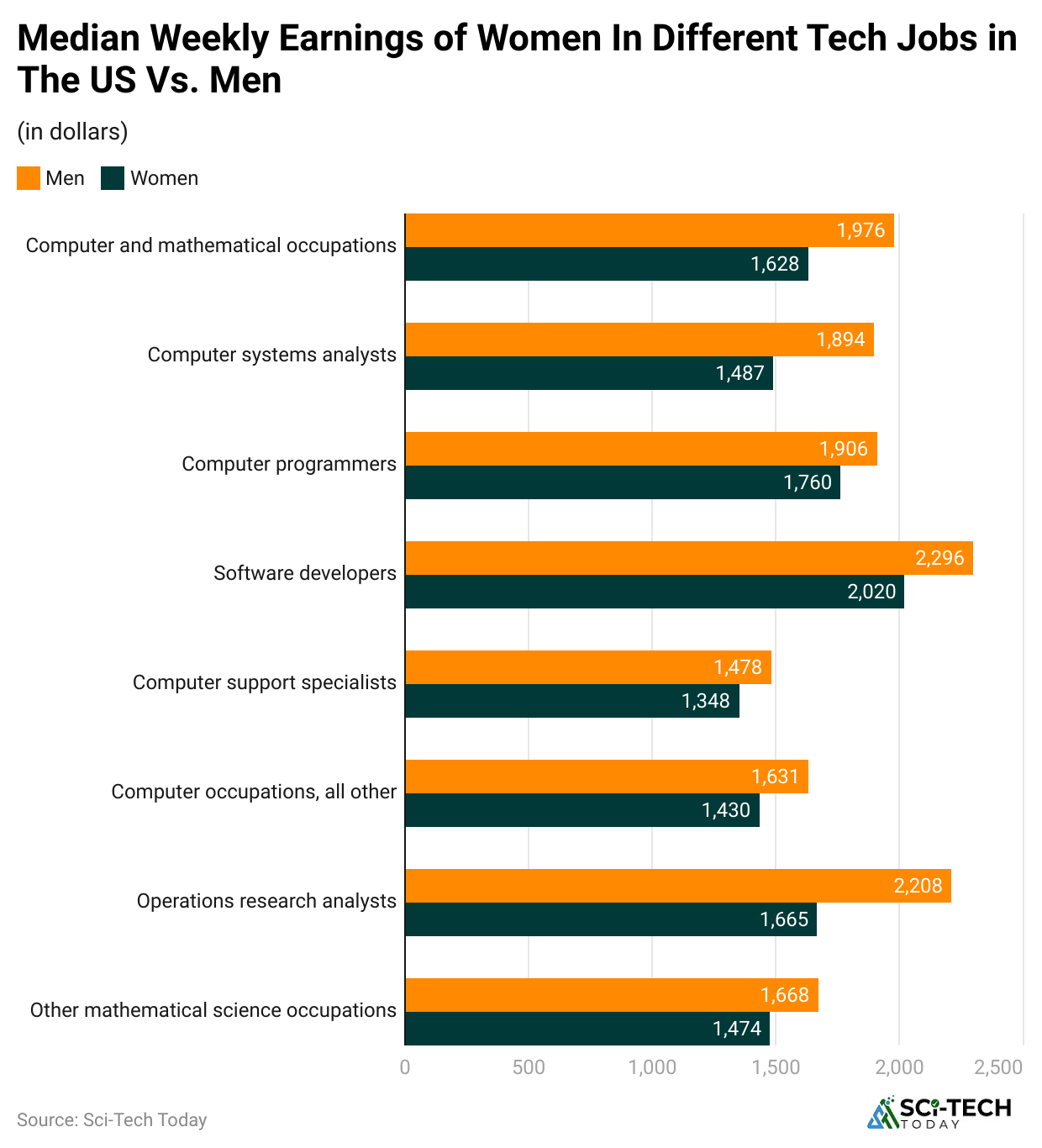
- A recent review of eight tech jobs in the U.S. by AIPRM found that men are typically paid more than women, even when they hold the same role.
- The biggest pay gap was found in operations research analyst positions. On average, women in this role earn 25% less than men each week.
- Men earn approximately $2,208 weekly, while women take home around $1,665 for performing the same job.
(Reference: aiprm.com)
| Tech occupation | Median weekly earnings (overall) ($) | Median weekly earnings (men) ($) | Median weekly earnings (women) ($) | Percentage change (women vs. men) |
| Other mathematical science occupations | 1,595 | 1,668 | 1,474 | -12% |
| Operations research analysts | 1,917 | 2,208 | 1,665 | -25% |
| Computer occupations, all other | 1,597 | 1,631 | 1,430 | -12% |
| Computer support specialists | 1,424 | 1,478 | 1,348 | -9% |
| Software developers | 2,283 | 2,296 | 2,020 | -12% |
| Computer programmers | 1,889 | 1,906 | 1,760 | -8% |
| Computer systems analysts | 1,701 | 1,894 | 1,487 | -21% |
| Computer and mathematical occupations | 1,890 | 1,976 | 1,628 | -18% |
Socioeconomic Diversity and Skills Gap in Technology
- The Sutton Trust report stated that around 67% of tech workers come from professional or managerial families, while only 19% come from working-class backgrounds, compared with 33.3% nationally.
- A class-based pay gap of GBP 4,736 exists in UK technology roles.
- Among top tech firms, 36.6% of board members attended private schools and 35% studied at Oxford or Cambridge.
- According to comptia.org, young non-college workers have an AI exposure index of -0.61, compared with +1.00 for graduates.
- 25 major tech companies have pledged to support 120 million workers by 2030 through reskilling initiatives, as per LinkedIn.
- The UK tech skills gap is estimated to cost the economy GBP 63 billion annually.
Diversity Inclusion Tech Awards (DITA) 2026
- The 9th Diversity Inclusion Tech Awards (DITA) 2026 are now accepting nominations to honor leaders in diversity, inclusion, and equity across Europe’s technology sector.
- The awards ceremony will take place on 17 September 2026 at the Gibson Hotel, Dublin, Ireland.
- The nomination deadline closes today, 12 June 2026.
- Besides, the program includes 13 open nomination categories and 3 special recognition awards.
- Nominations are free, and finalists receive complimentary event tickets.
- The Dublin Tech Summit organizes the awards.
- The 13 nomination categories are grouped into 2 pillars: 7 categories focused on diversity and inclusion, and 6 categories celebrating female achievement in technology.
- The program recognizes contributions in areas such as workplace equity, inclusive hiring, STEM advocacy, leadership, startups, AI, and data innovation.
- An additional 3 awards are selected directly by the organizing committee and are not open for public nomination.
Conclusion
The tech industry is making progress in terms of diversity, but there’s still a lot of work to be done. Women, people of colour, LGBTQIA+ individuals, people with disabilities, and those from lower-income families are still not fully represented—especially in leadership roles. Fixing this gap isn’t just the right thing to do; it also helps businesses grow stronger, become more creative, and better serve different types of customers.
By hiring fairly, providing everyone with equal opportunities, and fostering workplaces where all employees feel safe and respected, the tech industry can become a place where everyone has a fair chance at success. We have shed enough light on Diversity in Tech Statistics through this article.

Sources