








Introduction
Digital Advertising Fraud Statistics: Digital ad fraud still feels like one of the biggest threats hanging over the global advertising ecosystem in 2026, and it keeps draining brands, publishers, and advertisers of billions of dollars every year. Since digital ad budgets keep speeding up across connected TV (CTV), mobile, social networks, retail media, and programmatic advertising, the bad actors have also moved along. They now use more clever, AI-guided tactics, like bot traffic, click fraud, domain spoofing, ad stacking, fake impressions, plus synthetic identities.
At the same time, organizations are putting more money into fraud detection platforms, AI-style verification tools, and even blockchain transparency solutions so they can safeguard their budgets. Industry studies are basically saying that ad fraud is changing more quickly than older cybersecurity defenses, which is why continuous monitoring matters a lot for stretching ROAS and keeping advertisers comfortable.
This article will showcase the recent digital fraud statistics with key metrics and market trends.
Editor’s Choice
- Digital advertising fraud is expected to cost advertisers USD 100.2 billion in 2026, which makes it one of the industry’s largest money-related risks.
- 18.12% of worldwide programmatic traffic was labeled invalid in Q1 2026, so almost one in five ad interactions is still fraudulent.
- Campaigns without fraud protection tend to see 15× higher fraud rates, which underlines how useful verification and monitoring tools really are.
- Roughly 24.5% of programmatic advertising spend is wasted, showing how much invalid impressions and inefficient media buying can hurt.
- Asia-Pacific has the highest regional ad fraud rate at 27.85%, while Europe reports the lowest number, 7.80%.
- Linux shows the most operating-system-related fraud rate at 41.78%, compared with 12.97% on macOS, and that gap reveals clear platform-level differences.
- In major advertising markets, South Korea sits at a 23.47% fraud rate, while France is down at 1.19%.
- Global digital ad spending is forecasted to go beyond USD 850 billion by 2026, and fraud losses are expected to take almost 20% of programmatic budgets.
- The ad fraud detection and prevention business should top USD 4.8 billion in 2026.
- The enterprise spending on verification software keeps growing at a 15–18% CAGR.
2026 Digital Ad Fraud Benchmarks
2026 Ad Fraud Key Metrics
| Metric | 2026 Neutral Stat |
|---|---|
| Global Fraud Losses | $100.2 Billion |
| Average IVT Rate | 20.64% |
| “Unprotected” Fraud Gap | 15x Higher |
| Programmatic Waste | 24.5% of Spend |
(Source: clixtell.com)
- Digital advertising fraud keeps being one of the largest financial risks for marketers in 2026.
- The benchmark figures indicate that about 20.6% of all programmatic ad traffic gets labelled as invalid, which means roughly one in five ad encounters might be driven by bots, fake accounts, or other non-human behavior.
- Based on the Fraudlogix Dataset, the average Invalid Traffic (IVT) level for the year 2025 was 20.64%, suggesting advertisers need to keep checking campaign performance to safeguard media spend.
- In the Q1 2026 dataset, the global IVT rate is a bit better at 18.12%.
- Juniper Research forecasts that overall digital ad fraud losses will reach USD 100.2 billion in 2026, so fraudulent traffic is not some small operational annoyance anymore, but a serious economic obstacle for organizations across the world.
- The benchmarks also reveal that organizations without proper fraud protection face way higher risks, noticeably more.
- According to the IAS Media Quality Report, unprotected advertising campaigns end up with fraud levels that are 15 times higher than campaigns using fraud detection and verification solutions.
- The ANA Transparency Study estimates that 24.5% of total programmatic advertising spend is wasted, which underlines the really big financial hit from inefficient media buying and fraudulent impressions.
- The above numbers suggest that improving traffic verification and making campaign transparency more concrete is getting just as important as increasing advertising budgets.
- Digital advertising investments keep going up; reducing invalid traffic and removing wasted spend will end up being critical for improving return on investment, strengthening campaign performance, and making sure marketing budgets reach real audiences instead of fraudulent activity.
Regional Ad Fraud Trends
(Source: fraudlogix.com)
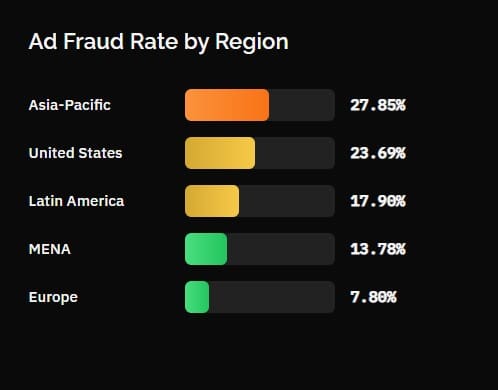
- The regional ad fraud data points to clear, but not always obvious, differences in how much invalid digital ad traffic shows up across global markets.
- Asia Pacific is the highest at 27.85%, so basically, more than one in four programmatic advertising interactions there might be invalid, not just “a little off”.
- The United States comes next with 23.69%, meaning that even in one of the world’s most mature digital ad markets, fraud is still a big obstacle.
- Latin America lands at 17.90%, which suggests that almost one-fifth of digital advertising traffic could be tied to fraudulent activity.
- The Middle East and North Africa, or MENA, sits at 13.78%, while Europe posts the smallest figure at 7.80%.
- Even though Europe is doing better, the statistics still confirm that no digital advertising market is truly sheltered from fraudulent traffic.
- The gap between Asia-Pacific (27.85%) and Europe (7.80%) really shows how regional factors like digital ecosystems, advertising maturity, and local fraud prevention capabilities can shape campaign quality a lot.
- Overall, the benchmarks stress that continuous traffic watch, verification tools, and fraud prevention tactics tailored by region are becoming more and more important to boost advertising efficiency, reduce wasted media spending, and protect return on digital advertising investments.
Operating System Trends
(Source: fraudlogix.com)
- When you compare the operating systems, it kinda shows that ad fraud risk is all over the place, depending on the platform.
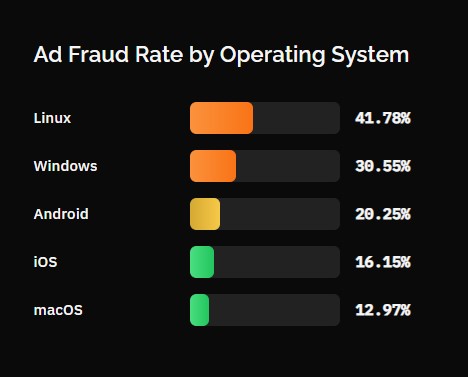
- Linux ends up with the highest ad fraud rate at 41.78%, so basically, more than four out of ten ad interactions on Linux setups may involve traffic that’s invalid or just straight-up fraudulent.
- Then Windows is next with 30.55%, which suggests almost one-third of advertising actions there could be driven by bots or other kinds of non‑genuine traffic.
- Android comes in at 20.25%, and that number points to about one out of every five ad impressions or clicks not really being legit.
- Advertisers who run cross‑platform campaigns should focus on tougher fraud detection, especially on operating systems with higher exposure to that invalid traffic, because it can quietly eat into results. For the rest, the fraud levels are comparatively lower; still, though it’s not something you can ignore, it needs constant watching.
- iOS sits at 16.15%, while macOS is the lowest among the operating systems reviewed, at 12.97%. Even if Apple-based environments generally show less fraud than Linux and Windows, the data basically confirms that no operating system is fully unscathed from fraudulent advertising, not 100% anyway.
- The gap between Linux at 41.78% and macOS at 12.97% also suggests that differences in platform-specific traffic behavior, the underlying infrastructure, and bot activity can really steer campaign quality.
- Operating system–level monitoring matters, since it helps advertisers tune media spend, boost campaign performance, and cut down invalid traffic before it starts messing with return on investment.
Country-Level Ad Fraud Rates
(Source: fraudlogix.com)
- Fraud rates across the world’s biggest digital ad markets show that fraud exposure changes quite a bit from country to country, even when you look at places with a lot of ad spend.
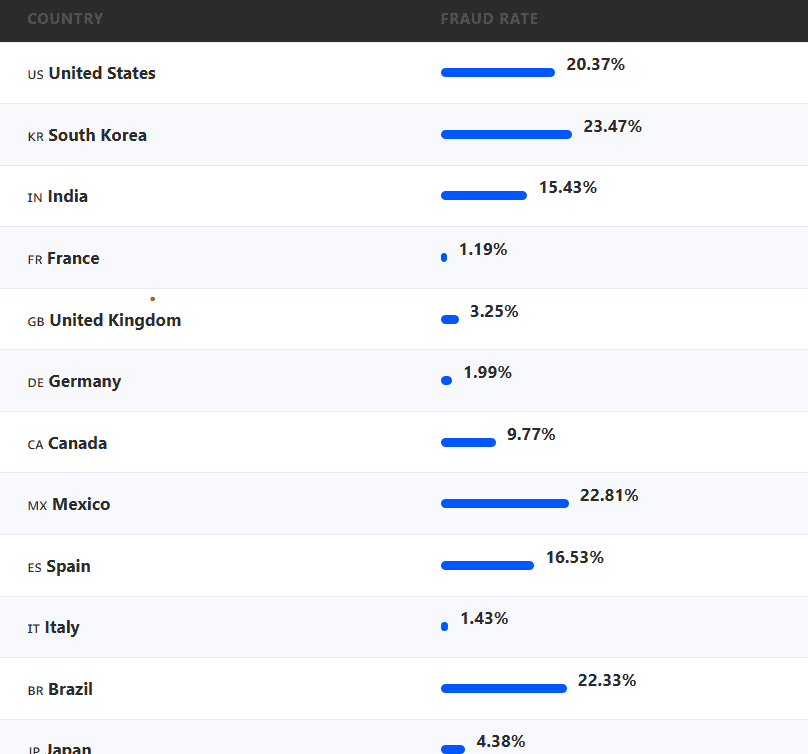
- In Fraudlogix’s Q1 2026 readout, which covered 26.3 billion ad impressions across more than 100 countries, South Korea came out on top for fraud at 23.47%, then Mexico with 22.81%, Brazil at 22.33%, and the United States at 20.37%.
- Spain landed at 16.53% while India was at 15.43%, so it looks like a notable portion of the online traffic in those environments might not be genuine.
- Put together, the numbers imply that advertisers in higher spend markets should stay on top of campaign hygiene, basically keep checking quality to cut down on wasted views and, ideally, lift return on investment.
- At the same time, the same dataset flags a handful of markets with comparatively less fraud risk. Canada reported 9.77%, Japan showed 4.38%, and the United Kingdom was down at 3.25%.
- Germany registered one of the lowest rates at 1.99%, then Italy at 1.43%, and France at 1.19%.
- The gap between South Korea at 23.47% and France at 1.19% is more than 22 percentage points, and that really underlines how uneven digital advertising integrity can be across major economies.
- Overall, these reference points mean advertisers should pair global campaign plans with country-specific verification and fraud monitoring tools.
- High invalid traffic markets will usually need harder prevention, while lower-risk markets tend to provide better efficiency and more chances to stretch budgets and boost advertising results.
Global Digital Advertising Fraud Market Statistics
- Worldwide digital advertising spending is projected to go past 850 billion dollars in 2026, kind of like a jump that nobody can ignore.
- Fraud-related losses are roughly about 20% of all programmatic advertising budgets, and yes, that adds up quickly.
- The ad fraud detection and prevention market globally should break above 4.8 billion in 2026, not too far off the current trajectory.
- Enterprise investment in ad verification software is also rising around 15–18% CAGR, and it feels pretty steady, even with all the shifting platforms.
- North America makes up nearly 42% of spending on ad fraud prevention, while Europe is at about 27%, and Asia-Pacific comes in near 24%.
- Retail media fraud monitoring investments have grown by more than 40% since 2024, and it seems buyers are paying closer attention.
- More than 65% of multinational brands now set aside dedicated fraud prevention budgets.
Device-Wise Ad Fraud Rates
(Source: fraudlogix.com)
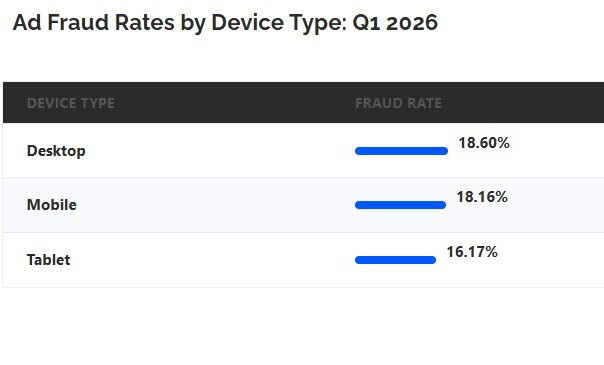
- According to Fraudlogix (Q1 2026), ad fraud is still pretty much steady across the main device buckets, so advertisers can’t really lean on device type by itself to lower the fraudulent traffic, not even a little.
- Desktop devices have the top fraud rate at 18.60%, and mobile is right behind at 18.16%. Tablets are a bit lower, at 16.17%.
- Only 2.43 percentage points from the highest category to the lowest kind of implies the problem is everywhere across the digital landscape, rather than being stuck on one single platform.
- These numbers also point to the fact that anti-fraud approaches should be applied across the board, more universally than selectively.
- Since desktop (18.60%), mobile (18.16%), and tablet (16.17%) all show meaningful fraud levels, marketers should keep checking the campaign quality across every channel, instead of putting all attention on one device, thinking it will solve everything.
- In other words, fraud detection, traffic validation, and real-time visibility are still necessary, no matter where the ads end up being served.
The Rise of Agentic AI and “Lead Poisoning” Transforming Ad Fraud
- The evolution of agentic AI is sort of redefining digital advertising fraud in a way that makes fraudulent activity more intelligent and also more financially damaging.
- As Juniper Research (2026) notes, global ad fraud losses are projected to go beyond USD 100 billion in 2026, which basically underlines how big the economic impact is now when AI-driven fraud starts targeting advertisers worldwide.
- Modern fraud isn’t stuck on fake clicks anymore. Instead, more advanced AI-powered systems generate realistic user behaviors that can mess with automated advertising platforms and lower campaign efficiency.
- So as fraud turns more human-like, businesses find it harder to spot invalid traffic before it nudges marketing performance off track.
- That USD 100 billion projection points to how fraudulent conversions can skew campaign optimization, and even distort day-to-day business decision-making.
- In particular, AI-powered advertising systems increasingly depend on conversion signals to push performance forward, so better data quality becomes more valuable than before.
- Marketers have leaned toward qualified conversions, not just total conversions, which helps limit the effect of fake leads on automated bidding strategies. This whole shift suggests that protecting ad spending now means stronger verification methods, deeper behavioral analysis, and constant monitoring during the entire customer journey, not just at one checkpoint.
- As AI keeps improving, organizations that put data quality and fraud prevention first should, in theory, be in a better place to safeguard marketing performance and maximize return on investment.
Conclusion
Digital ad fraud has turned into one of the most pressing problems for marketers, kinda messing with campaign performance, media efficiency, and the whole return on investment thing. AI-powered bots, synthetic identities, and all that advanced invalid traffic keep changing over time, so fraud detection feels harder than ever. Meanwhile, more money is going into verification platforms, AI-driven analytics, and real-time monitoring, which helps advertisers curb wasted spending and push better campaign quality.
Also, fraud isn’t the same everywhere—there are regional, country-level, and even platform-specific differences, so you really need tailored prevention plays, not a single blanket approach. And since digital ad spending still keeps climbing, the orgs that focus on fraud prevention and data quality should be in a stronger spot to get the most out of their advertising and guard their marketing budgets.
FAQ
Global digital advertising fraud losses are expected to top USD 100.2 billion in 2026.
Roughly 18.12% of global programmatic traffic was labeled invalid in Q1 2026.
Asia-Pacific shows the biggest regional ad fraud rate at 27.85%.
Linux has the highest reported ad fraud rate at 41.78%, according to Fraudlogix.
Good ad fraud prevention lowers wasted spend, strengthens campaign performance, defends ROI, and makes sure advertising dollars land with real people instead of bots or other fraudulent traffic.

Sources