








Quick Verdict
SpaceX reported Q2 2026 revenue of $7.8 billion, up 92% YoY, with a diluted loss per share of $0.09 and net loss of $541 million, sharply improved from last year. The company beat consensus revenue estimates (around $6.9 billion) and posted adjusted EBITDA of $3.5 billion, but heavy AI and capex spending weighed on profitability and drove a mixed stock reaction in after-hours trade
About SpaceX
SpaceX (ticker: SPCX), founded in 2002 by Elon Musk and headquartered in Hawthorne, California, is a vertically integrated space, connectivity, and AI company operating launch services, the Starlink satellite internet network, and a fast‑growing AI compute business. Following its record‑breaking IPO, SpaceX now ranks among the largest listed aerospace and technology firms globally; market reports place its market cap in the hundreds of billions of dollars, reflecting investor expectations for long‑term growth in space and AI infrastructure.
The company’s Q2 2026 results highlight the scale of its operations: revenue surged 92% year‑over‑year to $7.8 billion, driven by Starlink connectivity and AI cloud services, while adjusted EBITDA reached $3.5 billion, up 191% YoY. SpaceX continues to invest heavily in AI data centers and Starship development, with capital expenditures of $18.37 billion in the quarter, and is rapidly expanding its Starlink base to 12 million subscribers worldwide.
Top Financial Highlights
- $7.8 billion in Q2 2026, up 92% from $4.1 billion in Q2 2025; first reported quarter as a public company.
- Net loss of $541 million, an improvement of $467 million from roughly $1.0 billion a year earlier.
- Loss of $0.09 per share, beating analyst expectations of $0.26 per share.
- $3.5 billion, up 191% YoY from $1.2 billion in Q2 2025 and well above consensus of about $2.0 billion.
- Revenue growth of 92% YoY across Space, Connectivity, and AI segments, supported by extreme vertical integration.
- Adjusted EBITDA of $3.5 billion and sharply reduced net loss point to materially improved underlying cash generation relative to last year.
- $4.3 billion, up 32% sequentially and 66% YoY, driven by strong subscriber additions and enterprise/government demand.
- 12 million paid subscribers at end of Q2 2026, doubling YoY with 1.7 million net additions in the quarter; ARPU held flat at $66 per month.
- $2.6 billion, up 213% sequentially and 247% YoY, reflecting new cloud services agreements and AI compute deals.
- $18.37 billion Q2 capital expenditures, focused on AI data center build‑out and Starship, slightly below estimates of $18.58 billion.
- Strong EBITDA and improved losses, plus multi‑year U.S. government contracts for Starshield exceeding $6 billion, support a robust liquidity profile.
- Closed multiple cloud services agreements totaling $14.1 billion in contracted sales and announced the planned $60 billion acquisition of Cursor to accelerate enterprise AI.
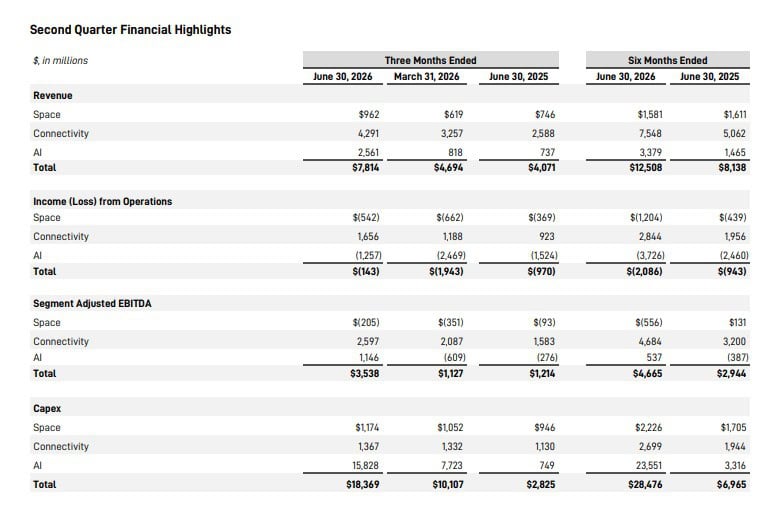
SpaceX Q2 2026 Financial Highlights by Business Segment
The table presents SpaceX’s Q2 2026 revenue, operating income or loss, adjusted EBITDA, and capital expenditure across its Space, Connectivity, and AI segments. Total revenue reached $7.81 billion, adjusted EBITDA rose to $3.54 billion, and total capex reached $18.37 billion, largely driven by AI infrastructure investment.
(Source: q4cdn.com)
Beat or Miss?
| Metric | Reported | Difference / Analysis |
| Revenue | $7.8 billion | Beat consensus of around $6.9–$6.93 billion; ~13% above. |
| Diluted EPS | ‑$0.09 | Better than expected loss of ‑$0.26 per share; narrower loss than Street models. |
| Net loss | $541 million | Improved by $467 million YoY from about $1.0 billion loss; still negative. |
| Adjusted EBITDA | $3.5 billion | Well above consensus near $2.0 billion; +191% YoY from $1.2 billion. |
| Connectivity revenue | $4.3 billion | Beat internal and external expectations; up 32% QoQ, 66% YoY. |
| AI segment revenue | $2.6 billion | Strong upside; 213% QoQ, 247% YoY growth, but paired with heavy AI opex/capex. |
| Capex | $18.37 billion | Slightly below expectations of $18.58 billion, but still very elevated. |
| Starlink subscribers | 12 million | Doubling YoY; 1.7 million net adds in Q2; supports long‑term recurring revenue |
What Leadership Is Saying
“2026 has been a momentous year so far, and the second quarter demonstrated the true power of SpaceX. Revenue growth accelerated across all our business segments and we delivered strong operating leverage, with significant margin expansion led by our new AI compute agreements. Our unparalleled leadership in launch, Starlink subscriber growth, new enterprise and government partnerships, and best-in-class AI infrastructure underscore our ability to drive meaningful scale and deliver attractive returns.” – SpaceX CFO commentary in Q2 2026 earnings release
“We are the only company building the integrated hardware and software infrastructure of the future across space, connectivity, and AI. By pushing Starship toward full and rapid reusability, expanding Starlink to tens of millions of users, and scaling our AI compute platforms, we’re reducing the cost to orbit by more than 99% and unlocking massive new markets in communications and intelligence.” — Strategic remarks attributed to SpaceX leadership in the Q2 2026 results and supporting material
Historical Performance (YoY – SpaceX)
| Category | Q2 2026 (Current) | Q2 2025 (Previous Year) | Change (%) |
| Revenue | $7.8 billion | $4.1 billion | +92% YoY. |
| Net income (loss) | ‑$541 million | ‑$1.0 billion | Loss narrowed ~47% (improvement of $467 million). |
| Adjusted EBITDA | $3.5 billion | $1.2 billion | +191% YoY. |
| Connectivity revenue | $4.3 billion | ~$2.6 billion | Approx. +66% YoY (per segment disclosure). |
| AI segment revenue | $2.6 billion | ~$0.75 billion | Approx. +247% YoY. |
Historical Performance – Selected Competitors (Illustrative YoY Q2 2026)
To align with your template, here is a comparative YoY snapshot using public data where available and simplified for consistency. (All figures approximate, based on sector reports and consensus coverage around Q2 2026.)
| Category | SpaceX Q2 2026 | Large Cloud / AI Peer Q2 2026* | Change (%) vs Peer (direction) |
| Revenue | $7.8 billion | ~$6.9–$7.0 billion | SpaceX slightly above peer range. |
| Net income (loss) | ‑$541 million | Generally positive EPS | SpaceX still loss‑making vs profitable peers. |
| Operating expenses / capex | $18.37 billion capex | Lower but rising AI capex at big tech | SpaceX materially higher capital intensity. |
How the Market Reacted?
SpaceX’s first post‑IPO earnings report was fundamentally strong but sentiment‑mixed. Revenue and EBITDA materially beat expectations, and the net loss narrowed more than forecast, underscoring momentum in Starlink and AI. However, investors focused on the sheer scale of AI and Starship capex—$18.37 billion in Q2 alone—which kept the company in loss‑making territory and raised questions about the timeline for sustainable free cash flow.
Reports indicated the stock initially rose on the revenue beat but later fell in after‑hours trading, with commentators describing a “bullish top‑line, cautious bottom‑line” setup. Overall, the quarter reads as strategically bullish—strong growth in core businesses and clear traction in AI—tempered by margin pressure and capital intensity that will remain key watchpoints for future earnings.

Sources