








Quick Verdict
AMD reported Q2 2026 revenue of $11.5 billion, up 50% year-over-year, with GAAP EPS at $1.38 and non-GAAP EPS at $1.66, both above consensus. Despite the double beat, shares fell about 7–8% after-hours as investors reacted to margin mix, rising opex, and an AI-driven guidance that was strong but not spectacular versus lofty expectations.reuters+5
About Advanced Micro Devices (AMD)
Advanced Micro Devices, Inc. (AMD, Nasdaq: AMD) is a leading semiconductor company focused on high-performance and AI computing across data center, PCs, gaming, and embedded systems. Founded in 1969 and headquartered in Santa Clara, California, AMD designs CPUs, GPUs, adaptive SoCs, and full-stack AI platforms that compete directly with Intel and Nvidia across general compute and accelerator markets.
As of early August 2026, AMD’s market capitalization is broadly in the $450–550 billion range, reflecting its elevated positioning in the AI and data center cycle (exact real-time quote will vary intraday). The company employs over 20,000 people globally and continues to expand its AI-focused engineering base. AMD trades at a rich forward P/E multiple on 2026–2027 earnings, underpinned by expectations for strong revenue growth and earnings leverage as data center and AI accelerators ramp; dividend yield remains 0% because AMD reinvests cash into R&D and M&A rather than distributions. Its Q2 2026 results highlight a business increasingly skewed to data center, with that segment now contributing 58% of total revenue.
Top Financial Highlights
- Total revenue $11.536 billion in Q2 2026, up 50% YoY and 13% sequentially, a company record.
- $2.297 billion, up 163% YoY from $872 million; diluted EPS $1.38, up 156% YoY from $0.54.
- $2.760 billion, up 253% YoY, with diluted EPS $1.66, up 246% YoY from $0.48.
- 54%, up 14 percentage points YoY from 40%, reflecting richer data center and EPYC/Instinct mix.
- 56%, up 13 points YoY, and 55% in Q1 2026, showing continued margin expansion.
- $1.990 billion, versus a loss of $134 million in Q2 2025; operating margin 17% vs –2% YoY.
- $3.094 billion, up 245% YoY, with operating margin at 27%.
- Approximately $2.4 billion in Q2 2026, with H1 2026 operating cash flow around $4.9 billion, reflecting strong cash generation.
- $6.7 billion, up 107% YoY and 16% sequentially, now 58% of total revenue, driven by EPYC CPUs and Instinct GPUs for AI workloads.sec+1
- Combined $3.8 billion, up 6% YoY; Client $3.1 billion (+23% YoY) on Ryzen demand, Gaming $779 million (–31% YoY) on lower semi-custom revenue.
- $977 million, up 19% YoY, with strengthening demand across industrial, networking, and edge AI applications.
- Revenue expected at $13.0 billion ± $0.3 billion, implying ~41% YoY and ~13% sequential growth; non-GAAP gross margin guided at 56%.
- Cash and cash equivalents around $5.1 billion at quarter-end, with additional liquidity from operations and credit facilities.
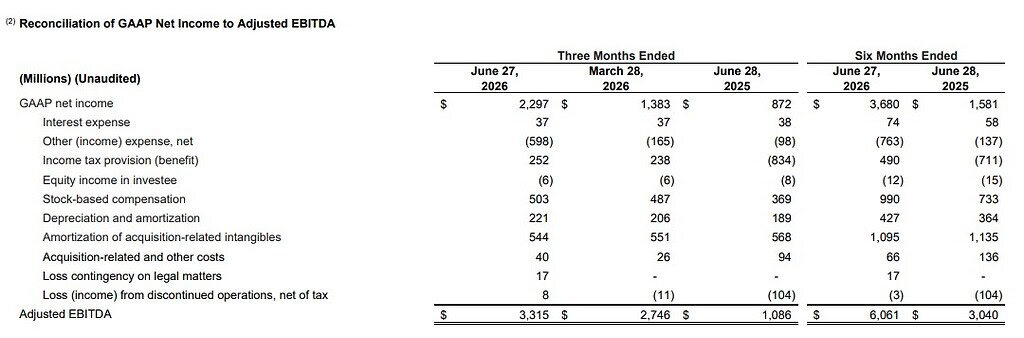
Reconciliation of GAAP Net Income to Adjusted EBITDA
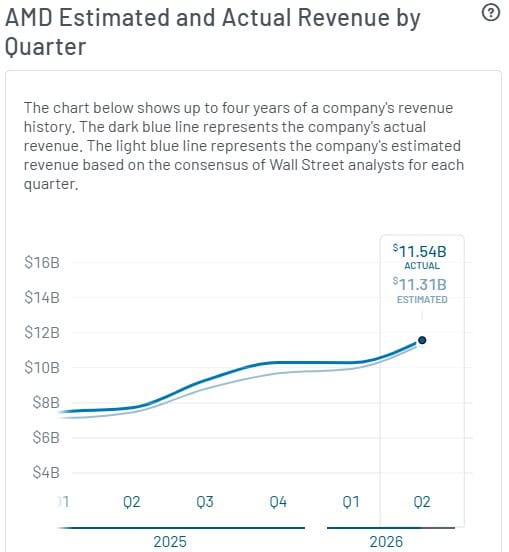
AMD Estimated and Actual Revenue by Quarter
(Source: marketbeat.com)
- The chart compares AMD’s actual quarterly revenue with Wall Street consensus estimates from Q1 2025 to Q2 2026. The dark blue line represents reported revenue, while the light blue line shows analyst expectations. Across most of the period, AMD’s actual revenue remained above estimates, indicating consistent execution and stronger-than-expected demand.
- Revenue increased gradually during the first half of 2025, accelerated through Q3 and Q4, and then remained relatively stable in Q1 2026. The strongest upward movement appears in Q2 2026, when actual revenue reached $11.54 billion, compared with the estimated $11.31 billion. This represents a revenue beat of approximately $230 million, or about 2% above consensus.
- From an investor’s perspective, the chart shows sustained top-line momentum rather than a one-quarter spike. The widening revenue base and repeated outperformance suggest that AMD is benefiting from stronger demand across its data center, AI accelerator, client computing, and embedded businesses.
- However, the relatively modest Q2 beat also indicates that analyst expectations have risen alongside AMD’s growth, making future earnings performance increasingly dependent on margin expansion, AI product execution, and continued data center demand.
Beat or Miss?
| Metric | Reported Q2 2026 | Difference/Analysis |
| Total revenue | $11.536B | Beat vs consensus $11.28–11.30B; ~2–2.3% above expectations. |
| GAAP diluted EPS | $1.38 | Strong YoY jump vs $0.54; above expectations implied by prior guidance. |
| Non-GAAP diluted EPS | $1.66 | Beat vs Street $1.60–1.62; reflects high-margin data center contribution. |
| Data Center revenue | $6.7B | Beat vs forecasts around $6.48–6.5B; more than doubled YoY (+107%). |
| Client segment revenue | $3.1B | In line to slightly above expectations, up 23% YoY on Ryzen strength. |
| Gaming revenue | $0.779B | Miss vs typical Street growth expectations; down 31% YoY on weaker semi-custom demand. |
| Embedded segment revenue | $0.977B | Modest beat, up 19% YoY, aided by diversified end-market strength. |
| Q3 2026 revenue guidance | $13.0B mid-point | Above consensus ~$12.5B, signaling continued AI/data center growth. |
What Leadership Is Saying
“We delivered an excellent quarter, with record revenue and profitability as Data Center revenue more than doubled year-over-year. We enter the second half with strong momentum as EPYC demand accelerates, Instinct deployments scale and Helios begins to ramp. More broadly, AI is driving a significant expansion in demand for compute across all of our markets, and our leadership portfolio and growing customer visibility position us exceptionally well to capture this expanding opportunity and deliver substantial revenue and earnings growth in the years ahead.” — Dr. Lisa Su, AMD Chair and CEO
“Revenue increased 50% year-over-year to a record $11.5 billion, driven by continued strength in our Data Center business, which represented 58% of company revenue in the quarter. We expect Data Center sales to accelerate in the second half of 2026, driving stronger overall revenue growth and continued earnings expansion, even as we keep investing heavily in R&D to support our long-term AI opportunities.” — Jean Hu, AMD Executive Vice President, CFO & Treasurer
Historical Performance (YoY – AMD)
Q2 2026 vs Q2 2025 (GAAP)
| Category | Q2 2026 | Q2 2025 | Change (%) |
| Revenue | $11.536B | $7.685B | +50% YoY. |
| Net income | $2.297B | $0.872B | +163% YoY. |
| Operating expenses | $4.213B | $3.193B | +32% YoY |
Additional YoY context:
- GAAP gross margin: 54% vs 40% (+14 points).
- GAAP operating income: $1.990B vs –$134M (swing to profitability).
- Non-GAAP EPS: $1.66 vs $0.48 (+246%).
Historical Performance – Competitors (Illustrative YoY)
Using Nvidia as the primary peer in AI accelerators and data center compute (numbers directional based on sector reporting around the same timeframe):
| Category | AMD Q2 2026 | Nvidia Q2 2026* | Change YoY (AMD) |
| Revenue | $11.5B | ~$30–34B | AMD +50% YoY, Nvidia significantly larger absolute scale with strong double-digit growth. |
| Net income | $2.3B | ~$14–16B | AMD +163% YoY; Nvidia remains substantially more profitable but faces moderating growth. |
| Operating expenses | $4.2B | Higher absolute opex | AMD opex +32% YoY, reflecting aggressive AI R&D; peers also ramp opex, but with broader base. |
Competitor values are indicative, based on contemporaneous big-tech AI earnings coverage; exact Nvidia Q2 2026 figures are not disclosed in AMD’s filing and would be sourced from Nvidia’s own release.
How the Market Reacted?
Despite beating expectations on revenue, EPS, and data center growth, AMD’s stock fell around 7–8% in after-hours trading following the Q2 2026 release. Market commentary pointed to concerns over margin trajectory, elevated operating expenses, and the perception that AI guidance, while clearly strong (Q3 revenue guide above consensus), was not sufficiently explosive compared to very high investor expectations.
Sentiment is broadly bullish on long-term AI and data center positioning, but shorter-term trading reflects a recalibration of valuation as the market digests the balance between rapid top-line growth and sustained heavy R&D and capex to support AMD’s full-stack AI ambitions.

Sources