








Quick Verdict
VBG Group AB posted Q1 2026 net sales of SEK 1,376.4 million, EPS of SEK 4.53 versus SEK 4.58 a year ago, and EBIT of SEK 161.8 million with an 11.8% margin, as FX and raw material headwinds compressed profitability despite 5.3% organic growth. After-hours movement: not disclosed.
About VBG Group AB
VBG Group AB (ticker: OMX Stockholm: VBG B, also traded as FRA: KU4) is a Swedish engineering group headquartered in Vänersborg, Sweden. Founded in 1951, the company develops, manufactures, and markets transport safety systems, mobile climate control solutions, and power transmission components through several specialized divisions. VBG operates globally with strong exposure to commercial vehicles, defense, processing industry, and mobile thermal solutions, positioning it as a niche player in industrial technology and transport safety.
As of mid-2026, VBG Group’s market capitalization is approximately SEK 7.9–8.6 billion based on recent Stockholm trading and independent equity research estimates. Over the last twelve months to Q1 2026, the group generated about SEK 5.4 billion in revenue and SEK 420.8 million in net income, implying a trailing P/E ratio in the high-teens range and underlining a solid but margin-challenged profitability profile. The group maintains a disciplined capital structure with interest-bearing net debt/EBITDA at 1.2x, providing flexibility for continued investment and bolt-on acquisitions.
Top Financial Highlights
- Net sales increased 1.9% year-on-year to SEK 1,376.4 million (Q1 2025: SEK 1,351.3 million).
- Organic growth, adjusted for currency and acquisitions, reached 5.3% versus –12.9% in Q1 2025, driven by broad-based demand and strong North American momentum.
- EBITA amounted to SEK 174.6 million (Q1 2025: SEK 177.4 million), with an EBITA margin of 12.7% (13.1%).
- Operating profit (EBIT) totaled SEK 161.8 million, down from SEK 165.8 million a year earlier; operating margin slipped to 11.8% from 12.3%.
- Profit before tax came in at SEK 147.7 million versus SEK 151.5 million in Q1 2025, reflecting FX and cost pressure.
- Net income for the period was SEK 113.2 million, slightly below SEK 114.5 million in the prior-year quarter (–1.1%).
- Earnings per share (EPS) were SEK 4.53 compared with SEK 4.58, a modest year-on-year decline.
- Operating cash flow before capital expenditures surged to SEK 92–92.4 million, up sharply from SEK 23.7–28 million, underscoring improved cash conversion.
- Interest-bearing net debt (adjusted for pensions and leases) stood at SEK 580 million, with net debt/EBITDA at 1.2x, indicating a conservative leverage profile.
- The group’s trailing 12‑month revenue is about SEK 5.4 billion, with trailing net income of SEK 420.8 million, giving a net margin near 7.8% over the period.
- Segment performance: Mobile Thermal Solutions remained the largest revenue contributor, generating roughly SEK 2.8 billion out of SEK 5.39 billion last year, with continued growth into Q1 2026.
- Order intake was broadly flat year-on-year but up 8% on a currency-adjusted basis, yielding a book-to-bill ratio of 111%, signaling a strengthening
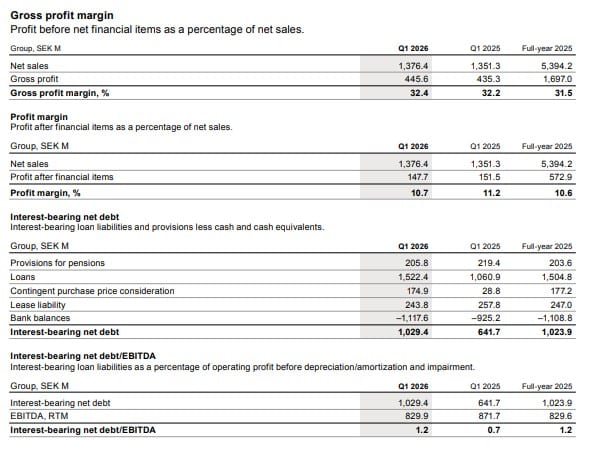
VBG Group AB Gross Profit Margin
(Source: storage.mfn.se)
- The table shows that the group delivered modest revenue growth and improved gross profitability in Q1 2026, but lower earnings after financial items and higher leverage indicate increased pressure below the gross profit line.
- Net sales increased by 1.9% to SEK 1,376.4 million, compared with SEK 1,351.3 million in Q1 2025. Gross profit grew faster, rising 2.4% to SEK 445.6 million from SEK 435.3 million. As a result, the gross profit margin improved by 20 basis points to 32.4%. It was also 90 basis points above the 31.5% margin recorded for full-year 2025, suggesting stronger pricing, a better product mix, or improved direct cost control.
- Despite the stronger gross margin, profit after financial items declined 2.5% to SEK 147.7 million, from SEK 151.5 million a year earlier. The profit margin therefore fell from 11.2% to 10.7%, a contraction of 50 basis points. This indicates that higher operating expenses, financing costs, or other items below gross profit absorbed the benefit of improved sales and gross profitability. However, the 10.7% margin remained slightly above the full-year 2025 level of 10.6%.
- The balance-sheet position weakened compared with the prior-year quarter. Interest-bearing net debt increased by 60.4% to SEK 1,029.4 million, compared with SEK 641.7 million in Q1 2025. The main driver was loans, which rose by SEK 461.5 million to SEK 1,522.4 million. Contingent purchase-price consideration also increased sharply to SEK 174.9 million, from SEK 28.8 million, likely reflecting acquisition-related obligations. Higher bank balances of SEK 1,117.6 million partly offset this increase.
- Compared with year-end 2025, net debt was broadly stable, rising by only SEK 5.5 million from SEK 1,023.9 million. This suggests that the significant year-over-year increase occurred mainly during 2025, rather than in the first quarter of 2026.
- The interest-bearing net debt-to-EBITDA ratio increased to 1.2×, compared with 0.7× in Q1 2025, reflecting both higher debt and a 4.8% decline in rolling twelve-month EBITDA to SEK 829.9 million. Although leverage has increased, a ratio of 1.2× remains relatively manageable. The key concern is that debt has risen while earnings momentum has softened, reducing the company’s financial flexibility compared with the previous year.
- Overall, the figures show improved gross-level operating efficiency but weaker profit conversion and a more leveraged balance sheet. Future performance will depend on controlling operating and financing costs, converting higher gross profit into bottom-line growth, and preventing further increases in net debt.
Beat or Miss?
Analyst consensus for Q1 2026 is not explicitly cited in the press release or summaries. Where estimates are unavailable, cells are marked N/A; commentary reflects qualitative assessment.
| Metric | Reported (Q1 2026) | Difference/Analysis |
| Net sales | SEK 1,376.4 M | N/A – modest growth; slightly below “round” SEK 1.38b level. |
| Organic growth | 5.30% | N/A – strong rebound vs –12.9% a year earlier. |
| EBITA | SEK 174.6 M | N/A – margin compression from 13.1% to 12.7%. |
| EBIT | SEK 161.8 M | N/A – operating margin down 50 bps to 11.8%. |
| Net income | SEK 113.2 M | N/A – down 1.1% year-on-year. |
| EPS | SEK 4.53 | N/A – slightly below prior-year SEK 4.58. |
| Operating cash flow | SEK 92–92.4 M | N/A – material beat vs internal prior-year baseline (SEK 23.7–28 M). |
| Net debt/EBITDA | 1.2x | N/A – comfortably low leverage. |
Historical Performance (YoY – VBG Group)
| Category | Q1 2026 | Q1 2025 | Change (%) |
| Revenue (Net sales) | SEK 1,376.4 M | SEK 1,351.3 M | 1.90% |
| Net income | SEK 113.2 M | SEK 114.5 M | –1.1% |
| EBITA | SEK 174.6 M | SEK 177.4 M | –1.6% |
| Operating profit (EBIT) | SEK 161.8 M | SEK 165.8 M | –2.4% |
| Operating margin | 11.80% | 12.30% | –0.5 ppt |
| EPS | SEK 4.53 | SEK 4.58 | –1.1% |
| Operating cash flow | SEK 92–92.4 M | SEK 23.7–28 M | ~+230–290% |
How the Market Reacted?
The Q1 2026 earnings articles and interim report do not explicitly state the immediate share price reaction to the release. Commentary from MarketScreener and Simply Wall St characterizes the quarter as one of steady revenue growth but margin compression, with robust cash flow and a strong order book supporting a cautiously bullish medium‑term outlook despite near-term profitability pressure.
In market terms, this type of print typically drives a neutral to mildly positive reaction, as investors balance organic growth and cash generation against softer margins and slightly lower EPS.