








Quick Verdict
Intellia Therapeutics reported a Q2 2026 net loss per share of $0.80, matching consensus, while collaboration revenue of $7.7 million missed the roughly $13.0 million analyst estimate. Shares initially slipped in premarket trading, but closed 2.5% higher on August 6 and rose further after hours.
About Intellia Therapeutics
Intellia Therapeutics, Inc. (Nasdaq: NTLA) is a Cambridge, Massachusetts-based clinical-stage biotechnology company founded in 2014. It develops potentially curative medicines using CRISPR-based gene editing and related technologies, concentrating on severe genetic diseases. Its core pipeline includes lonvoguran ziclumeran (lonvo-z), an in vivo gene-editing candidate for hereditary angioedema (HAE), and nexiguran ziclumeran (nex-z), a candidate for transthyretin amyloidosis developed with Regeneron.
Intellia’s current market capitalization was approximately $1.26 billion as of August 6, 2026, based on the latest available quote; its P/E was -3.35x, reflecting its loss-making development-stage profile, and its dividend yield was zero. The company reported roughly 403 employees in its latest available company-profile data. The investment case centers less on near-term revenue and more on regulatory progress for lonvo-z, for which Intellia expects FDA acceptance of its BLA in the second half of 2026 and a potential U.S. launch in the first half of 2027.
Top Financial Highlights
- Collaboration revenue was $7.7 million, down from $14.2 million in Q2 2025, largely due to lower Regeneron revenue.
- Net loss widened to $106.6 million, compared with a $101.3 million loss a year earlier.
- Basic and diluted loss per share improved to $0.80, from $0.98 in Q2 2025, helped by a higher weighted-average share count.
- Total operating expenses declined 3.1% year over year to $120.4 million.
- R&D expense fell 14.9% to $82.6 million, primarily reflecting lower external program costs and lower stock-based compensation.
- G&A expense rose 39.0% to $37.8 million, driven by commercial-infrastructure buildout, legal costs, and stock compensation.
- Operating loss was $112.8 million, versus $110.0 million in the prior-year quarter.
- The company reported $6.1 million in net other income, including $5.8 million in interest income.
- Cash, cash equivalents, and marketable securities totaled $628.4 million at June 30, following a public offering that generated approximately $195 million in net proceeds.
- Management expects its cash balance to fund operations at least into 2028, excluding potential lonvo-z product revenue.
- Intellia does not report conventional revenue-generating operating segments; nearly all reported quarterly revenue was collaboration revenue of $7.7 million.
- Gross margin and operating cash flow were not disclosed in the earnings release.
- The company expects FDA acceptance of its lonvo-z BLA in H2 2026 and, if approved, a U.S. commercial launch in H1 2027.
- Lonvo-z’s Phase 3 HAELO trial reduced HAE attacks by 87% versus placebo during the six-month efficacy evaluation period.
- Intellia remains on track to complete MAGNITUDE-2 enrollment for nex-z in hereditary ATTR amyloidosis with polyneuropathy.
Second Quarter 2026 Financial Result
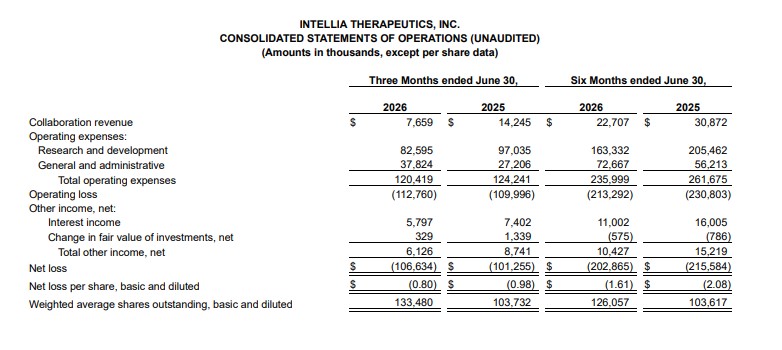
(Source: ir.intelliatx.com)
- The statement shows that Intellia Therapeutics remained deeply loss-making in Q2 2026, although its six-month performance improved compared with the prior year. The results reflect the typical profile of a clinical-stage biotechnology company, with relatively limited collaboration revenue and substantial investment in research and development.
- For the three months ended June 30, 2026, collaboration revenue declined sharply to $7.7 million from $14.2 million a year earlier, a drop of roughly 46%. Total operating expenses decreased only modestly to $120.4 million from $124.2 million. Research and development expenses fell to $82.6 million from $97.0 million, showing some cost moderation, but general and administrative expenses increased significantly to $37.8 million from $27.2 million.
- Because revenue fell faster than operating expenses, the quarterly operating loss widened slightly to $112.8 million, compared with $110.0 million in Q2 2025. Other income also weakened, falling to $6.1 million from $8.7 million, mainly because interest income declined and gains from investment revaluation were lower. Consequently, net loss increased to $106.6 million from $101.3 million.
- The loss per share improved to $0.80 from $0.98, but this improvement was largely influenced by a higher weighted average share count, which increased to 133.5 million shares from 103.7 million. This indicates meaningful shareholder dilution compared with the previous year.
- The six-month results show a more favorable cost trend. Collaboration revenue declined to $22.7 million from $30.9 million, but total operating expenses fell almost 10% to $236.0 million, largely due to lower R&D spending. As a result, the six-month operating loss improved to $213.3 million from $230.8 million, while net loss narrowed to $202.9 million from $215.6 million.
- From an investor perspective, the main positive is stronger expense discipline, particularly the reduction in R&D spending, which helped improve the first-half operating loss. However, declining collaboration revenue, rising administrative costs, weaker interest income, continued cash losses, and substantial share dilution remain important concerns. The company’s financial outlook therefore continues to depend heavily on clinical progress, future partnership revenue, and its ability to manage cash consumption while advancing its development pipeline.
Beat or Miss?
| Metric | Reported | Difference/Analysis |
| Collaboration revenue | $7.66 million | Missed consensus of about $12.98–$13.18 million by roughly $5.3 million, or 41% |
| EPS | ($0.80) | In line with the $(0.80) consensus estimate |
| Net loss | $(106.6 million) | Widened from $(101.3 million) in Q2 2025 |
| Cash and investments | $628.4 million | Up from $605.1 million at year-end 2025, supported by the April equity offering |
| Cash runway | At least into 2028 | Guidance excludes potential lonvo-z commercial revenue |
| Near-term regulatory outlook | BLA acceptance anticipated in H2 2026 | Potential lonvo-z launch targeted for H1 2027, contingent on approval |
The quarter was therefore mixed: the company met EPS expectations, but its collaboration revenue materially undershot consensus. Investors appeared to weigh that revenue shortfall against better-than-expected clinical and regulatory progress for lonvo-z.
What Leadership Is Saying
“The second quarter was a momentous period for Intellia highlighted by the positive Phase 3 HAELO clinical trial results we reported for lonvo-z in hereditary angioedema. These data serve as strong validation for in vivo gene editing and lonvo-z’s potential to transform the treatment paradigm for patients who are burdened by this disease.”
— John Leonard, M.D., President and CEO
“We believe this cash balance will be sufficient to get us at least into 2028. Importantly, while we expect to obtain approval and launch lonvo-z in the U.S. in the first half of 2027, our cash runway guidance is conservative in that it excludes all product revenues.”
— Ed Dulac, CFO, Q2 2026
Historical Performance
| Category | Q2 2026 | Q2 2025 | Change (%) |
| Collaboration revenue | $7.7 million | $14.2 million | -46.20% |
| Net loss | $(106.6 million) | $(101.3 million) | Loss widened 5.3% |
| R&D expense | $82.6 million | $97.0 million | -14.90% |
| G&A expense | $37.8 million | $27.2 million | 39.00% |
| Total operating expenses | $120.4 million | $124.2 million | -3.10% |
| Operating loss | $(112.8 million) | $(110.0 million) | Loss widened 2.5% |
| EPS | ($0.80) | ($0.98) | Loss per share improved 18.4% |
Although quarterly collaboration revenue declined sharply, Intellia reduced R&D spending and narrowed its per-share loss. The increase in absolute net loss reflects a combination of lower revenue and a higher G&A investment ahead of a potential lonvo-z commercial launch.
Peer Historical Performance
| Category | Q2 2026 | Q2 2025 | Change (%) |
| Intellia revenue | $7.7 million | $14.2 million | -46.20% |
| Intellia net loss | $(106.6 million) | $(101.3 million) | Loss widened 5.3% |
| Intellia operating expenses | $120.4 million | $124.2 million | -3.10% |
| CRISPR Therapeutics revenue | $10.2 million | $0.9 million | 1041% |
| CRISPR Therapeutics net loss | $(91.2 million) | $(208.5 million) | Loss narrowed 56.3% |
| CRISPR Therapeutics R&D expense | $67.2 million | $69.9 million | -3.90% |
| Editas Medicine revenue | $11.9 million | $3.6 million | 232.30% |
| Editas Medicine net loss | $(18.2 million) | $(53.2 million) | Loss narrowed 65.8% |
| Editas Medicine R&D expense | $20.2 million | $16.2 million | 24.70% |
| Beam Therapeutics revenue | $0.5 million | $8.5 million | -94.10% |
| Beam Therapeutics net loss | $(122.7 million) | $(102.1 million) | Loss widened 20.2% |
| Beam Therapeutics R&D expense | $95.1 million | $101.8 million | -6.50% |
The peer set illustrates divergent funding and commercialization positions in gene editing. CRISPR Therapeutics has an approved product, CASGEVY, and reported accelerating product-related momentum; Editas benefited from higher collaboration revenue and restructuring-related expense improvement; Beam, like Intellia, remains in a high-investment clinical-development phase.
How the Market Reacted?
NTLA initially traded down 1.73% to $10.78 in premarket trading following the report, reflecting investor concern over the collaboration-revenue miss. However, the stock closed August 6 at $11.24, up 2.46% from the prior close of $10.97, and then rose to $11.60 after hours, a further 3.20% gain.
The reversal suggests that investors ultimately assigned greater weight to the positive Phase 3 lonvo-z data, prospective BLA acceptance, and cash runway into 2028 than to the near-term revenue shortfall.

Sources