








Initial discussion
AI in Transportation Statistics: Artificial intelligence is quickly becoming a key part of modern transportation. It is changing how vehicles operate, how traffic is managed, and how goods reach their destinations. AI can analyze large volumes of data to predict traffic, optimize routes, detect vehicle issues, and reduce delays. It also supports driver-assistance systems, autonomous vehicles, smart public transport, and more efficient logistics. For businesses, these tools can help lower operating costs and improve fleet performance.
For passengers, it can make daily travel safer and more convenient. As transportation networks continue to expand, AI is helping cities and companies build smarter, more connected, and more efficient mobility systems.
Editor-Approved
- The global artificial intelligence in transportation market is estimated at USD 5.3 billion in 2026.
- North America leads the AI transportation market, accounting for an estimated 40.8% share in 2026.
- Hardware accounted for 55.1% of the market, while software accounted for the remaining 44.9%.
- The market remains fragmented, with the top 10 companies accounting for 22.99% of total revenue, while Waymo holds the largest individual share at 3.63%.
- Around 70% of transportation companies had adopted AI.
- Besides, 53.1% are exploring AI use cases but have not yet started implementation.
- However, 84% of executives said transportation still lagged other industries in AI adoption.
- By May 2026, autonomous vehicles had driven 360 million miles in the U.S., about 2.5 times as many as in June 2025.
- In 2026, Waymo has raised USD 16 billion in new funding, bringing its post-money valuation to USD 126 billion as it enters a new growth phase.
- A 2026 AI routing model cut delivery time by 20.2%, from 65.3 to 52.1 minutes.
- Automatic emergency braking can reduce police-reported rear-end crashes by about 50%.
- AI-based route optimization can reduce fuel costs by 10%-20% through more efficient travel planning.
- AI-powered traffic systems could reduce road congestion by 25%.
Global AI in Transportation Market Trends
(Source: thebusinessresearchcompany.com)
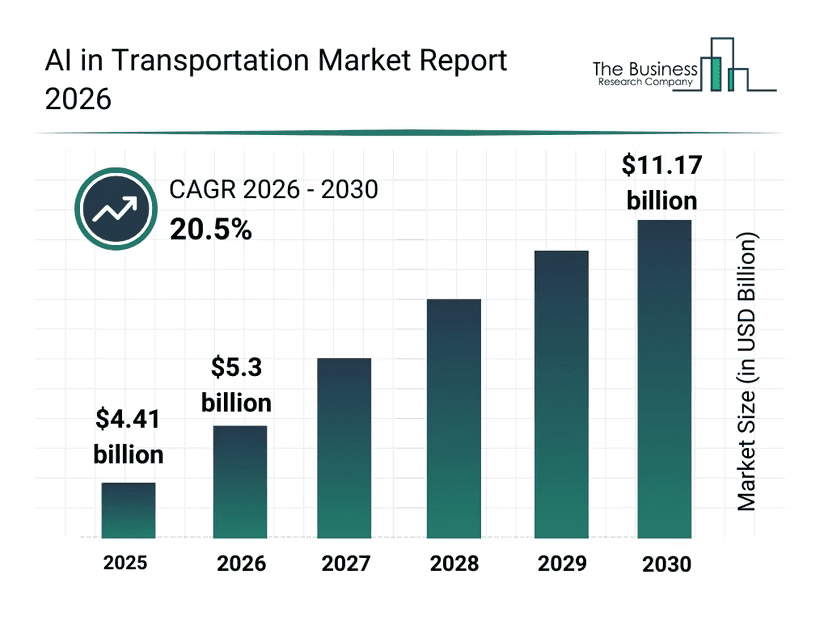
- The global artificial intelligence in transportation market is estimated at USD 5.3 billion in 2026.
- It is projected to reach USD 11.17 billion by 2030 and is expected to expand at a 20.5% CAGR during 2026-2030.
- North America leads the AI transportation market, accounting for an estimated 40.8% share in 2026.
- Autonomous trucks are projected to hold the largest share of applications, at 43.6%.
(Source: coherentmarketinsights.com)
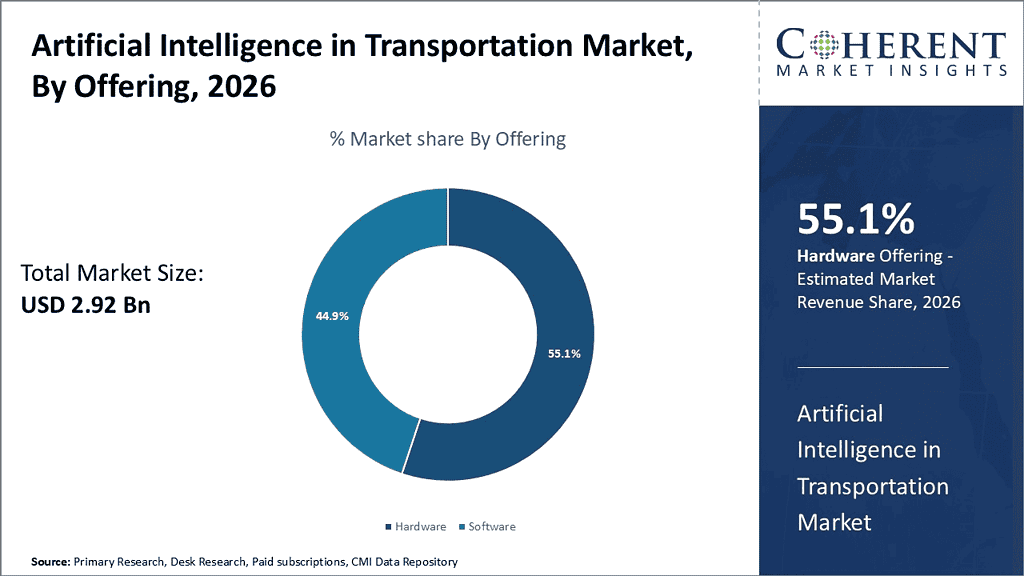
- Hardware accounted for 55.1% of the market, while software accounted for the remaining 44.9%.
(Source: coherentmarketinsights.com)
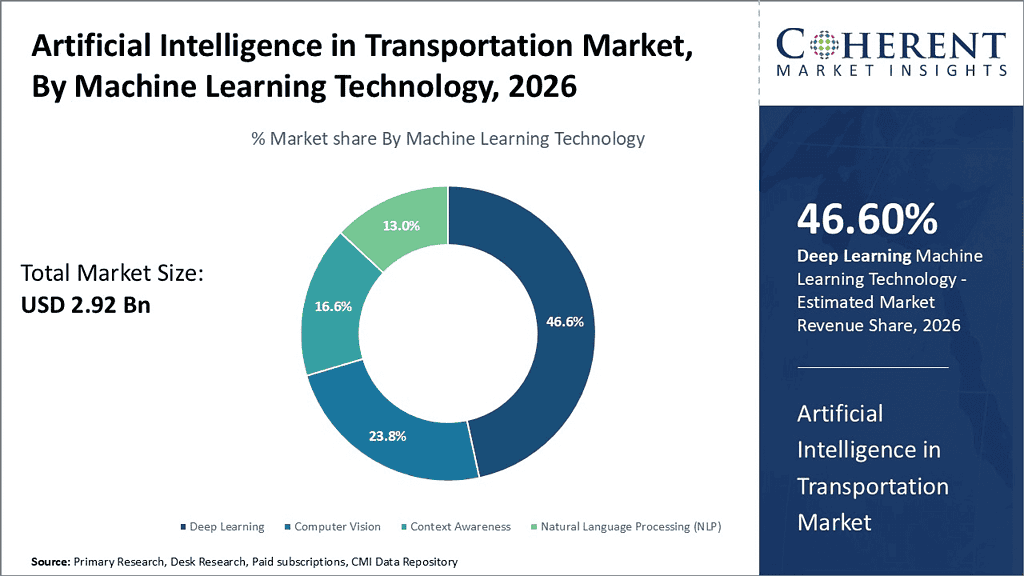
- Computer vision led with a 46.6% market share, followed by deep learning at 23.8%.
- Context awareness held 16.6%, while natural language processing accounted for 13%.
AI in Transportation by Mode
(Reference: xtendedview.com)
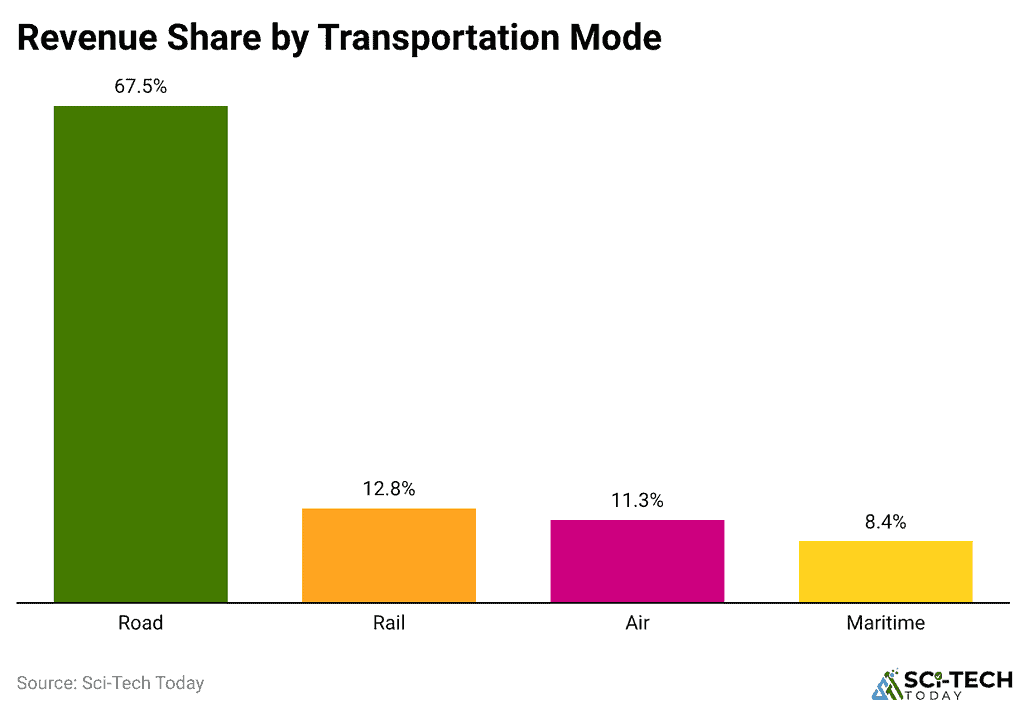
- Road transport led the 2025 market, accounting for 67.5% of revenue.
- Rail accounted for 12.8%, while air transport accounted for 11.3%.
- Maritime transport accounted for 8.4%, with AI supporting routing, port operations, maintenance, and cargo planning.
- The U.S. has 4 million miles of public roads, creating significant opportunities for AI applications.
Regional AI in Transportation Market, 2026
(Source: thebusinessresearchcompany.com)
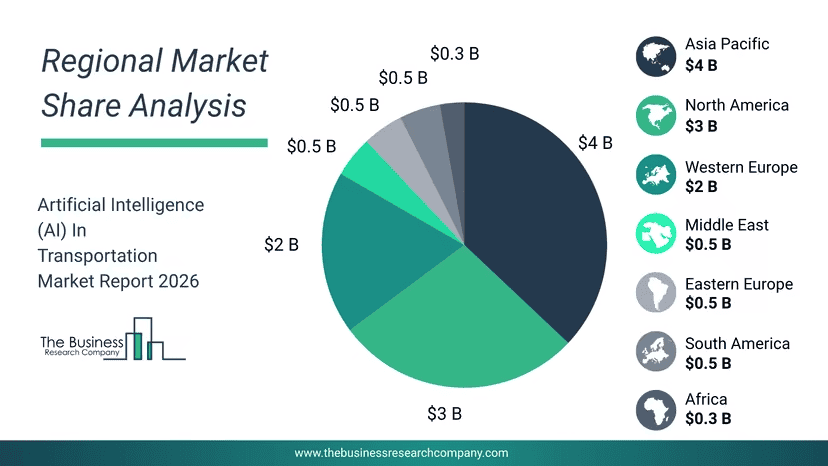
- Asia Pacific led the market with USD 4 billion, followed by North America at USD 3 billion.
- Western Europe accounted for USD 2 billion, while the Middle East contributed USD 0.5 billion.
- Eastern Europe and South America each represented USD 0.5 billion, and Africa accounted for USD 0.3 billion.
AI in Transportation Market Competitive Landscape
- The Business Research Company reported that the market remains fragmented, with the top 10 companies holding 22.99% of total market revenue.
- Waymo leads with 3.63%, followed by NVIDIA (2.6%), Tesla (2.54%), Alphabet (2.16%), and Microsoft (2.15%).
- Bosch and Mercedes-Benz each hold 2.12%, while Aptiv, Continental, and Intel account for 1.97%, 1.92%, and 1.78%, respectively.
AI Adoption in Transportation
- According to Xtendedview, in 2025, 70% of transportation companies had adopted AI, up by 17% year over year.
- Among companies seeing gains, 36% improved fleet planning, 35% optimized routes, and 34% improved operations.
- However, 84% of executives said transportation still lagged other industries in AI adoption.
- Generative AI reached 96% adoption, with data entry at 41%, route optimization at 39%, and forecasting and load matching at 35% each.
- More than 40% of shippers expect AI-enabled logistics services.
- Only 10% of providers reported measurable financial gains.
- Nearly 70% of shippers remained in the exploration or pilot stages.
- Meanwhile, 7% reported supply chain improvements and 1% embedded AI into core processes.
- AI adoption reached 31% in Asia-Pacific, compared with 14% in North America and 6% in Europe.
(Source: blog.optibus.com)
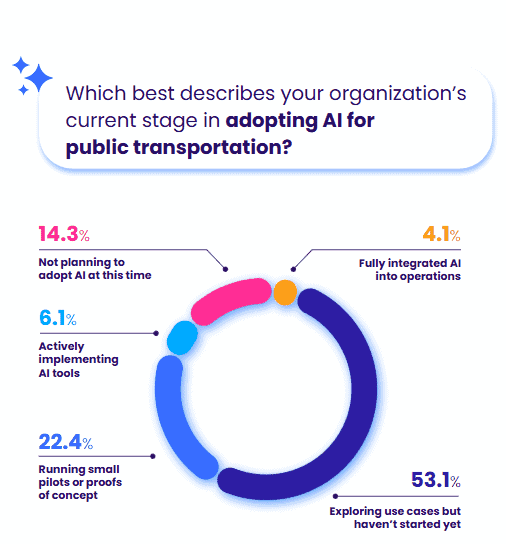
- Around 53.1% are exploring AI use cases but have not yet started implementation.
- About 22.4% are running small pilots or proof-of-concept projects.
- Nearly 6.1% are actively implementing AI tools.
- Only 4.1% have fully integrated AI into daily operations.
- In contrast, 14.3% are not planning to adopt AI at this time.
Autonomous Vehicle and Robotaxi Growth
- By May 2026, autonomous vehicles had driven 360 million miles in the U.S., about 2.5 times as many as in June 2025.
- The United States robotaxis completed 21 million rides by May 2026, while global services exceeded 700,000 rides per week.
- Waymo report also mentioned that one major service surpassed 220 million autonomous miles by March 2026.
- The U.S. robotaxis exceeded 450,000 weekly rides, compared with over 250,000 in China by late 2025.
- One operator’s rides rose from 4.66 million in 2024 to 14.9 million in 2025, while mileage rose from 77 million to 225 million.
- According to dmv.ca.gov, California AV testing exceeded 9 million miles between December 2024 and November 2025.
- Level 4 robotaxis operated commercially in more than 20 cities worldwide in 2026.
AI Transportation Investments and Partnerships
- In 2026, Waymo has raised USD 16 billion in new funding, bringing its post-money valuation to USD 126 billion as it enters a new growth phase.
- Uber-Rivian plans to invest up to USD 1.25 billion and deploy 50,000 robotaxis across 25 cities by 2031.
- Aurora generated USD 215 million in equity proceeds in Q2 2026 and held nearly USD 1.2 billion in cash and short-term investments.
- Uber-NVIDIA targets Level 4 robotaxi deployment in 28 cities by 2028.
- Uber-Pony.ai plans to deploy over 2,000 robotaxis across 5 European cities.
- Uber AV Ecosystem works with more than 30 autonomous vehicle partners across transportation and delivery.
- WeRide-Uber-AVOMO progressed in 4 of 15 planned cities, with 11 more targeted by 2030.
AI Transportation ROI and Operational Impact
- AI Business Weekly also shows AI-based route optimization can reduce fuel costs by 10%-20% through more efficient travel planning.
- Autonomous trucking can lower total ownership costs by 42%.
- Meanwhile, delivery costs can reach USD 0.03 per ton-mile compared with USD 0.07 for human-driven trucks.
- Smart traffic signals can reduce vehicle stops by 30%, cut intersection emissions by 10%, and reduce peak and off-peak trips by 11% and 8%, respectively.
- AI traffic optimization avoided 31.73 million metric tons of CO₂ annually across 100 Chinese cities.
- Moreover, AI freight solutions can reduce emissions by up to 7%.
- AI can lower rail maintenance costs by 15%- 30%, reduce downtime by 15%- 25%, and cut delays by 20%.
- In aviation, AI can reduce maintenance costs by about 17.5%, improve fuel efficiency by 3%-8%, and reduce airport taxi times by up to 15%.
- Public transit systems can achieve approximately 12% lower operating costs by adopting AI.
AI in Traffic Management and Congestion Reduction
- According to the U.S. Department of Transportation’s ITS Knowledge Resources, Arizona’s 2025 AI pilot cut intersection delays by 46%, while cross-traffic delays fell by 54%.
- The same pilot reduced pedestrian waiting by 22% and saved 322 hours of vehicle delay in one week.
- A California AI traffic system reduced traffic time by 30%, saving drivers 91 hours.
- Its system processed traffic conditions up to 10 times per second for faster signal adjustments.
- New Jersey AI traffic controls reduced corridor delays by 10% to 30%.
- A Toronto simulation across 12 intersections cut vehicle time by 19%, from 2,303 to 1,878 hours.
- AI signals with autonomous vehicles reduced travel time by 18.85% to 29.61% and delays by 60.02% to 73.74%.
- Jakarta’s AI and IoT traffic system improved traffic flow by about 15%.
AI Route Optimization and Navigation Statistics
- AI optimization could lower logistics costs by 15% to 20% and improve inventory levels by 35% to 65%.
(Reference: xtendedview.com)
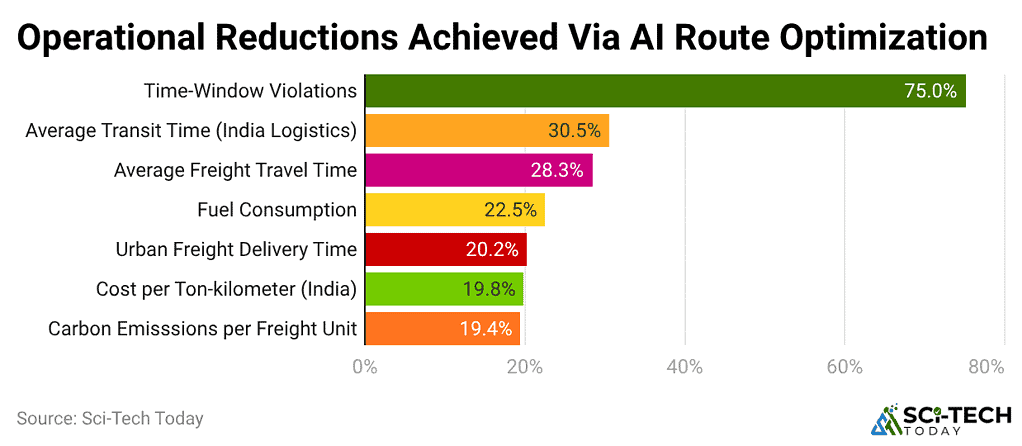
- A 2026 AI routing model cut delivery time by 20.2%, from 65.3 to 52.1 minutes.
- Fuel use fell 22.5%, from 0.120 to 0.093 liters per kilometer.
- Time-window violations dropped 75%, from 12 to 3, while capacity compliance reached 100%.
- Incident avoidance improved from 78% to 94%, and delivery completion rose from 96% to 99%.
- Another model reduced freight travel time by 28.3%, improved on-time delivery to 92.1%, and cut congestion by 15.7%.
- Travel time fell by 22.6%, while transportation costs declined by 18.9% under stable traffic conditions.
- AI routes improved haul efficiency by 10.3% in hours and 11.6% in miles.
- Last-mile AI produced 22.4% more quality routes than benchmarks and 24.1% more than couriers.
- In India, transit time fell 30.5%, from 82 to 57 hours, while costs declined 19.8% and reliability rose from 72% to 88%.
AI in Public Transportation and Transit Automation
- A 2026 APTA survey of 32 transit agencies found that 50% use or plan to use AI for back-office tasks, while 47% target operations.
- Among agencies without operational AI, 71% expressed interest in adopting it in the future.
- Customer support accounted for 44% of AI use or planned adoption, with 57% of non-users interested in it.
- Safety and security accounted for 38% of current or planned AI use, while 85% of non-users expressed interest in it.
- In 2025, almost 95% of transit organizations had researched, piloted, or implemented AI.
- Only 8% reported measurable or transformative benefits.
- The United States public transit recorded 8.1 billion trips in 2025, up 6% year over year.
AI and Autonomous Driving Safety Statistics
- Automatic emergency braking can reduce police-reported rear-end crashes by about 50%, according to the Insurance Institute for Highway Safety.
- Front automatic emergency braking was installed in 32% of U.S. vehicles in 2024 and could reach 55% by 2029.
- Front crash-prevention systems are projected to rise from 38% to 60% fleet penetration between 2024 and 2029.
- Blind-spot monitoring could increase from 35% to 57%, while lane-departure warning may rise from 33% to 56%.
- Pedestrian automatic braking is projected to grow from 26% to 50% penetration.
- A 2026 assessment found one Level 4 fleet had 68% fewer police-reportable crashes per mile than human drivers.
- A 2025 peer-reviewed study published in PubMed analyzed 56.7 million miles of driverless driving and found 96% fewer injury-reported intersection crashes.
AI in the Automotive Industry Trends
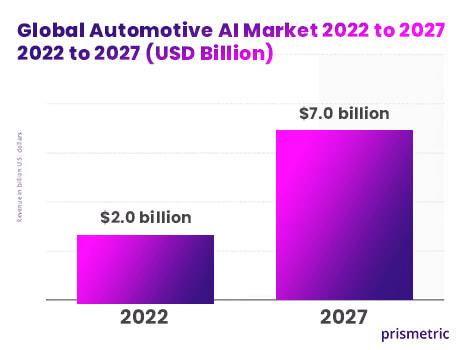
(Source: prismetric.com)
- The global automotive AI market was valued at USD 2.3 billion in 2022 and is projected to reach USD 7 billion by 2027, growing at a 24.1% CAGR.
- Nearly 58 million self-driving cars are projected to be on roads by 2030.
- AI-powered traffic systems could reduce road congestion by 25%.
- Predictive maintenance using AI could reduce fleet maintenance costs by 10%- 20%.
- AI-based route optimization could improve fuel efficiency by up to 15%.
- AI-powered driver monitoring and safety systems could reduce accident rates by 20%-30% in equipped vehicles.
Recent Developments of AI in Transportation
- By late 2025, the autonomous trucking network covered a 600-mile Fort Worth-to-El Paso route and exceeded 100,000 driverless miles.
- The driverless fleet grew to 10 trucks in December 2025, showing progress toward regular commercial operations.
- By January 2026, cumulative driverless mileage surpassed 250,000 miles, nearly tripling the early October 2025 total.
- By April 2026, mileage exceeded 370,000 miles, with 100% on-time performance and no collisions attributed to automated systems reported.
- The 2026 hardware targets a 1-million-mile lifespan and costs over 50% less.
- Its lidar now reaches 1 kilometer, enabling more than 34 seconds of potential reaction time.
Outcome
AI is becoming a key part of modern transportation. It helps improve traffic flow, route planning, fleet operations, safety, and logistics. Businesses and transport operators can use AI to cut delays, manage resources, and make faster decisions.
Still, wider use will require better infrastructure, strong data protection, clear rules, and trained workers. As these areas improve, AI can support safer, smarter, and more efficient transportation systems for businesses and everyday travelers.
FAQ
AI helps transportation through autonomous vehicles, traffic management, route optimization, predictive maintenance, and safer travel.
AI improves transport safety, reduces costs, optimizes routes, and enhances passenger experiences.
AI transportation software typically costs USD 50 to USD 1,000 monthly.

Sources