








Executive Overview
Wearable Displays Statistics: Wearable displays are bringing digital information closer to people than ever before. From smart glasses and watches to AR and VR headsets, these devices let users view information directly through screens worn on their bodies. Unlike traditional displays, they offer quick access to digital content while keeping users connected and hands-free. Their use is growing across healthcare, education, gaming, manufacturing, and defense.
For instance, doctors can check medical data during surgery, while factory workers can view step-by-step instructions without stopping their work. At the same time, better display quality, smaller components, and improved battery life are making these devices more practical for everyday use.
Best Overall
- The wearable display market was valued at USD 6 billion in 2025 and is projected to reach USD 7.2 billion in 2026.
- Smartwatches led the market with a 38.2% share, generating USD 10.8 billion in 2025.
- Consumer Electronics dominated the market with a 52.8% share, generating USD 15 billion in 2025.
- Individual consumers dominated the market in 2025, accounting for 73.4% of the market and generating USD 20.8 billion in revenue.
- Asia Pacific led the market in 2025 with USD 12.1 billion and a 42.6% share.
- OLED and MicroLED advancements have reduced screen thickness to 1.2 mm and power consumption by 41%, contributing 26% to growth.
- Samsung Display reported KRW 8.0 trillion (approximately USD 5.98 billion) in Q3 2026 revenue, with operating profit of KRW 1.1 trillion (approximately USD 823 million).
- The wearable display glasses market is growing, with global shipments expected to reach 50 million units by 2025.
- In 2026, shipment shares are approximately 2% for augmented reality, 51% for extended reality, 46% for mixed reality, and 1% for virtual reality.
- Around 5% of U.S. adults, or 13.4 million people, own camera-equipped smart glasses.
Key Factors Driving Wearable Display Market Growth
- Over 65% of smart wearables feature advanced visual interfaces, according to a report by Reanin.
- Strategic partnerships and mergers support over 60% of product development efforts.
- More than 55% of companies are investing in R&D, prototype testing, and improved designs to enhance display performance and support market expansion.
- Demand for health monitoring is increasing, with 71% of wearable users using them daily. This segment is expected to contribute 31% of market growth.
- OLED and MicroLED advancements have reduced screen thickness to 1.2 mm and power consumption by 41%, contributing 26% to growth.
- Growing demand for wearable gaming and AR applications is expected to drive 22% of market growth, according to Market Intelo.
- AI-powered health tracking, predictive analytics, and smart assistants are expected to contribute 21% of market growth through 2034.
Wearable Display Market Size
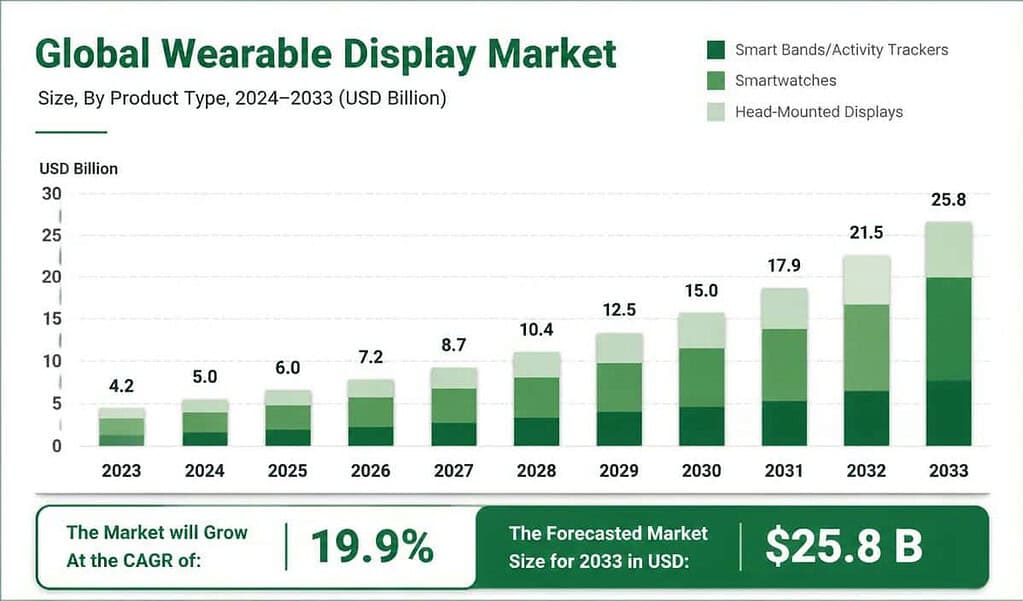
- The wearable display market was valued at USD 6 billion in 2025 and is projected to reach USD 7.2 billion in 2026.
- The market is expected to grow at a 19.9% CAGR from 2024 to 2033, reaching USD 25.8 billion by 2033.
- Global Market Insights reported that AR and smart glasses revenue is projected to rise from USD 848 million in 2025 to USD 9,724 million by 2035.
- Other display architectures lead the market with a 31.0% share.
- Meta, Samsung, Sony, Microsoft, and Apple jointly captured 70.5% market share in 2025.
Wearable Display Market Share by Technology
- Market Intelo noted that in 2025, OLED led the market with a 37.6% share, generating USD 10.7 billion in revenue.
- LCD held a 31.2% share, worth USD 8.8 billion, driven by budget smartwatches and fitness trackers.
- LED accounted for 18.6%, while MicroLED held 8.4%, generating USD 2.4 billion.
- Other technologies, including e-ink and reflective displays, represented 4.2% of the market.
By Product Type
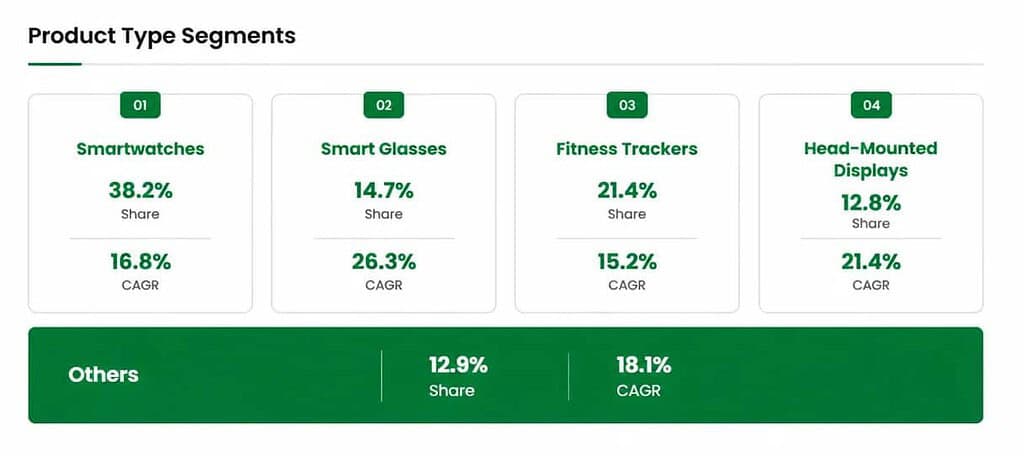
- Smartwatches led the market with a 38.2% share, generating USD 10.8 billion in 2025, up from USD 8.1 billion in 2024. The segment is projected to grow at a 16.8% CAGR through 2034.
- Fitness trackers accounted for 21.4% of the market, generating USD 6.1 billion, with a projected CAGR of 15.2%.
- Smart glasses accounted for 14.7% of the market, generating USD 4.2 billion in 2025, up from USD 2.2 billion in 2024. The segment is expected to grow at a 26.3% CAGR.
- Head-mounted displays accounted for 12.8% of the market, worth USD 3.6 billion, with a projected CAGR of 21.4%.
- Other devices accounted for the remaining 12.9%, generating USD 3.7 billion.
By Application
- Consumer Electronics dominated the market with a 52.8% share, generating USD 15 billion in 2025. The segment is projected to reach USD 51.3 billion by 2034, growing at a 16.2% CAGR.
- Healthcare held an 18.6% share, valued at USD 5.3 billion. It is expected to reach USD 18.7 billion by 2034, at a 22.4% CAGR, driven by remote patient monitoring and medical wearables.
- Sports & Fitness accounted for 14.2% of the market, generating USD 4.0 billion, with an expected CAGR of 18.7% from 2024 to 2034.
- Military & Defense held a 7.8% share, worth USD 2.2 billion, while Industrial applications accounted for 4.1%, valued at USD 1.2 billion.
- Other applications represented the remaining 2.5% share.
By End User
- Individual consumers dominated the market in 2025, accounting for 73.4% of the market and generating USD 20.8 billion in revenue.
- The global installed base reached 1.84 billion active devices in 2025, including smartwatches and other personal wearables.
- The individual segment is projected to grow at a 17.1% CAGR, reaching USD 77.1 billion by 2034.
- Enterprise users accounted for 26.6% of revenue, generating USD 7.5 billion in 2025.
- The enterprise segment is expected to grow at a 19.3% CAGR, reaching USD 32.2 billion by 2034.
Wearable Display Market: Regional Outlook
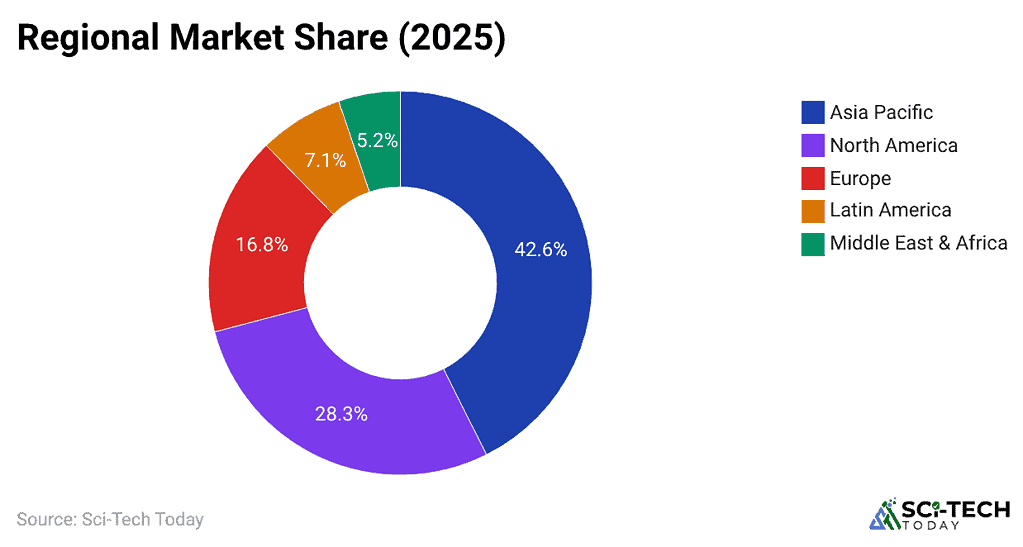
- Asia Pacific led the market in 2025 with USD 12.1 billion and a 42.6% share.
- India’s adoption grew 34% year over year, while the region is expected to capture 45.8% of market growth by 2034.
- North America accounted for 28.3% of the share. The region is projected to grow at a 14.2% CAGR through 2034.
- Europe accounted for 16.8% of the market, driven by demand for durable and premium displays.
- Latin America and the Middle East & Africa together held 12.1% of the market.
- Africa’s wearable adoption is projected to grow at a 22.4% CAGR, while this region is expected to contribute 18.7% of incremental market growth.
Key Wearable Display Companies’ Financial Performance
| Company | Reporting Period | Sales / Revenue | Other Information |
| Samsung Display | Q3 2026 | KRW 8.0 trillion | Operating profit: KRW 1.1 trillion |
| LG Display | Q3 2026 | KRW 6.277 trillion | OLED contributed 67% of revenue |
| BOE Technology | January – September, 2026 | RMB 151.81 billion | Net profit: RMB 4.25 billion |
| Sony Group | Q1 2026 | JPY 2,837.8 billion | Imaging and sensing segment revenue: JPY 512.7 billion |
| AUO | Q3 2026 | NT$66.88 billion | Operating loss: NT$2.37 billion |
| Japan Display | 2026 | JPY 132.33 billion | – |
| Kopin | Q2 2026 | USD 12.7 million | Revenue increased 51% year-on-year |
Extended Reality Glasses Lead Growth as Headset Shipments Decline
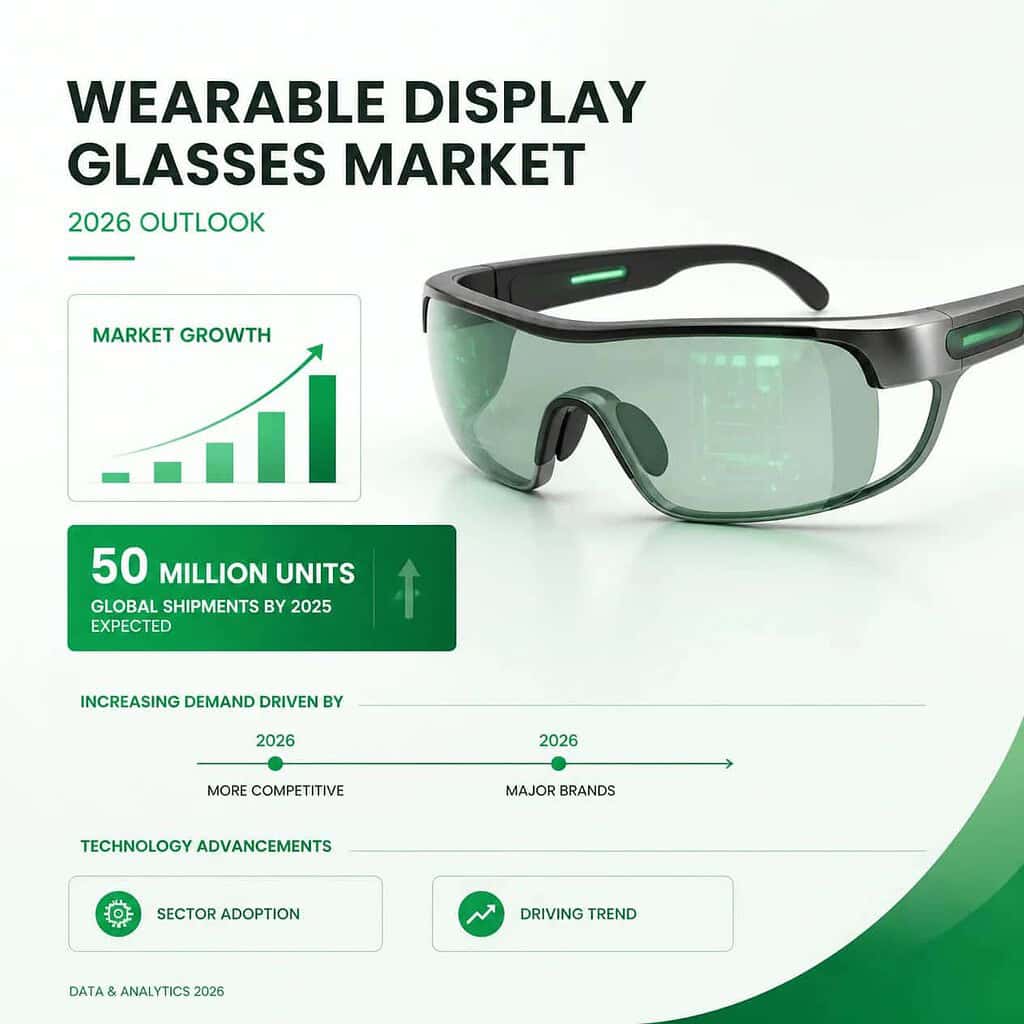
- The wearable display glasses market is growing, with global shipments expected to reach 50 million units by 2025.
- IDC reported that the global AR/VR headset shipments increased 5.1% year over year in Q2 2026 but fell 20.1% from the previous quarter.
- Extended Reality Glasses shipments grew 79.8% year over year in Q2 2026, capturing 46% of the market.
- Mixed reality remained the largest category, with a 49.3% share, despite a 22.3% decline.
- Augmented reality grew 14.1% and held a 1.9% share, while virtual reality shipments fell 37.6% to a 2.8% share.
- In Q2 2026, the PRC and Japan grew 85.8% and 88.2%, respectively.
- However, the U.S. declined 24.1%, while Western Europe fell 25.2%.
Worldwide XR Glasses and Headsets Outlook
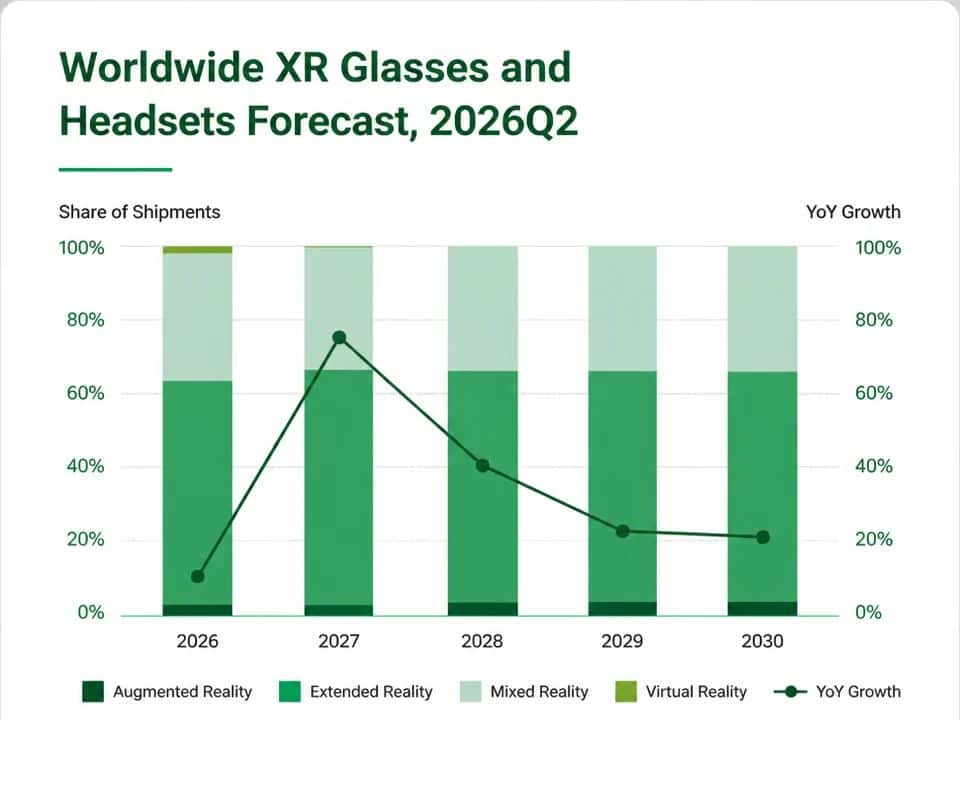
- In 2026, shipment shares are approximately 2% for augmented reality, 51% for extended reality, 46% for mixed reality, and 1% for virtual reality.
- By 2030, extended reality is forecast to lead with approximately 57%, followed by mixed reality at 41% and augmented reality at 2%.
- Annual shipment growth rises from approximately 10% in 2026 to 21% in 2030.
Smart Glasses User Statistics and Consumer Trends, 2026
- According to Security.org’s report, around 5% of U.S. adults, or 13.4 million people, own camera-equipped smart glasses.
- About 25% of non-users are likely to purchase smart glasses within 12 months, while 45% are unlikely to buy them.
- Popular features include hands-free photography, video recording, audio playback, and AI assistants. Around 25% use them for vision correction.
- Privacy concerns about secret recordings affect 78% of women and 65% of men.
- Around 85% of US adults support laws requiring recording indicators, including 63% who strongly support them.
Wearable Display Specifications
| Numeric specification | RayNeo GT Max with Pocket TV Pro | XReal xbx a01+ | RayNeo Air 4 Pro | Viture Beast |
| Listed Price (USD) | 628 | 299 | 299 | 549 |
| Discounted Price (USD) | 578 | 269 | – | – |
| Advertised Discount | 8% | 10% | – | – |
| Resolution Per Eye (Pixels) | 1920 × 1080 | 1920 × 1080 | 1920 × 1080 | 1920 × 1200 |
| Maximum Refresh Rate (Hz) | 120 | 120 | 120 | 120 |
| Field of View (°) | 59 | 50 | 47 | 58 |
| Virtual Screen Size (inches) | 307 | 147 | 201 | 174 |
| Weight (oz) | 2.75 | 2.18 | 2.68 | 3.10 |
| Tracking (Degrees of Freedom) | 3 | 0 | – | 3 |
| Speakers | 4 | 4 | 4 | – |
| Accessory Storage (GB) | 64 | – | ||
| Accessory Battery capacity (mAh) | 6,500 | – | ||
| Maximum Accessory Viewing Time (hours) | 5.5 | – | ||
| Approximate Phone Battery Drain (% per hour) | – | 20 | – | |
| Virtual Viewing Distance (meters) | – | 4 | ||
| Lens-dimming Levels | – | 9 | ||
Key Wearable Display Technology Developments
- January 2026: Manufacturers focused on 3 priorities: higher resolution, better brightness, and lower power consumption.
- March 2026: Around 43% of advanced wearable display designs focused on flexible and durable panels.
- April 2026: Companies advanced 3+ areas, including compact projectors, optical integration, and AI smart glasses.
- June 2026: Around 45% of advanced-display projects focused on micro-OLED and near-eye technologies.
- July 2026: Manufacturers improved 3+ areas to extend battery life and display performance in wearable devices.
Overall Assessment
Wearable displays are becoming a useful part of modern technology. Devices such as smart glasses and AR headsets allow users to view information, communicate, and interact with digital content more easily. Their use is expanding across industries, including healthcare, education, and entertainment.
However, high prices, short battery life, and privacy issues still limit wider adoption. With better designs and improved features, wearable displays could become more common in everyday activities over the coming years.
FAQ
Smartwatches, smart glasses, head-mounted displays, VR headsets, AR displays, and wearable projectors.
Wearable displays support healthcare monitoring, fitness tracking, navigation, gaming, industrial training, communication, education, and augmented reality experiences.
A wearable display shows digital information; an AR display overlays digital content onto the real-world view.

Sources