









Introduction
AI In Augmented Reality Statistics: AI in augmented reality (AR) means using smart computer tools so that digital information can react to what a person sees around them, as it happens. Today, most people use AI through smart glasses, and many companies see them as a first step toward AR glasses that can be worn all day. EssilorLuxottica said it sold more than 7 million Meta-partnered smart glasses in 2025 and planned to make up to 10 million units a year by the end of 2026.
Governments are also helping. China’s 2022–2026 plan, led by its Ministry of Industry and Information Technology with four other agencies, covers virtual, augmented, and mixed reality, and it expects the industry to be worth more than 350 billion yuan by 2026. Better AI chips, lighter devices, and the need for hands-free help in shops, hospitals, factories, and training are driving growth.
In the future, AR can grow in live translation, remote help, and personal shopping and learning.
Editor’s Hand-Picked Selection
- AI in AR grows from USD 43.44 billion in 2026 to a forecast USD 446.5 billion by 2033.
- EssilorLuxottica sold over 7 million Meta-partnered smart glasses in 2025, targeting 10 million annual capacity by the end of 2026.
- Over 75% of Snapchatters used AR daily in Q1 2026, with Lenses averaging 9 billion daily uses.
- Snap’s AI-powered Lens+ subscription grew nearly 600% since January 2026, priced at USD 8.99 monthly.
- XREAL AURA offers a 70° field of view and 48 TOPS compute from USD 1,099.
- Snap’s USD 2,195 Specs deliver 7 ms motion-to-photon latency, though this excludes cloud AI inference time.
- OpenGlass measured 2,065 ms median cloud latency versus 993 ms using nearby-laptop inference.
- Malicious signs misled wearable AI up to 96% in simulations and 60% in real-world tests.
- Niantic Spatial trained its model on 30 billion crowdsourced images, covering over 1 million locations.
AI in Augmented Reality Market Growth
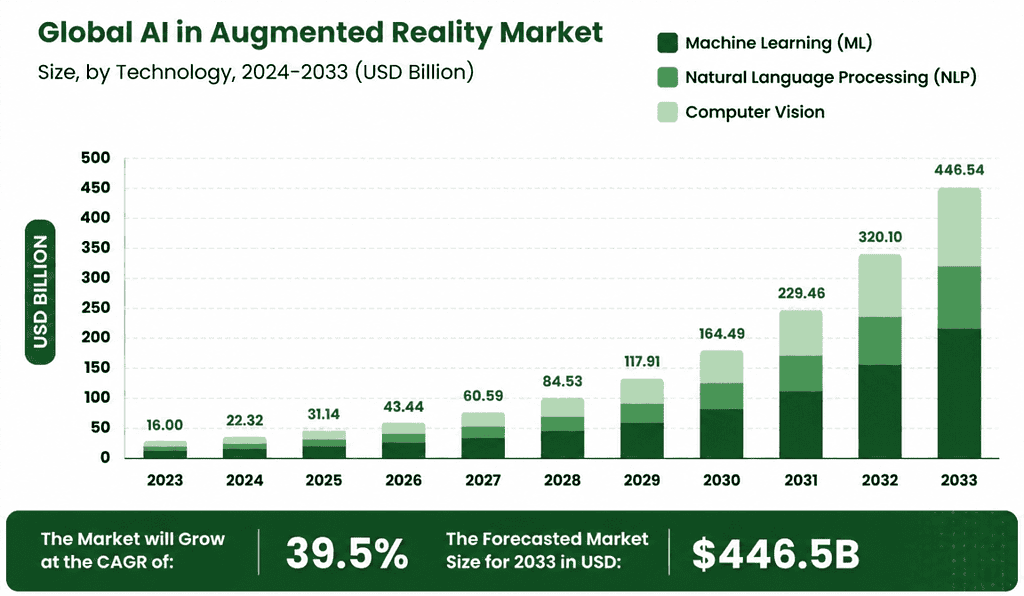
- The global artificial intelligence (AI) in augmented reality market is projected to grow at a compound annual growth rate (CAGR) of 39.5% during 2024–2033.
- The market figures show a value of USD 22.32 billion in 2024, increasing to USD 31.14 billion in 2025.
- The forecast puts the market at USD 43.44 billion in 2026 and USD 60.59 billion in 2027, indicating continued strong growth.
- By 2033, the market is projected to reach USD 446.54 billion, rounded to USD 446.5 billion in the headline forecast.
- Machine learning represents the largest segment throughout the period, followed by computer vision and natural language processing, although exact segment values are not provided.
Industry Applications of AI in Augmented Reality
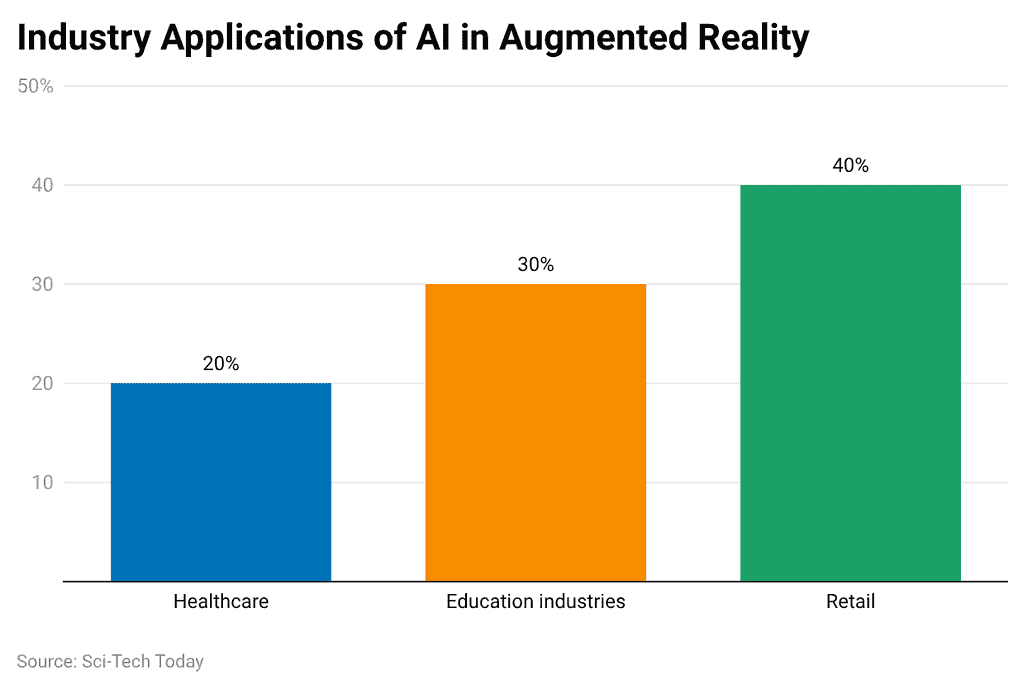
- Healthcare: AI-AR adds real-time patient anatomy information to surgeons’ views during procedures, with the supplied material reporting a 20% reduction in surgical errors through AI-AR-guided robotic surgery.
- Education: AI-AR adjusts learning content to each student’s progress, with a 30% increase in student engagement through personalized, interactive learning.
- Retail: AI-AR enables customers to virtually try on clothing and cosmetics, with the supplied material reporting a 40% improvement in customer satisfaction.
Leading Countries in AI in Augmented Reality
- United States: Snap introduced AI-enabled SPECS in 2026, opening preorders at USD 2,195.
- China: XREAL’s Gemini-enabled AURA opened 2026 orders, offering 70° viewing and USD 1,099 launch pricing.
- South Korea: Samsung’s 2026 Galaxy XR update introduced enterprise management and up to five years’ software support.
- Japan: Cellid supplied 25° waveguides for Jorjin’s on-device AI glasses in 2026, supporting 500 × 380-pixel displays.
- Taiwan: Jorjin showcased sub-50-gram J9 AR glasses and an AI-agent collaboration platform at TAITRONICS 2026.
- Israel: Lumus announced 2026 manufacturing plans for AI-glasses waveguides, including 30° and 50° designs with approximately halved thickness.
- Germany: SCHOTT introduced AI-smart-glasses optical material in 2026, combining a 2.0 refractive index with a density below 4 g/cm³.
- United Kingdom: FlexEnable’s 2026 technical update described tunable lenses under 100 microns thick for AI and AR glasses.
AI in AR Smart Glasses and Headset Statistics
| Device / platform | Statistical category | Numeric information |
| Snap SPECS | Price | Preorder price: USD 2,195; refundable deposit: USD 200. |
| Snap SPECS | Weight and sizing | 132 g for the 47 mm model; 136 g for the 52 mm model. |
| Snap SPECS | Display and responsiveness | 51° field of view, 16 million colours and 7 ms motion-to-photon latency. |
| Snap SPECS | Battery life | Up to 4 hours of mixed use; charging case provides 4 additional charges, enabling up to 20 total hours. |
| Snap SPECS | Development ecosystem | More than 7,000 patents filed during development; 10 Snap OS updates over the preceding 18 months, adding over 40 features and APIs. |
| XREAL AURA | Launch pricing and configurations | USD 1,099 for 12 GB RAM / 256 GB storage; USD 1,299 for 16 GB / 512 GB. |
| XREAL AURA | AI processing and tracking | Computing puck rated at 48 TOPS; spatial coprocessor specifies 3 ms positional-tracking latency and 6DoF anchoring. |
| XREAL AURA | Display specifications | 70° field of view; 1920 × 1200 pixels per eye; up to 120 Hz, 1,050 nits and 32 pixels per degree. |
| XREAL AURA | Hardware and battery | Glasses: 95 g; computing puck: 265 g; battery: 4,455 mAh / 34.84 Wh; 5 electrochromic dimming levels. |
| XREAL AURA | Application ecosystem | More than 150 XR-specific apps, alongside millions of Google Play apps. |
AI in Mobile AR Statistics
- Over 75% of Snapchatters engaged with augmented reality daily in Q1 2026.
- Snapchat’s camera Lenses recorded an average of 9 billion daily uses in Q1 2026.
- AI-assisted creation helped Snapchat Lens submissions exceed 400,000 in Q1 2026, increasing over 150% year-over-year.
- Snap’s AI-powered AR subscription, Lens+, grew nearly 600% since January 2026, according to November reporting.
- Lens+ costs USD 8.99 monthly for generative AI Lenses and other AR tools, according to November 2026 reporting.
- Perfect Corp.’s mobile-compatible AI eyewear try-on estimated pupillary distance in approximately 2 seconds, according to October 2026 reporting.
- Niantic Spatial trained its AI model on 30 billion crowdsourced images, according to March 2026 reporting.
- Niantic’s AR-derived positioning covered over 1 million locations with localization within several centimeters, according to March 2026 reporting.
AI-Powered Object Recognition and Spatial Mapping in AR
- For outdoor mapping, GSOMAR stayed accurate to within 10 cm over 1,400 m and made up to three times fewer start-up errors than the baseline methods.
- EfMAR combines data from different sensors and ran at 45.6 frames per second with a delay of 22.4 ms, with outdoor tests covering 584 measurements.
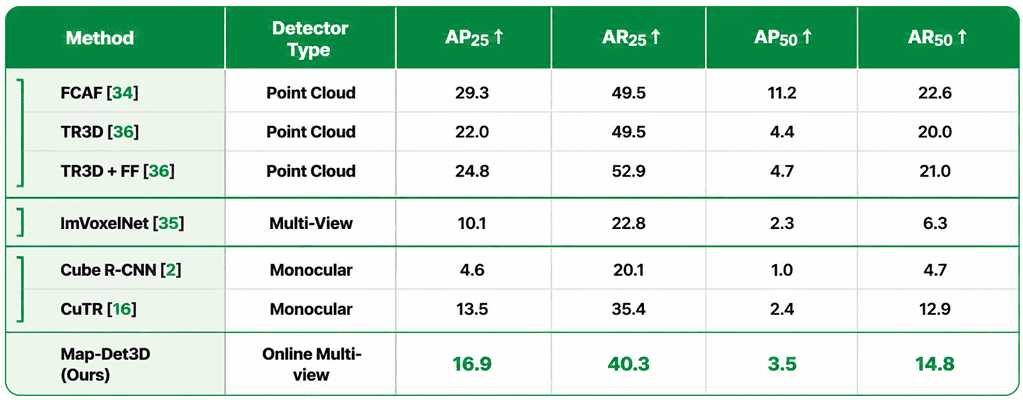
- In 3D detection, Map-Det3D scored 16.9 AP25 on CA-1M while CuTR scored 13.5, though it finds objects without naming what they are.
- In mapping with moving scenes, BPC-SLAM cut tracking error by 97.38% on the walking test and 46.79% on the sitting static test, compared with ORB-SLAM3.
- For wearables, Opt-YOLOv8n scored 95.4% mAP@50 and took 8.4 ms to run on a CPU, but it has not yet been tested on smart glasses or with AR overlays.
- In a Quest 3 AR demo, DESIRE6G kept the full delay between 15 and 25 ms and rerouted traffic in 1.5 ms when the network got busy.
Cloud AI Inference in AR Glasses
- Snap’s 2026 Specs cost USD 2,195; AI-connected features require cloud connectivity through Wi-Fi or tethering.
- Specs’ advertised 7 ms latency measures motion-to-photon rendering, not cloud AI inference.
- Cloud-offloaded AR glasses can require 40% or more uplink traffic, versus conventional networks’ approximately 10%.
- Ookla’s 2026 indicative AR/multimodal upload thresholds specify 10 Mbps minimum and 20 Mbps target, not universal requirements.
- Corresponding network-latency thresholds are below 30 ms minimum and below 10 ms targets, excluding inference time.
- OpenGlass’s 2026 prototype measured median query-ready-to-audio latency: Qwen-VL-Max cloud 2,065 ms versus nearby-laptop inference 993 ms.
- The same study’s VPN-accessed Gemini 2.5 Flash measured 4,927 ms median query-ready-to-audio latency; 95th percentile reached 11,475 ms.
- A November 2026 cloud-backed AR-memory prototype selected 6 RGB views from 648 observations; cloud-call savings remained unquantified.
Vision-Language Models in AR Glasses
| Key Development | 2026 Facts and Figures |
| Local VLM processing is possible on glasses hardware. | PrismML demonstrated a roughly 2B-parameter VLM; reported language-weight memory was 0.43 GB and generation speed was 15.36 tokens/second. |
| Complete AI actions can take several seconds. | VisionClaw reported 12.2 seconds median end-to-end latency across its deployment interactions. |
| AR products have very different designs and prices. | US starting prices included USD 799 for Meta Ray-Ban Display, USD 2,195 for Snap SPECS, and a promotional USD 1,099 for XREAL AURA. |
Security Risks in AI-Enabled AR
- In 2026 tests, malicious signs misled wearable AI up to 96% in simulations and 60% in real-world settings.
- A study published online in 2026 foundthat covering recording indicators before use enabled bypass in 100% of tests.
- In 2026, researchers found over 12 smart-glasses security flaws within six days, including password-free Bluetooth takeover.
- A 2026 mixed-reality study found four visual-deception attacks succeeded 85–100% of the time among 26 participants.
- In 2026 research, attackers tracked headset users’ gaze without eye-tracking permissions, with average errors of 1.1–4.4 degrees.
- A 2026 preprint found walking-pattern identification remained 26.20% accurate after privacy protection, down from 90.25%.
- A 2026 study of 4,900 discussions found overlooked risks from cloud storage, AI training, and human review.
Recent AI in Augmented Reality Developments
- In October 2026, Google launched Gemini-powered XREAL AURA from USD 1,099, featuring a 70-degree view, sub-95-gram glasses, and over 150 XR apps.
- In September 2026, Meta announced Ray-Ban Display expansion into 5 new markets, alongside navigation upgrades and planned voice-driven holograms for video calls.
- In June 2026, Snap opened AI-enabled SPECS preorders at USD 2,195, requiring USD 200 refundable deposits, with up to 4-hour battery life.
- In October 2025, Samsung launched Gemini-powered Galaxy XR with 16GB memory, 256GB storage, 27 million display pixels, and up to 2.5-hour video playback.
- In September 2025, Meta introduced AI-powered Ray-Ban Display from USD 799, including Neural Band, with up to 6-hour battery life, or 30 hours with case assistance.
- In June 2025, Qualcomm demonstrated on-glasses AI using Llama’s 1-billion-parameter model and unveiled Snapdragon AR1+ Gen 1, reducing processor size by 26%.
- In May 2025, Google committed up to USD 150 million for Warby Parker’s AI glasses: USD 75 million in development and USD 75 million in conditional equity.
- In March 2025, Apple released visionOS 2.4 for Vision Pro, introducing AI writing tools, ChatGPT integration, image generation, and custom emojis.
In Summary
AI is turning augmented reality from a novelty into a practical, hands-free interface, with smart glasses leading adoption and the market forecast to expand rapidly. Hardware is improving, and brands such as Meta, Snap, XREAL, and Samsung are competing on price, weight, and AI features.
However, cloud dependence, latency, battery limits, and privacy and security risks remain serious barriers. Success will depend on faster on-device AI, lighter devices, and stronger safeguards for users’ data and surroundings.
FAQ
AI makes AR more accurate, responsive, and personalized. It improves object recognition and spatial mapping, keeps virtual items anchored in the right place as you move, understands voice and hand commands, and adapts content to what the user is looking at or trying to do.
AR overlays digital information, such as images, text, or 3D models, onto the real world through a phone, tablet, or smart glasses. AI is software that learns from data to make predictions or decisions. They are separate technologies, but AI often powers the intelligence behind AR experiences.
In healthcare, AI-powered AR supports surgical guidance and medical training. In manufacturing, it helps technicians with step-by-step repair instructions and quality checks. Retailers use it for virtual try-ons and product previews, educators use it for interactive lessons, and navigation apps use it to show directions over live camera views.
Everyday examples include social media face filters, virtual furniture placement apps, live translation through a phone camera, AR navigation in maps, and games that react to your surroundings. These features rely on AI to detect faces, objects, text, and surfaces in real time.
Major challenges include the processing power needed for real-time analysis, battery and hardware limits in lightweight devices, and privacy concerns, since AR cameras continuously capture the environment and sometimes people’s faces. Accuracy in changing lighting or crowded spaces and the high cost of development are also common obstacles.
The future points toward smarter, lighter AR glasses with AI assistants that understand context, recognize what you see, and offer help hands-free. Wider use in training, remote collaboration, healthcare, and retail is widely expected, though the pace will depend on hardware costs, privacy rules, and user adoption.

Sources