








Starter
AI In Visual Effects Statistics: AI in visual effects (VFX) means using smart computer tools to help create movie and TV effects. These tools can cut out objects, join shots together, build scenes, and make actors look younger. Big studios now use them in real projects. Netflix said that an AI-made scene in the series El Eternauta was finished 10 times faster than with usual VFX tools.
Lower costs, faster work, and government support are the main reasons for growth. Since 1 April 2025, the UK government has given a higher 39% tax credit on UK VFX costs. Job growth is expected to stay slow, as US employment for special effects artists is projected to grow only 2% from 2024 to 2034. Future opportunities include faster planning of scenes, effects for small-budget projects, and training artists to use AI tools.
Key Findings by the Editor
- Netflix reported about 300 titles using generative AI by July 2026, concentrated in post-production.
- Netflix’s 17 minutes of AI-enhanced documentary footage were produced twice as fast and at 50% lower cost.
- Market.us forecasts AI in VFX growing from USD 2.3 billion in 2025 to USD 9.6 billion by 2033.
- AI de-aging reportedly costs USD 200,000 to 600,000 per film, versus USD 5 million-plus for traditional CG.
- AI rotoscoping reportedly cuts artist hours 60 to 80%, though budget savings do not scale equally.
- From 2 August 2026, EU AI Act Article 50 requires covered providers to mark AI-generated content machine-readably.
- NVIDIA stated in March 2026 that DLSS 4.5 uses AI to draw 23 of every 24 displayed pixels.
- A 2026 audit found 76% of sampled open-source models had training-data licensing conflicts.
- UK VFX tax credit hit 39%; US special effects artist jobs projected to grow just 2% through 2034.
AI in Film and Television VFX Statistics
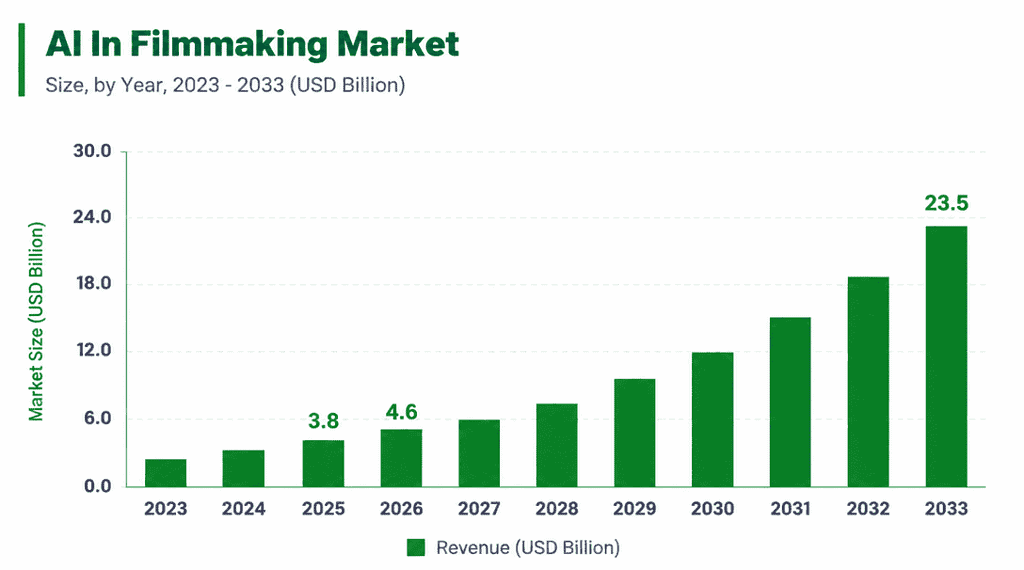
- The global AI filmmaking market, including VFX applications, is estimated at USD 4.6 billion in 2026.
- AI filmmaking revenue is forecast to grow 26.2% annually during 2026–2033, reaching USD 23.5 billion.
- Netflix reported approximately 300 titles using generative AI by July 2026, with applications concentrated in post-production.
- Netflix’s 2026 documentary The American Experiment included 17 minutes of AI-enhanced footage, according to co-CEO Ted Sarandos.
- Sarandos said those AI-enhanced sequences were produced 2× faster than previous production options in July 2026.
- Those same sequences cost 50% less than previous options, Netflix reported in July 2026.
- AI-video developer Runway raised USD 315 million in February 2026, reaching a reported USD 5.3 billion valuation.
AI in Video Game Visual Effects Statistics
- NVIDIA’s 2026 DLSS 4.5 launch brought AI-enhanced Super Resolution to over 400 games and applications.
- In 2026, DLSS 4.5’s second-generation transformer used 5× more compute to improve image quality and temporal stability.
- NVIDIA’s 2026 DLSS 4.5 announcement introduced 6× Multi Frame Generation, generating five additional frames per traditionally rendered frame.
- NVIDIA reported 2026 DLSS 4.5 capabilities enabling 240+ FPS gaming with path tracing on GeForce RTX 50 Series GPUs.
- NVIDIA stated in March 2026 that DLSS 4.5 uses AI to draw 23 of every 24 displayed pixels.
- NVIDIA’s 2026 DLSS 5 announcement specified real-time AI-enhanced lighting and materials at resolutions up to 4K.
- NVIDIA’s October 2026 DLSS 5 update doubled model performance while reducing 4K VRAM usage by 20%.
Generative AI Video and Image Tools in VFX Workflows
- In 2026, Adobe Firefly offered over 30 AI models for integrated image and video creation workflows.
- Adobe’s March 2026 Firefly Image Model 5 release supported native 4-megapixel images and prompt-based editing.
- Runway’s January 2026 documentation listed Gen-4 video generation at 12 credits per second; Turbo required 5.
- Runway’s 2026 Gen-4 specifications supported 5- or 10-second clips at 24 frames per second.
Gen-4 Spec Details
| Gen-4 | Gen-4 Turbo | |
| Cost | 12 credits per second | 5 credits per second |
| Supported durations | 5 seconds (60 total credits) 10 seconds (120 total credits) | 5 seconds (25 total credits) 10 seconds (50 total credits) |
| Platform availability | Web, iOS App | |
| Base prompt inputs | Text, Image (required) | |
| Text prompt character limit | 1000 characters | |
| Output resolutions | 16:9 — 1280×720 px 9:16 — 720×1280 px 1:1 — 960×960 px 4:3 — 1104×832 px 3:4 — 832×1104 px 21:9 — 1584×672 px | |
| Frame rate (FPS) | 24fps | |
- Luma’s January 2026 Ray3.14 release introduced native 1080p video generation across core Dream Machine workflows.
- Luma reported Ray3.14 generated 720p video 4× faster than Ray3 at its January 2026 launch.
- Luma’s 2026 Ray3.14 launch reported 720p generation costing one-third as much as Ray3.
- Luma’s 2026 Ray3.14 guide specified 18-second video modification, approximately 30-second extensions, and upscaling to 4K.
AI in Visual Effects Production Cost
- 2026 estimates from Vitrina suggest AI can reduce total VFX budgets 10–25% on automation-heavy productions; savings aren’t guaranteed.
- Applicable rotoscoping, cleanup, wire-removal, and crowd-generation shots reportedly achieve 20–40% cost reductions in 2026.
- AI de-aging reportedly costs USD 200,000–600,000 per film, versus USD 5 million-plus for traditional CG replacement.
- Generating 50 AI concept images reportedly costs under USD 100, versus USD 15,000–30,000 through traditional concept teams.
- AI rotoscoping reportedly reduces artist hours 60–80%; these time savings do not necessarily translate directly into equivalent budget reductions.
- Standard-shot AI compositing reportedly cuts working time 40–60%, reducing labor requirements rather than guaranteeing equivalent price reductions.
- Mid-tier studios replacing 50% of rotoscoping hours reportedly reduce costs 25–35% on rotoscoping-heavy projects.
AI in Visual Effects Market Size
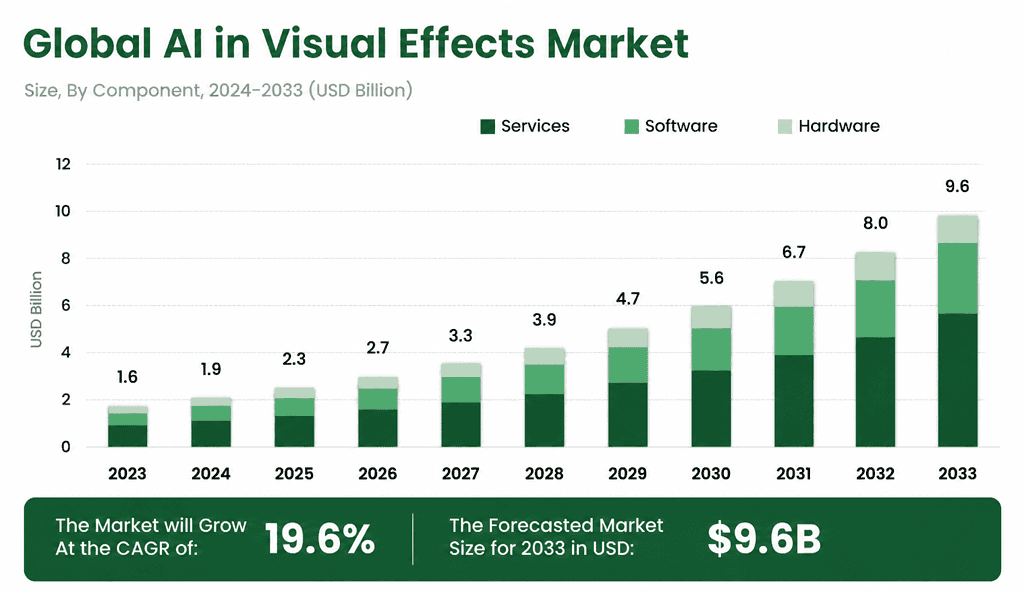
- According to Market.us, the global AI in visual effects market is forecast to grow at a compound annual growth rate (CAGR) of 19.6% during 2024–2033.
- The market was valued at USD 2.3 billion in 2025, providing the starting point for the forecast.
- For 2026, the market size is projected to reach USD 2.7 billion.
- By 2033, the market is projected to reach USD 9.6 billion.
- The market includes services, software, and hardware; services represent the largest component throughout the period, followed by software and hardware, although exact component values are not provided.
Neural Rendering and Differentiable Rendering in VFX Pipelines
- Neural rendering learns scene appearance; differentiable rendering supplies gradients for optimizing geometry, materials, and lighting from images.
- In 2026 VFX workflows, captured photographs become neural scenes for novel viewpoints, environment reconstruction, and previsualization.
- Released February 26, 2026, Nuke 17.0 adds native Gaussian Splatting importing, manipulation, rendering, and exporting for compositing.
- Nuke 17’s supporting pipeline improvements advertise up to 98× faster GPU upscaling and 1.88× faster deep compositing.
- August 2026 research reports differentiable Voronoi rendering averaging 623 FPS on RTX 5090 using Mip-NeRF 360 benchmarks.
- That renderer achieves 3.2× the fastest compared prior ray-based method; research benchmarks do not establish production-wide VFX speedups.
- A 2026 inverse-rendering survey reviews 84 papers from 2020–2025, contextualizing image-based scene recovery rather than measuring studio adoption.
Licensing Risks in Generative VFX Models
- Provenance: A 2026 audit found 76% of sampled open-source models had training-data licensing conflicts; not VFX-specific.
- Missing permissions: 25% of audited training datasets lacked recorded licenses or concrete provenance, complicating commercial clearance.
- Noncommercial restrictions: 15 dataset cases affected over 30% of audited models, potentially blocking paid VFX work.
- Distribution exposure: Models using those noncommercial datasets exceeded 23 million downloads; popularity does not establish commercial permission.
- Revenue thresholds: Stability’s covered models require enterprise licensing above USD 1 million annual revenue, regardless of revenue source.
- Limited indemnification: Adobe lists USD 10,000 maximum coverage for certain plans; eligible workflows and contractual conditions restrict protection.
- Enterprise coverage: Adobe lists the greater of USD 3 million or 2× sales-order fees, subject to applicable terms.
Synthetic Media Detection in Visual Effects
- On February 9, 2026, C2PA announced Content Credentials 2.3, strengthening provenance verification and tampering detection rather than directly classifying synthetic footage.
- In February 2026, C2PA reported over 6,000 members and affiliates with live Content Credentials applications, expanding infrastructure for verifying digital-media origins.
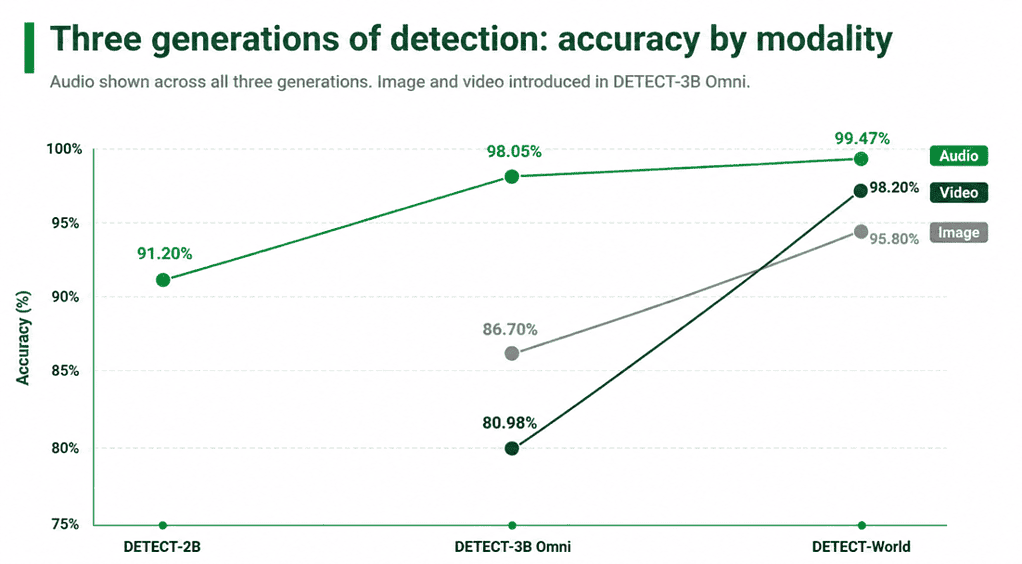
- On August 12, 2026, Resemble AI reported 98.2% video-detection accuracy on internal benchmarks covering face swaps, lip-sync manipulation, and AI-filter injection.
- Resemble AI’s August 2026 benchmarks reported 95.8% image-detection accuracy covering 1,000 files, with 4.3% false negatives and 4% false positives.
- Resemble AI’s August 2026 audio benchmark reported 99.47% accuracy, 0.66% false positives, and 0.40% false negatives; audio results do not establish visual-detection performance.
- In August 2026, Resemble AI reported audio-detection latency falling from 1,164 milliseconds to 399 milliseconds, a 66% reduction supporting faster verification.
- From August 2, 2026, EU AI Act Article 50 requires covered providers to add machine-readable marks enabling detection of AI-generated or manipulated content.
- Under Article 50, applicable August 2, 2026, artistic deepfakes require appropriate disclosure that preserves enjoyment, directly informing synthetic-content transparency in visual-effects productions.
Recent AI in Visual Effects Statistics
- On April 28, 2026, Autodesk introduced AI Rigging and Neural Layer, enabling animation-ready 3D characters in minutes and AI-powered cinematic rendering.
- On March 4, 2026, Autodesk introduced Wonder 3D, enabling editable character and object generation from text or images across all Flow Studio tiers.
- On December 16, 2025, Adobe integrated Topaz Astra into Firefly Boards, enabling AI-powered video restoration and upscaling to 1080p or 4K.
- On October 1, 2025, Chaos announced AI Upscaler, enabling Enscape, V-Ray, Corona, and Envision users to increase render resolution to 16K.
- On August 12, 2025, Autodesk launched free Flow Studio access and reduced Lite pricing 50%, from USD 20 to USD 10.
- On April 24, 2025, Adobe made Firefly Video generally available, supporting 5-second clips, resolutions up to 1080p, and 16:9, 9:16, and 1:1 formats.
- On February 12, 2025, Adobe launched Firefly Standard, offering 2,000 monthly credits and up to 20 five-second 1080p videos, starting at USD 9.99.
- On February 12, 2025, Adobe reported Firefly Video Model demonstrations generated in under 90 seconds, including atmospheric effects and 2D and 3D animation.
Final Thoughts
AI has moved from experiment to a working tool in visual effects. Major studios now use generative tools in post-production, and market forecasts point to steady long-term growth. Cost savings are possible but not guaranteed, and time saved does not always become budget saved.
Licensing conflicts in training data and new transparency rules mean studios are required to prioritize provenance and disclosure, while artists who learn AI-assisted workflows will stay best placed.
FAQ
AI is used in visual effects to automate time-consuming tasks such as rotoscoping, object removal, background replacement, motion tracking, and upscaling footage. It also helps generate digital environments, de-age actors, and create realistic simulations, which speeds up production and reduces manual work.
Generative AI in VFX refers to tools that create images, video, textures, and 3D assets from text prompts or reference material. Artists use it for concept art, previsualization, and background elements, while final shots usually still need manual refinement to meet cinematic quality standards.
AI is more likely to reshape VFX roles than replace them. It automates repetitive work such as cleanup and masking, while artists remain essential for creative direction, shot composition, and quality control. Professionals who learn AI-assisted workflows are likely to be in the strongest position.
AI de-aging uses machine learning models trained on images and footage of an actor at different ages. The model learns to adjust facial features, skin texture, and expressions frame by frame, producing a younger look while preserving the original performance. Artists then refine the results for consistency.
Several widely used tools include AI features, such as Adobe After Effects and Premiere Pro, DaVinci Resolve, Nuke, Autodesk Maya, and Blender through add-ons. Capabilities like automatic masking, noise reduction, and smart tracking vary by software version and plan.
AI shortens turnaround times, lowers production costs, and makes advanced effects more accessible to smaller studios and independent creators. It also lets artists test more creative ideas quickly and spend less time on repetitive technical tasks.