









Introduction
BYD Statistics: BYD came into the 2025–2026 stretch as the obvious leader in China’s new-energy vehicle market NEV and also as one of the bigger automotive names on earth. It started as a battery manufacturer, then kinda grew into a full vertically integrated automotive giant, and after that, it kept pushing its advantage across battery-electric cars (BEVs), plug-in hybrids (PHEVs), batteries, semiconductors, plus energy storage systems. In 2025, the company moved more than 4.5 million vehicles worldwide, and it also managed to overtake Tesla in annual pure EV sales.
At the same time, BYD stepped up its international reach, targeting Europe, Latin America, Southeast Asia, and Australia. Even with tougher rivalry and more price pressure inside China, BYD’s sheer size, battery know-how, and heavy global production spending kept it sitting near the very top among the biggest automakers going into 2026.
Editor’s Choice
- BYD pulled in a record RMB 803.97 billion (USD 116 billion) in FY2025 revenue, up 3.5% year over year.
- FY2025 net profit slipped 19% to RMB 32.62 billion (USD 4.72 billion), even though revenue grew.
- BYD’s net profit margin got tighter, shrinking from 5.2% in FY2024 to 4.1% in FY2025.
- Q1 2026 revenue dropped 11.8% year over year to RMB 150.23 billion (USD 21.7 billion).
- Q1 2026 net profit fell 55.4% to RMB 4.08 billion (USD 590 million), which is the most severe slide in six years.
- BYD’s BEV share rose from 31% in Jan–Feb 2025 to 50% in Jan–Feb 2026, and this move clearly ran ahead of the industry average.
- Global BEV sales totalled 2.26 million units in 2025, climbing 28% year over year.
- BYD sold more EVs than Tesla by roughly 620,000 vehicles in 2025, and it became the world’s largest EV brand by volume.
- Total new-energy vehicle (NEV) sales passed 4.5 million units in 2025, which means growth of over 2,100% since 2018.
- BYD managed to turn out its 15 millionth NEV in December 2025, and the jump from 10 million to 15 million units was kind of fast, just 13 months in total.
- Q1 2026 gross margin actually improved step by step to 18.8%, though at the same time, operating margin slipped to 3.1% and net margin to 2.7%.
- BYD put RMB 11.34 billion (USD 1.67 billion) into R&D in Q1 2026, which kind of underlines their ongoing drive for novelty even while profits are under pressure.
- Over in the UK, BYD logged 21,337 vehicles in Q1 2026, taking 3.98% market share and, in a way, reinforcing the European growth playbook.
Market Share Of Types Of Passenger Cars
(Source: theicct.org)
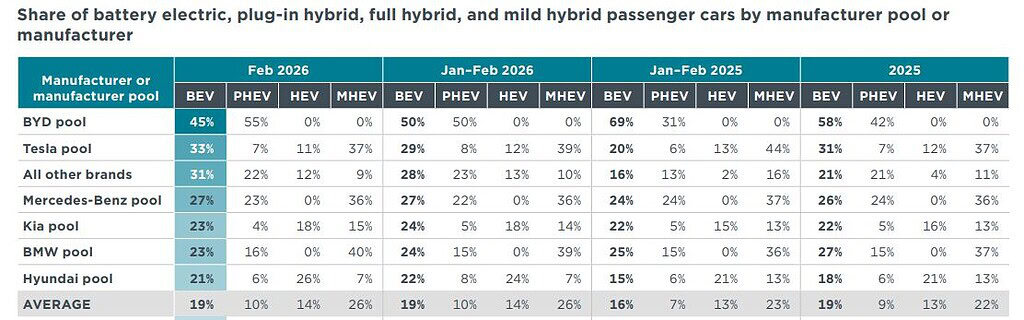
- The latest passenger car market share data kinda points to BYD still owning the electrified vehicle space during the first two months of 2026.
- For Jan–Feb 2026, about 50% of BYD’s passenger car sales were PHEVs, and the other 50% were BEVs, which basically leaves HEV at 0% and MHEV also at 0%.
- Then, in February 2026, on its own, BYD looked pretty close again, with 55% BEV and 45% PHEV sales.
- Tesla stayed more battery-electric minded, showing 29% BEV share for Jan–Feb 2026 and then 33% BEV in February 2026.
- At the same time, the more classic automakers seemed to spread things out across different powertrains.
- Mercedes-Benz posted 27% BEV, 22% PHEV, and 36% MHEV for Jan–Feb 2026, while BMW landed at 24% BEV, 15% PHEV, and 39% MHEV.
- Kia went with a more even setup, listing 24% BEV, 5% PHEV, 18% HEV, and 14% MHEV, in that same period.
- Looking back at Jan–Feb 2025, electrification levels seem to have generally stepped up. BYD’s BEV share climbed from 31% to 50%, and Tesla’s moved from 20% up to 29%.
- Even the industry averages got better, with BEV share increasing from 16% to 19% and PHEV share going from 7% to 10%. For all the other brands together, BEV penetration rose from 16% in Jan–Feb 2025 to 28% in Jan–Feb 2026.
- So the above stats suggest a market that’s getting more and more anchored around battery-electric vehicles and plug-in hybrids, with BYD pushing that shift via a pretty distinctive electrified product mix, and a higher share locked into BEV plus PHEV segments.
BYD Global Revenue and Profitability
| Period | Revenue (RMB) | Revenue (USD approx.) | YoY Change |
| FY2024 | RMB 777.1 billion | ~USD 107 billion | 0.29 |
| FY2025 | RMB 803.97 billion | ~USD 116 billion | 0.035 |
| Q1 2026 | RMB 150.23 billion | ~USD 21.7 billion | –11.82% |
(Source: quartr.com)
- BYD’s latest financial results kind of show a company that is still growing at a massive scale, but at the same time running into harder profitability issues, especially in a super crowded and intensely competitive EV market.
- In FY2025, BYD racked up RMB 803.97 billion ( USD 116 billion ) in revenue, up 3.5% year over year from RMB 777.1 billion ( USD 107 billion ) in FY2024. Even though revenue hit a fresh high, the earnings part didn’t follow the same vibe.
- Net profit slid 19% year-over-year to RMB 32.62 billion ( USD 4.72 billion ), down from RMB 40.25 billion in FY2024, when profit actually jumped 34%.
- BYD’s net profit margin slipped from 5.2% in FY2024 to 4.1% in FY2025, so it looks like any gains from revenue are being increasingly eaten by price pressure and general margin squeeze.
- Revenue landed at RMB 150.23 billion ( USD 21.7 billion ), which is an 11.8% year-over- year drop.
- Simultaneously, net profit fell 55.4% to RMB 4.08 billion ( USD 590 million ), basically a much steeper slowdown than revenue by itself would suggest.
- Overall, the numbers point to BYD still being among the world’s biggest electric vehicle makers, but keeping profits steady is getting tougher as rivalry heats up and margins tighten across the wider global electric vehicle industry.
BYD Overseas Quarterly Results
(Source: dfcfw.com)
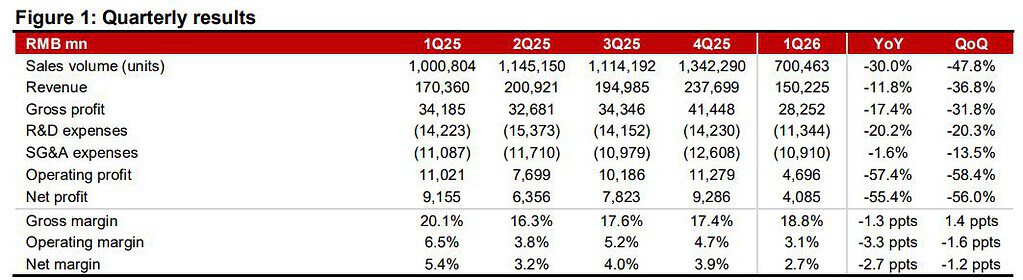
- BYD’s overseas business kinda rolled into 2026 with weaker momentum, as most of the major financial and operating numbers went south, both versus the previous quarter and compared with the same stretch last year.
- In 1Q26, sales volume showed up at 700,463 units, and honestly, that part looks very strong on the surface. Still, there’s a 30.0% year-over-year (YoY) fall plus a 47.8% quarter-over-quarter (QoQ) drop from 4Q25, so the overall pace isn’t great.
- Revenue then moved in a similar direction, slipping to RMB 150,225 million, down 11.8% YoY and 36.8% QoQ. Together, these snapshots point to a real slowdown in overseas demand, along with deliveries, during the quarter.
- Gross profit narrowed to RMB 28,252 million, which means a 17.4% YoY decrease and a 31.8% QoQ contraction.
- On the operating line, operating profit fell to RMB 4,696 million, down 57.4% YoY and 58.4% QoQ.
- Net profit, meanwhile, dropped to RMB 4,085 million, with declines of 55.4% YoY and 56.0% QoQ. The contraction in earnings was sharper than the revenue drop, so it feels like the ability to generate profits is under more pressure than the top-line weakness alone would suggest.
- On the cost side, R&D expenses were cut to RMB 11,344 million, down 20.2% YoY and 20.3% QoQ, while SG&A expenses came in at RMB 10,910 million, only down 1.6% YoY but down 13.5% QoQ.
- Gross margin edged up to 18.8%, gaining 1.4 percentage points QoQ, but it’s still 1.3 percentage points lower YoY.
- Operating margin slid to 3.1%, down 3.3% YoY and 1.6% QoQ, while net margin fell to 2.7%, dropping 2.7%YoY and 1.2% QoQ.
- Overall, the statistics indicate that while gross profitability stabilized somewhat sequentially, overall earnings efficiency continued to weaken.
BYD Annual Passenger Cars Sales
(Source: statista.com)
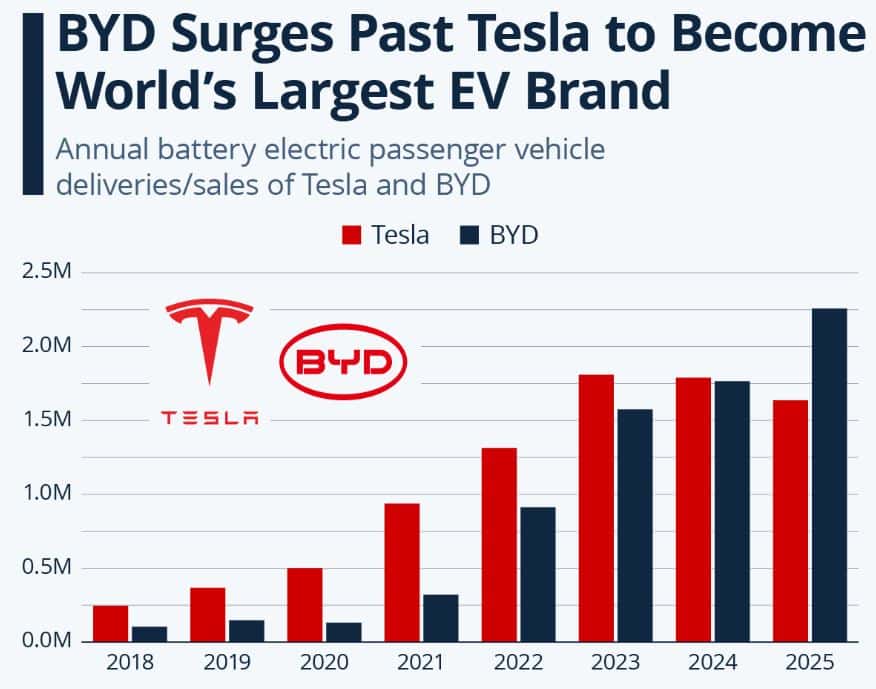
- In 2025, there was a big change across the global electric vehicle scene because BYD moved ahead of Tesla in sales volume, pretty decisively.
- The figures make it look like the competition map is shifting, with Chinese manufacturers getting more momentum, while Tesla saw deliveries cool off, maybe not dramatically at first, but still clearly.
- BYD’s Battery Electric Vehicles, BEVs, racked up 2.26 million units in 2025, and that’s a strong 28% increase year over year.
- Meanwhile, Tesla delivered 1.64 million vehicles, which comes out to something like an almost 10% drop versus the prior year.
- End up with this gap of about 620,000 vehicles, and it basically locks in BYD as the top EV brand globally, by sheer volume.
- Tesla’s sales across the European Union slid by close to 40% during the first 11 months of 2025, which points to softer demand in one of the most important EV markets on the planet.
- However, BYD’s EU sales more than tripled vs 2024, suggesting quick inroads and, yeah, more and more consumer buy-in for Chinese electric cars.
- The company went from a relatively obscure player outside China to an international automotive heavyweight by leaning hard on Battery Electric Vehicles, and also Plug-in Hybrid Electric Vehicles, PHEVs.
- After BYD already passed Tesla on EV production during 2024, it then stretched the advantage in 2025 through faster sales expansion and a wider international footprint, like step by step, but also all at once.
BYD Sales By Propulsion Type
(Source: statista.com)
- BYD is one of the automotive industry’s most remarkable growth narratives, and it sort of shows how fast a manufacturer can ramp up through full electrification, no exaggeration.
- The figures make it look like this company went from a rather small electric passenger vehicle player to a worldwide industry leader in less than ten years, give or take.
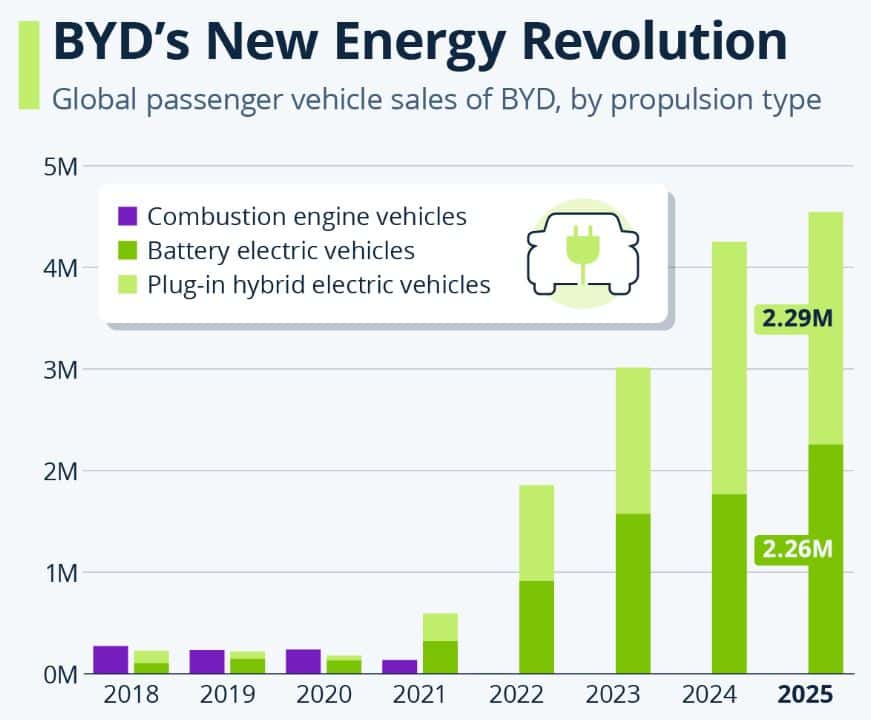
- Back in 2018, BYD moved just a bit above 200,000 new energy passenger vehicles per year.
- Then, by 2025, the sales jumped to over 4.5 million vehicles, which equals a growth of more than 2,100% in seven years.
- A key moment arrived in 2023, when BYD actually passed Volkswagen and became the best-selling car brand in China, which is the biggest automotive market on Earth. Since then, the company has kept pressing that advantage, year after year, stronger it seems.
- In December 2025, BYD marked the production of its 15 millionth New Energy Vehicle (NEV).
- For 2025 specifically, BYD sold 4.5 million NEVs total, split almost evenly between Battery Electric Vehicles (BEVs) and Plug-in Hybrid Electric Vehicles (PHEVs). That suggests a fairly balanced customer appetite for both electrified approaches.
- Taken together, these results place BYD among the fastest expanding automakers worldwide, and they also underline how much China is shaping the whole electric mobility transition, right now, today.
BYD’s Entry Into The UK Electric Van Market
- BYD’s launch of the DOLPHIN Cargo e-Van is kinda a big deal in how the company is pushing forward, because it’s not just passenger cars anymore. It’s moving into the light commercial vehicle (LCV) space, which feels like the next logical step.
- The timing is also very clear, since the vehicle was formally showcased at the 2026 Commercial Vehicle Show, running from 21–23 April 2026 at Birmingham’s NEC exhibition center. Source: BYD UK Announcement
- As per SMMT (Society of Motor Manufacturers and Traders), BYD’s UK growth gives the background for this move. In Q1 2026, BYD logged 21,337 vehicle registrations, and that landed it a 3.98% share of the UK new car market.
- In other words, the brand is showing up more and more in one of Europe’s toughest automotive markets, which also creates a platform for expansion into commercial fleets.
- On the vehicle side, the DOLPHIN Cargo e-Van aims to juggle day-to-day usability with efficiency. It provides over 1,000 litres of cargo capacity, and it posts a combined WLTP driving range of 265 miles.
- Under city driving conditions, the range bumps up to 347 miles (City WLTP), which makes it more competitive inside the fast-growing electric van segment. Source: BYD Product Specifications.
- From a market view, these details basically point it toward urban delivery operators and fleet decision-makers who want low-emission transport.
- The pairing of 1,000+ litres of load space with a 347-mile city range hits two of the big fleet targets, capacity and operational efficiency. Source: BYD UK, Commercial Vehicle Show 2026.
BYD’s Margin Squeeze
- BYD FY2025 Annual Report sort of paints a picture of a company that keeps dominating on scale, but also runs into increasing profitability pressure, more and more.
- In FY2025, BYD pulled in a record RMB 803.97 billion (around USUSD 112.6 billion) revenue, up 3.46% year-over-year.
- Still, net profit slid 19% to RMB 32.62 billion (USUSD 4.7 billion), so revenue growth no longer maps neatly into earnings growth like it used to.
- In May 2025, BYD cut prices across 22 vehicle models, and the discounts went as high as 34%, which then forced competitors to respond with reductions up to about 30% from other automakers.
- Sure, BYD’s revenue still rose by RMB 26.87 billion, but the net margin got squeezed from 5.2% in 2024 down to 4.1% in 2025, roughly a 110 basis points compression. In practical terms, that’s about RMB 7.63 billion less profit than if margins stayed stable.
- BYD’s domestic sales reportedly dropped 26.5% year-over-year in December 2025, while rivals like Xiaomi, AITO, and Leapmotor managed growth above 90% over the same span.
- On top of that, the top 10 manufacturers now control about 95% of China’s NEV market, whereas it was nearer 60–70% only a few years ago. (CNBC)
- Revenue fell 11.82% year-over-year to RMB 150.2 billion (USUSD 21.7 billion), while net profit dropped 55.4% to RMB 4.08 billion (USUSD 599 million). This marked BYD’s worst quarterly profit decline in six years.
- At the same time, BYD is still pushing innovation, and it spent RMB 11.3 billion on R&D in just Q1 2026 alone. (Binance Square)
- According to UBS research, new energy vehicles accounted for 59.4% of China’s passenger car sales in November 2025, while analysts expect China’s EV growth rate to slow in 2026.
- Research from AlixPartners estimates that only 10% of Chinese EV brands may achieve profitability in the coming years, with as many as 50 manufacturers potentially forced to downsize or exit the market. This consolidation could strengthen BYD’s long-term position.
- The near-term outlook points to continued margin challenges despite the company’s enormous scale.
Conclusion
BYD rolled into 2026 as the global top dog in new-energy vehicles, backed by record revenue and a product lineup that is fully electrified. The company also kept pushing its international footprint, and in pure EV volume, it actually overtook Tesla, while production kept scaling up at a really fast, almost unprecedented speed.
Still, the whole situation wasn’t as smooth. Price wars in China got intense, margins got squeezed, and revenue growth started to cool off a bit, which brought real headaches for profitability. Net profit fell sharply, including in Q1 2026, even as BYD kept spending a lot on R&D and expanded overseas operations more broadly than before.
So yeah, in the near term, earnings look under pressure, but BYD’s manufacturing scale, battery strength, and continued overseas rollout give it a better chance at sustained, longer-term growth.
FAQ
BYD moved more than 4.5 million new-energy vehicles (NEVs) worldwide in 2025.
Yes. BYD sold about 2.26 million BEVs in 2025, beating Tesla’s 1.64 million deliveries.
BYD reported RMB 803.97 billion (around USD 116 billion) in FY2025 revenue.
In Jan–Feb 2026, BYD’s passenger cars were split 50% BEV, 50% PHEV, with no HEV or MHEV sales at all.
Mainly due to aggressive price reductions, fierce competition, and shrinking margins, net profit dropped 19% in FY2025 and then slid 55.4% in Q1 2026.