








Introduction
Voice Assistant Usage Statistics: Voice assistants have become an integral part of the digital ecosystem in 2026, sorta transforming how consumers deal with smartphones, smart speakers, vehicles, wearables, and connected homes, day by day. Thanks to generative AI, large language models (LLMs), and natural language processing, assistants like Siri, Alexa, and Google Assistant have gotten noticeably better at accuracy and also in contextual awareness.
And it’s not just the consumer side anymore; companies are increasingly rolling out these platforms for customer support, healthcare, and retail, sometimes even in very specific workflows. With billions of voice-enabled devices already active worldwide and enterprises putting serious money into conversational AI, voice tech is moving from a “nice to have” convenience thing into a mainstream human-computer interface type of tool.
The stats below show the latest movement, adoption levels, market values, and the business spending that’s shaping the voice assistant industry in 2026.
Editor’s Top Picks
- The global Intelligent Virtual Assistant (IVA) market is projected to climb from USD 15.3 billion in 2023 to USD 309.9 billion by 2033, and that growth rate is around 35.1% CAGR, really steep.
- U.S. voice assistant adoption keeps moving upward, with users expected to go from 145.1 million in 2023 to 162.7 million by 2027, which means about 17.6 million extra users.
- Smartphones are behind 56% of all voice interactions, while 77% of adults aged 18–34 use voice assistants on mobile devices consistently.
- Adults aged 25–49 show the strongest daily use pattern, with 65% using voice assistants every day, so they are basically the most active group.
- Voice commerce is picking up speed fast, with the global market forecast rising from USD 150.34 billion in 2025 to USD 194.03 billion in 2026, which works out to a 29.1% CAGR, pretty high.
- At this point, roughly 8.4 billion voice assistants are already active around the world, which kinda backs up the idea that voice tech is now a mainstream digital interface.
- About 72% of shoppers reorder the same brand, and 61% say they’d rather use voice for their repeat buys.
- Around 44% of smart speaker owners purchase household items via voice every week.
- Smart speaker users are 3.2× more likely to finish voice purchases than people who rely on smartphones only.
- Around 40–45% of non-users avoid smart speakers, mainly because of worries tied to always-on listening, plus personal data collection.
- Voice biometric authentication helps boost confidence a lot, pushing voice commerce activity up by 37% by enabling more secure and more personalized transactions.
Intelligent Virtual Assistant Market Growth
(Source: market.us)
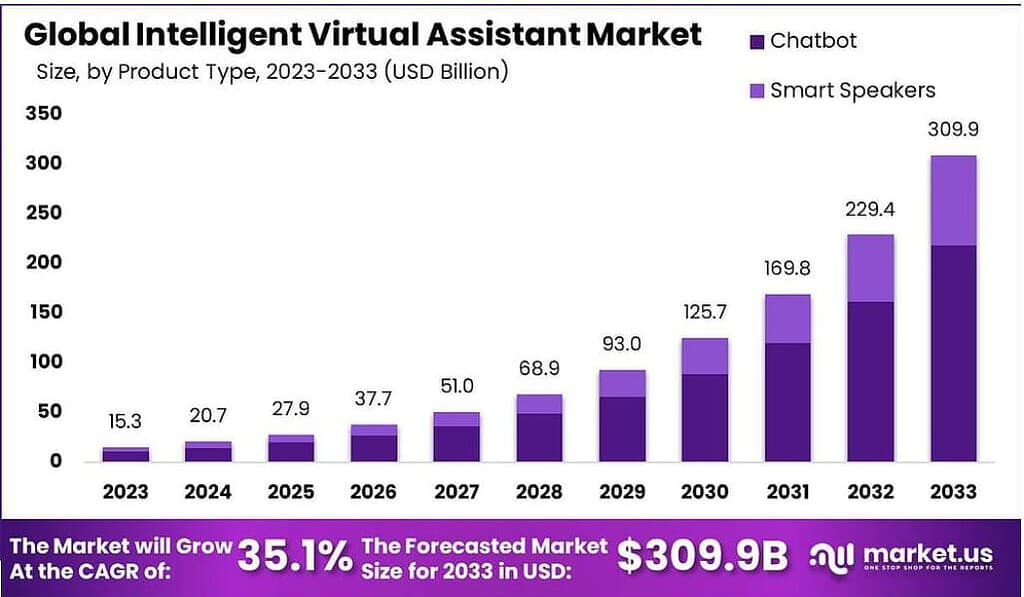
- As of 2026, the global Intelligent Virtual Assistant market is moving into a phase of exceptional expansion, kind of mirroring the quick uptake of AI-powered tech across different sectors.
- According to the Global Intelligent Virtual Assistant Market Report, this market was estimated at USD 15.3 billion back in 2023, and it’s projected to rise at a strong 35.1% CAGR all the way through 2033.
- Revenue already hit USD 20.7 billion in 2024, then climbed to USD 27.9 billion in 2025. By 2026, it is expected to reach USD 37.7 billion, which basically points to an accelerating pattern of investment in these virtual assistant tools.
- In the second half of the period, market revenue is anticipated to grow from USD 51.0 billion in 2027 to USD 68.9 billion in 2028, and then to USD 93.0 billion in 2029.
- Forecasts say the market should clear the USD 100 billion benchmark by landing at USD 125.7 billion in 2030, followed by USD 169.8 billion in 2031.
- Each year, it keeps widening, which suggests a deeper commercial adoption of intelligent virtual assistants, both in enterprise use cases and in everyday consumer applications.
- Looking further, the market is forecast to reach USD 229.4 billion in 2032 and an impressive USD 309.9 billion by 2033, which represents almost a 20x jump compared with 2023.
- The above set of numbers reads like one of the swiftest-growing corners within the broader artificial intelligence industry.
- The same sustained 35.1% CAGR points to steady long-range demand, and it also places intelligent virtual assistants as a significant growth engine inside the global AI economy over the next decade.
U.S. Voice Assistant Users
(Reference: emarketer.com)
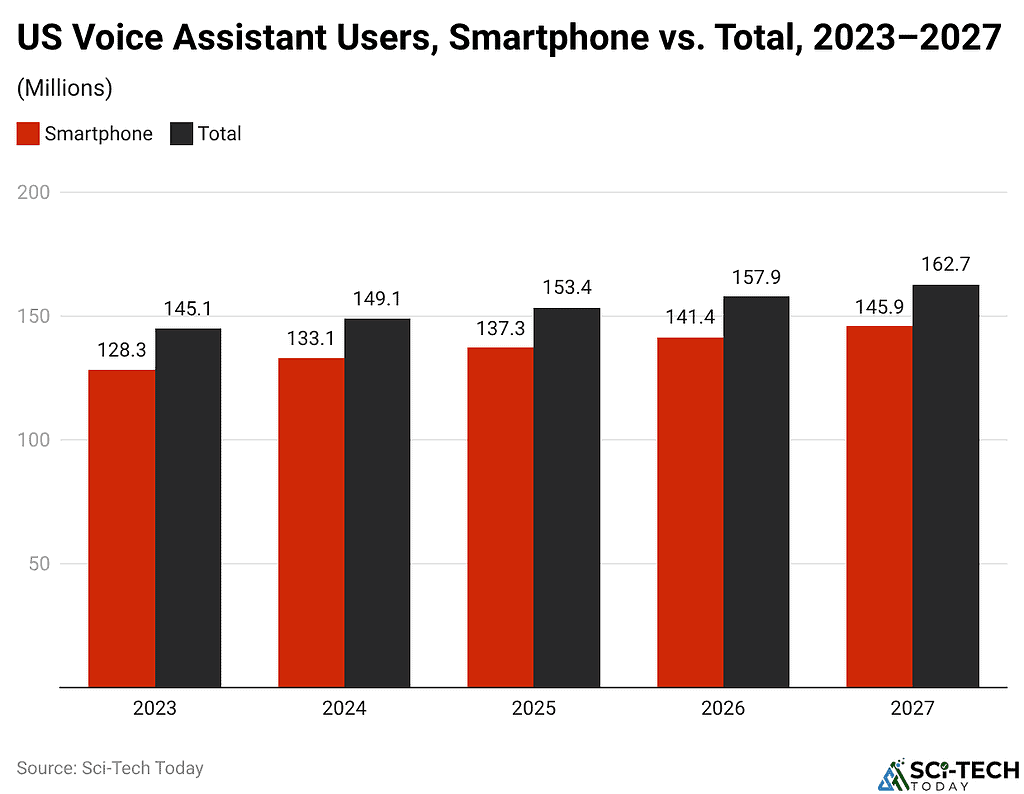
- The U.S. voice assistant market is still on this steady growth track, with total users expected to climb from 145.1 million in 2023 up to 157.9 million in 2026, and then jump again to 162.7 million by 2027.
- An extra 17.6 million users across the five years, and it shows that voice-enabled technology keeps pulling in new people on smartphones, smart speakers, connected cars, and smart TVs.
- For smartphones specifically, users are projected to go from 128.3 million in 2023 to 141.4 million in 2026, and then land at 145.9 million in 2027, which really underlines that smartphones stay the biggest on-ramp for voice assistant adoption. Source: EMARKETER Forecast
- By 2027, total voice assistant users should be more than half of all U.S. internet users, basically suggesting that speaking to a device is turning into a mainstream digital habit, not some fringe add-on.
- The year-over-year rise looks pretty consistent from 149.8 million total users in 2024 to 153.4 million in 2025, 157.9 million in 2026, and 162.7 million in 2027.
- On top of that, adding generative AI-powered features is expected to keep boosting adoption by making voice assistants more “clever”, more back-and-forth in conversation, and more practical for daily errands and regular tasks.
Voice Assistant Usage
- In 2025, voice assistant adoption had this kind of clear generational vibe going on, not just adoption, but like how often people actually use them and how involved they are.
- Younger adults pretty much show up on top, both with usage frequency and engagement, and you can kind of see the split right away.
- For example, adults 25-49 seem to be the busiest, with a daily usage rate that’s the highest; 65% are using voice assistants every day, so this is the most active age group.
- When you look at monthly users in the U.S., Millennials are first at 61.9%, then Gen Z at 55.2% and Gen X at 51.9%, while Baby Boomers are way lower at 31.5%.
- 30% of Gen Z consumers are using voice assistants for shopping weekly, which suggests more confidence with voice-enabled commerce.
- Still, smartphones are really the base for voice assistant adoption; they make up 56% of all voice interactions.
- Younger consumers stay in the lead for mobile voice activity, with 77% of adults aged 18–34 using voice assistants on smartphones.
- There’s also a little gender imbalance showing up among Alexa users, where 63.7% are male and 36.3% are female.
- Even though younger generations are currently the biggest user base, the 65+ crowd is starting to grow fast, probably because accessibility matters and the hands-free experience is just easier.
- The above statistics say voice assistants aren’t only convenience tools anymore; they’re slowly turning into everyday digital companions across different generations.
Voice Commerce (v-Commerce) and Purchasing Behavior
- Voice commerce is kind of growing into one of the quickest retail lanes, and the global value of transactions keeps climbing fast from 2025 to 2026.
- Research and Markets says the global voice commerce market should go up from USD 150.34 billion in 2025 to USD 194.03 billion in 2026, so that’s an impressive 29.1% CAGR.
- Digital Applied adds another angle, forecasting an increase from USD 86 billion in 2025 to USD 164 billion by 2028, which is roughly a 24% annual growth rate, even if the numbers look a bit different at first.
- For the United States, they expect the voice commerce market to reach USD 22.4 billion in 2026 while worldwide revenues climb to USD 186.28 billion by 2030, at a 24.6% CAGR.
- Roughly 8.4 billion active voice assistants are already being used globally, and voice commerce queries are rising by 18% every year, or at least that’s the pace being reported.
- Most of the behavior seems to be tied to everyday buys, with 34% of voice transactions used for grocery reorders, 28% for household basics, and 19% linked to media or subscription services.
- Consumer goods as a group bring in about 39.2% of total voice commerce revenue, and 44% of smart speaker owners place household product orders through voice every week.
- Roughly 72% of shoppers reorder the very same brand when they buy through voice assistants, while 61% tend to use voice for repeat buys rather than trying out new products.
- The average U.S. voice commerce transaction sits near USD 47, which kind of reflects how everyday low-value items dominate.
- People also tend to see voice shopping in a positive light; 83% say it’s convenient, but still 46% are uneasy about order accuracy.
- Smart speaker owners end up being 3.2 times more likely to complete voice purchases compared with folks who use smartphones only, and 46% of consumers have already reordered products using voice.
- Voice biometric authentication connects to about a 37% lift in voice commerce activity, showing how secure payments help nudge repeat purchases.
- The results suggest voice commerce is turning into a mainstream channel for recurring orders, with solid growth, high adoption, and growing trust in AI-powered shopping.
Privacy, Security, and The Trust Barrier
- Voice commerce keeps expanding, but it’s like consumer trust is stalling everything, becoming the main thing people worry about.
- Around 40-45% of people who do not use smart speakers in North America and Europe steer away from them, mainly because they’re uneasy about the mic being on all the time, the devices kind of “staying alert” all day, and the gathering of personal data.
- In fact, academic work shows non-users usually express notably stronger privacy concerns than current users.
- Kaspersky market reports point to trust being worn down by big, well-publicised data breaches, plus worries about voice data collection, as the key obstacle the industry can’t ignore.
- Security specialists suggest that users regularly check what voice history has been stored, tighten up privacy settings, and turn off microphones when the devices aren’t in use, so unnecessary data gathering drops off.
- These ideas basically mirror a wider trend where companies are placing more weight on user control over personal information, rather than only on features.
- Technology providers are coming up with new privacy-focused innovations to sort of rebuild trust, and it’s kind of obvious how much they want that back.
- One of the more important changes is edge computing, where voice commands get processed directly on the device, rather than being shipped off to cloud servers.
- Biometric voice recognition is turning into a sort of key security function, so devices can identify individual household members for more tailored services, and also add firmer checks when making payments or signing into accounts.
- Industry analysts basically see these tools as necessary to lower fraud exposure while also boosting user confidence in voice-based transactions.
- Forrester Predictions 2026, Computers & Security, USA Smart Speakers Market Analysis researchers say that stitching together edge processing, voice biometrics, strong encryption, and clearly managed consent will be what matters for keeping adoption steady in the long run.
- Since consumer expectations about privacy keep going up, companies that treat secure and transparent voice experiences as a priority should be in a better spot to push voice commerce farther than it is today, into markets and groups that are currently not using it as much.
Conclusion
Voice assistants have, sorta, become one of the fastest-growing parts of the AI ecosystem, and they’re changing how people talk, browse, buy, and manage connected things. There’s been strong market momentum, with adoption rising across smartphones and smart speakers too, plus the swift spread of voice commerce that really shows the commercial pull. Still, privacy and security worries are not going away, and they keep acting as a brake on mass take-up, so companies keep putting money into edge computing, voice biometrics, and more robust data safeguarding.
And as generative AI keeps getting better at natural conversations, voice assistants are likely to grow into something more “aware”, safer, and more tailored to each person. That, in turn, should strengthen their position as a main interface across consumer life, enterprise work, healthcare settings, retail environments, and even smart home routines.
FAQ
The global Intelligent Virtual Assistant market is projected to climb to USD 309.9 billion by 2033, with a 35.1% CAGR.
In the U.S., voice assistant users are expected to reach 162.7 million by 2027, from 145.1 million in 2023.
The global voice commerce market is forecast to move from USD 150.34 billion in 2025 to USD 194.03 billion in 2026, largely pushed by broader consumer adoption.
The biggest snag is privacy and security, with about 40-45% of non-users avoiding smart speakers due to data collection concerns and the idea of always-on microphones.
Voice biometric verification boosts voice commerce activity by 37%, which helps with security, user confidence, and better odds of finishing transactions.