






Introduction
API Economy Statistics: The API economy has kinda evolved into one of the most important pillars of global digital transformation in 2026. Organizations rely more and more on Application Programming Interfaces, yeah APIs, to connect applications, automate workflows, monetize digital services, make AI integration easier, and build platform-based business models. In practice, APIs now power nearly every modern cloud application, fintech platform, e-commerce marketplace, healthcare ecosystem, and enterprise software solution. And as businesses keep adopting microservices, cloud-native architecture, IoT, and generative AI, investments in APIs are accelerating worldwide.
At the same time, the increased need for secure API management, developer portals, API marketplaces, and real-time integrations has shifted APIs from being “just” technical utilities into something more strategic business assets that can generate billions in revenue while also helping teams innovate more quickly and deliver smoother customer experiences.
This article on API economy statistics will show the market trends, adoption, and security concerns.
Editorial Top’s Picks
- The global API Economy market is projected to expand from USD 15.6 billion to USD 45.3 billion by 2033, growing at a robust 23.5% CAGR.
- APIs are expected to create an estimated USD 14.2 trillion in global economic impact by 2027, highlighting their role as a central engine of digital transformation.
- The API Management market is forecast to reach USD 16.29 billion in 2026 and USD 21.8 billion by 2027, showing accelerating enterprise adoption.
- API-first strategies are becoming normal, with 83.2% of organizations adopting API-first practices, while 65% already monetize APIs to generate business revenue.
- About 80% of API traffic now comes from non-human users, like AI agents, automation tools, microservices, and IoT devices.
- API attacks have surged 113% year over year, and basically, orgs are dealing with an average of 258 API attacks every day.
- In modern enterprises, they’re juggling nearly 6,000 APIs already.
- 95–99% of successful API attacks come from authenticated users or from stolen credentials.
- API-related security incidents occur, the damage is usually around USD 3.6–4.2 million per breach.
- About 47% of companies end up delaying software releases because of worries around API security.
- Developers reportedly save 5–10 hours each week by using marketplace APIs, while organizations that standardize their APIs are seeing 45% quicker deployment speeds.
- And the global API marketplace is expected to reach USD 47.8 billion by 2030, which kind of makes it obvious that APIs are one of the fastest-growing pieces of digital infrastructure.
API Economy Market Size
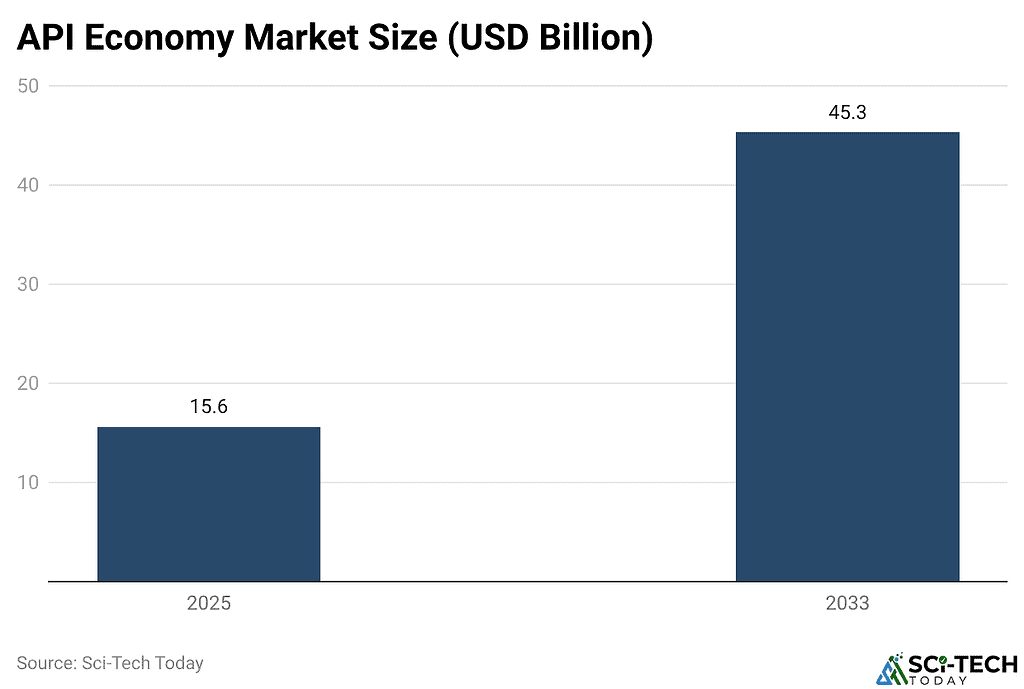
(Reference: htfmarketinsights.com)
- The API Economy market is starting into a phase of fast expansion, and the forecast numbers look really strong.
- Market estimates suggest the industry should keep growing at a 23.5% CAGR, growing from USD 15.6 billion to USD 45.3 billion by 2033. Also, it is expected to show a pretty solid 18.9% year-on-year growth rate, which points to steady demand and ongoing spending on API-driven technologies.
- The above figures underline how much APIs now matter for digital transformation and enterprise connectivity.
- The strong yearly growth plus the wider long-term market rise indicate the API Economy should keep being among the fastest-growing parts of the worldwide technology scene. Source: Market Research Future (MRFR)
API Economy Accelerates Toward Multi-Trillion-Dollar Economic Impact
- The API Economy is moving ahead at an exceptional pace, and market statistics keep showing how important it is within the global digital setup.
- The API Management market is on track to reach USD 16.29 billion in 2026, backed by a strong 34% compound annual growth rate (CAGR) seen between 2020 and 2026.
- Growth seems to stay consistent, with the market expected to climb to USD 21.8 billion by 2027, reflecting sustained corporate investment in API tools.
- Market indicators suggest that these numbers effectively show that APIs are becoming essential groundwork for cloud computing, digital transformation, and connected business services.
- The API Monetization market is forecast to reach USD 8.56 billion by 2027, and that’s an impressive 115% jump compared with 2023.
- APIs are also expected to create around USD 14.2 trillion in total global economic impact by That part really highlights how APIs power digital commerce, financial services, healthcare, and enterprise innovation.
- APIs aren’t only technical utilities anymore. They are more like strategic business assets, helping with revenue generation and longer-term economic value. Source: McKinsey & Company, MarketsandMarkets
API Economy Becomes A Powerful Revenue and A Competitive Growth Engine
- The API Economy has shifted into a strong business growth driver. A bunch of leading firms are using API based services to pull in meaningful revenue.
- For example, Stripe processed more than USD 1.9 trillion in total payment volume in 2025.
- Twilio, meanwhile, reported official FY2025 earnings where revenue of USD 5.07 billion came specifically from API consumption.
- Shopify supports over 8,000 third-party applications that run on its APIs, and the Google Maps API brings in more than USD 3 billion each year from paid API access. Also, industry surveys say companies with a formal API approach see an average 25% increase in revenue.
- Meanwhile, 52% of executives point to APIs as a noteworthy revenue source, and 58% of organizations report higher revenue after they implement API strategies.
- McKinsey estimates that Generative AI technologies might add up to USD 4.4 trillion to the global economy every year, and that shift is mostly made possible and built into the API infrastructure.
- APIs alone are creating the whole value by 2027, but rather they’re enabling it, which would be a 76% jump compared to 2023.
- Still, only 5% of enterprise AI projects delivered measurable ROI in 2024, and in practice, the ones that did were usually backed by solid API infrastructure. There’s also this point that API-mature businesses launch products about three times faster.
- Meanwhile, companies that don’t have mature API management often need 6–12 months just for integrations.
- During Europe’s Strong Customer Authentication (SCA) rollout, the API-mature orgs handled compliance in about 3–5 days, and others took more than six months, showing the edge that robust API ecosystems can bring.
API-First Adoption Plus AI Monetization Are Changing The API Economy.
- The API Economy is moving, pretty quickly, from just digital integration to actual revenue generation. More organizations are going with API-first strategies.
- Industry data suggests 83.2% of organizations have put some kind of API-first approach in place, though only 25% have fully crossed over into true API-first enterprises.
- At the same time, 65% of organizations using APIs effectively are already pulling in revenue through those APIs, either by charging directly for API access or by enabling digital products and partnerships that matter.
- Artificial intelligence is getting to be a pretty big driver of API growth, and it is also changing the way enterprises try to gauge their technology investments.
- Industry data suggests that by 2026, around 80% of all API traffic will come from non-human users, like AI agents, automation scripts, microservices, and IoT devices.
- At the same time, this shift seems to show a stronger reliance on APIs so AI systems can trade data and handle business operations. Because of that, companies are putting more weight on API performance, scalability, and clear return on investment metrics, just so AI-powered applications can actually be supported practically.
- In industry surveys, OpenAI models still show up as the main choice for most enterprise LLM API workloads; after that, you usually see Anthropic and Meta.
- More specifically, Anthropic Claude 3.5 sits at 28%, Meta Llama 3/4 is at 12%, and Google Gemini lands at 5%. These numbers underline how model APIs are now basically a core segment of the modern API economy.
API Security and Data Breach Vulnerabilities
- API security is one of the fastest-growing corners of enterprise cybersecurity, especially as organizations keep extending their digital ecosystems.
- A recent Research Nester report suggests the global API security market might sit around USD 12.6 billion in 2026, up from USD 10.8 billion in 2025, and it could climb to USD 46.1 billion by 2035, with a 17.5% CAGR.
- Spherical Insights gives projections that look even more aggressive: the market may rise from USD 984.5 million in 2024 to USD 21.98 billion by 2035, at a 32.63% CAGR.
- In the cloud segment, a 2026 LinkedIn analysis estimates growth from USD 2.8 billion in 2025 to USD 8.4 billion by 2033. The wider application security market is expected to reach USD 41.16 billion in 2026 and USD 66.03 billion by 2031.
- ZeroThreat.ai’s 2026 numbers show that API attack volumes jumped by 113% year over year, and organizations are seeing, on average, 258 API attacks every day.
- Around 78% of these attacks take advantage of weaknesses that appear in the OWASP API Top 10, and more than 90% of web-based attacks are now linked to APIs in some way.
- Also, many modern enterprises run nearly 6,000 APIs on average, and that alone broadens the attack surface a lot.
- Recent Salt Security trend reports, as summarized through ZeroThreat’s synthesis, point to something like this: attackers are increasingly moving through normal user sessions, rather than relying on outside exploits.
- Between 95% and 99% of successful API attacks come from authenticated users or from stolen credentials.
- Salt Labs’ data also indicates that 32% of organizations had an API security incident over the past year, and broader industry analyses even suggest that as many as 99% of enterprises faced meaningful API security challenges.
- The most often reported issues are sensitive data exposure (44%), general API vulnerabilities (43%), authentication weaknesses (41%), and then credential stuffing or brute-force attacks (27%).
- ZeroThreat also mentions that major API-related breaches now end up costing organizations an average of USD 3.6-4.2 million per incident, and Salt Security says 47% of companies say they delay application deployments because of API security concerns.
- Meanwhile, TechBlocks’ 2026 enterprise strategy points out that 80% of API traffic in 2026 is expected to come from non-human actors, including AI agents, automation systems, microservices, and IoT devices. So classic perimeter defense gets more and more useless over time.
- API security has turned into a strategic business investment, not merely an IT checkbox, with zero-trust architecture, continuous monitoring, and AI-driven threat detection becoming essential capabilities for safeguarding today’s digital enterprises.
Developer Productivity and API Marketplaces
- The API economy is slowly but surely being pulled forward by third-party developer marketplaces.
- ResearchAndMarkets projects the global API marketplace market to climb to USD 47.8 billion by 2030, growing at a 17.6% CAGR.
- SNS Insider says the U.S. API marketplace will move from USD 5.62 billion in 2025 to USD 28.57 billion by 2035, again at 17.8% CAGR. If you connect those dots, the combined marketplace opening is already over USD 25 billion in 2026.
- Meanwhile, Fortune Business Insights estimates the API management market expands from USD 6.89 billion in 2025 to USD 8.77 billion in 2026, then it heads to USD 37.43 billion by 2034 at a 19.1% CAGR, which basically screams continued spending on API plumbing, alongside marketplaces.
- Mordor Intelligence expects the telecom API market to hit USD 405.67 billion in 2026, up from USD 355.16 billion in 2025, and later grow to USD 788.52 billion by 2031 at a 14.22% CAGR.
- For healthcare, Future Market Insights puts the healthcare API market at USD 247 million in 2026, rising from USD 238.9 million in 2025, with projections of USD 345.1 million by 2036, which is a 3.4% CAGR.
- Postman’s State of the API Report adds more colour by showing that 51% of developers spend more than half of their building time on APIs.
- Also, 42% say reduced repeat work and easier integrations are the biggest advantages of API reuse. The report further notes that 75% of developers think API-first organizations end up with happier development teams.
- Postman and Kong put together industry interviews, and these further estimate that developers kind of save 5-10 hours every week when they use marketplace APIs rather than building those common services internally, which leads to real productivity boosts and quicker product delivery.
- Integrate.io says 45% of enterprises are leaning on third-party integration platforms or API marketplaces now, and they project the data integration market to grow to USD 15.24 billion in 2026, then up to USD 47.60 billion by 2034.
- Beetechy’s 2026 State of Enterprise AI Report notes that when organizations standardize on APIs and marketplace channels, they typically see about a 45% uplift in deployment speed.
- Commercial platforms have basically become a kind of strategic productivity engine, helping teams innovate sooner, reduce development expenses, and strengthen digital transformation across different industries.
Conclusion
The API economy kind of evolved into the base layer of most modern digital businesses, sort of powering cloud computing, AI, fintech, e-commerce, healthcare, and enterprise software. You see strong double-digit market growth, a trillion-dollar economic impact, and pretty broad API-first adoption, too. APIs are now strategic business assets, not just some basic integration tool, or whatever you want to call it. But at the same time, the quick rise of AI-driven traffic and the expansion of digital ecosystems have made security problems way more intense.
That’s why API protection became the top enterprise priority. Teams that actually put money into secure API management, keep developer productivity moving, and also think about API monetization tend to be in a better spot to speed up innovation, lower integration expenses, unlock new income streams, and stay ahead in a digital economy that keeps changing.
FAQ
The global API economy market is projected to reach USD 45.3 billion by 2033, growing at a 23.5% CAGR.
APIs are expected to contribute about USD 14.2 trillion to the global economy by 2027.
Roughly 80% of API traffic is generated by non-human users; AI agents, automation platforms, microservices, and IoT devices are part of that mix.
API attacks rose by 113% year over year, and organizations saw an average of 258 API attacks per day.
Developers can save 5–10 hours per week by using marketplace APIs, and API -standardized organizations reach 45% faster application deployment, too.