









Introduction
Fake News Statistics: Fake news refers to information that is untrue and deliberately circulated, intending to deceive the reader. The dissemination of fake news statistics has increased tremendously over the past few years with the development of social media and other online platforms.
It has become a serious concern in various countries as of the year 2026 for aspects such as trust among the citizens, politics, and the social conduct of the people. There are concerted efforts by both the authorities and technology industries to contain the menace of false information. This article will show the fake news statistics and facts below, showing how prevalent this modern issue is today.
Must Read By The Editor
- As of 2026, 54% of global internet users accessed news via social media or video platforms.
- A staggering 71% of respondents participate in tension-filled political arguments as a result of speaking with other people within their social circles and the conclusions of family members.
- In the second quarter of 2020, Facebook also deleted around 7 million posts that were found to include disinformation.
- 56% of Facebook users, especially those exposed to disinformation that aligns with their worldview, have difficulty distinguishing real news from fabricated news, per social media statistics.
- Asians in America, for example, hold divergent views about the role of media in the spread of fake news.
- According to fake news statistics, only 30% of Caucasian Americans think the media is a fake news source.
- Furthermore, a significant 32% of the older population believes that national television networks are feeding people lies.
- It is claimed that nearly 41% of American citizens try their best not to watch any news at all.
- 21% of respondents of the newspaper’s readers rated the New York Times as highly accurate.
- An overwhelming 83% of the respondents believe that the constant circulation of untrue information is detrimental to the country’s political environment.
- In France, a fake news website managed to get more than 11 million interactions in a single month.
- 64% of these social media news consumers experienced such instances.
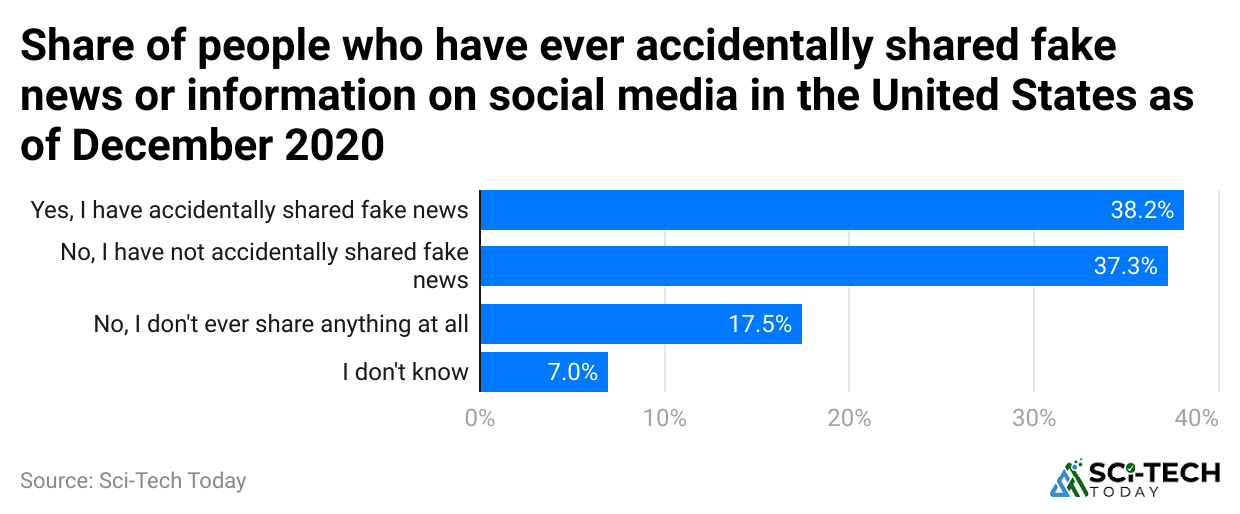
- 34% of the adult population of America admitted that they posted a picture or news article that turned out to be fabricated.
- The 2022 Digital News Survey regarding fake news reports a high incidence of anxiety regarding false information on the internet, with 37% of respondents from 46 countries mentioning this.
- Only 26% of respondents trusted news originating from social media networks, which was the least reliable information source.
- In another fake news statistics survey, 51% of the participants were willing to admit their worries that political fake news campaigns may hurt them, with special terrors in India, where social networks have fueled the dissemination of information and fake news.
Key Takeaways
- As of 2026, 54% of global internet users accessed news via social media or video platforms.
- Young people are more influenced by misinformation than older people, especially because they are active users of social media. This weakness was observed during the COVID-19 outbreak.
- In terms of the ‘latest news’ hyperbole, global survey statistics show that many Gen Z and Millennial news outlets about COVID-19 did not share fake content or report it, while others shared it too.
- This is the case with public health misinformation, which is even worse because of its disruptive nature. It includes untested treatments and conspiracy theories. Even after the peak of the epidemic, such information concerning COVID-19 was circulated widely.
- Fake news statistics from early 2025 discovered that well over 56% of news consumers in the US experienced false information on the COVID-19 pandemic in the week before the research was conducted.
- In Slovakia, 45%, the highest of the surveyed nations, stated they had come across false information concerning the ongoing conflict in Ukraine.
- According to the fake news statistics, more than 33% of the surveyed children aged 12-15 claim that they have encountered untrue or misleading information on the Internet or social networking sites in the past year.
- Another 34% needed clarification, indicating the extent of doubt in the reliability of the information they encountered.
- The investigation likewise looked at how children accepted false news, and differences were noticed in their reactions by age. For one, older kids reported the most suspicious things to teachers, friends, or other relatives.
- Nevertheless, to most kids, the dilemma would simply be ignored or acted upon, with the tendency to disregard the content even more prevalent among 15-year-olds.
- In a worldwide assessment, more than 70% of adults in Great Britain acknowledged fears around the issue of disinformation through social media, which was the 3rd highest in the ranking of 18 countries studied, vs the average global trends.
- Dismissing this issue was especially hindered in older adults, as 80% of the population above 55 years had this concern.
- Of those surveyed within the age bracket of 65 and above, the primary level of concern was health and medical misinformation, with the next being misinterpretation of politics and society in the UK.
- With the 2025 global election scheduled, increasing attention has been drawn to the possibility that misinformation may affect election campaigns and the voting itself, calling for more awareness.
- The percentage of Americans who are very confident about their ability to detect fake news: 23% of Americans think that fake news causes a lot of confusion; 67% of Americans have shared fake news on purpose; 38.2%
- A whopping 88% of Indian first-time voters understood that misinformation is an alarming concern in society.
- India, with over 500 million WhatsApp users, is the largest forwarding market in the world as well.
Frequency Of Seeing False Or Misleading Information Online Among Adults In The US
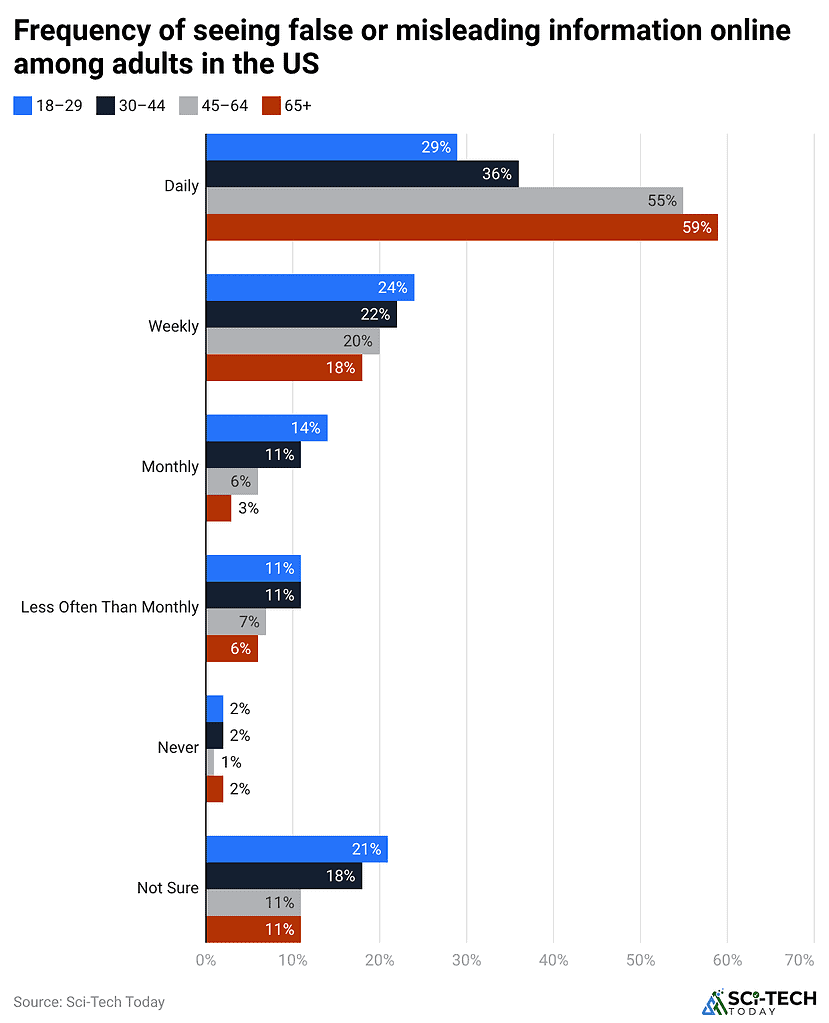
- Daily news consumption rises sharply with age, with 59% of those 65+ and 55% of the 45–64 group consuming news daily, compared to just 29% of the 18–29 age group.
- Younger audiences (18–29) are the least likely to consume news daily, indicating a significant generational gap in traditional news engagement habits.
- Weekly news consumption is most popular among 18–29-year-olds at 24%, slightly higher than the 30–44 (22%), 45–64 (20%), and 65+ (18%) groups, showing younger users prefer periodic over daily updates.
- Monthly news consumption is highest among 18–29-year-olds at 14%, while only 3% of the 65+ group consumes news monthly, reinforcing that older audiences favor more frequent engagement.
- “Less often than monthly” consumption is led by 18–29 and 30–44 age groups, both at 11%, suggesting younger and middle-aged adults are more likely to engage with news sporadically.
- Very few respondents across all age groups report never consuming news, with figures ranging from just 1% to 2%, showing that news remains a part of nearly everyone’s media diet.
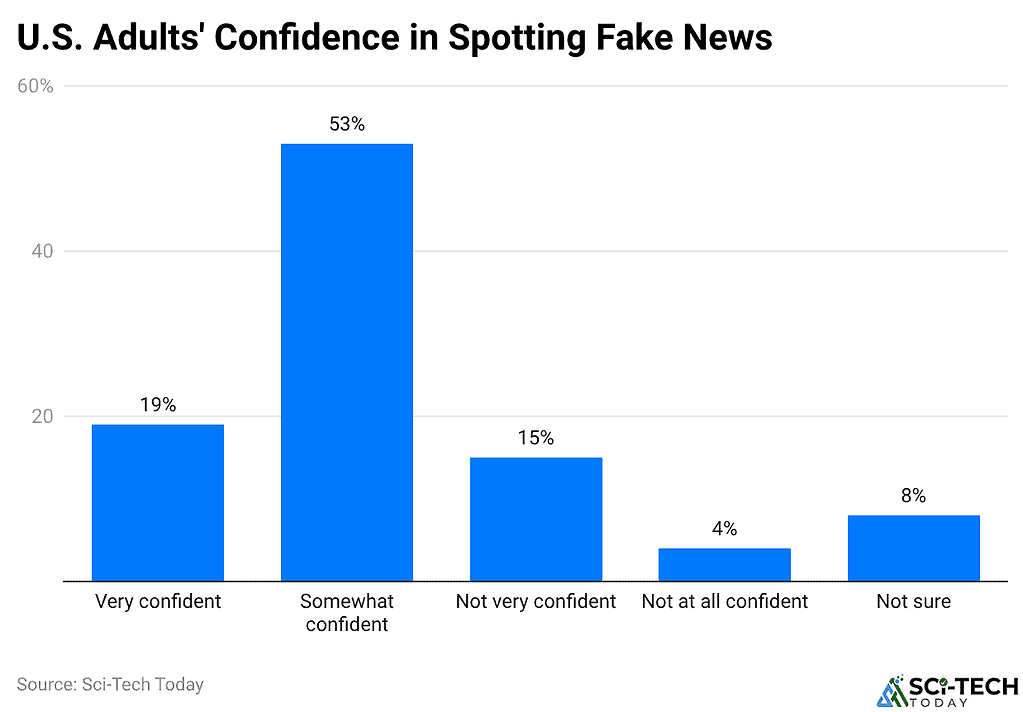
U.S. Adults’ Confidence In Spotting Fake News
(Reference:statista.com)
- A majority of U.S. adults (53%) feel “somewhat confident” in their ability to distinguish real news from fake news, indicating moderate but not absolute trust in their own judgment when consuming media.
- Only 19% of respondents say they are “very confident” in identifying fake news, showing that strong confidence in news evaluation remains relatively low across the population.
- 15% of adults report being “not very confident” in their ability to spot misinformation, reflecting growing uncertainty in navigating today’s complex digital news environment.
- A small but notable 4% admit they are “not at all confident” in recognizing fake news, highlighting a segment of the population that feels especially vulnerable to misinformation.
- 8% of respondents are “not sure” about their ability to differentiate real from fake news, suggesting confusion or ambivalence about evaluating media credibility.
Trust in Media By Region and Age Demographics
- In 2025, only 40% of respondents indicated they had any level of trust in connecting with any form of news available on social media.
- On the contrary, traditional means of receiving news, such as newspapers and television news services, are predominantly trusted by the world population at the rate of 54%.
- Norway topped the chart in terms of trust in the media, with a Reuters Institute for the Study of Journalism survey conducted in 2025 showing that over 72% of the respondents trusted their news sources most of the time or all of the time.
- On the contrary, only 24% of the study participants in Greece felt such confidence in the media’s reporting.
- Only 10% of the Republicans in the survey said that they have confidence in the media, while this number was 73% in the case of Democrats.
- Again, the same scholars point out that younger Americans are more cynical about the media than their elder counterparts. Only 16% of the 18 to 29-year-old age group had faith in the media, compared to 33% of people aged 65 years and above.
- In 19 out of 33 countries surveyed, more than half of the respondents indicated that they trust PSM, while commercial media earned a similar level of trust in only six countries.
- Fake news statistics observed that affluent and educated people had a lot more confidence in public service media than the lower classes.
- For instance, in Germany, individuals with a higher education degree were more likely to show trust in the PSM than those who had just finished high school, where 51% of the population reported trust.
Impact of Fake News on the Global Economy
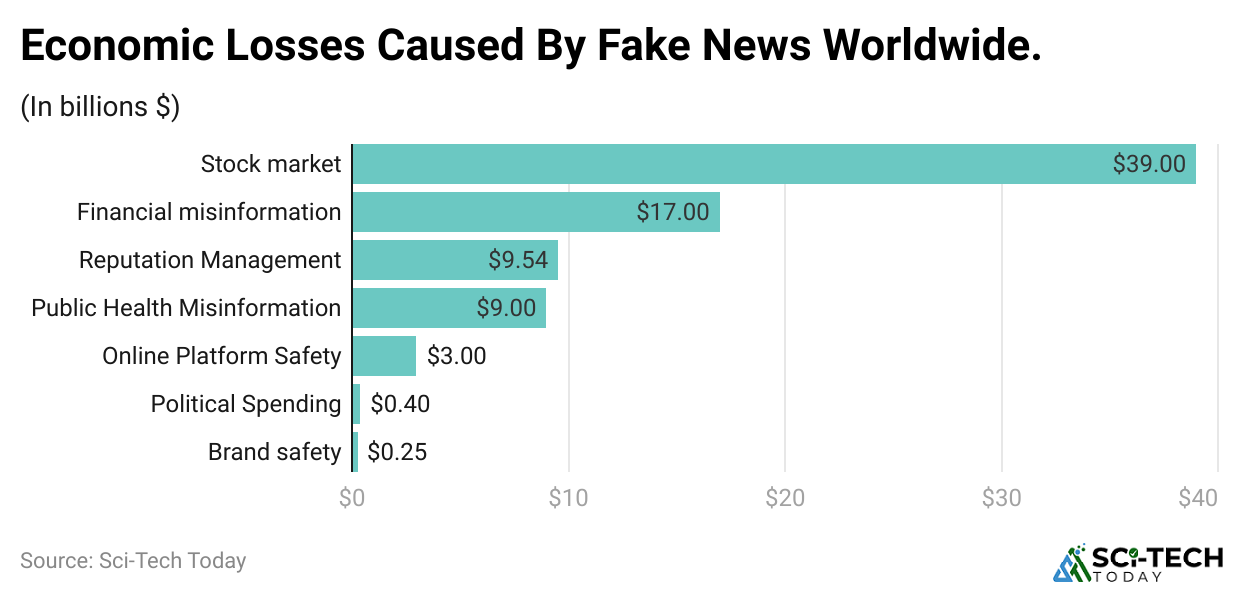
(Source:demandsage.com)
| Stock market | USD 39 billion |
| Financial misinformation | USD 17 billion |
| Reputation Management | USD 9.54 billion |
| Public Health Misinformation | USD 9 billion |
| Online Platform Safety | USD 3 billion |
| Political Spending | USD 0.4 billion |
| Brand safety | USD 0.25 billion |
- According to fake news statistics carried out by the cybersecurity company CHEQ and the University of Baltimore, the global economy loses about $78 billion annually because of online fake news.
- The report further states that fake news contributes to a $39 billion loss in the stock market every year.
- Financial Deception: $17 billion
- Reputation Management: $9.54 billion
- Health Misinformation: $9 billion
- Platform Safety: $3 billion
- Political Spending: $0.4 billion
- Brand Safety: $0.25 billion
Impact Of Fake News
- The majority (60%) of journalists show a strong level of concern about the potential restrictions of freedom of press in the US.
- In a survey, 94% of the journalists reported that fake news and information was a problem for America, with 71% saying it was a very big problem and 23% a moderately big problem. Only 6% described it as a little problem or no problem at all.
- Almost all the journalists surveyed (94%) feel that the fabrication of news and information is a very pressing problem nowadays, with about seven in ten believing it is an extremely big problem.
- 58% of the people interviewed talk about misinformation among colleagues at least several times a month, while about one third deal with misinformation regularly.
- 97% of journalists are convinced that the spread of misinformation/disinformation causes damage to society.
- News media is distrusted by a majority, but 30% consider it highly trustworthy, and 7% of “very conservative” journalists share this view.
Fake News Statistics By Social Media
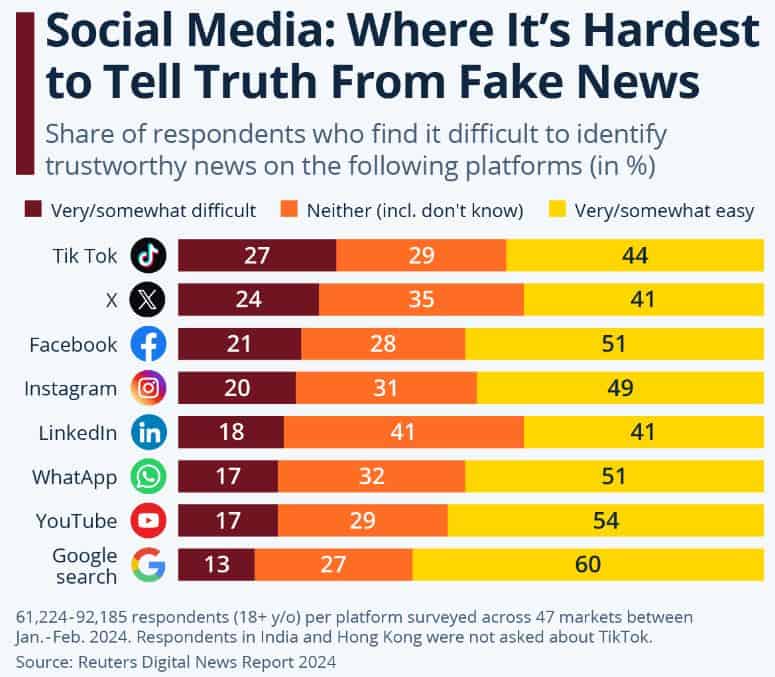
(Source: statista.com)
- A survey carried out in 47 markets for the Reuters Institute Digital News Report 2024 notes that TikTok and X were the hardest social media platforms for assessing news content reliability.
- The attached graph shows that in early 2024, almost every fourth participant reported finding it at least fairly easy to distinguish between true and false information on these two platforms.
- Other platforms, such as Facebook and Instagram, showed similar results, with 21% and 20% of the respondents sharing the same concern, respectively.
Efforts To Combat Fake News
- Meta (Facebook) and Google invested over USD 2 billion in the prevention and correction of misinformation.
- European Union allocated USD 1.2 billion to USD 1.5 billion to fight disinformation, an increase of 27%.
- Social media platforms such as Twitter and TikTok have invented new software systems and AI techniques that can cut the spread of disinformation by approximately 40%.
Summary
The ongoing war against fake news is an issue of worldwide proportions that will keep gaining more ground in 2026. Misinformation covers trust, politics, health, and even the financial sector, owing to the connectivity of billions of people over the internet. It is worth mentioning, however, that advances are being made through education, technology, and regulation; counterfeiting or the threat it poses is still rampant.
Fake news statistics reveal that in terms of dollars, misinformation impacts the economy by billions, and being able to tell what is real and what is false amongst all the information will always be a problem, especially in this era. No doubt that even in the year 2026, the war against false information is not won.
FAQ
Fake news exists primarily because the internet’s attention economy monetizes outrage, while social media algorithms reward highly emotional and provocative content over factual accuracy. Additionally, bad actors and propagandists use fabricated stories to manipulate elections, polarize populations, and bypass traditional media gatekeepers.
Fake news is false, misleading, or fabricated information presented as legitimate journalism. Created for financial profit or to manipulate political opinions, it often exploits social media algorithms to spread rapidly and provoke strong emotional responses.
Avoiding fake news requires practicing critical reading, verifying the original source, and fact-checking claims across multiple reputable media outlets before believing or sharing them.

Sources