









Introduction
Space Research Funding Statistics: Space research funding hit kind of unprecedented levels in 2026 because both governments and private organizations went faster with investments across lunar exploration, Earth observation, satellite infrastructure, deep-space science, and human spaceflight. The whole global space sector has shifted a lot from a government-led industry into something like a strategic economic and geopolitical domain, so nations started raising budgets even while broader fiscal pressures remained. Major agencies like NASA, ISRO, ESA, CNSA, and JAXA kept expanding their research efforts, and commercial companies pulled in billions in private capital, too.
With the rising attention on Moon missions, space stations, climate-monitoring satellites, and defense-related space systems, worldwide government space outlays went above $130 billion each year, so 2026 is turning into one of the most heavily financed years in the history of space exploration. This space research funding statistics article will overview of the funding and budget of space research worldwide.
Featured Selection
- The United States, it leads global government space spending at USD 79.7 billion, taking the largest slice of public space investment worldwide.
- China comes next with USD 19.9 billion, which basically reinforces the competition between the world’s two main space powers.
- India’s government space budget reached USD 1.9 billion in 2025, showing its emergence as a serious global space player.
- NASA’s proposed FY2027 budget sits at USD 18.8 billion, and that’s a notable 24.2% cut from earlier funding.
- Even with those reductions, NASA says it will put USD 7 billion toward lunar exploration and USD 1 billion into Mars programs, with priorities leaning toward human deep-space missions.
- NASA’s Science Mission Directorate budget could drop from USD 7.25 billion to USD 3.89 billion, and that would be a sharp 47% year-over-year fall.
- More than 40 NASA missions and over 50 operational or planned science assets are staring at cancellation, shutdown, or even postponement under the proposed budget and structure.
- The global space economy basically hit around USD 626 billion in 2025, which kind of locks in its spot as one of the world’s fastest-growing tech areas.
- Commercial activities are now bringing in 78% of all space-industry revenue, so it shows how much the private sector runs the show compared with government-led spending.
- Starlink’s subscriber counts moved from 2.3 million users in 2023 to 10.3 million by Q1 2026, and that tracks the explosive rise of satellite broadband services.
Government Space Budgets (Funding) By Country

(Source: orbitalradar.com)
- The commercial space world is getting more centered, more piled up among just a few global powers, and the United States still holds a big, almost commanding position, with USD $79.7 billion in government space budgets ( civil and defense ).
- China is right behind it at about USD 19.9 billion, and that really underscores the intensifying geopolitical competition between the world’s two largest space economies.
- Past the United States and China, spending drops in a pretty sharp way. Japan is third at USD 4.9 billion, then France shows up with USD 4.5 billion, and Russia sits at USD 3.4 billion.
- In Europe, Germany brings USD 2.7 billion, while Italy adds USD 2.3 billion. That sort of reinforces the thought that Europe is a major player, but also a bit fragmented.
- Also, emerging markets are not just standing still. In 2025, India’s government space budget reached $1.9 billion, placing it among the top space economies, and it seems to echo how its launch capability is ramping up, plus the private sector is getting more involved.
- The United Kingdom contributes USD 1.5 billion, then South Korea at USD 0.7 billion, with Canada close behind at USD 0.6 billion. They pretty much round out the main group.
- Taken together, these figures point to a highly concentrated industry, where the United States and China cover most of the commercial space activity.
- At the same time, places like India, South Korea, and Canada are steadily widening their role, so it feels like the next decade may bring a broader and more competitive global space marketplace.
NASA Budget Statistics
(Reference: govwin.com)
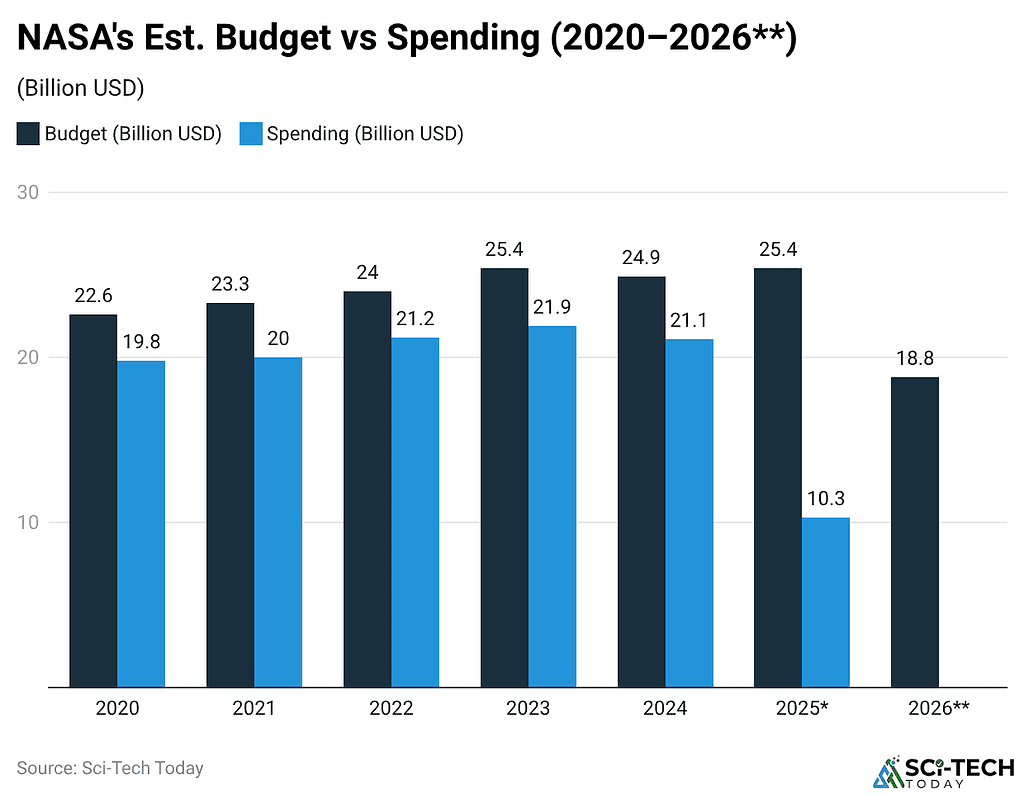
- The proposed FY 2027 NASA budget represents, in my view, one of the most significant funding realignments in the agency’s recent history. The numbers kind of show a very clear strategic turn away from traditional science missions and those older exploration systems toward human lunar plus Mars exploration programs.
- The plan is seeking $18.8 billion in discretionary funding for NASA. That’s a substantial 24.2% reduction compared with prior funding levels, yet despite the overall dip, human exploration stays a priority of sorts.
- About $7 billion is earmarked for lunar exploration initiatives and another $1 billion for Mars-related programs, which pretty strongly suggests deep-space crewed missions are the main point.
- Overall, science funding is facing a proposed reduction of roughly $3.8 billion, with Space Science down by $2.3 billion and Earth Science down by $1.2 billion.
- Astrophysics is not really spared either. The Nancy Grace Roman Space Telescope, which has already accumulated an estimated $3.5 billion in development costs so far, would still see reduced funding in the proposal.
- Aeronautics programs are targeted for a $346 million reduction, too, and that includes the elimination of green aviation research initiatives.
- Meanwhile, Deep Space Exploration Systems would be reduced by $879 million, potentially affecting some of NASA’s most expensive legacy programs.
- The FY2026/FY2027 budget requests explicitly protect and fund SLS and Orion for the Artemis missions.
- Space Operations funding would decrease by $508 million, which then means less International Space Station crew capacity and a dip in research activity before the station’s planned retirement around 2030.
- STEM engagement programs see a $143 million drop, so in practice, a lot of educational initiatives get effectively wiped out. And Mission Support funding would also decline, by about $1.1 billion, give or take.
- Taken together, the statistics point to NASA moving into a phase of fiscal restructuring, not expansion. So the budget reads like a shift away from wide-ranging scientific investment toward a more tight game plan: human deep space exploration, plus greater reliance on commercial space systems.
NASA Science Mission Directorate Statistics
- The proposed FY 2027 NASA budget is one of those big, modern history kind of funding turns, and it’s dramatic.
- The budget figures show a deliberate redistribution of resources away from scientific research and more toward human exploration work, changing the general balance of NASA’s portfolio in a pretty fundamental way.
- Funding would drop from $7.25 billion in FY 2026 to roughly $3.89 billion in FY 2027, that’s a decline of $3.36 billion, or about 47% within just one year.
- Artemis and other human-spaceflight initiatives would get close to a 10% increase, indicating a clear strategic leaning toward lunar and Mars exploration even while the rest of the agency is shrinking.
- Budget reviews suggest that more than 40 missions could be cut off right away, and over 50 operational assets plus upcoming efforts spanning Earth Science, Astrophysics, Heliophysics, and Planetary Science are staring at cancellation, shutdown, or just indefinite postponement.
- In practical terms, it basically puts nearly half of NASA’s current science portfolio at risk, too.
- Earth Science looks like the hardest-hit lane. Budget proposals say they want to wipe out funding for more than 50 current or planned Earth-observation missions, including big climate-monitoring programs.
- Long-running spacecraft like OCO-2, OCO-3, and Aura are among the affected assets, though. Aura by itself has delivered roughly 20 years of atmospheric observations since its 2004 launch, so it’s one of NASA’s longest-running environmental monitoring missions, period.
- Estimates from policy organizations indicate that about 2,000 NASA civil servants could get reassigned or see job losses if this proposed funding structure gets rolled out.
- Historically, NASA has seen budget fluctuations before, but analysts point out that a 47% single-year cut to a whole science directorate feels unprecedented in the modern era.
- Meanwhile, as the agency’s science budget shrinks sharply, exploration spending keeps growing, and that combination creates one of the largest strategic resource reallocations in NASA’s history, frankly.
- The proposed FY 2027 plan would basically shave down NASA’s scientific footprint in a noticeable way while concentrating resources on human exploration, and that makes it one of the most consequential budget proposals for space science in decades.
Commercial Space Economy Statistics 2026
- The modern space industry isn’t really “government-led” anymore; it’s overwhelmingly a commercial affair.
- The latest figures say the global space economy hit about $626 billion in 2025, and it’s one of the fastest-growing technology sectors on the planet.
- Most importantly, the private sector now produces around 78% of all space-related revenue, while government civil and military spending covers the remaining 22%
- According to PwC’s 2025 “space industry trends, the space economy moved from roughly $570 billion in 2023 to $613 billion in 2024, and then on to $626 billion in 2025.
- Over the last five years, the sector held to a 7.3% compound annual growth rate (CAGR), so even with wider economic uncertainty, the expansion stayed steady.
- More than half of total space revenue now comes from satellite services and space-enabled applications. That covers broadband connectivity, navigation, broadcasting, Earth observation analytics, logistics optimization, plus geospatial intelligence services.
- Satellite communications by itself generated roughly $196 billion in revenue during 2023, and it’s expected to climb to around $218 billion by 2035.
- According to a GlobeNewswire report, long-term forecasts stay pretty optimistic, almost too much, but anyway. Industry projections say the global space economy might climb from around $450 billion in 2022 to close to $1 trillion by 2030. Other outlooks even put it at about $1.1 trillion by the end of the decade.
- A key driver behind all this is Starlink, the satellite broadband network from SpaceX. The subscriber count went from 2.3 million users in 2023 to about 8.9 million in 2025. Then by the first quarter of 2026, it was sitting near 10.3 million subscribers.
- Starlink brought in more than $10 billion in 2025, and according to analysts at Quilty Space and Bloomberg, it is expected to lie between $15.9 billion and $24 billion in 2026.
- Space Foundation and PwC note that more than 1,700 space companies are being watched by specialist investment indices.
- At the same time, institutional money is showing up more often in space-specific funds, satellite systems, data platforms, and orbital infrastructure efforts.
- The above numbers pretty clearly show a single, straightforward thing: the commercial slice is now the main engine of the global space economy.
- With 78% of revenue coming from private activity, and a market already valued at $626 billion, plus forecasts that top $1 trillion, space is steadily transforming from a government-guided project into a big global commercial business.
Conclusion
Funding for space research in 2026 is showing a big shift in the way the global space business works. Governments are still putting a lot of money into strategic programs, but in practice, commercial companies now kind of pull most of the weight, driving growth and new ideas, with less waiting and more speed, you know.
The United States and China remain the biggest public backers, while other space-rising countries like India are slowly getting more say in things. At the same time, NASA seems to be redirecting its attention, sending extra resources toward lunar and Mars exploration, and trimming back some of the spending that would otherwise support science projects, and it feels like less is going to “pure science” in favour of exploration goals.
Overall, the worldwide space economy is already around $626 billion, and most industry earnings come from private activity. So space has basically turned into a strong mix of economic power, technical progress, and geopolitical influence.
FAQ
The United States leads worldwide with roughly $79.7 billion in government space spending.
NASA’s proposed FY2027 budget is about $18.8 billion.
NASA plans to put around $7 billion toward lunar exploration initiatives.
The global space economy reached approximately $626 billion in 2025.
Commercial activity brings in around 78% of the total space-sector revenue.