









Overview
Uninterruptible Power Supply Statistics: Uninterruptible Power Supplies (UPS) protect the machines and systems we depend on. They shield equipment from power cuts, voltage drops, and spikes, and other electrical problems, giving time for safe shutdowns or allowing critical loads to keep running. UPSs are used in data centers, edge sites, hospitals, factories, telecom towers, and office buildings.
This article covers market size and growth, shipment and installation volumes, common capacities and form factors, technology types (online, line-interactive, standby), and battery options such as VRLA and lithium-ion. We also look at industry demand, regional differences, reliability and maintenance, and service models like purchase or subscription. The aim is to inform buyers, vendors, planners, and stakeholders.
Must Reads by the Editor
- According to Market.us, the Uninterruptible Power Supply market is predicted to grow from USD 10.1 billion in 2025 to USD 15.1 billion by 2033.
- The Global Market Insights also stated that in 2025, the United States UPS market accounted for around USD 4.1 billion.
- Product and service solutions were the largest segment at roughly USD 13.4 billion in 2025, with sales to large enterprises near USD 6.0 billion.
- A gminsights.com report states these top players (Eaton, Huawei, Vertiv, Schneider Electric, Delta Electronics, Riello UPS, ABB) together controlled over 55% of the market share in 2024.
- In 2025, large enterprises make up roughly two‑thirds of the UPS market (about 68% share) and bring in around USD 9+ billion in revenue.
- In 2024, large enterprises made up just over half the UPS market with a share of 54%, and brought in roughly USD 6 billion in revenue.
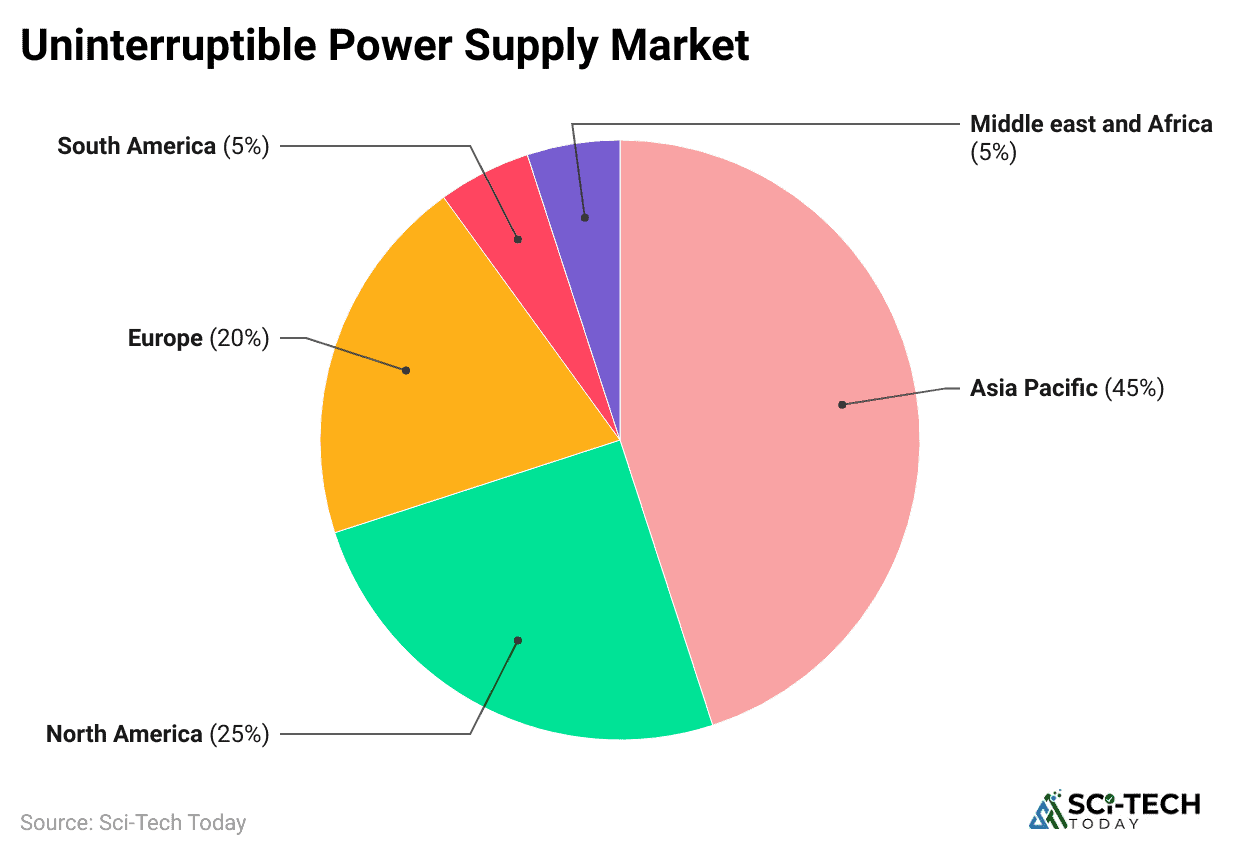
- The uninterruptible power supply (UPS) market showed that Asia Pacific led with the largest share at 45%.
- According to Cognitive Market Research, the market size of the industrial Uninterruptible Power Supply in the North American region is estimated to reach USD 1700.24 million by 2025.
- The UPS market is divided into four power rating categories: less than 5 kVA, 5 to 50 kVA, 51 to 200 kVA, and above 200 kVA.
General Uninterruptible Power Supply Statistics
- As mentioned in market.us, rising digital services increased UPS demand, and data centres expanded despite 2.4% fewer PC shipments.
- AI and cloud growth boosted data-centre demand; early 2024 had 3,871.8 MW of building, 69% higher.
- In October 2024, U.S. construction spending was USD 2.17 trillion, and data centres received major funding.
- IEA predicts data centres’ electricity use will grow from 415 TWh in 2024 to 945+ TWh by 2030, about 3%.
- According to GSMA Mobile Economy 2025, about 5.8 billion people, or more than 71% of the world, had mobile subscriptions at the end of 2023, and that is expected to rise to 6.3 billion by 2030.
- Telecom operators plan to spend over USD 600 billion on mobile towers from 2022 to 2026, and roughly 85% of that budget will be used for building 5G infrastructure.
Types of Uninterruptible Power Supply Comparison
| Metrics | Offline (Standby) UPS | Line Interactive UPS | Online Double-Conversion UPS |
| Transfer Time | 2 to 10 ms | Minimal |
0 ms |
|
Power Conditioning | Minimal | Good | Perfect |
| Efficiency | Higher | Higher |
Lower |
|
Voltage regulation | Minimal | Good | Perfect |
| Cost | Lowest | Moderate |
Highest |
|
Efficiency | Higher | Higher | Lower |
| Best for | Home Use, Non-Critical Applications | Business Applications |
Mission-Critical Applications |
Uninterruptible Power Supply Market Trends
- More companies are choosing lithium-ion batteries because they store more energy for their size, last longer, and need less upkeep.
- New modular UPS designs let firms add or remove units so the system can grow or shrink to fit needs.
- UPS units are now often tied into solar and wind systems so that backup power can be greener.
- Remote monitoring tools let operators check and manage UPS equipment from anywhere to keep systems running smoothly.
- Makers are also designing UPSs to use less energy, which cuts bills and helps meet sustainability goals.
Uninterruptible Power Supply Market Growth Analyses

(Reference: amazonaws.com)
- Annual growth rate in the UPS market rose from 12.5% from 2022 to 2023 to 11.1% from 2023 to 2024.
- During the years 2024-25, the growth rate in the UPS market was 10%, and it is expected that from 2025 to 2026, the market will represent 9.1%, which indicates continued growth at a declining rate.
Uninterruptible Power Supply Market Size
(Source: shortpixel.ai)
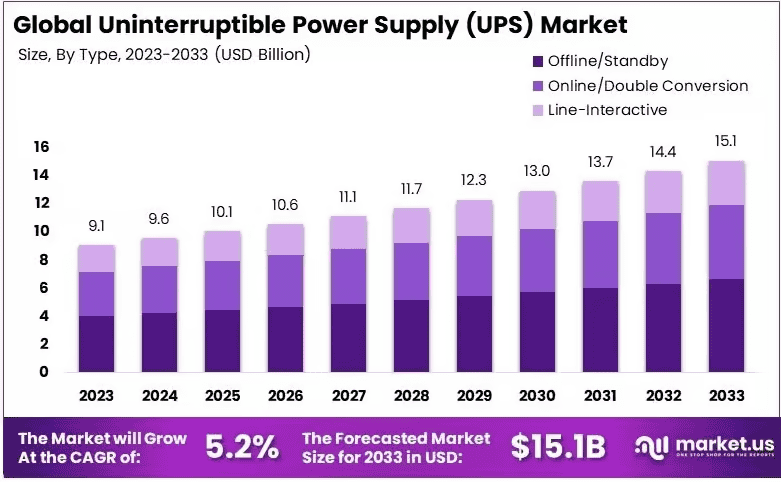
- According to market.us, the Uninterruptible Power Supply market is predicted to grow from USD 10.1 billion in 2025 to USD 15.1 billion by 2033.
- This market is representing a growth rate of 5.2% CAGR from 2025 to 2033.
- The above graph also estimates the market size in the coming year, followed by 2026 (USD 10.6 billion), 2027 (USD 11.1 billion), 2028 (USD 11.7 billion), 2029 (USD 12.3 billion), 2030 (USD 13 billion), 2031 (USD 13.7 billion), and 2032 (USD 14.4 billion).
- Asia Pacific holds the largest UPS market share of 35% in 2023, with major technological progress in China, Japan, and India.
- The Global Market Insights also stated that in 2024, the United States UPS market accounted for USD 3.6 billion.
- Product and service solutions were the largest segment at roughly USD 9.5 billion, with sales to large enterprises near USD 6.0 billion.
- Data-centre demand accounted for about USD 3.9 billion, and indirect channels (resellers and distributors) made up around 60% of total sales that year.
- Mordor Intelligence further states that in 2024, the global UPS market was led by the Less than 10 kVA segment, which held about 47% share.
Uninterruptible Power Supply Market Share by Organization
(Reference: gminsights.com)
- In 2025, large enterprises are estimated to make up about 68.3% of the UPS market.
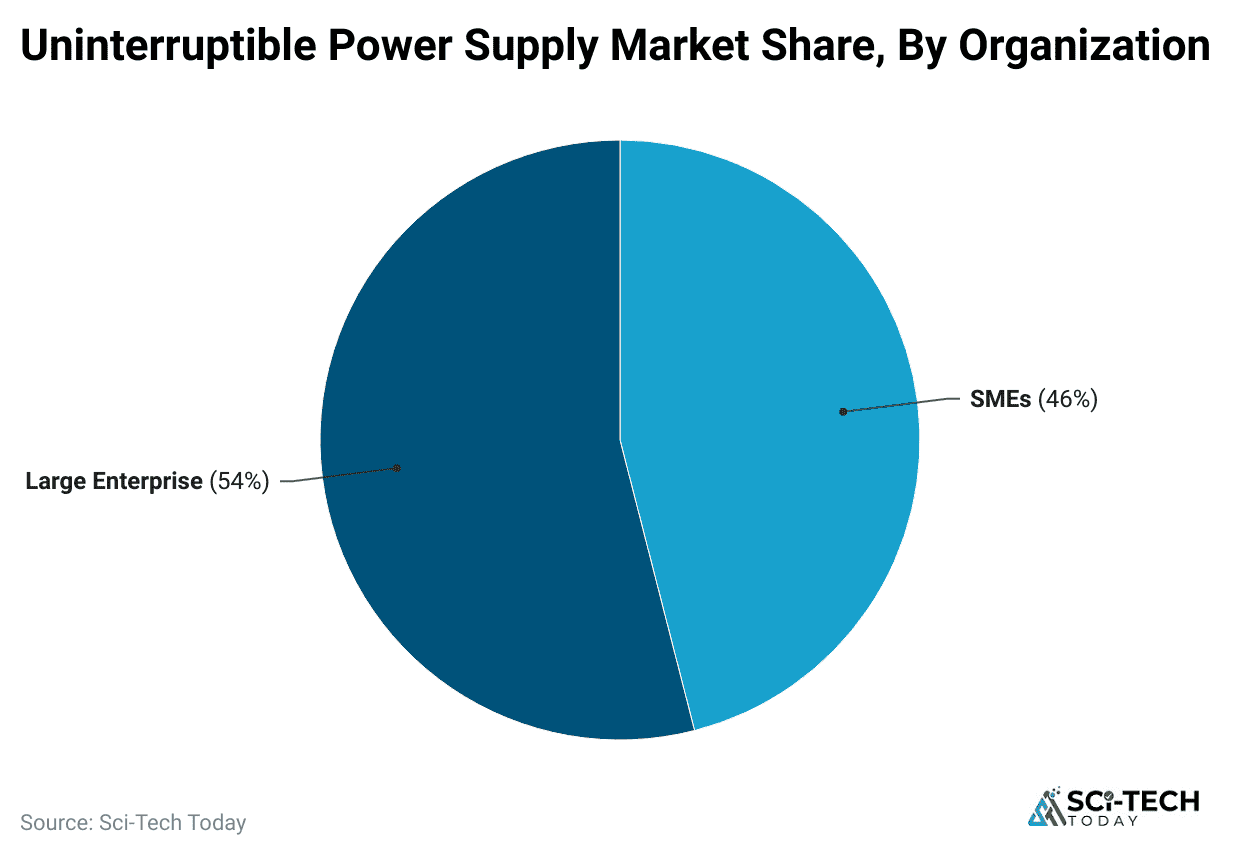
- In 2024, large enterprises made up just over half the UPS market with a share of 54%, and brought in roughly USD 6 billion in revenue.
- Small and medium-sized businesses covered the rest, accounting for around 46% of the market.
By Regional Insight
(Reference: amazonaws.com)
- In 2025, the uninterruptible power supply (UPS) market showed that Asia Pacific led with the largest share at 41%.
- Meanwhile, the North American region followed with 35%, and Europe accounted for 23%.
- Lastly, South America and the Middle East & Africa each contributed 8%, respectively.
Industrial Uninterruptible Power Supply Market Size by Region
- According to Cognitive Market Research, the market size of the industrial Uninterruptible Power Supply in the North American region is estimated to reach USD 1700.24 million by 2025 and USD 2247.66 million by the end of 2033.
- The annual growth rate of the market will grow at a CAGR of 4.218% from 2025 to 2033.
Furthermore, other regional market sizes are estimated in the table below:
| Region | Market Size (USD million) | CAGR (2025 to 2033) | |
| 2025 | 2033 | ||
| Europe | 1512.84 | 2039.02 | 3.801% |
| Asia Pacific | 2647.47 | 3859.91 | 4.826% |
| South America | 400.698 | 571.114 | 4.529% |
| Middle East | 309.724 | 437.867 | 4.423% |
| Africa | 243.622 | 328.234 | 3.797% |
By Country
(Reference: cognitivemarketresearch.com)
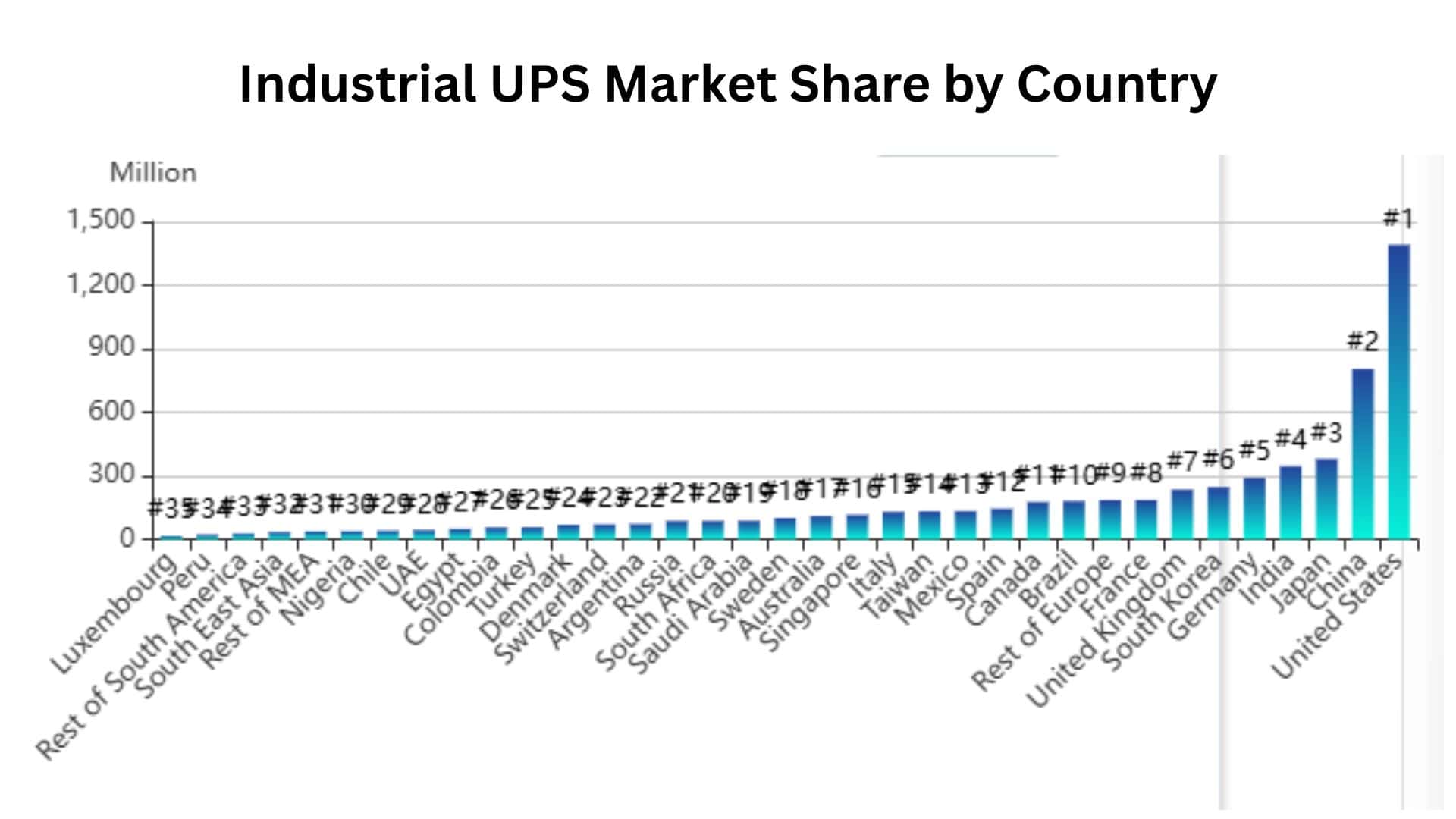
- It is expected that the revenue of the US industry for UPS will be close to USD 1,390.12 million in 2025.
- Also, it is expected that by 2033, the revenue will increase up to USD 1,821.28 million.
- The annual growth rate for this period will be around 3.44%.
The market size analyses in other countries are as follows:
| Country | Market Size (USD million) | CAGR (2025 to 2033) | |
| 2025 | 2033 | ||
| Canada | 176.655 | 247.467 | 4.304% |
| Mexico | 133.469 | 178.914 | 3.731% |
| United Kingdom | 234.49 | 323.592 | 4.108% |
| France | 185.323 | 238.565 | 3.207% |
| Germany | 290.466 | 413.92 | 4.527% |
| Italy | 129.802 | 169.646 | 3.403% |
| Russia | 86.232 | 105.009 | 2.493% |
| Spain | 145.081 | 199.416 | 4.056% |
| Sweden | 100.604 | 137.328 | 3.966% |
| Denmark | 68.834 | 90.981 | 3.548% |
| Switzerland | 70.952 | 90.94 | 3.151% |
| Luxembourg | 15.96 | 19.656 | 2.638% |
| China | 804.832 | 1190.78 | 5.019% |
| Japan | 379.912 | 523.403 | 4.086% |
| India | 345.495 | 540.387 | 5.751% |
| South Korea | 245.95 | 343.146 | 4.251% |
| Australia | 109.605 | 142.431 | 3.329% |
| Singapore | 115.43 | 171.766 | 5.094% |
| South East Asia | 227.418 | 344.69 | 5.336% |
| Taiwan | 132.638 | 188.209 | 4.471% |
| Brazil | 180.715 | 255.402 | 4.419% |
| Argentina | 72.647 | 107.769 | 5.053% |
| Colombia | 56.394 | 77.123 | 3.991% |
| Peru | 21.83 | 30.429 | 4.239% |
| Chile | 41.152 | 59.567 | 4.732% |
| Egypt | 49.277 | 67.519 | 4.015% |
| Turkey | 57.268 | 83.063 | 4.758% |
| Saudi Arabia | 87.001 | 123.741 | 4.502% |
| UAE | 43.95 | 65.855 | 5.185% |
| Qatar | 34.351 | 47.776 | 4.21% |
| South Africa | 86.388 | 122.497 | 4.462% |
| Nigeria | 38.712 | 53.108 | 4.032% |
Uninterruptible Power Supply Power Rating Analyses
- The UPS market is divided into four power rating categories: less than 5 kVA, 5 to 50 kVA, 51 to 200 kVA, and above 200 kVA.
- The 5 to 50 kVA range dominates as it balances cost and performance.
- Units below 5 kVA mainly serve homes and small offices, 51–200 kVA models support industrial setups and larger data centres.
- Meanwhile, above 200 kVA systems power massive data centres and manufacturing plants.
Uninterruptible Power Supply Industry Partnerships Analyses
- As per gminsights.com, Schneider Electric came out with the small and modular Galaxy VXL UPS for industrial applications, hyperscale colocation, and AI data centers in April 2025.
- Vertiv too partnered with ZincFive to offer Trinergy UPS together with nickel-zinc cabinet batteries.
- Eaton launched its 9PX Gen2, a small 4U UPS for data centers that offers 5 to 11 kW of power in May.
- As per market.us, Ballard Power Systems partnered with Vertiv in June 2024 to design hydrogen fuel cell backup power solutions for data centers.
- In the same year, as of July, Schneider Electric and AVEVA worked with IN-CORE Systèmes to improve electric vehicle battery production.
- In September, Delta Electronics India signed an MoU with Savex Technologies, officially.
- In November, E2E Networks formed a strategic partnership with Larsen & Toubro in India.
Final Thoughts
In recent years, UPS systems shifted from niche safety gear to essential infrastructure across industries. Three factors drive demand: more data centres and edge computing, greater renewable use that makes grids less stable, and stricter uptime and security needs. Vendors now offer combined solutions hardware with monitoring and services, and buyers focus on lifecycle costs, remote management, and greener options.
Regions with digital growth and weak grids expand fastest; mature markets upgrade to efficient, long-life batteries, while emerging markets choose modular, low-cost systems. UPSs are becoming active energy partners.
FAQ
The primary international standard for Uninterruptible Power Systems (UPS) is the IEC 62040 series, which covers IEC 62040-1 (Safety), IEC 62040-2 (Electromagnetic Compatibility – EMC), and IEC 62040-3 (Performance and Testing).
An uninterruptible power supply (UPS) is an electrical device that provides near-instantaneous emergency power and voltage regulation to connected equipment when the main power source fails, preventing data loss or hardware damage.
A standard Uninterruptible Power Supply (UPS) uses both AC and DC internally, taking an AC input from the wall, storing energy as DC in its battery, and usually outputting AC power to your devices.