








Brief Overview
Apple Customer Loyalty Statistics: By the end of the year 2026, Apple’s partnership with consumers does not seem to be just a one-off sale. Instead, it is an extensive subscription offering lasting many years. The whole ecosystem the company built around itself the iPhone, Mac, iPad, Watch, services, and payments is now being pulled together in a much tighter knot with two major strands: data-driven personalization and new AI functions. In fact, this mix is turning upside down the loyalty paradigm. Customers are not coming back to Apple just for the hardware anymore. Instead, they are not leaving Apple because it increasingly predicts, simplifies, and enriches their lives before they ask.
This article brings together the most recent Apple customer loyalty statistics. It shows how AI is changing Apple customer loyalty in 2026 and what this means for revenue, retention, and competitive strategies.
Best in the Editor’s Eye
- Apple, throughout time, keeps customer retention rates more than 90%, while iPhone has a customer retention rate of approximately 92%, which is a lot higher than that of most competitors in the smartphone market.
- Though slightly less than before, customer loyalty towards Apple in the smartphone market will still be around 89% in 2025.
- iPhone users who plan to buy another Apple device are about 84%, giving a guarantee of sales for the long term.
- The loyalty trade-in programs are a strong factor, as approximately 74.6% of the customers are migrating into Apple’s ecosystem after the upgrade.
- Among the iPhone users in the US, 89% of them got another iPhone as their next device, thus making Apple the most trusted brand and the most dominant player in the market.
- In the smartphone market of the US, Apple has a 52% share, while Samsung and Motorola have shares of 24% and 12%, respectively.
- The emotional aspect is one of the main factors here, because 73% of the users consider themselves loyal, and 96.4% of millennials promise to repurchase Apple devices.
- The average Net Promoter Score of Apple is around 61, which is significantly higher than that of the industry benchmark and that of its competitor, Samsung.
- Strong service alongside support, such as the Genius Bar, which is an integral part of the whole process, is one of the reasons for the very high customer satisfaction rating of around 81% and the low rate of customer churn.
- In fact, loyalty spreads over different product lines, and customers are always moving up from iPhones to Macs, iPads, wearables, and services.
- Even though the company is facing slower upgrade cycles and the use of old devices, Apple’s premium model adoption and high customer loyalty rates of around 93% still support its US revenue.
Customer Retention Rate
(Reference: sqmagazine.com)
- The performance of Apple regarding customer retention brings to light one of the strongest loyalty dynamics in the world market for technology.
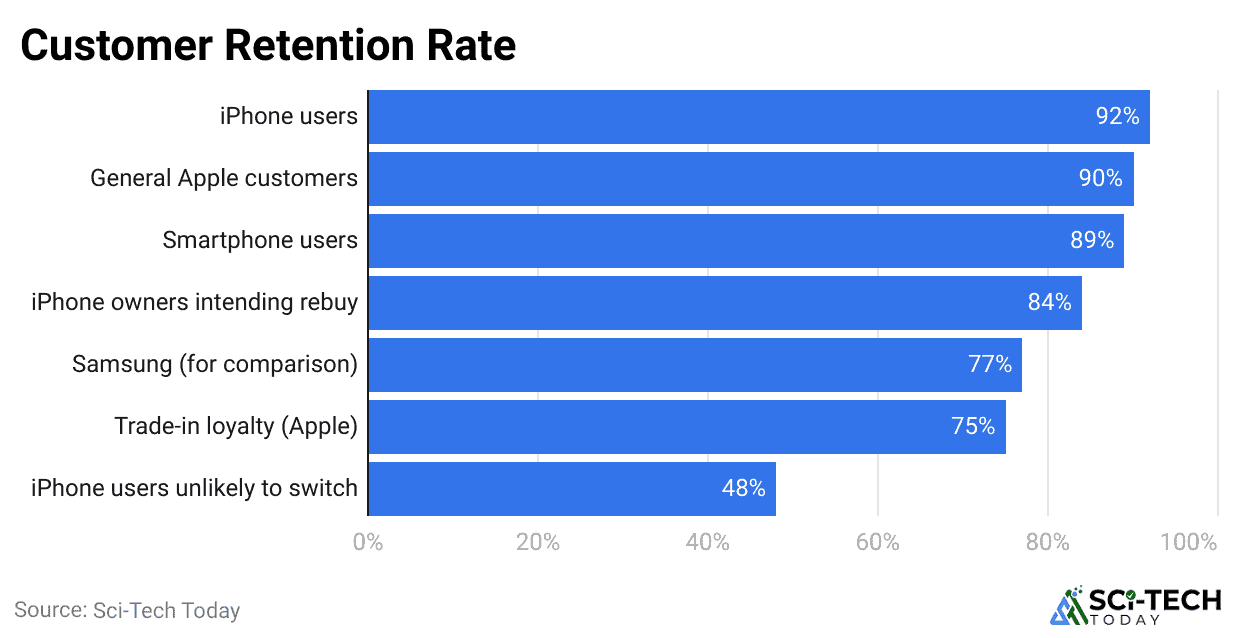
- Over the years, Apple has been successful in retaining more than 90% of its customers, which points to the fact that most of its customers choose to buy Apple products instead of moving to competitors.
- This retention is unusual in the consumer electronics industry, where product cycles are short, and competition is fierce.
- It is often mentioned that among iPhone users, the retention rate is 92%, which shows how much the device has become a necessity for users through their daily interactions via applications, services, and inter-device integration.
- By 2026, it is expected that the overall loyalty of the smartphone market to Apple will be around 92%.
- While this is a minor decrease from the previous peak levels, it still places Apple significantly above the industry average and thus confirms its leading position with respect to customer loyalty.
- Rival companies may implement competitive pricing, introduce the same features, and even go for aggressive innovation; however, Apple will still manage to keep a lot more of its user base.
- As a point of reference, the customer retention rate of Samsung is about 77%, which brings out the extent of Apple’s advantage and the power of its ecosystem-driven lock-in.
- Around 84% of current iPhone users say that they would buy another Apple device when their turn to upgrade comes.
(Source: gsmarena.com)
- Newest studies about smartphone brand loyalty in the US signify that Apple is still actually keeping the majority of its users.
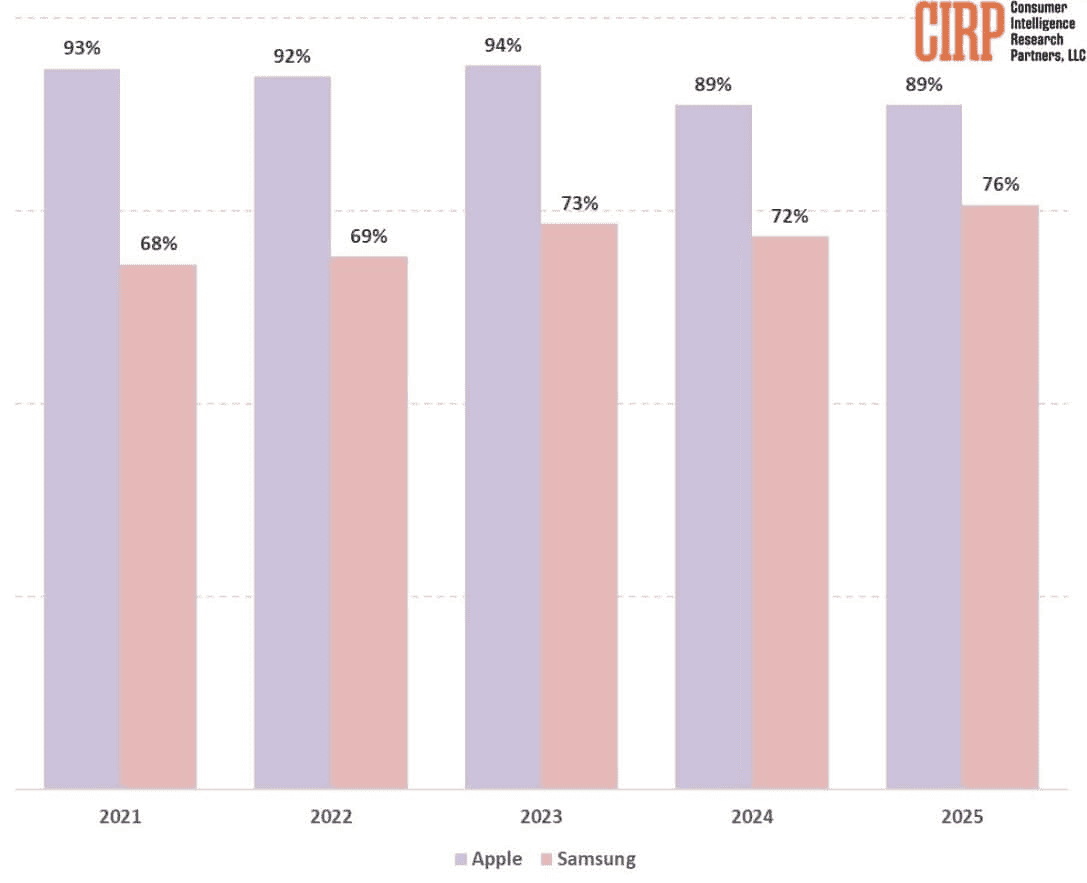
- A striking figure of 89% of iPhone users went for another iPhone during the upgrade, thereby showing very strong loyalty, albeit the figure has fallen by 5 percentage points since 2023.
- However, the slight fall in percentage hasn’t changed Apple’s loyalty level; it remains the highest among all smartphone brands in the market.
- On the other hand, Samsung has been able to bounce back with its brand loyalty, getting up from 68% to 76% in the period from 2021 to 2025, meaning an 8% increase.
- Nevertheless, experts point out that the loyalty numbers of Apple and Samsung are not strictly comparable, as the latter has a much smaller group of highly devoted customers.
- Apple enjoys a very well-knit ecosystem that is conducive to customer retention, whereas Samsung, on the other hand, has to deal with the problem of competing against a multitude of Android alternatives that are available to consumers.
- The survey data is only for the US market, where Apple leads with a 52% share, followed by Samsung with 24% and Motorola with 12%.
Emotional Connection and Brand Advocacy
- Approximately 73% of iPhone owners rate their loyalty to Apple as either very or somewhat.
- Loyalty among the millennials is the strongest, with 96.4% of them stating they would purchase another Apple device when they upgrade.
- Consumers with an emotional connection to a brand are significantly more likely to recommend it, with referral rates of around 71% versus 45% of regular users.
- Apple’s marketing model puts a hefty emphasis on the customer’s self-image, thereby assisting consumers in forming a personal attachment to the company’s products.
- Many users would say that switching brands would either disturb their functioning or feel like they are losing a part of their “digital identity.”
- Surveys furthermore indicate that more than half of Apple users feel a sense of pride while using Apple products, which, in turn, strengthens the emotional bond and brand loyalty.
- Some of the repeat customers characterize Apple products as being part of a community that is either creative or has a similar mindset.
- These emotional attachments frequently bring about softer responses to issues; thus, the loyal customers are more inclined to disregard the errors than they would in the case of other brands.
Net Promoter Score (NPS) Statistics
(Source: sqmagazine.com)
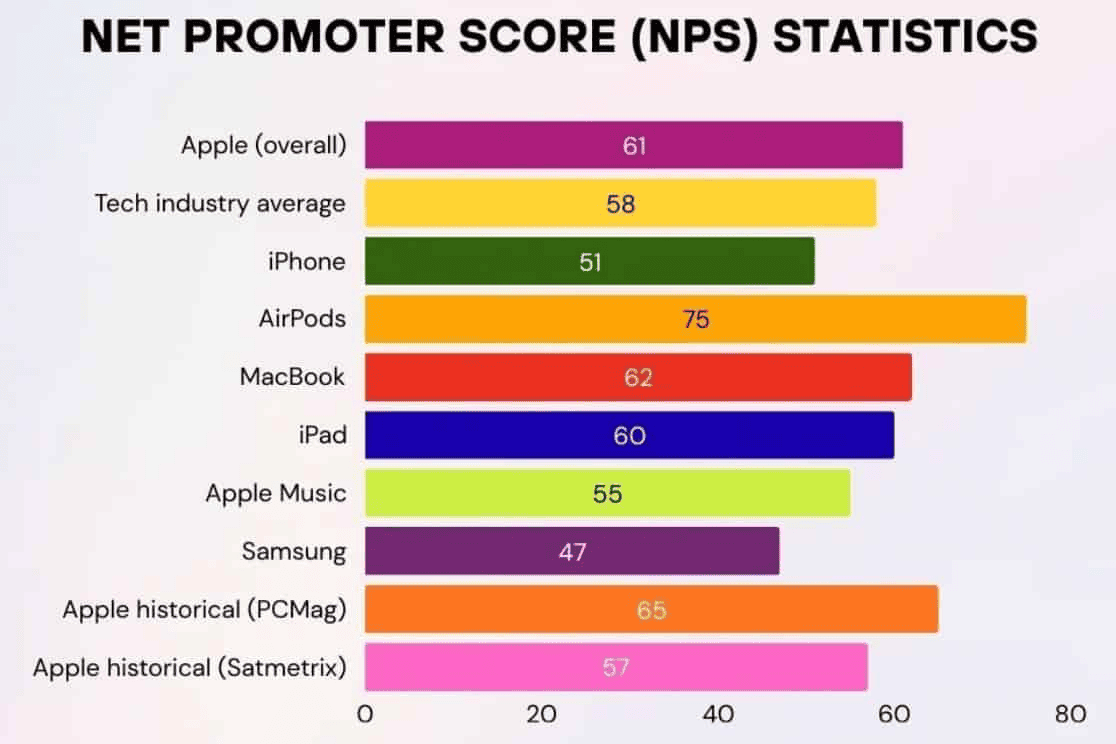
- The year 2025 sees Apple’s Net Promoter Score being reported widely at approximately 61, which ranks it above the average of the technology industry, which is about 58.
- CustomerGauge gives the average NPS of Apple across its product range, including gadgets such as earphones and laptops, as 61.
- Different products have different scores, with the iPhone getting approximately 51, AirPods around 75, MacBooks 62, iPads 60, and Apple Music at 55.
- Past research has produced similar outcomes, with PCMag attributing an NPS of 65 and Satmetrix giving a score nearer to 57.
- As any score above 50 is treated as excellent, the performance of Apple reflects a loyal customer base.
- Among the competition, Apple far surpasses brands like Samsung with its estimated NPS of about 47.
Apple Watch Users Loyalty Statistics
- The Apple Watch retained its position as the #1 smartwatch manufacturer in 2025 by dominating the sales of premium smartwatches.
- The official statistics released by Apple stated that Apple Watch has scored 96% satisfaction from its users.
- Above 90% of Apple Watch users have at least one iPhone.
- Health and fitness are the highest statistical reasons why customers upgrade their gadgets.
- Brand retention is above 80% for users that are replacing old smartwatches.
- Health monitoring users show a significant level of engagement.
Apple’s Dominance in Smartphone Loyalty
- The smartphone market is still led by Apple when it comes to customer retention, and iPhone users are estimated to have a loyalty of about 92%, as opposed to around 77% for Samsung.
- The past few years have seen Apple very often being given a retention rate of above 90%, signifying that the customer base is very strong.
- Research usually considers iPhone users to be about 18% more loyal than Android users overall.
- In the US, Apple is especially dominating the high-end smartphone category, being frequently the best in terms of customer satisfaction, repurchase intention, and recommendation likelihood rankings.
- Despite the growing rivalry and the regulators watching closely, Apple’s loyalty metrics continue to hold their ground.
- In 2025, consumer surveys conducted by various companies still put Apple on top as the most loyal tech brand, thus enabling the company to offer more services and attract customers more deeply to its ecosystem.
Demographic Insights on Brand Loyalty
- The numbers indicate that approximately 79% of iOS users remain loyal to Apple, and 73% of iPhone users regard themselves as somewhat loyal at least.
- Brand loyalty is strongest among millennials, with 96.4% stating they will repurchase Apple products.
- On the other hand, Gen Z consumers are more flexible in their brand loyalty after the pandemic, with 57% of them reporting lower brand loyalty across the board.
- Apple is the most preferred brand in terms of loyalty among tech companies, which is true for about 55.2% of U.S. consumers.
- Older customers, especially those aged 55 and over, are, not surprisingly, more resistant to the switch, which also helps Apple to maintain its customer base.
- Different loyalty levels are observed in different regions, with the Western markets having higher loyalty than many of the emerging economies.
- Among the users who frequently upgrade their devices, it is the higher-income and premium category who show the most pronounced loyalty tendency.
Apple Customer Lifetime Value
- The typical Apple iPhone consumer has a lifetime worth of around USD 8,000 in a 20-year customer relationship.
- Apple has an incredible 90% customer retention rate, which greatly decreases customer churn.
- As many as 92% of iPhone users intend to continue their usage only within the Apple ecosystem.
- It is expected that about 80% of iPhone users already have another gadget such as the AirPods.
- The number of paid Apple subscribers on its software and services platform already exceeded 1 billion officially.
- Its recurring business segment known as Apple Services created revenues of a staggering USD 109.16 billion in 2025.
- The current Apple customers are 3.5 times more likely to buy hardware products of the same brand than others.
- As many as 77% of those iPhone users who use a smartwatch use only the Apple Watch for better connectivity.
Apple Service and Support Satisfaction
- The results of a survey conducted with approximately 16,000 consumers show that Apple is the leading smartphone brand in customer satisfaction, with a score of 81%.
- CIRP’s data for the year ending June 2025 shows that the average loyalty of iPhone users in the U.S. is 89%.
- This percentage increases to 92% if the users stick with the same carrier, but drops to 79% if they switch.
- The availability of Genius Bars and convenient walk-in support is often credited by customers as the main reason that they stick to the brand.
- Feedback gathered from store visits and interactions with support has a direct influence on internal systems for NPS and customer satisfaction, which in turn are linked with staff performance and thus prompt better service provision.
- Moreover, Apple is constantly gathering feedback from customers through surveys conducted after purchase and post-service, and incorporating Net Promoter Score into their understanding of customer experiences, which leads to better experiences for customers.
- Communication that is direct and fast problem-solving are contributing factors in customer retention, even when product problems exist.
- One of the reasons why Apple is perceived as more trustworthy in terms of support than platforms of multiple vendors is that it is responsible for both the hardware and the software. This support trust is a major factor that deters many customers from switching brands.
Brand Loyalty Rates
- An iPhone loyalty rate of 89% was observed by Apple in the latest CIRP report.
- The loyalty score of Apple continues to be much better than the estimated 77% retention rate of Samsung.
- According to previous CIRP reports, Apple has been performing above the 90% loyalty level for smartphones.
- 55.2% of people consider that Apple is the brand that they are most loyal to in terms of technology.
- Approximately 84% of people using iPhones plan to stick with the Apple brand in the future.
- According to the estimate of NPS of Apple, the value stands at 61.
- About 74.6% of trade-in customers keep buying Apple products after upgrades.
Loyalty Statistics by Product Category
- The loyalty of customers still holds strong across Apple’s product categories.
- iPhone retention rates can reach as high as 92% under the best conditions, and 89% is the overall loyalty rate; these figures are based on the CIRP research.
- Mac users have been reporting very high levels of satisfaction, and they are likely to continue with the same brand for their next purchase.
- Users of iPads often rely on them for doing tasks together with their other Apple devices; thus, they become very much dependent on the ecosystem.
- The Apple Watch and other forms of wearable technology gain consumer loyalty due to the continuous collection of health and fitness data.
- Although AirPods are frequently bought as companions to other devices, they lead to continuous use as a result of easy and automatic pairing.
- Apple’s portfolio of services, comprising iCloud, Apple Arcade, and Apple TV+, is another factor that contributes to loyalty across products; indeed, the NPS scores for services are comparable to, if not even higher than, those for hardware.
- It is not uncommon for a loyal customer to gradually move into different Apple product categories.
Apple’s US Revenue Growth Driven by Brand Loyalty and Premium Adoption
- Loyalty is still a major factor in maintaining and retaining customers; thus, the reason for the company’s 93% loyalty rate, which is greatly ahead of Android’s 80%.
- It can be seen that buyers are switching from regular models to premium models such as Pro Max, whose price is about 20% higher than that of Pro and about 33% more than Plus.
- Although Apple is projected to have an annual installed base growth of 2%, which it has not seen in the past three years, averaging 5%, this will prompt some new sales as people migrate from Android to iPhones.
- Thus, in the US, Apple will still be able to go up on iPhone cash in FY24 even if shipment volumes decline slightly.
- Another aspect that was pointed out in the report was the reduced engagement with Apple’s TV service.
- The percentage of iOS owners who own an Apple TV box went down to 14.5% from 22% a year ago, while the figures for Apple TV+ viewership show that it went down from 31.7% to 26.6% in 2023.
Loyalty Trends and Future Outlook
- With the average age of iPhones constantly rising, devices in the US are now approximately 35 months or almost three years old, indicating slower upgrade cycles.
- Apple may have to depend more on the enhancement of user retention via services and cross-selling within its ecosystem rather than on the frequent upgrading of devices as hardware replacement rates decline.
- Additionally, regulatory changes like the one mandating the opening of the App Store could dismantle some of the mechanisms that have traditionally kept users locked in ecosystems.
- Consumers’ loyalty-related expectations are also undergoing transformation as there is more and more demand for programs that are not only flexible but also transparent; over 81% of users are in favour of customizable rewards.
- AI-driven and predictive personalization can therefore be expected to be an even bigger part of future loyalty strategies.
- Identity, shared values, and trust might also come to be the emotional factors that determine loyalty among smartphone users as the differences in the features offered by various brands become less and less distinct.
- To keep hardware loyalty, Apple might have to offer more powerful incentives like trade-in programs or easy financing.
- However, price sensitivity during periods of high inflation or economic stress may challenge loyalty among the less committed buyers.
- The company’s continual struggle will be to keep its value proposition while adapting to the needs of users who have become used to staying with a device for a longer period.
Wrap Up
Apple Customer Loyalty Statistics: Apple’s customer loyalty in 2026 indicates the strength of a totally coherent ecosystem. This ecosystem has been made even more appealing by emotional ties, excellent service, and slowly but steadily increasing AI-powered customization. Apple, with over 90% retention, continues to beat all the competitors in the race for smartphones, services, and devices. This is happening even though the upgrade cycles are slowing down.
High Net Promoter Scores, strong repurchase intent, and effective trade-in programs highlight long-term customer commitment. However, regulatory interventions and economic dilemmas could lead to a slight drop in loyalty. Yet, the company’s ability to offer premium hardware, seamless support, and predictive experiences has already set it on the right path. Therefore, Apple is sustaining revenue growth and deepening lifetime customer value over the years.
FAQ
Apple does not have a traditional, points-based loyalty or rewards program for everyday purchases. Instead, they offer an official cash-back program called Apple Card Daily Cash, as well as the ability to redeem rewards directly through Apple Pay
Apple users remain fiercely loyal primarily due to their tight grip on users through the “walled garden” ecosystem. Once a user owns an iPhone, Apple Watch, and Mac, the seamless integration (like Universal Control and AirDrop) makes switching to competing brands highly inconvenient.
Although the corporation dominates the market of mobile devices and computers, it does have some problems that are worth mentioning. These weaknesses include expensive products, entry into markets where more competition exists, and non-compatibility with other software.