








Introduction
Reputation Management Statistics: In 2026, reputation management has kind of turned into one of the most valuable business investments, affecting everything from consumer confidence and online discoverability all the way to revenue expansion and even enterprise valuation. With AI-powered search, review platforms, social media talk, and digital word of mouth now steering purchase choices, companies can’t really keep treating reputation like some last-minute, reactive public relations thing.
Instead, more and more organizations are putting real budget behind online reputation management ORM, review monitoring, crisis response, and brand sentiment analytics, just to safeguard long-term business value. Studies indicate that customer reviews, search rankings, and how fast a brand responds can strongly influence conversion rates, sales outcomes, and customer commitment, which is why reputation management has become a key competitive lever across almost every sector.
This article on reputation management will reflect on customer behaviour, reviews, and the impact of social media in managing reputation.
Editor’s Choice
- 93% of consumers say online reviews affect their buying decisions, which basically proves that digital reputation is now pulling the buying strings.
- 94% of customers steer clear of businesses with negative online signals, and 50% won’t choose companies that land under 4 stars.
- A company can lift revenue by 5–9% for each one-star rating improvement, and products with five or more reviews can raise conversions by as much as 270%.
- 63% of social media users expect brands to reply within one hour, so fast engagement turns into a straightforward competitive edge.
- 82% of consumers trust companies more when senior leaders are active on social media, suggesting leadership presence matters.
- 75% of users never go past Google’s first search results page, so first-page reputation is kind of non-optional for brand momentum.
- One negative article on the first page can cut off potential customers by 22%, while three negative search results can push customer loss up to 59%.
- Over 80% of AI Overviews actually cite user-generated content, while AI summaries now show up in roughly 15% of Google searches.
- AI era is pushing reputation investment to accelerate, and organizations are expected to spend around 5× more on LLM optimization than traditional SEO by 2029.
- LLM API spending jumped from USD 3.5 billion to USD 8.4 billion in just one year.
Consumer Trust And Behavior Statistics: Reputation Drives Modern Buying Decisions
- These numbers pretty clearly show reputation is now one of the strongest forces behind consumer purchasing choices.
- In fact, digital trust affects buying decisions even more than traditional advertising or competitive pricing that sounds “better.”
- BrightLocal’s Consumer Review Survey reveals that 93% of consumers are influenced by online reviews when they decide to buy, and 81% research a business online before they purchase.
- Trust in digital feedback keeps growing, with 76% saying they trust online reviews as much as personal recommendations, and 84% placing the same level of trust in recommendations from strangers online as they do in friends.
- Also, 68% of consumers are willing to pay more for products or services from companies with a positive reputation.
- 70% say trust matters more than price when choosing between competing brands.
- On the other hand, according to Zendesk/ReviewTrackers, 94% have avoided a business after finding negative information online, and 50% won’t even consider businesses with ratings under 4 stars.
- About 60% of consumers say that a company’s reply to reviews influences their choice to use that business.
- 85% say they’re more likely to select brands that respond steadily to customer feedback.
- Also, 79% will read at least six reviews before they decide if a business feels trustworthy.
- Around 77% of consumers seem to prefer brands with clear communication, while 74% lose trust when they see outdated or not-quite-correct business details online.
- At the same time, 64% stop buying from a brand after a bad customer service situation that’s tied to reputation problems.
- 91% of millennials trust user-generated content more than traditional advertising, which is pretty telling.
- So overall, the above kinda make it clear that online reputation, transparency, real customer engagement, and genuine reviews have turned into essential competitive advantages in today’s digital marketplace.
Review Management Statistics By Customer Reviews
- Online reviews have shifted from just simple comments to one of the strongest drivers behind purchasing decisions and business revenue.
- The newest numbers show that 96–97% of consumers check reviews before choosing a nearby business, and 92% hesitate to buy when there are no reviews, so having reviews becomes a baseline need rather than a nice extra.
- On average, they look through 10 reviews before they trust a business, and they use six different review platforms to sort through opinions.
- 47% will not even consider a business that has fewer than 20 reviews, so both the number of reviews and the variety of places where they appear really matter.
- About 68% of customers only end up picking places with 44-starratings or better, and 55% stay locked on business listings rated between 4.0 and 5.0, and 86% get put off by 1–2-star reviews.
- Financially, it matters too, because raising ratings doesn’t just “help perception” but can show real lift; for example, each one-star bump can push revenue by 5–9%, while products that already have five or more reviews may see conversion rate gains reaching as much as 270%.
- Roughly 75% say they’re concerned about fake reviews, and 76% trust businesses that show both good and bad feedback more than those polished, perfect five-star pages.
- Engagement is not optional either, since 81% expect responses to reviews within a week, 88% want replies to every review, and 45% are more likely to go visit a business that professionally addresses negative comments.
- So, if you actually manage reviews well, it strengthens trust, supports conversions, and helps keep long-term business outcomes moving in a positive direction
Social Media And Brand Monitoring Statistics
- Social media has turned into a main pillar for reputation management, with people expecting fast action, openness, and real, meaningful interaction.
- The newest figures suggest 63% of social media users expect brands to respond within one hour, so real-time monitoring and direct customer engagement become basically non-negotiable.
- Online review management is kinda equally influential; 52% of customers expect businesses to respond to reviews within seven days, while companies that actively reply generate 12% more revenue than those that stay silent.
- Also, 55% of consumers end up with a more favorable view of a business when owners respond to reviews, plus 65% of customers say they would leave a more upbeat review if they were simply asked to give feedback.
- Around 92% of consumers look at companies more positively when they actively back social and environmental causes.
- During a crisis, 63% of the public are more willing to extend goodwill to socially responsible companies, which really underlines how important corporate social responsibility (CSR) is for brand resilience.
- Leadership visibility has kinda solidified as a key trend across the 2025–2026 cycle. 82% of consumers say they trust more when senior executives keep an active presence on social media, so executive communication directly contributes to corporate reputation.
- 72% of executives believe reputation will influence enterprise value more deeply than profit margins by 2031.
- 72% think having better access to reputation metrics could help organizational performance by an average of 63%.
- Rapid response, genuine engagement, visible executives, and social responsibility are no longer optional; they’re measurable drivers for customer trust, revenue growth, and long-term brand success.
Search Engine And Brand Visibility Statistics
- Search engines became the first checkpoint people hit when they’re trying to figure out if they can trust a brand, or if the brand is actually credible.
- About 75% of users never go past that first page of Google results, so being visible there turns into this really valuable digital sort of asset for pretty much any business.
- Roughly 88% of online shoppers look up a brand on Google before they buy, and 54% of consumers end up finding new brands through search engines, not really through social media or sponsored ads.
- In B2B, it gets even sharper, because around 90% of buyers start their vendor evaluation with a branded search, like right away.
- Since 46% of all Google searches are local, businesses with an optimized Google Business Profile get 7x more clicks and 70% more visits compared with incomplete listings.
- Banded results that show review snippets tend to boost click-through rates by 25–30%, which is not small.
- 62% of consumers say they lose trust when they find inconsistent business details across different search results.
- Meanwhile, brands that post fresh, authoritative content are 3 times more likely to show up and dominate the first page.
- 70% of job seekers avoid companies that show bad reviews or unfavorable press.
- The above statistics highlight that strong search visibility, consistent business information, and positive first-page content are critical drivers of customer trust, conversions, and long-term brand growth.
Reputation Management Cost Statistics
(Reference: webfx.com)
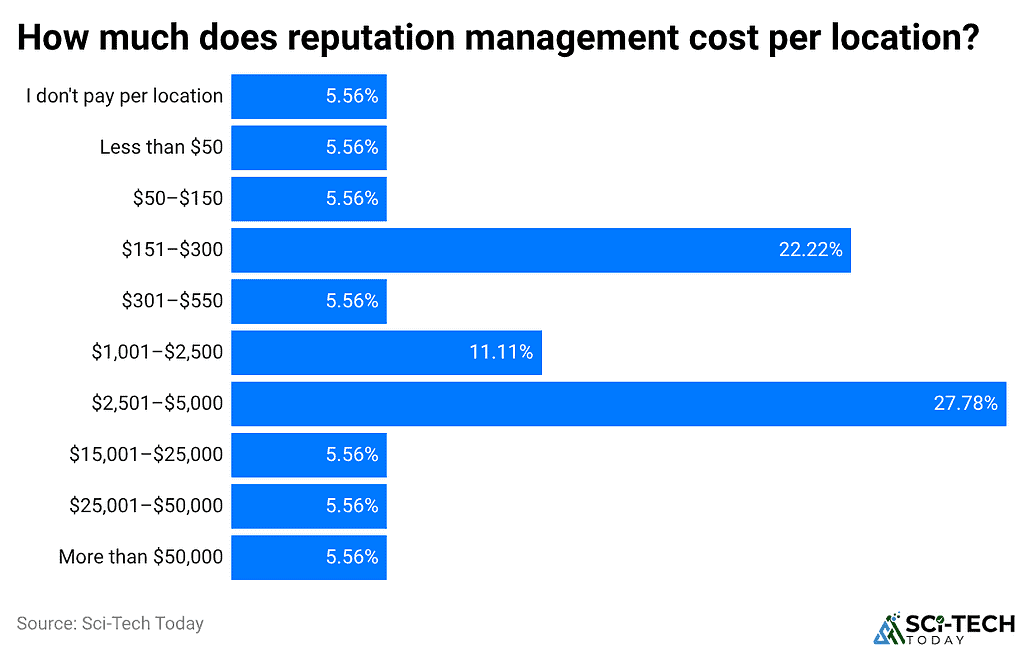
- The above chart basically tells us that businesses are, more and more, treating reputation management like a strategic thing, not just a “we can skip this” discretionary cost.
- The spending split also suggests most companies hand out moderate budgets per location, but only a little portion ends up either at the very low end or the very high end, which is kind of consistent if you think about it.
- The industry pricing audit is based on a localized agency sample size (USD N=18USD), and it really leans toward mid-market distributions in terms of how the operations look on the ground.
- The biggest portion is 27.78% of businesses spending between USD 2,501 and USD 5,000 per location. That range is the most common one.
- 22.22% on the second-largest group, they invest between USD 151 and USD 300 per location, so it feels like there’s a preference for cost-effective reputation management solutions.
- There’s also a smaller slice at 11.11% that allocates between USD 1,001 and USD 2,500 per location. This seems to indicate that some organizations are willing to put more weight into online reputation and customer engagement, probably because it connects faster to real outcomes.
- After that, the remaining categories each take up 5.56% of companies. This set includes businesses spending less than USD 50, USD 50–USD 150, USD 301–USD 550, USD 15,001–USD 25,000, USD 25,001–USD 50,000, and also those above USD 50,000 per location.
- Another 5.56% report that they do not pay per location for reputation management services, which is a bit different but still fits the overall picture.
- Reputation management spending that concentrates in the mid-market budget zone. It supports customer acquisition, builds trust, and supports longer-term growth, rather than just a short-term push.
The Impact Of AI Overviews (SGE) On Brand Sentiment
- In 2026, AI-powered search has fundamentally changed the way consumers discover and weigh brands.
- Instead of just leaning on traditional search rankings, people are getting AI-generated summaries first, before they even land on a website.
- Over 80% of branded AI Overviews come with citations pulled from user-generated content like Reddit threads, Quora replies, review sites, and those online forums where everyone has an opinion.
- So third-party voices end up carrying way more sway over how a brand is perceived than company-owned pages ever did, which makes online reputation management more urgent than it used to be.
- AI Overviews show up in roughly 15% of Google searches, and that seems to shave down average organic click-through rates by 18%.
- For informational searches, the drop is even harsher, reaching declines of up to 47%. Once the AI summary is visible, only about 8% of users stick with clicking the classic organic results.
- Users typically average just 1.4 clicks per session, compared to the older 3–5 clicks range.
- People who end up on a website after AI-generated summaries typically show a 4.4× higher engagement value compared with regular organic visitors, so the AI traffic volume might be smaller, but it feels a lot more “qualified” in practice.
- IDC expects that by 2029, organizations will allocate as much as five times more budget to LLM optimization than to traditional SEO.
- Global generative AI spending is expected to climb with a 59% compound annual growth rate, or CAGR, from 2023 to 2028.
- Between 2025 and 2026, big enterprises increased their AI-search and LLM optimization budgets by about 35%, year over year.
- Adobe adds that more than half of digital leaders are planning additional double-digit AI investment increases in 2026.
- On the infrastructure side, enterprise spending on LLM APIs jumped from about USD 3.5 billion in late 2024 to roughly USD 8.4 billion by mid-2025, which basically signals how much AI-driven search and reputation management matter now.
Sector-Specific Benchmarks: B2B Enterprise Vs. Local Retail
| Reputation dimension | Local retail (B2C) | B2B enterprise |
| Primary review platforms | Google Maps, Yelp, Facebook, TripAdvisor, Amazon | Gartner Peer Insights (330+ categories, 4,700+ products), G2 (6M+ reviews post-merger), TrustRadius cpl.thalesgroup+1 |
| Review characteristics | High-volume, anonymous, recency-weighted star counts | Verified employment and purchase required; expert peer narrative; rigorous platform vetting |
| Buyer AI research behavior | AI Maps / local search for proximity and hours | 51% of B2B software buyers start buying process in an AI chatbot using peer-review data |
| Revenue impact of 1‑star rating change | 5–9% revenue change (Harvard Business Review) | Not directly measured in star increments; shortlist inclusion/exclusion drives entire pipeline |
| Role of data privacy/security compliance | Minimal; customer trust tied to service quality | Mandatory; SOC 2, ISO 27001, GDPR posture directly evaluated in procurement cpl.thalesgroup+1 |
| Brand-equity impact of security breach | 31% of affected consumers stop relationship; 65% lose trust | 9–12% of total brand value at risk (tech sector); up to 16–17% for financial/banking software vendors |
| Stock / financial impact of breach | Limited for private retail operators | Average −5% share price on disclosure; −7% for firms with poor security posture; delayed recovery at 120 days |
| Key reputation-management actions | Listing accuracy, response rate, review recency, in-store solicitation | Review velocity on peer platforms, AI-chatbot visibility, data-compliance documentation, breach-response protocol |
Conclusion
Reputation management is now kind of a strategic business thingy that has a real impact on how people trust you, how visible you are in search, how fast revenue grows, and the whole long-term brand value side. Things like online reviews, employee advocacy, executive messaging, and even AI-driven search experiences seem to shape the way customers find a company and then decide whether it’s worth it or not. With AI Overviews showing up more often, plus user-generated content and review platforms nudging purchasing choices, businesses can’t just sit back and react when reputation stuff goes sideways.
They have to actively watch and guide their digital footprint in a steady and intentional way. Firms that put money into clear communication, fast customer replies, and AI-centered reputation planning usually end up with stronger loyalty, better conversions, and a tougher competitive edge in a market that’s more digital and, honestly, more trust-driven than before.
FAQ
Because it affects customer trust, buying choices, search visibility, and revenue growth across digital spaces.
About 93% of consumers say online reviews sway them during buying decisions, like pretty strongly.
One negative first page listing can cut down potential customers by 22%, and if there are three negative results, it can push customer loss up to 59%.
More than 80% of AI Overviews end up referencing user-generated content, so reviews, forums, and community chatter are becoming more influential every month.
A one-star lift in ratings can raise revenue by 5 to 9%, and products that have five or more reviews can boost conversions by as much as 270%.