








Opening
AI In Drone Technology Statistics: Drones are no longer just flying cameras. With the help of Artificial Intelligence (AI), they are becoming smarter and more capable of handling tasks with less human effort. AI helps drones recognise objects, avoid obstacles, and respond to changes while flying. This makes them useful in many fields, including agriculture, construction, defence, and disaster management. Farmers can check crop health, companies can inspect buildings, and rescue teams can search for people in hard-to-reach places.
As AI continues to improve, drones are finding new ways to make everyday tasks faster, easier, and safer. At the same time, their growing use highlights the need for proper safety measures and responsible handling.
Top Recommendation
- The global AI in drone technology market is projected to increase from USD 21.9 billion in 2025 to USD 29.0 billion in 2026.
- Tactical UAVs (MALE and HALE) are projected to lead the market with a 43.92% share in 2026.
- As of 2025, defense and security led with 32.6% of market revenue, followed by infrastructure and industrial inspections at 21.9%.
- North America’s market reached USD 6.89 billion in 2025, capturing 23.57% globally, and is projected to hit USD 7.88 billion in 2026.
- DJI’s revenue could exceed RMB 100 billion in 2026. Its estimated 2025 revenue was around RMB 80 billion.
- Over 600,000 agricultural drones were deployed across 100+ countries and regions by the end of 2025.
- The inspection drone market is projected to reach USD 25.82 billion by 2030, growing at a 17.3% CAGR.
- Military drone procurement is expected to rise from 16,157 units in 2026 to 26,544 units by 2031.
- On February 3, 2026, EHang Egret flew 22,580 drones simultaneously from one computer in Hefei, China.
- Ombrulla reported 30%-50% higher defect-detection rates with AI-assisted drones than manual visual inspections.
- Nearly 10% of 16,000 organizations surveyed plan to adopt drone detection, drone surveillance, or robotics within 12-18 months.
- In the United States, FAA and DoD programs allocated USD 4.4 million for autonomous navigation, cybersecurity, and BVLOS technology.
Global AI in Drone Technology Market Size
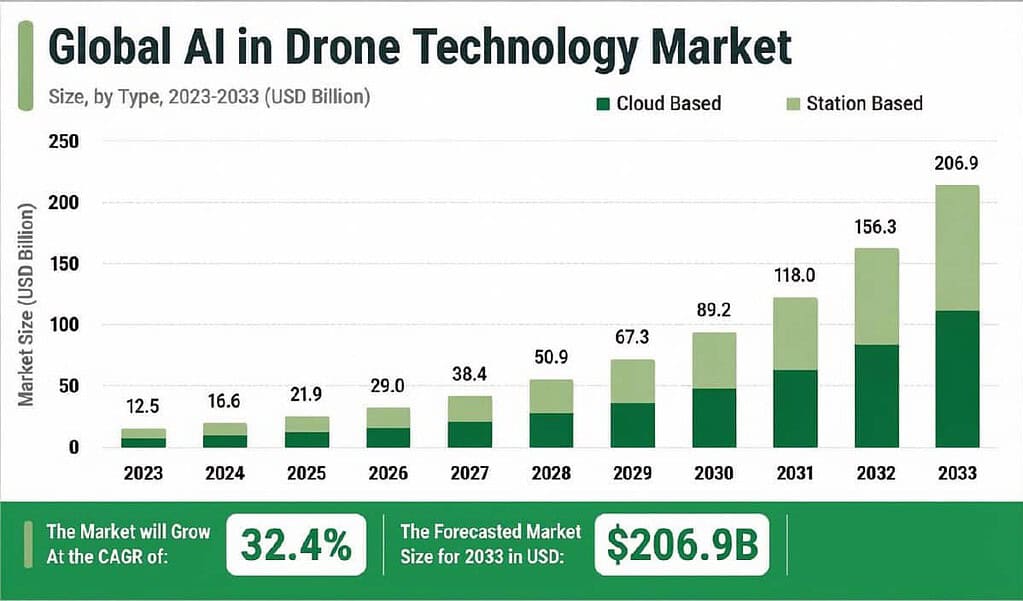
- The global AI in drone technology market is projected to increase from USD 21.9 billion in 2025 to USD 29.0 billion in 2026.
- The market is forecast to reach USD 206.9 billion by 2033, growing at a CAGR of 32.4% during 2023-2033.
Key Segments Driving AI Drone Market Growth
- Fortune Business Insights stated that Tactical UAVs (MALE and HALE) are projected to lead the market with a 43.92% share in 2026.
- Machine learning (ML) is expected to hold a 36.80% share in 2026, up from 36.49% in 2025.
- BVLOS operations are reported at a 33.77% market share in 2026, compared with 33.11% stated for the same year.
- VLOS Operations segment is projected to grow at a CAGR of 17.7% from 2026 to 2034.
- Remotely controlled AI drones are expected to account for 8.51% of the market in 2026.
- Semi-autonomous drones are forecast to grow at 17.4% over the forecast period.
- Infrastructure and industrial inspection is projected to grow at a CAGR of 17.7%.
AI in Drones Market Share by Application in 2025
- Defense and security led with 32.6% of market revenue, followed by infrastructure and industrial inspections at 21.9%.
- Agriculture and forestry accounted for 15.4%, while logistics and delivery represented 9.8%.
- Public safety held 8.6%, followed by environmental monitoring at 5.1% and smart cities at 4.2%.
- Healthcare and humanitarian aid contributed 1.6%, while other applications accounted for 0.8%.
Regional and Country-Level Market Report
| Region / Country | Market Size 2025 | Global Market Share in 2025 | Projected Market Size 2026 |
| North America | USD 6.89 billion | 23.57% | USD 7.88 billion |
| United States | – | – | USD 7.55 billion |
| Europe | USD 4.76 billion | 30.39% | USD 5.49 billion |
| United Kingdom | – | – | USD 1.19 billion |
| Germany | – | – | USD 0.86 billion |
| Asia Pacific | USD 6.14 billion | 4.01% | USD 7.16 billion |
| China | USD 2,117.2 million | – | USD 2.45 billion |
| Japan | USD 838.1 million | – | USD 0.98 billion |
| India | USD 1,263.7 million | – | USD 1.5 billion |
| Middle East & Africa | USD 1.86 billion | 9.11% | USD 2.12 billion |
| Middle East | USD 810.2 million | – | – |
| Africa | USD 1,046.6 million | – | – |
| Latin America | USD 0.55 billion | 2.73% | USD 0.63 billion |
Global Drone Data Services and Analytics Market Growth
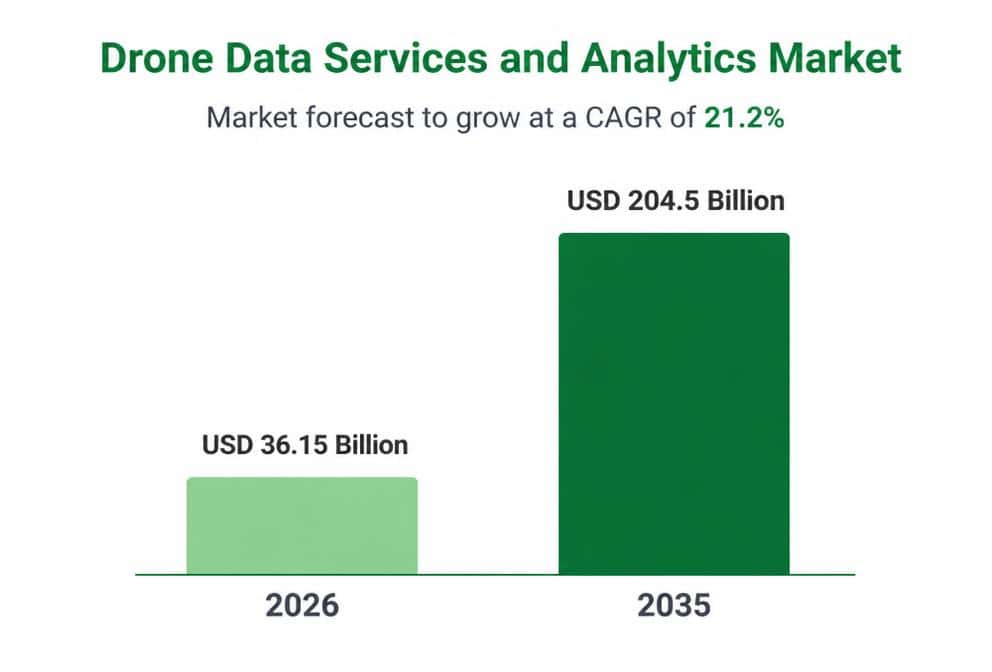
- The global market is projected to grow from USD 36.15 billion in 2026 to USD 204.50 billion by 2035, at a 21.23% CAGR from 2026 to 2035.
- Inspection and monitoring is expected to reach USD 59.44 billion by 2035.
- Meanwhile, construction and infrastructure could reach USD 57.00 billion.
- Cloud-based deployment is forecast to reach USD 144.80 billion by 2035.
- North America leads in 2025, while Asia-Pacific is projected to grow fastest at a 24.00% CAGR.
Leading Drone Companies Revenue and Financial Performance
- 36Kr Europe reports suggest that DJI’s revenue could exceed RMB 100 billion in 2026. Its estimated 2025 revenue was around RMB 80 billion.
- AeroVironment, Inc. reported record revenue of USD 1,976.8 million for fiscal year 2026, an increase of 141% compared with the previous year. Its annual bookings reached USD 2.7 billion, while funded backlog stood at USD 1.2 billion.
- Parrot’s revenue for the first half of 2026 climbed 71% to EUR 57.3 million. Its professional micro-UAV business performed particularly well, growing 134% to EUR 42.1 million.
- Skydio secured USD 110 million in Series F funding, with existing investors leading the investment round.
- Following this latest financing, Skydio’s valuation has increased to USD 4.4 billion.
- Teledyne Technologies, Teledyne FLIR LLC’s parent, reported Q2 2026 sales of USD 1,662.5 million, up 9.8% YoY. Net income reached USD 251.7 million, increasing 19.9%; diluted EPS was USD 5.37. Adjusted EPS stood at USD 6.28, while funded backlog reached approximately USD 5.0 billion.
- EagleNXT’s drone revenue rose 67% sequentially, reflecting stronger sales momentum.
- Total revenue reached USD 2.7 million in Q2 of 2026.
- Draganfly generated CAD 2.66 million in revenue during Q2 2026. Moreover, total revenue increased approximately 26% year over year.
- idea. Forge Technology’s market cap reached 36.74 billion as of October 14, 2026.
- It ranks 16,437th globally and 982nd in India, with market cap growth of 82.07% in one year.
- Red Cat generated USD 20.19 million in Q2 2026 revenue, up 527% year over year.
Agriculture: Transforming Farming Through AI Drones
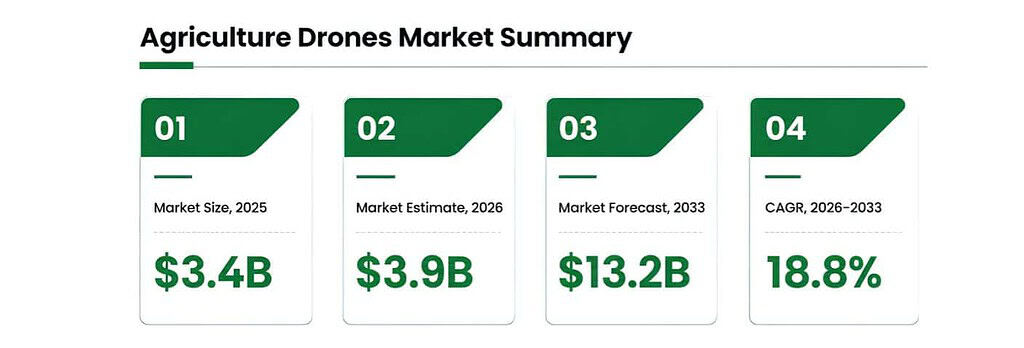
- The global agricultural drone market is estimated at USD 3.9 billion in 2026 and is projected to reach USD 13.2 billion by 2033, growing at a CAGR of 18.8%.
- Targeted weed spraying in Brazilian pastures has reduced herbicide use by up to 35%, according to DJI.
- AI drones use aerial imagery, thermal data, and field mapping to identify crop stress and improve decisions on irrigation and crop protection.
- DJI reported over 600,000 agricultural drones deployed across 100+ countries and regions by the end of 2025.
- Cumulatively, this represents approximately 410 million tonnes of water savings and 51 million tonnes of carbon-emissions reductions.
- Training, maintenance, spraying, and seeding services are expanding access to drone-based precision farming.
AI Drones in Infrastructure and Construction
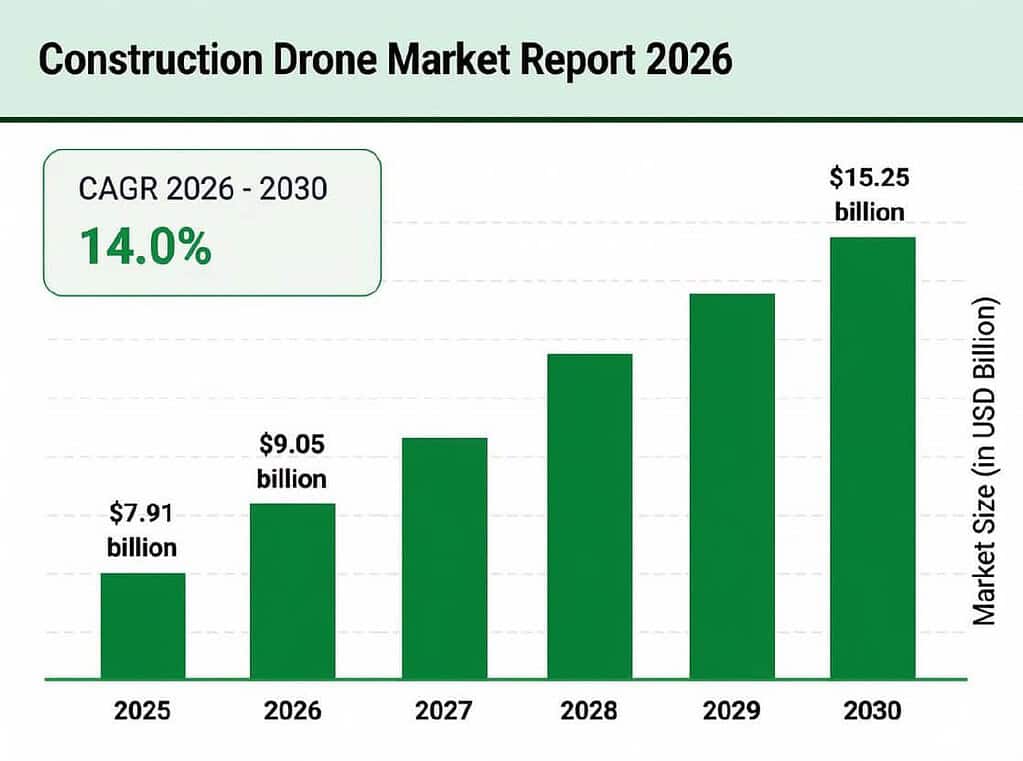
- The global construction drone market is expected to grow from USD 7.91 billion in 2025 to USD 9.05 billion in 2026.
- The market is projected to reach USD 15.25 billion by 2030, growing at a CAGR of 14.0% during 2026 to 2030.
- The inspection drone market is projected to reach USD 25.82 billion by 2030, growing at a 17.3% CAGR.
- AI drones use aerial imaging, LiDAR, and thermal sensors for land surveys, 3D mapping, and asset inspections.
- Repeated drone flights improve construction monitoring, progress tracking, and site documentation.
- Drones help inspect power lines, wind turbines, solar farms, and pipelines while reducing risky manual work.
AI Drones in Defence and Security
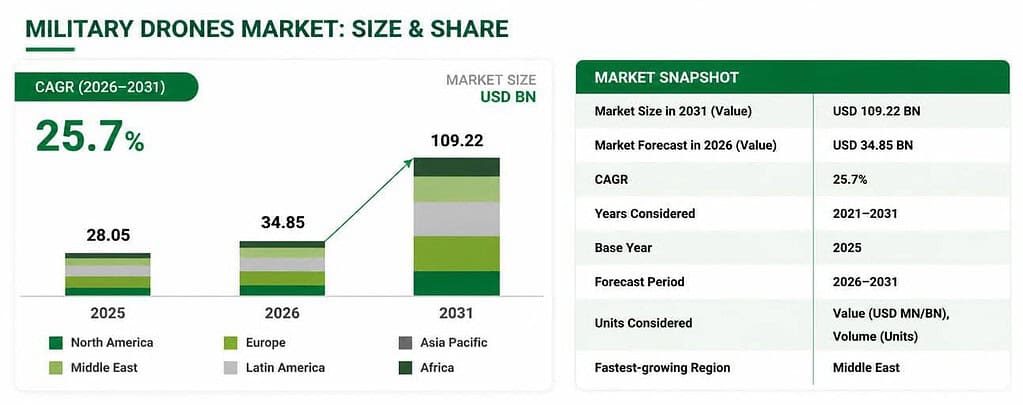
- The global military drone market is projected to grow from USD 34.85 billion in 2026 to USD 109.22 billion by 2031, at a 25.7% CAGR.
- Military drone procurement is expected to rise from 16,157 units in 2026 to 26,544 units by 2031.
- The Middle East held 41.9% of the military drone market in 2025.
- Fuel cell-powered drones are forecast to grow at a 32.5% CAGR from 2026 to 2031.
- Catapult-launched drones are projected to grow at a 26.7% CAGR, while fully autonomous drones are expected to grow at 31.7% over the same period.
AI Drones in Logistics and Delivery
- Delivery drones transport medicines, laboratory samples, food, parcels, and industrial supplies, especially to remote areas or locations with heavy traffic.
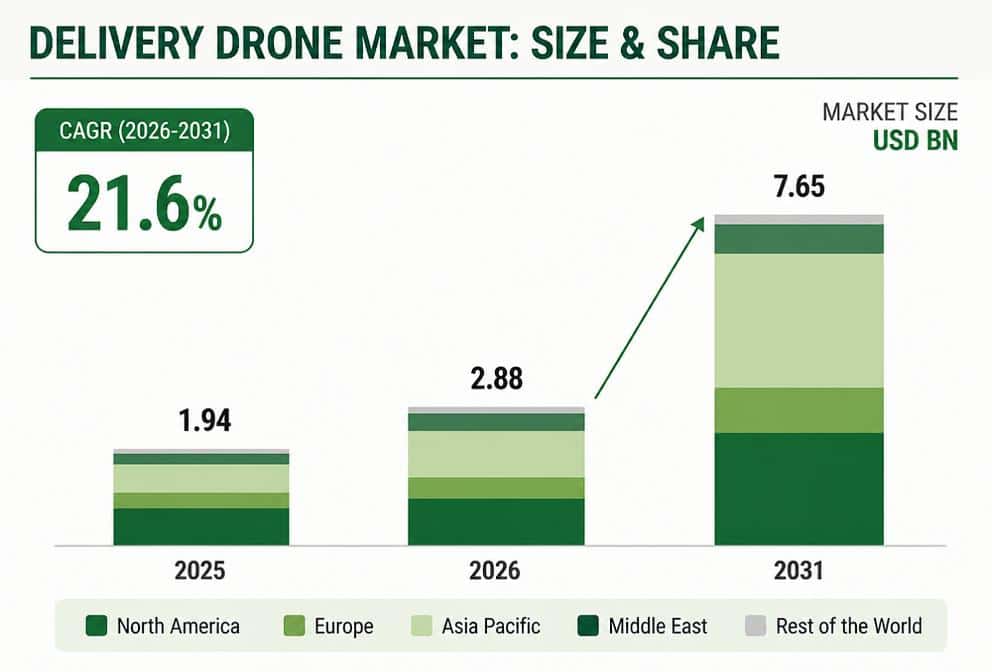
- The global delivery drone market is projected to grow from USD 2.88 billion in 2026 to USD 7.65 billion by 2031, at a 21.6% CAGR.
- Drone market volume is forecast to increase from 114,939 units in 2026 to 292,544 units by 2031.
- The Middle Eastern delivery drone market is projected to grow at the highest CAGR of 27.8% from 2026 to 2031.
- Drones weighing above 55-100 kg are forecast to grow at a 24.9% CAGR during 2026-2031.
- Wingcopter, PABLO AIR, and Blueflite are key market players with strong product offerings and market presence.
AI Drones in Entertainment
- AI drones capture aerial footage for films, advertisements, and live events, while synchronized LED drones create animated light shows.
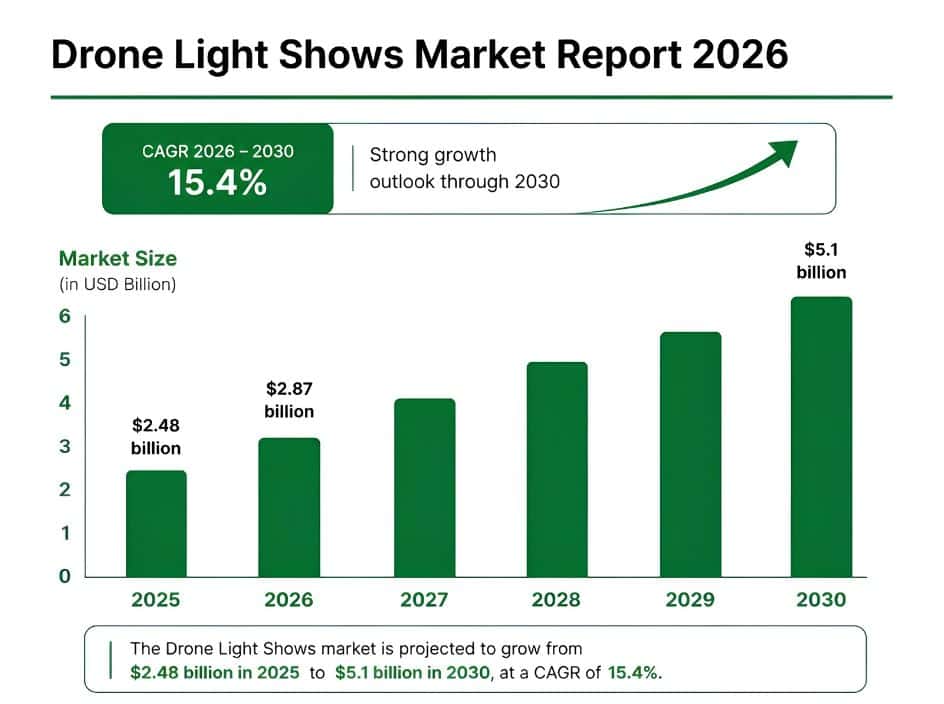
- The global drone light-show market is estimated at USD 2.48 billion in 2025 and USD 2.87 billion in 2026.
- The market is projected to reach USD 5.10 billion by 2030, growing at a 15.4% CAGR from 2026 to 2030.
- On February 3, 2026, EHang Egret flew 22,580 drones simultaneously from one computer in Hefei, China.
- In September 2026, Sky Elements and Damoda America recorded 71,207 cumulative drone launches across performances in Texas within one week.
- On September 28, 2026, 10,183 drones formed a dragon, setting a record for the largest mythical-creature drone display.
AI Drone Inspection and Search-and-Rescue Performance, 2026
- Ombrulla reported 30%-50% higher defect-detection rates with AI-assisted drones than manual visual inspections.
- Averroes claimed above 95% defect-detection accuracy for AI-powered inspection analysis.
- iFactory reported 89 defects detected using drones and AI, compared with 82 found through manual inspections the previous year.
- One iFactory example involved a 55-minute drone flight using RGB and thermal imagery.
- A University of Massachusetts Amherst team aimed to reduce search time from 72 hours to 7 minutes.
AI Drones and Robotics in Security Statistics
- Security Management magazine further mentioned that nearly 10% of 16,000 organizations surveyed plan to adopt drone detection, drone surveillance, or robotics within 12-18 months.
- 88% of security technology providers expect autonomous systems to affect security operations over the next 5-10 years; 8% anticipate a transformational impact.
- In February 2026, only 5.7% of organizations experienced a drone-related incident in the previous 12 months.
- Organizations plan to use drones for real-time incident monitoring (29%), patrols (27%), and alarm verification (23%).
- Leading applications include environmental monitoring (38%), high-risk response (33%), security patrols (32%), general incident response (28%), and visitor management (22%).
Government Funding for AI Drone Innovation (2024-2026)
- United States: FAA and DoD programs allocated USD 4.4 million for autonomous navigation, cybersecurity, and BVLOS technology.
- India: The Drone PLI Scheme provided ₹57 crore to support local manufacturing, AI mapping, and agricultural drones.
- China: Low-altitude economy programs involved more than ¥100 billion for drone infrastructure, AI swarms, and logistics.
- European Union: Horizon Europe allocated €112 million for AI, robotics, and autonomous flight systems.
- Israel: Innovation Authority and defense R&D funding included NIS above 3.8 million USD 40 million for counter-drone AI and interception systems.
Summary
AI is changing the way drones work, making them more useful and efficient. Today, drones are helping in areas like farming, security, delivery, and disaster response. They can complete many tasks faster and with less human effort. However, issues such as privacy, safety, and proper regulations must be addressed.
As technology continues to grow, AI-powered drones are expected to play a bigger role in our daily lives and make many tasks easier.
FAQ
AI drones support agriculture, surveillance, mapping, infrastructure inspection, disaster management, delivery, search and rescue, and environmental monitoring.
AI helps drones navigate routes, avoid obstacles, analyse surroundings, and make decisions independently.
Conventional drones follow programmed instructions, while AI-powered drones can analyse surroundings, recognise objects, avoid obstacles, and adapt decisions autonomously.