








Preface
Organic Farming Statistics: Organic farming is a natural way of growing crops and raising animals without using harmful chemicals, synthetic fertilizers, or genetically modified seeds. Instead, it uses compost, crop rotation, and natural pest control to keep the soil healthy and produce safe, nutritious food. As more people choose healthy eating and eco-friendly products, organic farming is becoming popular around the world. It not only protects the environment but also improves soil quality, saves water, and supports biodiversity. From small family farms to large agricultural businesses, organic farming is helping build a healthier future.
This article explains how organic farming works, its benefits, challenges, and the latest trends shaping the industry.
Best Choice
- The global organic farming market is valued at USD 253.09 billion in 2026 and is projected to reach USD 512.66 billion by 2033, growing at a 10.6% CAGR.
- Organic farming is practiced in more than 180 countries, covering 98.9 million hectares and supported by 4.8 million farmers worldwide.
- Global sales of organic food and beverages reached nearly EUR 145 billion in 2025, highlighting strong consumer demand.
- Organic farmland accounts for 2.1% of the world’s agricultural land, totaling 98.9 million hectares across 183 countries.
- Oceania leads the world with 53.2 million hectares, representing 54% of global organic farmland.
- The global organic food market is expected to grow from USD 286.48 billion in 2026 to USD 719.51 billion by 2034, at a 12.2% CAGR.
- India has over 4.43 million organic farmers, accounting for about 30% of the world’s organic producers, the highest globally.
- The United States recorded USD 76.6 billion in organic food sales in 2025, making it the world’s largest organic food market.
- Europe generated EUR 54.7 billion in organic retail sales, while the European Union contributed EUR 46.5 billion, with sales increasing 3.6% year over year.
- The global organic foods retail market is estimated at USD 208.81 billion in 2026 and is forecast to grow at a 11.8% CAGR through 2033.
Interesting Facts About Organic Farming
- Organic farming uses natural methods instead of synthetic fertilizers and pesticides to grow crops.
- Organic farmland covers only about 2% of the world’s total agricultural land, making it a small but growing sector.
- Organic farms can support up to 30% more biodiversity, including bees, birds, and beneficial insects.
- Healthy organic soil stores more carbon and improves long-term soil quality.
- Many organic certification programs require farmers to follow crop rotation practices.
- Organic farmers may use natural pesticides and biological pest control when needed.
- Organic soils retain more water, helping crops perform better during dry conditions.
- Farmers often use compost and animal manure to naturally improve soil fertility.
- Organic farming usually requires more manual labor and careful farm management than conventional farming.
- Farmers typically need a transition period of up to 3 years before their land can be certified as organic.
Global Organic Farming Market Overview
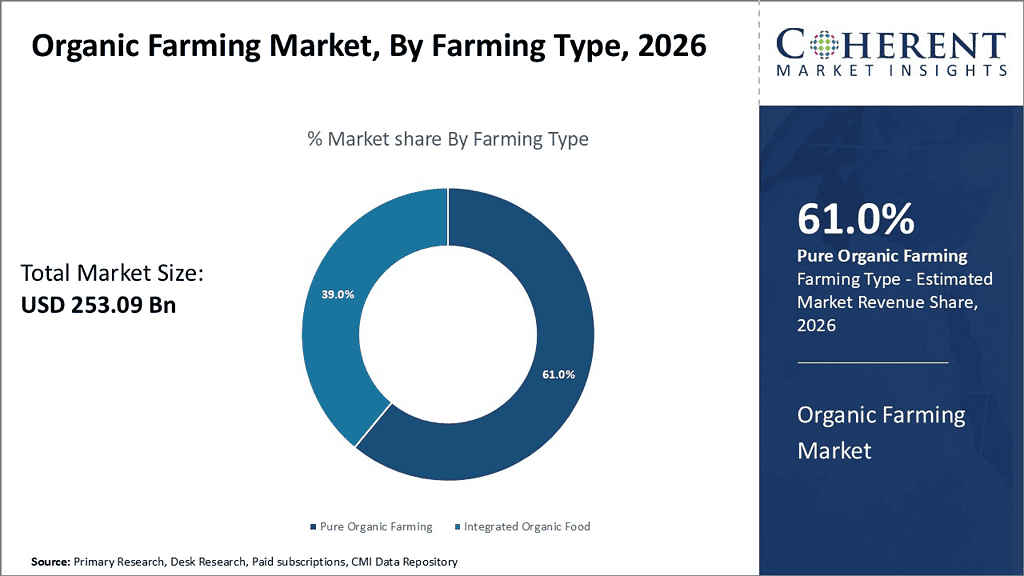
- The organic farming market is valued at USD 253.09 billion in 2026 and is projected to reach USD 512.66 billion by 2033, reflecting a strong CAGR of 10.6% over 2026-2033.
(Source: coherentmarketinsights.com)
- Market segmentation by farming type includes pure organic farming (61% share in 2026) and integrated organic farming (39%).
- According to fibl.org, organic farming is practiced in more than 180 countries worldwide.
- Around 99 million hectares of farmland are managed using organic farming methods by at least 4.8 million farmers.
- Global sales of organic food and beverages reached nearly EUR 145 billion in 2025.
Organic Farmland
- Global organic farmland covered 98.9 million hectares across 183 countries, equal to 2.1% of the world’s agricultural land.
- Organic farmland declined by only 0.2% from 2023.
- Oceania led with 53.2 million hectares, followed by Europe (19.6 million hectares), Latin America (10.3 million hectares), and Asia (8.7 million hectares).
- Worldwide, there were 4.8 million organic producers and 0.14 million organic processors, supporting the global supply chain.
- Market Data Forecasts that the global organic food market will reach USD 286.48 billion in 2026 and USD 719.51 billion by 2034, growing at a 12.2% CAGR.
Global Organic Farmland by Region
- Global organic farmland reached 98.9 million hectares, accounting for 2.1% of the world’s total agricultural land.
- Oceania had the largest share with 53.2 million hectares, representing 54% of global organic farmland. Organic land also made up around 14%-15% of the region’s total farmland, mainly due to Australia.
- Europe ranked second with 19.6 million hectares, equal to 19.8% of global organic farmland. Organic farming covered about 3.7%-4% of the region’s agricultural land, while the EU average was around 10%.
- Latin America and the Caribbean recorded 10.3 million hectares, accounting for 10.4% of the global organic farming area.
- Asia had 8.7 million hectares, representing 8.8% of the world’s organic farmland.
- North America reported 4.3 million hectares, contributing 4.4% to the global organic farming area.
- Africa had 2.8 million hectares, equal to 2.8% of global organic farmland, and recorded the fastest growth with a 24.4% increase in organic farming area.
Organic Fertilizer Market Statistics
- According to Coherent Market Insights, the global organic fertilizer market is valued at USD 13.94 billion in 2026 and is projected to reach USD 21.66 billion by 2033, growing at a 6.5% CAGR.
- Plant-based fertilizers lead the market with a 58.9% share in 2026, while animal-based fertilizers account for 41.1%.
- Solid organic fertilizers dominate the market with a 68.9% share.
- Cereals and crops represent the largest application segment, accounting for 33.7% of the market due to strong global food demand.
- North America holds the largest regional market share at 38.2% in 2026.
United States Organic Farming and Market Statistics
- According to ers.usda.gov, the U.S. had 3.6 million acres of certified organic cropland and 1.3 million acres of certified organic pasture in 2021, totaling 4.9 million certified acres.
- Certified organic cropland increased by 79% between 2011 and 2021, while organic pasture declined by 22% during the same period.
- The country recorded 17,445 certified organic operations in 2021, an increase of more than 90% since 2011, with certified farms rising 36% between 2015 and 2021.
- Organic farmland represents only about 1% of U.S. farmland but generates nearly 3% of total U.S. farm receipts.
- California leads the nation in certified organic acreage, followed by New York and Montana.
- U.S. organic food sales reached USD 65.4 billion in 2024 and climbed to USD 76.6 billion in 2025, growing 6.8% year over year.
- Organic produce remained the largest category, accounting for 33% of sales, while organic beef recorded the fastest growth at 44.3%.
- Traditional grocery and mass-market retailers account for about 55–56% of organic food sales, while online sales increased from 2% in 2012 to 6.7% in 2024.
In Europe
- Europe had 19.5 million hectares of organic farmland in 2023, equal to 3.9% of its total agricultural land, as per FiBL.
- The European Union accounted for 17.7 million hectares, representing 10.9% of total farmland.
- By 2024-2025, the EU’s organic farmland exceeded 18 million hectares, covering around 11% of agricultural land, with steady growth continuing into 2026.
- The European organic farming market is projected to reach USD 40.44 billion in 2026, growing at a 7.68% CAGR from 2025-2034.
- Europe had nearly 495,000 organic producers in 2023, while the EU had about 435,000, an increase of 1.8% from 2022.
- Organic retail sales reached EUR 54.7 billion across Europe and EUR 46.5 billion in the EU, rising 3.6% year over year.
- Average organic spending was EUR 66 per person in Europe and EUR 104 per person in the EU.
- Spain led Europe with 3.0 million hectares of organic farmland, followed by France (2.8 million hectares), Italy (2.5 million hectares), and Germany.
- The EU aims to increase organic farmland to 25% by 2030.
In Finland
- Finland had 309,487 hectares of organic farmland in 2024, including certified and in-conversion land, equal to 13.6% of its agricultural land, above the EU average of 11.1%.
- Organic farmland increased by 109.2% between 2001 and 2024, although it declined by about 9% from 2022 to 2024 due to lower profitability and subsidy changes.
- Grassland dominated organic farming with 274,574 hectares, while permanent crops covered 861 hectares.
- Organic retail sales reached USD 335 million, representing 1.8% of Finland’s food retail market. Per-capita organic spending was USD 59.6 in 2024.
- Finland had 4,058 organic producers (8.9% of all farmers), 379 processors, 45 importers, and imported around 11,460 tonnes of organic products.
- Finland plans to expand organic farmland from 274,000 hectares (12.1%) in 2018 to 580,000 hectares (25.6%) by 2027, while targeting 25% organic farmland and 5% organic market share by 2030.
In India
- A report published by npop.apeda.gov.in reported that India had 7.3 million hectares under organic certification in FY 2024, including 4.5 million hectares of farmland and 2.8 million hectares of wild collection areas. Organic farmland accounted for around 2.5% of total agricultural land.
- Madhya Pradesh (26%), Maharashtra (22%), Gujarat (15%), and Rajasthan (13%) together contributed about 76% of India’s certified organic area.
- India produced 3.6 million metric tonnes (MT) of certified organic products in FY 2024, while output increased from 1.335 million MT in 2015-16 to 4.699 million MT in 2024-25.
- India has over 4.43 million organic farmers, representing about 30% of the world’s organic producers, ranking 1st globally by producers and 4th by certified organic area, according to pib.gov.in.
- The domestic organic products market is projected to reach USD 10.1 billion by 2026, while the organic farming market is valued at USD 6.13 billion in 2025 and is expected to grow at a 9.98% CAGR through 2034.
- India’s organic exports exceeded USD 1 billion, grew by 51% in the latest financial year, and the country was named “Country of the Year” at BIOFACH 2026.
In Germany
- Germany had 1.99 million hectares of organic farmland and 35,881 organic farms at the end of 2024, with organic farming covering about 11%-11.5% of total agricultural land.
- Organic farms represented 14.1% of all farms, and the average organic farm size was 53 hectares.
- Bavaria (429,662 ha), Brandenburg (228,852 ha), Baden-Württemberg (212,745 ha), and Mecklenburg-Western Pomerania (207,795 ha) together accounted for 57% of Germany’s organic farmland.
- Germany’s organic farmland increased by 24,213 hectares (1.3%) in 2024, although the number of organic farms declined by 799 from the previous year.
- Germany held 18.4% of the European organic farming market in 2025, with an estimated market value of USD 6.9-7.5 billion.
- The country aims to increase organic farmland to 30% by 2030, with a policy review scheduled in 2026.
Countries with the Highest Organic Food Consumption
(Source: organicresearchcentre.com)
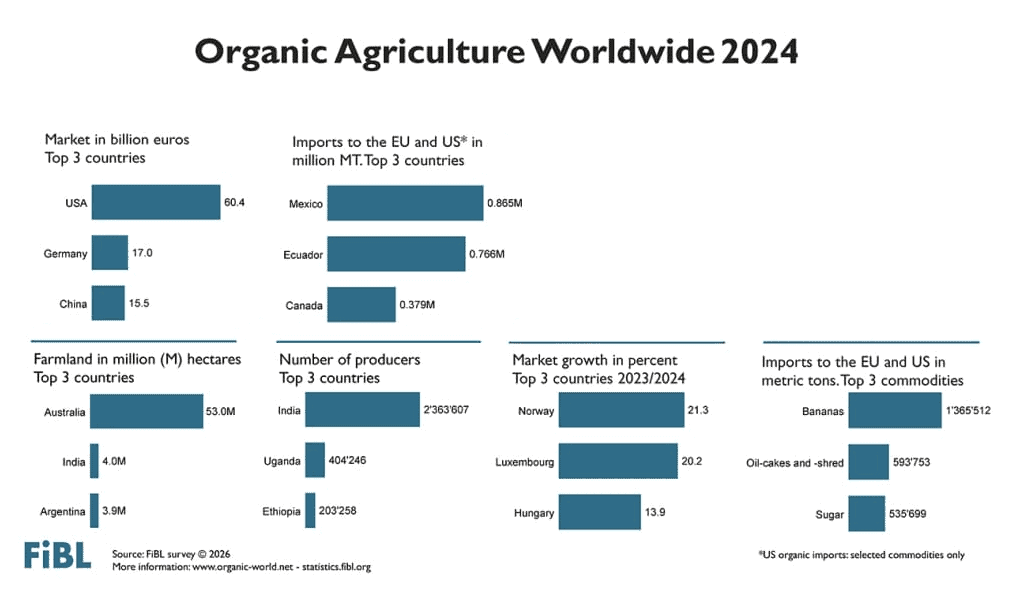
- The organic food market is led by the USA with about USD 60.4 billion in sales, followed by Germany at USD 17.0 billion and China at USD 15.5 billion.
- Mexico, Ecuador, and Canada are the top suppliers of organic products to the EU and USA, exporting around 0.865 million MT, 0.766 million MT, and 0.379 million MT, respectively.
- Australia has the largest organic farmland at 53.0 million hectares, while India and Argentina follow with 4.9 million hectares and 3.0 million hectares.
- India is the largest organic producer base with about 2,386,367 producers, ahead of Uganda at 407,426 and Ethiopia at 203,258.
- Market growth is strongest in Norway at 21.3%, Luxembourg at 20.2%, and Hungary at 13.9%.
- For imports into the EU and USA, bananas (1,985,212 metric tons), oil‑cakes and oil‑seed (593,753 metric tons), and sugar (535,699 metric tons) are the top organic commodities.
Organic Retail Share
- Global organic foods retail sales are estimated at USD 208.81 billion in 2026, with a forecast compound annual growth rate of 11.8% through 2033.
- Europe is projected to hold around 45.2% of global organic foods retail share.
- Asia‑Pacific is expected to account for about 13.5% of global organic foods retail share.
- The remaining retail share (roughly 41.3%) is distributed across North America, Latin America, the Middle East, and Africa.
Recent Developments
- In May 2026, LONGi Green Energy Technology Co., Ltd. expanded its bifacial solar module range with higher efficiency panels, aiming to improve energy yield and durability for large-scale solar projects.
- In April 2026, Trina Solar Co., Ltd. launched next‑generation bifacial modules with advanced cell technology and improved rear‑side efficiency, boosting power generation for utility‑scale installations.
- In March 2026, JinkoSolar Holding Co., Ltd. enhanced its bifacial module portfolio with high‑performance designs focused on reliability and output, supporting wider global solar adoption.
Closing Thoughts
Organic farming is a smart and sustainable way to grow food while protecting nature. It improves soil health, saves water, supports wildlife, and reduces the use of harmful chemicals. Although it may cost more and produce lower yields at times, rising demand and better farming methods are helping it grow worldwide.
As more people choose healthy and eco-friendly food, organic farming will continue to play an important role in creating a safer and more sustainable future.
FAQ
Organic farming improves soil health, protects biodiversity, reduces pollution, produces chemical-free food, and supports sustainable agriculture.
Organic farming uses natural methods and avoids synthetic chemicals, while conventional farming depends on chemical fertilizers, pesticides, and additives.
Almost all crops, including fruits, vegetables, grains, pulses, herbs, and spices, can be grown organically successfully.

Sources
- Coherent Market Insights
- Forschungsinstitut für biologischen Landbau FiBL
- DataM Intelligence
- Forschungsinstitut für biologischen Landbau FiBL
- Ideassonline.org
- Market Data Forecast
- Coherent Market Insights
- ERS.USDA.gov
- Forschungsinstitut für biologischen Landbau FiBL
- European Environment Agency (EEA)
- NPOP - APEDA
- Press Information Bureau
- Thuenen
- The Organic Research Centre (ORC)