








Brief Overview
AI In Fraud Detection Statistics: AI in fraud detection refers to using machine learning to watch transactions, logins, applications, and messages in real time, so it can spot suspicious activity before any money is lost. Old-style systems followed fixed rules and could usually only catch fraud after it already happened. Now, the same kind of AI is used by both sides. Banks and fintech companies use things like voice patterns, typing behavior, device information, and video checks to confirm someone is really who they say they are.
At the same time, criminals use AI to create fake voices, fake identities, and smarter phishing messages that can slip past older security checks. Instant money transfers make this even harder, since there’s very little time to catch fraud before the money is gone. Regulators now want banks to use AI that works all the time and can clearly explain its decisions, instead of just checking boxes once in a while. As fraud becomes more automated, stopping it is turning into an ongoing battle of AI versus AI.
In this article, you’ll get to know the real-time numbers and newest facts about AI in fraud detection.
Key Choices Marked by the Editor’s Eye
- Global financial losses from fraud exceeded an estimated USD 485 billion in 2024.
- Mastercard reports organizations lost an average of USD 60 million to payment fraud last year.
- Checks were the most exposed payment method, with 63% of organizations reporting fraud in 2024.
- Sardine’s foundation model improved fraud-detection accuracy by 68% for consumer cards and 41% for business cards.
- Stripe’s AI reduces fraud by 32%, preventing an estimated USD 110 billion in losses.
- HSBC’s AI screens 980 million monthly transactions and cuts false positives by 60%.
- Visa Decision Manager resolves 98.7% of 3.2 billion screened transactions automatically.
- Mastercard invested roughly USD 11 billion in cybersecurity innovation since 2018.
- Global AI fraud detection market projected to reach USD 108.3 billion by 2033.
Recent AI in Fraud Detection Events
- In October 2026, Treasury screened 1.1 billion payments worth USD 3.7 trillion, returning 13,500 improper payments totaling USD 175 million.
- In September 2026, Feedzai launched Farol, reducing alert handling by 20%, accelerating rule analysis 13 times, and drafting suspicious-activity reports 12 times faster.
- In September 2026, Razorpay launched Vulcan, trained on 3 trillion data points across 4 billion payments and detecting 8 times more international-card fraud.
- In June 2026, Feedzai opened its USD 9 trillion IQ Score network, reporting 4 times greater fraud detection and 50% fewer alerts.
- In February 2026, Britain released its FRA Accelerator, reducing fraud-risk assessments from several days to approximately 0.5 days.
- In February 2026, Mastercard reported that 42% of issuers and 26% of acquirers saved over USD 5 million with AI in 2 years.
- In October 2025, Feedzai raised USD 75 million at a USD 2 billion valuation after being selected to protect the digital euro.
- In May 2025, Stripe upgraded Radar, reducing eligible-transaction fraud over 30%, SEPA fraud 42%, and ACH fraud 20%.
- In September 2025, Airtel reported its AI defenses reduced customer fraud losses by 68.7% and cybercrime incidents by 14.3% from September 2024 to June 2025.
AI’s Growing Impact on Payment Fraud
- Global financial losses from fraud exceeded an estimated USD 485 billion in 2024 and are expected to increase further.
- Real-time payments are completed within seconds, giving financial institutions less time to identify and stop suspicious transactions.
- Criminals increasingly use generative AI to create social-engineering scams and quickly move stolen money through multiple accounts.
- Deloitte estimates that generative AI could drive US fraud losses to USD 40 billion by 2027, more than 3 times USD 12.3 billion in 2023.
- Financial institutions are using AI to detect unusual activity, assess transaction risks, and make approval or blocking decisions in real time.
- Over the past 2 years, AI helped 42% of issuers and 26% of acquirers prevent more than USD 5 million in fraud.
How AI Is Increasing Payment Fraud Risks
- Mastercard reports that organizations lost an average of USD 60 million to payment fraud in the past year.
- Criminals use AI to analyze public data, create targeted scams, and produce convincing phishing messages, voice clones, and deepfake videos at scale.
- Payment leaders identify synthetic identity fraud at 61%, impersonation scams at 60%, and cross-border fraud at 54% as the fastest-growing threats.
- Synthetic identity fraud combines stolen personal information with false details, while AI helps criminals process large datasets and create more realistic fake identities.
- E-commerce fraud is a growing concern for 47% of payment leaders, while 42% highlight Buy Now, Pay Later abuse.
- Deepfake fraud concerns 21% of payment leaders, increasing pressure for stronger identity checks and customer safeguards across digital payments.
Payment Methods Most Exposed to Fraud
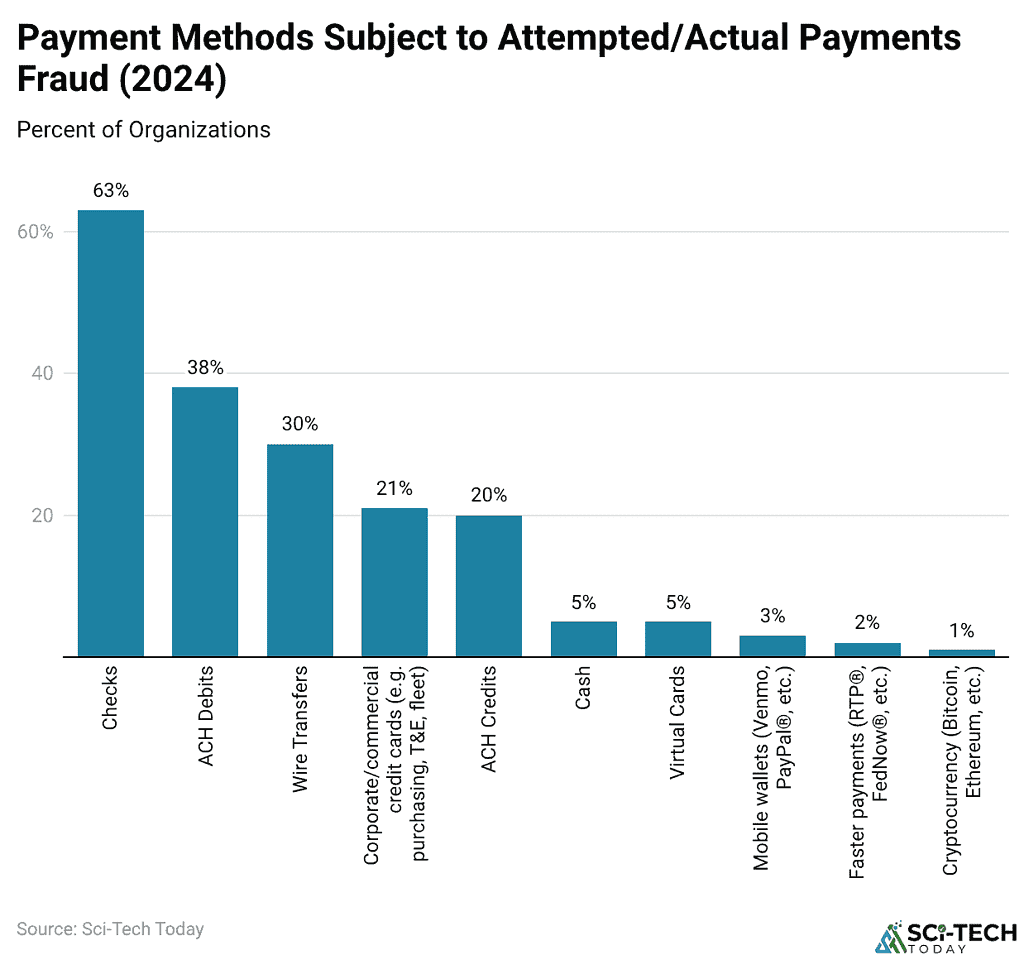
- Checks were the most exposed payment method, with 63% of organizations reporting attempted or actual fraud in 2024.
- ACH debits ranked second at 38%, followed by wire transfers at 30%.
- Corporate and commercial credit cards faced fraud at 21% of organizations, while ACH credits affected 20%.
- Cash and virtual cards each recorded a 5% fraud exposure rate.
- Mobile wallets, including Venmo and PayPal, were affected at 3%.
- Faster payments, including RTP and FedNow, recorded 2%, while cryptocurrencies such as Bitcoin and Ethereum had the lowest rate at 1%.
How Generative AI Is Used in Fraud Detection
- Among 713 fraud professionals across 8 regions, 16% use GenAI for anti-fraud work, while another 58% plan future adoption.
- Among current users, 49% apply GenAI to detect phishing and scams by examining message content, language patterns, metadata, and suspicious links.
- Around 46% use GenAI to identify and assess fraud risks by reviewing transactions, customer behavior, documents, and other unstructured information.
- GenAI helps 45% of users draft investigation reports, summarize evidence, explain alerts, and prepare consistent narratives for regulatory review.
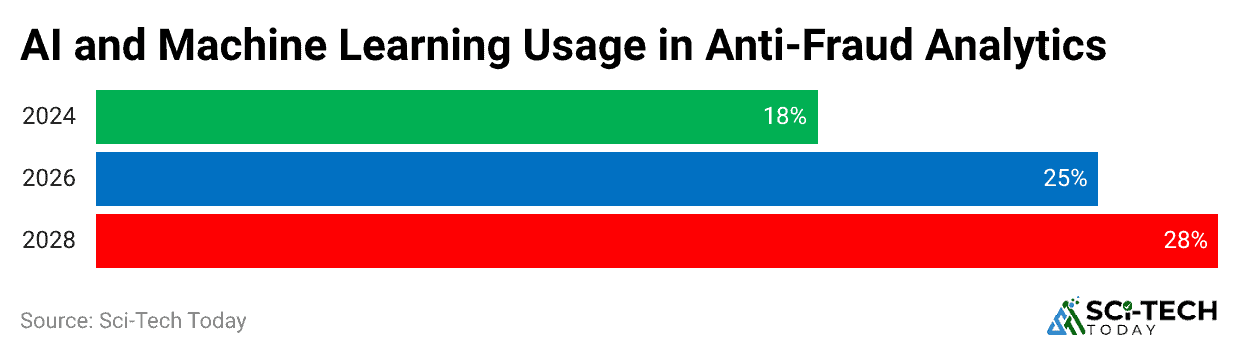
- AI and machine learning usage in anti-fraud analytics increased from 18% in 2024 to 25% in 2026, while another 28% expect adoption within 2 years.
- Future GenAI applications include creating analytical rules at 55%, evaluating or generating code at 51%, and supporting model training at 49%.
- Feedzai’s Farol summarizes alerts and evidence, helping analysts close cases 20% faster, analyze fraud rules 13 times faster, and draft SARs 12 times faster.
- Sardine trained an 8-layer transformer on about 1 billion transactions from 13 issuers, improving detection accuracy by 68% for consumer cards and 41% for business cards.
- Sardine’s foundation model caught 35% more fraud from the same transaction volume by learning complete cardholder behavior rather than relying only on fixed rules.
- Only 7% of organizations feel more than moderately prepared for AI-powered fraud, although 86% consider output accuracy important or very important.
AI Use Cases in Fraud Detection
- Stripe Radar analyzes 1,000+ transaction attributes in under 100 milliseconds, reducing SEPA fraud by 42% and ACH fraud by 20%.
- Stripe’s AI reduces fraud by 32%, prevents USD 110 billion in fraud, and processes USD 1.9 trillion annually using 70 trillion data points.
- Razorpay Vulcan analyzes 3 trillion data points across 4 billion payments, detecting 8 times more international-card fraud and 5 times more disputed transactions.
- Feedzai’s Farol closes fraud alerts 20% faster, analyzes risk strategies 13 times faster, and drafts suspicious-activity reports 12 times faster.
- Mastercard uses GenAI across 1 trillion data points, improving fraud detection 20% on average and up to 300%.
- Mastercard’s GenAI identifies compromised cards up to 200% faster and high-risk merchants up to 300% faster.
- U.S. Treasury’s machine-learning controls prevented or recovered more than USD 4 billion in fraud and improper payments during FY2024.
- AI and machine learning are used in fraud analytics by 25% of organizations, up from 18% in 2024; 28% expect adoption within 2 years.
How Banks Use AI to Detect Fraud
- HSBC’s AI screens 980 million monthly transactions, detects 2–4 times more crime, and reduces false positives by 60%.
- Bank of America uses more than 50 AI models to identify and prevent fraudulent activity.
- Visa AI evaluates 400 attributes within 1 millisecond, preventing USD 30 billion annually for 8,000+ banks.
- Mastercard reports 42% of issuers and 26% of acquirers saved over USD 5 million using AI.
- Financial institutions using AI beyond 5 years saved USD 4.3 million, nearly double the USD 2.2 million average.
- Feedzai’s agentic AI closes alerts 20% faster, analyzes strategies 13 times faster, and drafts reports 12 times faster.
- DBS processes suspicious transactions within 10 milliseconds using AI and operates 1,500+ models across 370+ use cases.
- AI improved fraud investigation and case resolution speed for 83% of payment leaders, while 85% reported measurable returns.
Success Rate of AI in Fraud Detection
- Visa Decision Manager automatically resolves 98.7% of 3.2 billion screened transactions, preventing an estimated USD 33 billion in fraud.
- Visa’s AI pilot increased fraud detection 40% at a 5:1 false-positive ratio, identifying 54% of fraud missed by existing systems.
- Visa Deep Authorization identified 27% more consumer fraud and 40% more small-business fraud, maintaining a 5:1 false-positive ratio.
- Visa Managed Services reduced an issuer’s fraud rate 31% within 3 months and improved attempted-fraud blocking from 47% to 76%.
- Visa AI increased suspected-fraud blocking 144% during Black Friday–Cyber Monday 2025, compared with the prior year.
- Swedbank improved fraud detection by 20%–30% through AI models that identify anomalies beyond traditional rules.
- Visa’s AI-assisted scam disruption closed nearly 12,000 fraudulent merchants, preventing more than USD 37 million in projected losses.
Leading Companies Investing in AI to Detect Fraud
- Mastercard invested approximately USD 11 billion in cybersecurity innovation since 2018, increasing AI fraud detection by 20% on average and up to 300%.
- Feedzai raised approximately USD 75 million at a USD 2 billion valuation in 2025 to expand AI-driven financial-crime prevention.
- Stripe trained Radar on 70 trillion data points, achieving a 32% average fraud reduction and blocking fewer than 0.05% of legitimate transactions.
- Visa blocked 144% more suspected fraud during Black Friday–Cyber Monday 2025 using AI-powered security systems.
- DBS deployed 1,500+ AI models across 370+ use cases, targeting over SGD 1 billion in annual economic value by 2025.
- Sardine’s AI foundation model improved consumer-card fraud detection by 68% and business-card fraud detection by 41%.
- Razorpay trained Vulcan on 3 trillion data points across 4 billion payments, improving payment success rates by 8%–10%.
| Company | Finding | Figure(s) |
| Mastercard | Cybersecurity investment since 2018; AI fraud detection improvement | USD 11 billion; 20% average, up to 300% |
| Feedzai | 2025 funding round and valuation | USD 75 million raised; USD 2 billion valuation |
| Stripe | Radar training data; fraud reduction and false-positive rate | 70 trillion data points; 32% fraud reduction; <0.05% legitimate transactions blocked |
| Visa | Suspected fraud blocked during Black Friday–Cyber Monday 2025 | 144% more fraud blocked |
| DBS | AI models and use cases; targeted 2025 economic value | 1,500+ models; 370+ use cases; SGD 1 billion+ |
| Sardine | Fraud-detection improvement by card type | 68% consumer-card; 41% business-card |
| Razorpay | Vulcan training data; payment success rate improvement | 3 trillion data points; 4 billion payments; 8% to 10% |
Global AI in Fraud Detection Market Growth
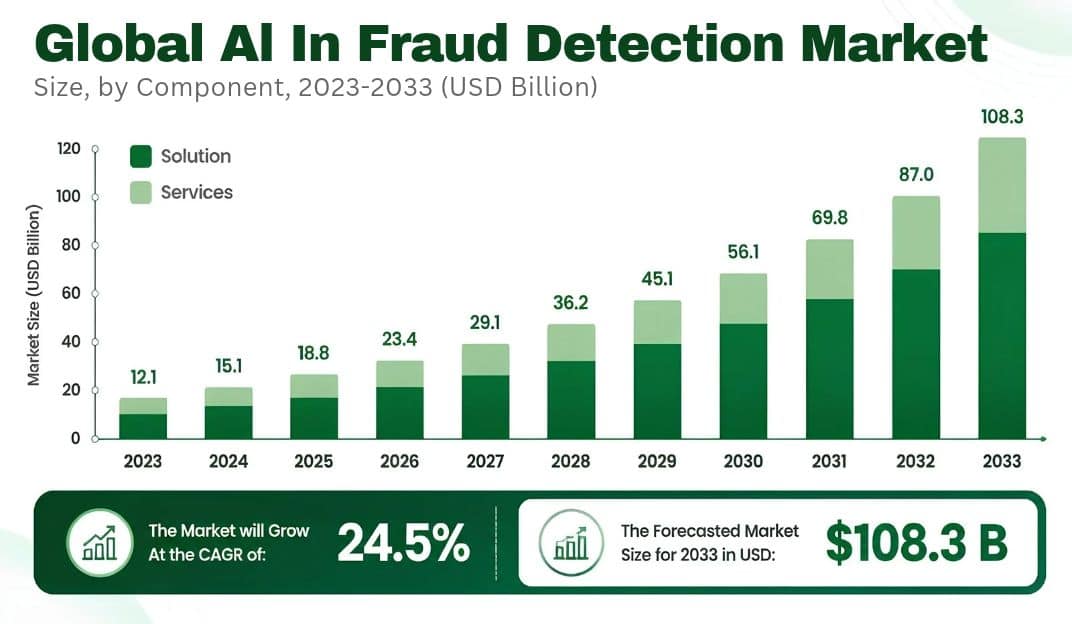
- The global AI fraud detection market was valued at USD 12.1 billion in 2023 and increased to USD 15.1 billion in 2024.
- The market is estimated at USD 18.8 billion in 2025 and USD 23.4 billion in 2026.
- The market is forecast to reach USD 69.8 billion in 2031, USD 87.0 billion in 2032, and USD 108.3 billion in 2033.
- Overall, the market is expected to grow at a 24.5% CAGR during 2023–2033, supported by rising demand for AI solutions and services.
Wrap Up
AI has become a key part of stopping fraud, with banks like HSBC, Visa, and DBS checking billions of transactions in milliseconds to catch problems early and reduce losses. But criminals use the same kind of AI too, creating fake voices, fake identities, and real-time scams that can slip past older security systems. Checks and ACH transfers are still the payment methods most likely to be targeted by fraud.
Meanwhile, more fraud teams are starting to use generative AI, and that trend is growing fast. As this technology keeps expanding, stopping fraud is becoming less about having AI and more about having AI that adapts faster than the criminals’ AI does.
FAQ
Using AI tools generally does not violate privilege on its own, but inputting confidential client information into non-secure or public AI platforms can risk exposure, which is why many firms require vetted, enterprise-grade tools with strong data protections.
Many firms now provide responsible-AI training covering how to verify outputs, recognize hallucinated citations, understand tool limitations, and follow firm policies on data handling, though training requirements still vary widely across organizations.
Reported time savings vary by task and tool, but many lawyers report saving several hours per week on research, drafting, and document summarization, freeing up time for strategy and client-facing work.
Requirements vary by jurisdiction and firm policy, but many bar associations now recommend or require transparency with clients about AI use, particularly when it affects billing, work product, or case strategy.
Immigration law, personal injury, and civil litigation tend to show higher AI adoption, largely due to high volumes of repetitive document review, research, and correspondence that AI tools can streamline.
Some AI tools offer predictive analytics based on historical case data and precedent, but accuracy varies significantly by jurisdiction and case type, and most experts caution against relying on these predictions alone.
Many bar associations have issued ethics guidance or formal opinions addressing AI use, generally emphasizing competence, confidentiality, and the duty to verify AI-generated work product before relying on it professionally.