









Orientation
Precision Farming Statistics: Precision farming is changing the way farmers grow crops by using smart technology and real-time data. Tools like GPS, drones, sensors, AI, and satellite imagery help farmers better understand their fields and make the right decisions in real time. Instead of treating every part of a farm the same, precision farming allows them to use water, fertilizers, and pesticides only where they are needed. This saves money, increases crop yields, and reduces waste.
As the world faces rising food demand, climate change, and limited natural resources, precision farming offers a smarter and more sustainable way to farm. It is helping farmers produce more food while protecting the environment for future generations.
Top Recommendation
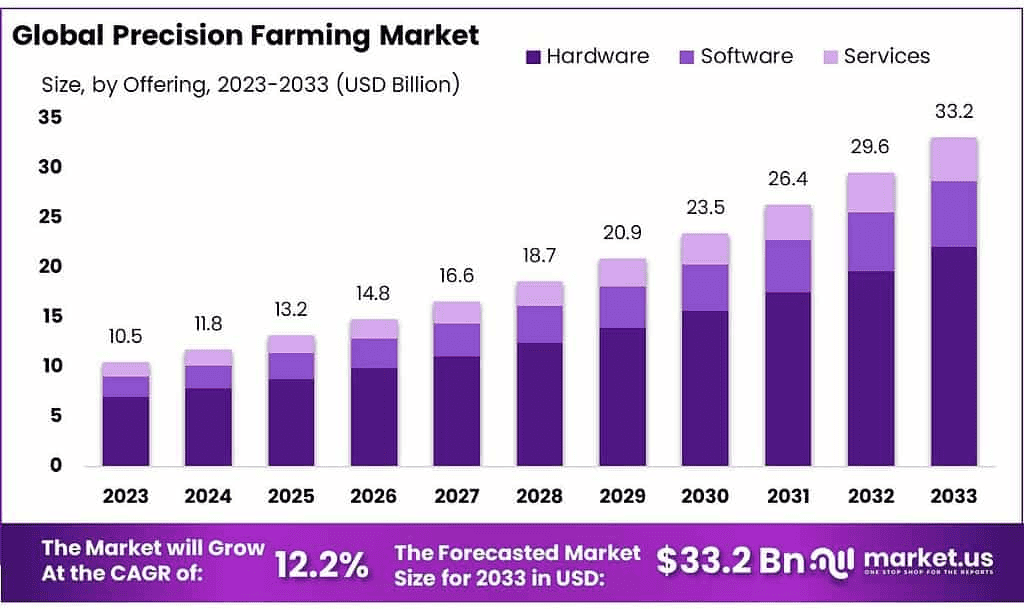
- The global precision farming market is expected to reach approximately USD 33.2 billion by 2033, growing at a CAGR of 12.2% from 2023 to 2033.
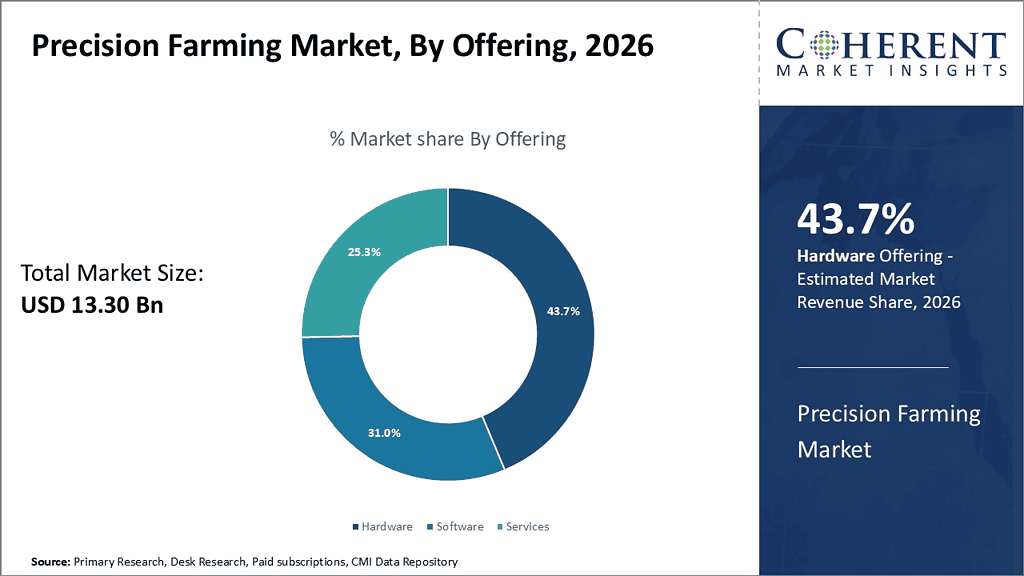
- Hardware dominates the precision farming market with a 43.7% share in 2026, ahead of software (31%) and services (25.3%).
- Crop management is the largest precision farming application, accounting for 37.8% of the market in 2026.
- Nearly 89.31% of surveyed farms use autonomous or unmanned vehicles such as GPS-enabled tractors.
- Weather station sensors are used by 58.02% of crop producers.
- Precision crop farming is projected to generate USD 13.13 billion in IoT market value in 2026.
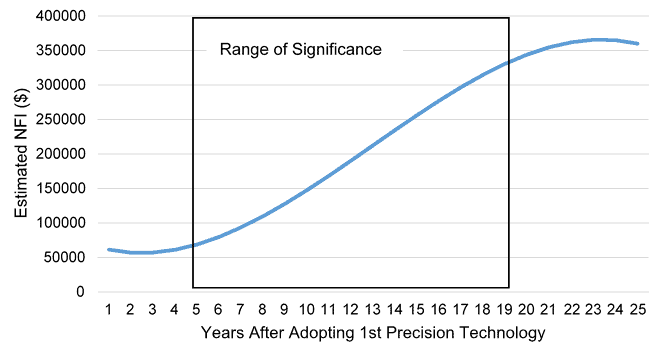
- Long-term adoption of precision farming technology can increase farm net income from around USD 50,000 to nearly USD 350,000 over 25 years.
- India’s Digital Agriculture Mission digitized 7.63 crore Farmer IDs and 23.5 crore crop plots in 2026, significantly expanding digital agriculture infrastructure.
- A 2026 explainable AI model improved crop recommendation accuracy by 6%, achieving an R2 score of 0.99 with exceptionally low prediction error.
- Precision farming attracted approximately USD 1.82 billion in investments during 2025.
Global Precision Farming Market Outlook
(Source: market.us)
- The precision farming market is projected to reach about USD 13.2 billion in 2025 and USD 14.8 billion in 2026.
- By 2033, the market size is expected to rise to roughly USD 33.2 billion.
- Over 2023-2033, the market is forecast to grow at a robust CAGR of 12.2%.
Precision Farming Market by Offering
(Source: coherentmarketinsights.com)
- Hardware leads the precision farming market with a 43.7% share, while software follows at 31% in 2026.
- Services hold a 25.3% share, with the total market size reaching USD 13.30 billion.
By Application
- In 2026, crop management is the largest precision farming application with a 37.8% market share, according to Coherent Market Insights.
- Soil management and water management follow with 20.5% and 14.0% shares, respectively, reflecting investment in core agronomy needs.
- Farm management software, livestock monitoring, and other applications account for 12.7%, 8.5%, and 6.5%, with total market size at USD 13.30 billion in 2026.
Sensor Adoption in Crop Production
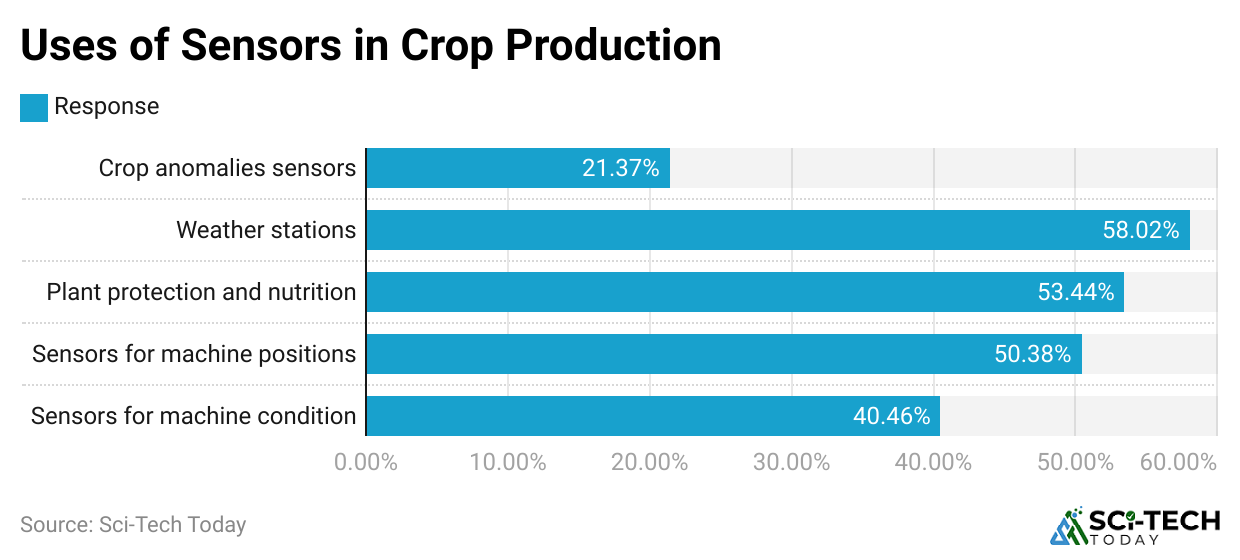
- According to Market.us Media, in current crop production, 58.02% of surveyed users rely on weather station sensors for timely climate information.
- Plant protection and nutrition sensors are used by 53.44% of respondents to optimize input application and improve yields.
- Sensors for machine position (50.38%) and machine condition (40.46%) are widely deployed to enhance equipment efficiency and reduce downtime.
- Crop anomaly sensors remain underutilized, with only 21.37% adoption.
Machine Use in Crop Production
- As of the latest survey, unmanned vehicles such as tractors show the highest use at 89.31%, followed by navigation and optimization systems at 61.83%.
- Drones for soil condition monitoring are emerging tools, currently adopted by 33.59% of respondents.
Use of Sensors and IoT Devices in Livestock Production
- Around 32.06% of livestock producers use microclimate sensors to monitor temperature, humidity, and air quality, helping maintain better conditions for animals.
- 42.75% of respondents rely on smart collars to track animal health and identify signs of illness early.
- 46.56% use smart collars to monitor movement and behavior, supporting feeding, breeding, and health decisions.
- Another 32.06% use smart collars to monitor animal nutrition and improve feeding management.
Use of Robots in Livestock Production
(Source: market.us)
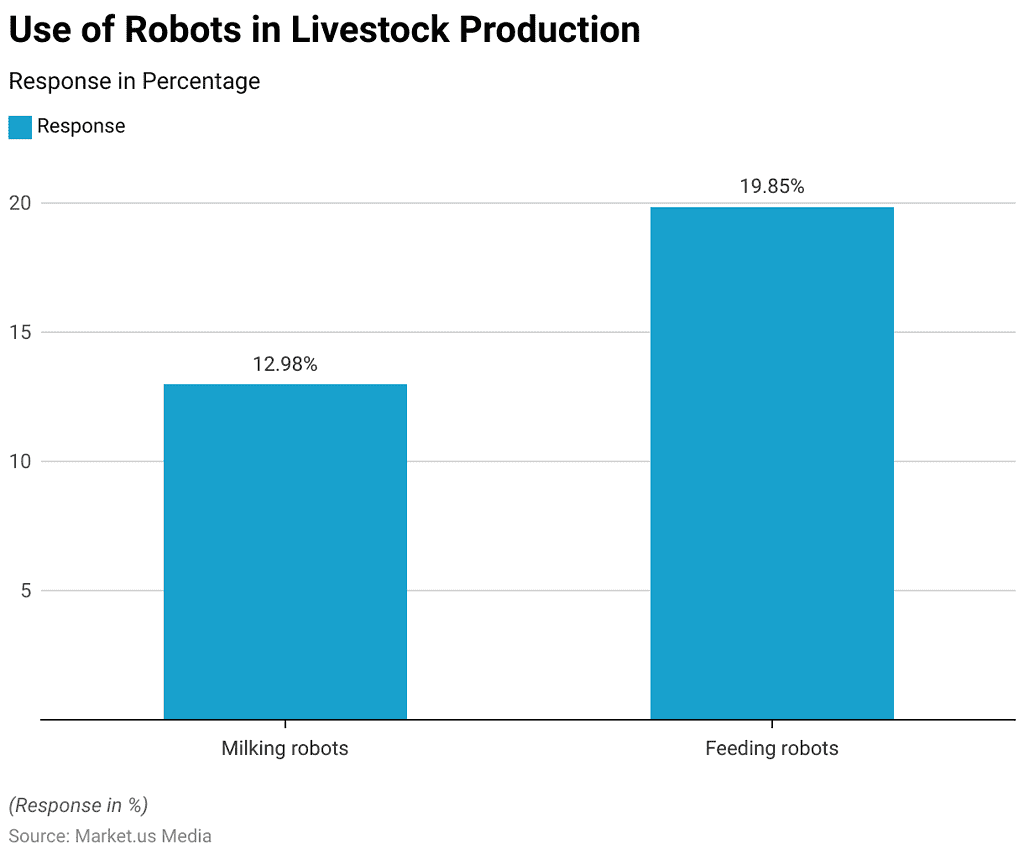
- Milking robots are adopted by 12.98% of respondents.
- Moreover, feeding robots report higher uptake at 19.85%.
Application of IoT in Agriculture Market, 2026
| Segment | Market growth (USD Million) |
| Precision crop farming | 13,134 |
| Livestock monitoring and management | 8,797.6 |
| Indoor farming | 6,086.9 |
| Aquaculture | 4,016 |
| Others | 1,818.7 |
Income Trend From Precision Farming Technology
(Source:agecon.unl.edu)
- This chart shows that farm net income (NFI) rises steadily after adopting precision farming technology.
- Starting near USD 50,000, NFI grows almost continuously over the first 20 years of adoption.
- The “range of significance” (around years 6–20) highlights the period when income gains become most meaningful and sustained.
- During this range, NFI climbs from roughly USD 75,000 to more than USD 300,000, reflecting strong economic benefits.
- By year 25, NFI approaches USD 350,000, indicating that long‑term use of precision tools can deliver robust income growth for farms.
Precision Farming in England
- It is anticipated that the worldwide precision agriculture market will grow from more than six billion U.S. dollars in 2020 to 12.8 billion U.S. dollars by 2026.
- In England, 80% of farms that use precision farming methods concentrate on enhancing productivity.
- Half also aim to improve animal health and welfare, whereas close to 40% apply these techniques to reduce environmental pollution.
- The use of inputs more efficiently suggests that it is possible to achieve a sustainable increase in food production.
- Nonetheless, almost half of the farms that do not use precision farming point out high costs as a roadblock. Despite these difficulties, the number of farms employing precision agriculture in England has steadily increased over the past seven years.
- At least 20% of all English farms now use precision agriculture techniques outside the southwest region.
- These practices require accurate satellite positioning to ensure accuracy during execution; however, they can also significantly reduce soil compaction and fuel consumption during cultivation.
- Among the top quarter economic performers, around 40% utilize one or more precision farming methods.
Precision Farming In the US
- In 2018, Latin America’s precision farming statistics market was worth more than 630 million U.S. dollars, and there is an expectation of continuous expansion in the coming years.
- Argentina would be the fastest-growing country in this sector from 2019 to 2025, with an almost 17% CAGR.
- Brazil and Mexico were also considered to experience great growth since they were forecasted to register a CAGR of above 16% during that time.
- The precision farming statistics show how much precision horticulture technology can expand within this area.
Use of Sensors in Precision Farming
(Reference: media.market.us)
- In today’s world of agriculture, sensors have become an integral part of the crop production process as they provide necessary information and improve efficiency in various agricultural activities.
- About 40.46% of respondents monitor machine conditions using sensors, which allows them to carry out timely maintenance and reduce downtime.
- Another 50.38% use sensors for tracking machine positions, thus enabling precise and automated farming operations.
- Many people are using plant protection and nutrition sensors, with about 53.44% of respondents using these devices to optimize inputs and enhance crop health. Meanwhile, 58.02% employ weather stations to gather essential data needed for irrigation, pest control, and harvesting decisions.
- Nonetheless, precision farming statistics on crop anomaly detection are not widely available since only 21.37% of respondents have adopted this technology to identify and remedy any abnormalities that arise during their crops’ growth period.
Use of Machines in Precision Farming
- The role of machines in contemporary crop production is crucial. They perform various functions that enhance agricultural efficiency and productivity.
- For example, 89.31% of respondents use uncrewed vehicles such as tractors and robotic machines for planting, cultivation, and harvesting purposes.
- Notably, 61.83% of the respondents also frequently mentioned navigation and optimization systems as being used to improve precision and efficiency in field operations.
- Moreover, agricultural drones are becoming popular among farmers, with 33.59 % using them to monitor soil state, humidity levels, and crop growth stages.
- Therefore, the application of these devices reveals that the agriculture sector is focused on adopting new technologies for increased harvests while conserving resources and promoting sustainable farming methods.
Global Market Volume of Agricultural Robots in Precision Marketing
(Reference: statista.com)
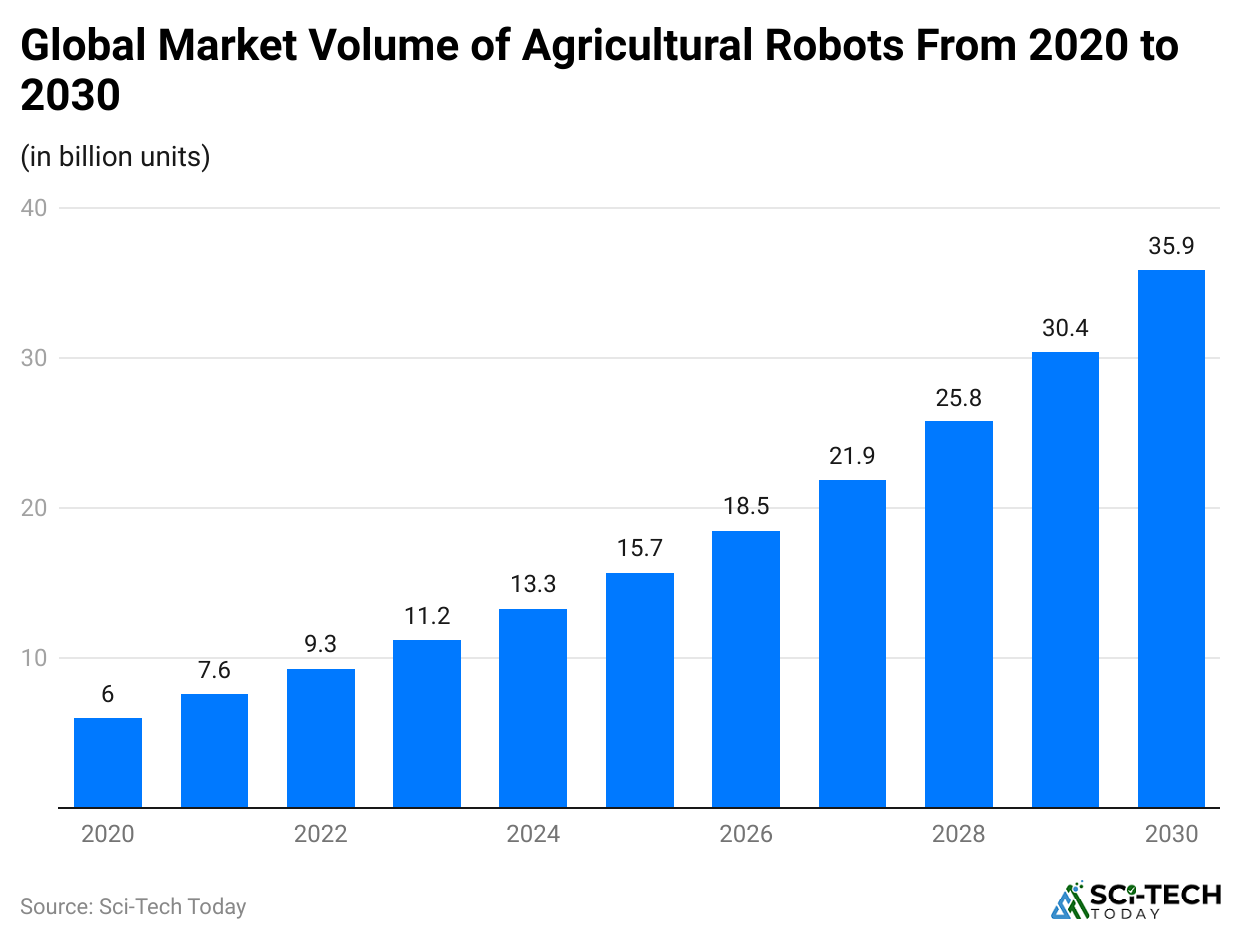
- Insights on the worldwide agricultural robot market volume from 2020 to 2030 can be derived from precision farming statistics.
- It probably has recent data on the market volume of agricultural robots, which tells how many are in use or sold now.
- The key highlight is the growth of this market. It is expected that by 2030, the global agricultural robot market will achieve nearly 36 billion units. This prediction indicates considerable growth in the use and acceptance of them over ten years.
Application of IoT in Precision Farming
- Precision farming statistics reveal that the global market for Internet of Things (IoT) applications in agriculture is experiencing strong growth across various segments between 2020 and 2026. In 2020, the market value for precision crop farming was USD 7,285.3 million, while in 2021, it grew to USD 8,280.6 million, and it is estimated to hit USD 13,134 million by 2026.
- Similarly, the livestock monitoring and management segment saw a significant rise from USD 4,834.1 million in 2020 to USD 5,503.3 million in 2021, with expectations of reaching USD 8,797.6 million by 2026.
- Indoor farming is also an emerging sector, with market values increasing from USD 3,234.1 million in 2020 to USD 3,707.4 million in 2021 and projected to rise to USD 6,086.9 million by 2026. Aquaculture followed suit, as its value rose from USD 2,011 billion in 2011 and 2020 to USD 2,327 billion in 2021, likely reaching USD 4 billion over five years.
- Other segments have also played a part in this expansion as their market values increased from 1,1525 billion dollars (2020) to 1,2851 billion dollars (2021), with an increase of up to 1,8187 billion dollars (2026)
- Overall, rapid global growth in agriculture is being experienced through the applications of IoT technology-driven solutions meant to optimize and improve efficiency on various agricultural fronts.
Status and Availability of Precision Farming
- Cost/profit mapping services were adopted more frequently, increasing from 38% in 2019 to 55% in 2022, which highlights an increased emphasis on financial analysis in farm management.
- Geographical Information Systems (GIS) were used for field mapping, and the percentage increased from 85% to 90%, which indicates that spatial data analysis is being integrated into precision agriculture.
- Grid or zone soil sampling remained widely used as it increased only slightly from 90% to 91%.
- Guidance and autosteer sales and support rose from 38% to 46%, indicating a growing demand for automated navigation systems in farm machinery.
- Satellite and aerial imagery use surged by 10%—from 70% to 80%—showcasing an overall reliance on remote sensing technologies.
- This was evidenced by the growth of variable rate technology (VRT) applications for fertilizers, lime, and pesticides, where VRT pesticide application increased by 30%, going up from 20% to almost half at 50%.
- Sales and support for yield monitors and data analysis tools also increased rates of acceptance, with yield monitors raising their uptake rate from 40% to 46%. In comparison, other data-related devices rose in uptake levels from 63% to 70%.
- According to dealer statistics, precision agriculture services are generally widely and more progressively adopted, thus depicting how the industry continues to move towards advanced technologies that require considerable amounts of data.
Recent Developments in Precision Farming (2025-2026)
- In 2026, India’s Digital Agriculture Mission digitized 7.63 crore Farmer IDs and 23.5 crore crop plots. The National Pest Surveillance System now covers 66 crops and monitors 432+ pest types, while AI-based advisories support 10,000+ extension workers.
- During 2025, India’s AI monsoon forecasting program reached 3.88 crore farmers across 13 states, with 31%-52% of farmers changing sowing or land-preparation decisions based on AI forecasts.
- By December 2025, the Kisan e-Mitra chatbot had answered 93 lakh+ farmer queries, handled 8,000+ daily queries, and supported 11 regional languages.
- In 2026, precision farming platforms increasingly integrated AI, IoT, blockchain, GPS, drones, and satellite imagery to improve irrigation, fertilizer use, and crop monitoring.
- A 2026 explainable AI model achieved an R² of 0.99, RMSE of 0.0321, MAE of 0.0201, and improved crop recommendation accuracy by 6%.
- Australia’s Octopusbot raised USD 1 million+ in 2026 and delivered grain yield forecasts with 97.4% accuracy up to 7 months before harvest using 10,000+ AI models.
- Precision farming attracted approximately USD 1.82 billion in investments during 2025, reflecting continued growth in agricultural automation.
- A 2026 review identified IoT sensors, UAVs, wireless sensor networks, edge computing, and AI analytics as key technologies for real-time precision farming.
- Research published in 2026 showed precision farming is increasingly focused on improving resource efficiency, reducing environmental impact, and supporting climate-resilient agriculture.
- In 2025, low-cost satellite analytics and AI tools became more accessible, helping smallholder farmers adopt precision farming technologies.
Bottom Line
Precision farming is changing the way farmers grow crops by making farming smarter and more efficient. It helps save water, fertilizer, and time while improving crop quality and increasing yields. Although the technology can be expensive at first, it offers long-term benefits for both farmers and the environment.
As digital tools become more affordable, precision farming will play a bigger role in helping meet the world’s growing food needs more sustainably.
FAQ
The primary goals are to increase crop yields, reduce production costs, improve resource efficiency, minimize environmental impact, and enhance overall farm profitability.
Common technologies include GPS and GIS mapping, Drones and satellite imagery, Soil and crop sensors, AI and machine learning, IoT devices, Variable Rate Technology (VRT), Automated irrigation systems, and Farm management software.
This helps farmers increase crop productivity, reduce fertilizer and pesticide use, save water and fuel, lower labor costs, improve decision-making using real-time data, and increase profits, while promoting sustainable farming.

Sources