








Introduction
Call Centre vs. Digital Channel Usage Statistics: Over the past decades, customers have come to expect faster and easier support. As a result, many companies are reviewing how to balance call centres with digital service options. Many customers now prefer digital channels such as WhatsApp, live chat, email, other social media messaging apps, and self-service portals for simple queries, order updates, and quick fixes.
In such cases, call centres play an effective role in handling customer inquiries for urgent or complex issues. Trained agents listen carefully, ask the right questions, and resolve a problem within a single conversation. Besides, digital channels are available 24/7 and often cost less to run.
This article presents several statistical analyses and insights that explain how call centres and digital channels are connected, and compares speed, resolution, and satisfaction across touchpoints.
Editor’s Choice
- Many call centres aim to answer 80% of calls within 20 seconds and strive to achieve 90% within 15 seconds.
- In 2025, 80% of call centres will have already used AI chatbots.
- DataReportal’s 2025 global insights report 5.24 billion social media user identities, with adoption at 94.2% of internet users.
- Call Centre Helper’s 2024 survey shows that voice still leads, with 53.1% inbound and 14.5% outbound (67.6% total).
- According to a report published by CMSWIRE, U.S. call centres employ nearly 3 million people.
- 9 in 10 consumers want a seamless omnichannel journey, so companies must integrate online and offline support.
- In the U.S., Emplifi reports that customers most often seek service help on Facebook (55%) and Instagram (47%).
- marketingassets.microsoft.com further states that live chat offers real-time website/app support through bots or agents; 48% used it.
- Consumers most often prefer to communicate with businesses by phone (68%), followed by email (55%).
General Statistics On Call Centre Vs. Digital Channel
- Call Centre Helper’s 2024 survey shows that voice still leads, with 53.1% inbound and 14.5% outbound (67.6% total).
- Email with a share of 16.6%, followed by live chat (7%), social (2.1%), SMS (1.7%), letters (1.2%), video chat (0.4%), and other (3.4%).
- In the Call Centre Helper benchmark, service-app usage is reported as Facebook (43.5%), Instagram (27.0%), X (26%), Messenger (22.5%), and WhatsApp (21.5%).
- McKinsey reports that 57% of leaders expect call volumes to increase by up to 20% over the next 1-2 years.
- More than half expect digital inbound contacts to exceed 40% within three years.
- NICE reported that 25% of agents always work across multiple channels.
- Additionally, 50% of the time, with work models at 3% in-person, 69% hybrid, and 28% remote.
- Gartner reports that self-service fully resolves only 14% of issues (36% even for “very simple” ones).
- 71% of Gen Z say live calls are the quickest and easiest.
- 97% want to switch channels without repetition, but only 16% of CX leaders report that their data/systems are fully integrated.
- 73% will implement agent-assist by the end of 2025, and Salesforce expects AI to resolve 30% of cases in 2025, rising to 50% by 2027.
Call Centre Statistics
- In 2022, U.S. customer satisfaction averaged about 73%, according to sprinklr.com
- For urgent retail issues, more than half of customers prefer phone support, whereas about 30% prefer texting.
- Many call centres aim to answer 80% of calls within 20 seconds and strive to achieve 90% within 15 seconds.
- A support call costs about USD 2.70 to 5.60. 71% of consumers expect personalised help, and 76% get frustrated when it’s missing.
- It is forecasted that automation in agent interactions will increase approximately 10% by the end of 2026.
- Valuing customer time signals good service for 73%.
- On social media, nearly half expect a response within 60 minutes, and 80% expect a response the same day.
- 58% are willing to pay more for better experiences, yet 78% abandon planned purchases after negative experiences.
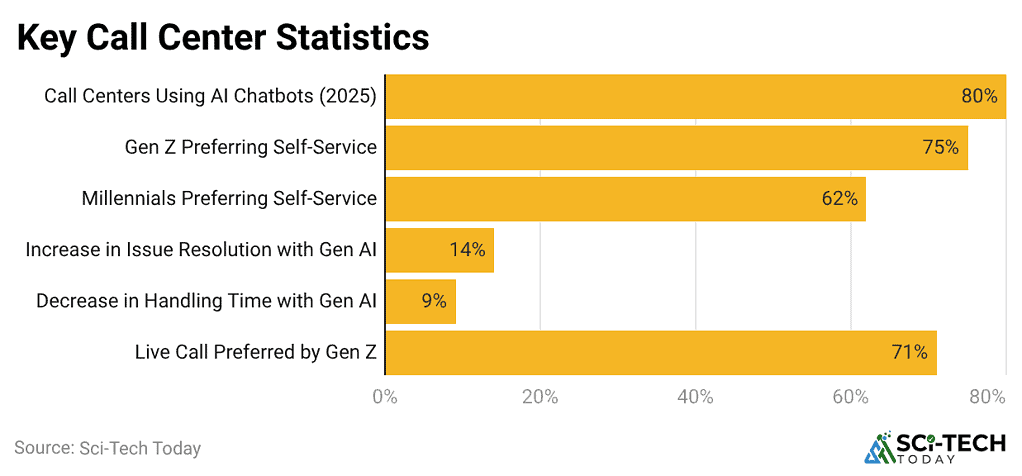
- Self-service is preferred almost always by 62% of Millennials and 75% of Gen Z.
(Reference: cmswire.com)
- In 2025, 80% of call centres will have already used AI chatbots.
- Regarding preferences, 75% of Gen Z customers prefer self-service.
- Moreover, 62% of Millennials also favour self-service options.
- Nevertheless, 71% of Gen Z respondents still prefer a live call to resolve issues.
- Regarding performance impact, the use of Gen AI is associated with a 14% increase in issue resolution and a 9% decrease in handling time.
By Usage and Preferences
- According to a report published by CMSWIRE, U.S. call centres employ nearly 3 million people.
- An average centre manages approximately 4,400 calls per month, with only around 48 missed calls.
- Many customers still prefer speaking with a real person by phone, even when the issue is not urgent.
- Customers also want tailored service: 71% expect personalisation, and 76% feel frustrated when they don’t get it.
- The global call centre market was USD 352.4 billion in 2024 and may reach USD 500.1 billion by 2030.
- Also, 77% expect to reach someone immediately, and 21% want instant ticket resolution.
By Customer Experience
- According to Invoca.com, 74% of consumers primarily purchase for the experience.
- Many customers also pay a 16% premium for excellent service.
- 9 in 10 consumers want a seamless omnichannel journey, so companies must integrate online and offline support.
- Most customers now want proactive help: 87% expect the call centre to recognise them and know their needs.
- Among call-centre professionals, 95% prioritise customer satisfaction.
- In 2025, strong omnichannel service can help keep up to 89% of customers.
- Many centres still target 80% of calls answered within 20 seconds, with a target 90% within 15 seconds.
Digital Channel Usage Statistics
- DataReportal’s 2025 global insights report 5.24 billion social media user identities, with adoption at 94.2% of internet users.
- 97.3% of connected adults each month, while the average person spends 2h 21m/day on social and uses 6.83 platforms per month.
- In the U.S., Emplifi reports that customers most often seek service help on Facebook (55%) and Instagram (47%).
- 58% want brands to respond; about one-third expect direct message replies within 1 hour, and delays of over 24 hours can cost brands about one-third of customers.
- WhatsApp reached 3 billion monthly users in 2025, and Meta data cited by Salesforce indicated that more than 1 billion users connect with business accounts weekly.
- A NICE report also shows that 80% of agents are scheduled for voice plus digital.
- Zendesk adds that 51% prefer bots for instant help and 67% are eager to use personal AI assistants.
Call Centre Trends In Digital Channels Analysis
- Web self-service traffic rose in 57% of centres, while email volumes increased by 50%.
- Social media activity grew in 47% of centres, and chat usage increased for 45%.
- 56% of centres reported a drop in overall call volume.
- Nevertheless, 55% reported that average handle time increased, indicating that workloads did not always decrease.
- Customer satisfaction stayed stable for 92% of centres, and nearly 86% want work-from-home to be permanent.
Customer Support Digital Channels Benchmarks
- marketingassets.microsoft.com further states that live chat provides real-time website or app support, used by 48% of channel users, and that the average chat CSAT is 64.2%.
- Moreover, 64% of users claimed email was effective for formal help after using it, and 47% preferred email compared with 23% for phone and 23% for email chat.
- In 2025, around 98% of SMS messages were opened for quick updates and reminders.
- Additionally, 90% read within 3 minutes, about 45% replied, and 15% used it for support.
- On social media, 15% of brands use it to handle public and private support, and about 75% expect a reply within 24 hours.
- Businesses offer 1:1 support on WhatsApp, Messenger, and WeChat.
- 53% use self-service, and 91% would use a helpful knowledge base.
- For high-touch consultations, telehealth accounted for nearly 17% of outpatient claims and 4.9% of medical claim lines.
Industry Benchmarks For Call Centres
| Industry | Description |
| Financial services | Average customer satisfaction is approximately 79%, indicating that service quality is a significant factor. |
| Healthcare | Call abandonment averages 7%, showing strong call handling. |
| E-commerce | First-call resolution is approximately 75%, indicating that many issues are resolved on the first contact. |
| Technology | Service level is about 79%, with most calls answered within the expected time. |
| Retail | Only 39% of U.S. customers feel agents understand their needs, hurting loyalty. |
| Telecom | Agent occupancy is typically 80–90%, keeping workloads balanced and productive. |
| Insurance | Schedule adherence is about 80%, so agents stay available as planned. |
| Automotive | Customer satisfaction averages 78% for sales, service, and repair inquiries. |
How Consumers Prefer To Contact Digital Channels
(Reference: website-files.com)
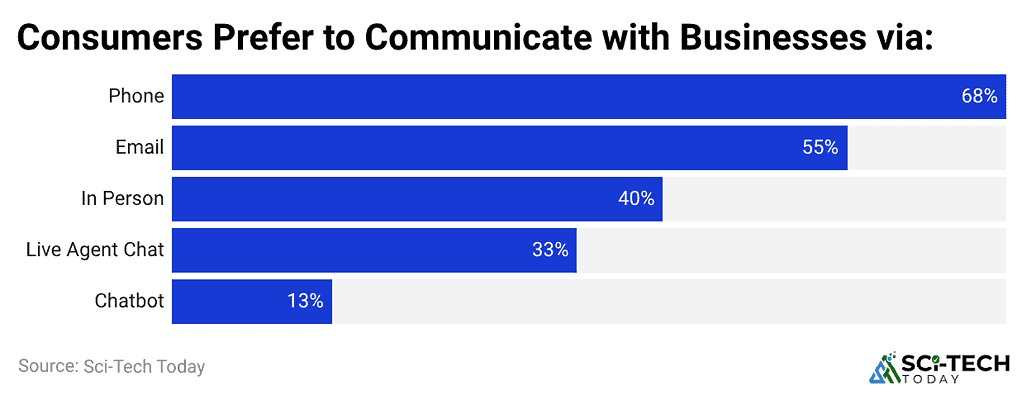
- Consumers most often prefer to communicate with businesses by phone (68%), followed by email (55%).
- In-person support remains important for 40% of people.
- Digital options are also widely used: live agent chat is preferred by 33% of consumers.
- Whereas chatbots are the least preferred option at 13%.
Conclusion
After completing the article, call centres and digital channels are the most effective platforms when used together. To complete simple, repetitive tasks, people are increasingly using mobile live chat, websites, and social media platforms. They provide quick response and have readily available customer service that can resolve issues within a few minutes.
However, call centres are vital sources of support when issues are complex, urgent, or require real-time assistance. The best service model integrates both into a seamless process, in which digital steps remain clear, and agents can instantly view the full interaction history. When used wisely, data can cut costs and raise satisfaction.
FAQ
A call centre channel is a method customers use to contact support, like phone, chat, or email.
For simple tasks, customers usually prefer digital self-service apps, websites, and chat because it’s fast.
When the issue is complex, urgent, sensitive, or needs explanation, reassurance, or negotiation.
Digital channels cut routine calls, yet call centres still handle complex, high-value customer issues effectively.
Companies automate simple, repeat tasks online and route complex, urgent, emotional, or high-value cases to agents.