








Introduction
Green Marketing Statistics: Green marketing has been kinda shifting from a niche branding move into this mainstream, gotta-do business thing by 2026. Like, as people keep putting more weight on environmental responsibility, companies are spending more and more on sustainable offerings, clearer ESG updates, carbon-neutral operations, and circular economy plans. At the same time, governments are getting stricter about what counts as “environmental” in marketing, so businesses can’t just say things; they have to back up their sustainability talk with hard, measurable proof.
And yeah, findings from McKinsey, Nielsen, Deloitte, Gartner, and a bunch of other groups basically show that sustainability now affects how people buy, how loyal they stay, what they’ll pay, and how profitable things get over the long run. The numbers below sort of map out the newest market values, consumer tendencies, investment patterns, and challenges that are shaping the worldwide green marketing scene in 2026.
Editor’s Choice
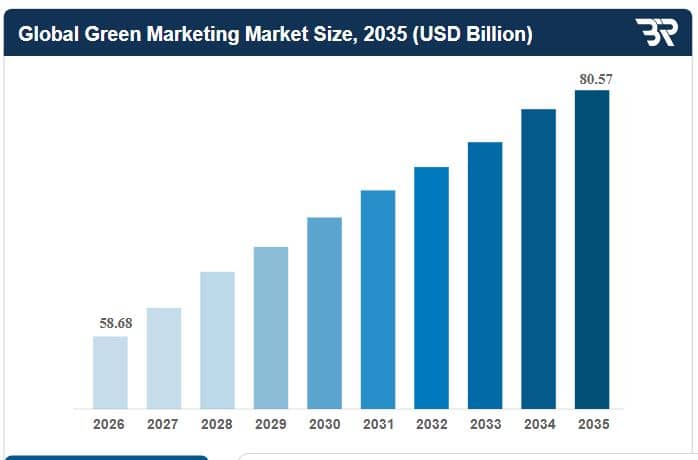
- The global green marketing market is forecast to rise from USD 58.68 billion in 2026 to USD 80.57 billion by 2035, showing ongoing pull for eco-focused positioning.
- 78% of consumers say they’ve switched brands due to environmental concerns, and it’s basically proof that sustainability has become a serious buying nudge.
- Sustainable brands are growing about 5.6× faster than traditional rivals, which suggests real financial upside when green marketing is actually credible.
- 74% of brands report positive ROI from green marketing initiatives, and 67% of marketers claim sustainability messaging improves brand distinction.
- 60% of consumers prefer products with recyclable packaging, while 79% expect brands to reduce packaging waste in a proactive way.
- 71% of consumers are cutting back on overall usage to live more sustainably, indicating a longer-term change in shopping habits.
- Trust still feels like a major problem, with 59% of consumers thinking companies kinda overstate their environmental story and 57% that just don’t trust green marketing.
- The European Commission also noted that 53% of environmental claims are misleading, and 40% don’t come with real supporting evidence.
- The global green technology and sustainability market is projected to hit USD 140.03 billion by 2034.
Green Marketing Market Growth
(Source: businessresearchinsights.com)
- The global Green Marketing Market is being valued at USD 58.68 billion in 2026, and it’s expected to climb to about USD 80.57 billion by 2035, with a 3.58% CAGR across the 2026 to 2035 window.
- Right now, 60% of global buyers prefer eco-friendly products, while 78% say they’ve switched brands because of environmental worries.
- In addition, 82% of consumers tend to trust sustainable brands more, especially when those brands actually show environmental responsibility, and that’s what keeps the long-term appetite for green marketing pretty steady.
- About 40% of consumers don’t really factor environmental matters into their buying decisions, plus 57% distrust green marketing claims.
- Also, 59% think companies are exaggerating their sustainability efforts, and nearly 31% of brands report some kind of backlash tied to greenwashing.
- For example, 63% of companies are increasing sustainability-focused marketing, 75% of ad campaigns include sustainability themes, 47% are putting a spotlight on supply chain transparency, and 33% even add trackable sustainability performance metrics.
- Regionally, North America is kinda leading the pack at 37% market share, then Europe trails at 30%, Asia-Pacific sits with 25%, and the Middle East & Africa is at 8%.
- Eco-friendly products are already driving more than 42% of market activity, consumer goods cover another 39%, and sustainability messaging is said to sway about 65% of online buying decisions.
- The recent signals keep stacking up: 71% growth in sustainable product searches over the last five years, 63% of businesses publishing sustainability content on social media, 41% offsetting emissions and 55% reducing waste via environmental initiatives.
Businesses and Sustainable Packaging Are Accelerating The Green Marketing Revolution
- Green marketing is turning into a core business route as more companies connect their brand identity with sustainability.
- 63% of companies plan to bump up sustainability-related marketing in 2025, while 58% already lean on sustainability certifications to build stronger credibility.
- Eco-conscious communication is also becoming more normal now, with 40% of global advertisements including environmental themes.
- The money argument looks just as strong, because 74% of brands report a positive ROI from green marketing campaigns, 67% of marketers think sustainability messaging improves brand differentiation, and 61% of companies say their sustainability efforts have strengthened customer loyalty.
- While 32% of businesses have dedicated sustainability officers who support marketing work, 51% of small businesses see eco-friendly marketing as a real chance to grow, and 48% say they plan to lift their green advertising budgets next year.
- At the same time, 35% of consumer packaged goods (CPG) brands are either already carbon-neutral or they’re planning to move there soon, pointing to a steadily rising corporate commitment toward sustainability.
- About 60% of consumers say they prefer items packed in recyclable materials, and 56% actively steer clear of plastic packaging.
- On top of that, 69% of global consumers opt for refillable or reusable products, so the whole circular consumption pattern is getting stronger.
- Roughly 47% of brands are using biodegradable or compostable packaging materials, 38% are adding recycled content into their packaging, and 33% are targeting zero-waste packaging by 2030.
- There’s also the branding angle, since 44% of shoppers report that sustainable packaging makes the brand feel better, 58% think it signals better product quality, and 79% expect brands to cut packaging waste.
- With that momentum, the eco-friendly packaging market is forecast to top USD 470 billion by 2032, which basically reinforces that sustainable packaging has turned into both a competitive edge and a big engine for long-term green marketing growth.
Sustainability is Reshaping Everyday Consumer Buying Habits
- Consumer behavior is getting more and more sustainability-driven, with 71% of people actively reducing their total consumption to live more sustainably.
- Environmental awareness is also showing up in purchase choices, because 43% of buyers go for things that are produced nearby to shrink their carbon footprint, while 46% of consumers end up shopping via resale or thrift platforms.
- With younger shoppers, it gets even clearer, as 52% of Gen Z say they prefer secondhand fashion, which really points to the rising interest in circular consumption.
- 35% of households compost on a regular basis, 31% of consumers have put home solar systems in place, and 29% intentionally choose brands powered by renewable energy.
- Product transparency is starting to matter more, with 44% of shoppers looking at carbon labels whenever those labels exist.
- Also, 39% of consumers use eco-focused mobile apps to track and improve their sustainability habits. Since 57% of consumers say environmental documentaries directly nudge their purchasing decisions.
- The above numbers suggest that sustainability is moving from just a preference into a more mainstream lifestyle, so businesses likely need to align their products, their messaging, and their environmental commitments with what buyers are now expecting.
Green Marketing Faces Trust Challenges
- 59% of consumers say brands exaggerate their environmental claims, and 46% end up leaning on watchdog reports to check sustainability promises before they spend.
- On the business side, the same kind of friction shows up, with 44% of companies struggling to communicate sustainability in a way that lands, 31% getting hit by backlash tied to greenwashing.
- 41% say environmental rules are difficult to interpret, and 23% admit they were fined because eco-label information was misleading.
- Internally, 62% of marketers report it’s tough to prove the return on investment (ROI) of sustainability efforts; 53% point to data gathering as the top barrier to openness; 38% say their brands don’t provide enough sustainability training for marketing teams.
- 35% of companies have now turned to third-party auditors to validate environmental claims, which sounds good on paper but can be a lot to manage.
- Nielsen’s 2026 Global Sustainability Report and the 28% faster growth of sustainable products to McKinsey’s Sustainability Report.
- Fortune Business Insights (2026) puts the global green technology and sustainability market at USD 31.05 billion in 2026, and projects it could jump to USD 140.03 billion by 2034.
- Looking forward, 58% of CMOs expect sustainability to turn into the leading branding play by 2030, 42% of brands are planning to use blockchain for eco-proof supply chain tracing, and 63% of global advertisers plan to link CSR metrics straight to campaign KPIs.
- Additionally, 47% of product innovation budgets are expected to keep their focus on sustainability by 2028, 50% of consumers want carbon calculators available at checkout, 62% of companies will invest in sustainability-led influencer marketing, and 78% of marketers believe green marketing will become essential, not optional, by 2030.
- Backing this longer-run shift, the global green economy is projected to bring about around 300 million sustainable jobs by 2050.
- EU Green Marketing Rules Raise the Bar for Environmental Claims in 2026. The European Union is, in a way, reshaping green marketing through the Directive on Empowering Consumers for the Green Transition (ECGT/EmpCo), and it does this by pushing stricter standards for environmental claims across all 27 EU Member States.
The Regulatory Landscape – The EU Green Claims Directive
- The new rules are driven by growing concerns over misleading sustainability messaging.
- According to the European Commission, 53% of environmental claims examined across the EU were found to be vague, misleading, or unfounded, while 40% lacked supporting evidence altogether (ClimatePartner; Verive).
- AFRY reinforces these findings, reporting that more than half of green claims are misleading and 40% remain unsubstantiated, highlighting why stronger regulation has become necessary (AFRY).
- Environmental law experts further note that around 40% of current sustainability claims are entirely unsupported, making it difficult for consumers to distinguish genuine environmental performance from marketing language.
- The Directive also blocks climate neutrality assertions when they’re basically just carbon offsetting, and it asks that any new environmental commitments be tied to a concrete, countable execution plan, plus independent checking (Cooley; C2C Certified).
- Starting 27 September 2026, every sustainability label used within the EU has to come from public authorities or be supported by recognized third-party certification schemes, with independent verification, so the self-made “this is green” badge situation gets wiped out, for real (Eversheds Sutherland; MyGreenLab; C2C Certified).
- With 53% of claims judged misleading, 40% missing evidence, and enforcement kicking off in September 2026, companies will likely have to swap out unclear sustainability talk for transparent environmental messages that are independently verified and supported by real evidence.
- In other words, it looks like credibility plus compliance becomes the base layer for doing “green marketing” successfully across Europe (European Commission; AFRY; Carbon Trust; Eversheds Sutherland).
Return On Investment (ROI) and Profitability Metrics
- Sustainability has turned into something you can actually measure in a company’s numbers, not just a glossy branding idea.
- In the Frontiers in Sustainability study, B Corp certification shows a statistically significant, positive effect on company growth, and the upside seems to build with time, while earlier work mentioned inside that same study already pointed out that certified firms often see stronger short-term progress too, and then it just keeps getting better as the certification period matures.
- Also, B Lab UK seems to underline the pattern. They say that UK small and medium -sized B Corps managed 23.2% turnover growth from 2023 to 2024, versus a national SME average of 16.8%, and at the same time, employee headcount rose 9.6% while nationally it dipped by 0.5%.
- The same report further notes that B Corps are 25% more likely to pay a family living wage, 104% more likely to rely only on renewable energy, and 114% more likely to bring community representatives onto their boards.
- On top of that, A Beautiful Green reports that 35% of B Corps reached workforce growth above 25%, compared with 23% among conventional businesses, and nearly 43% of French B Corps also crossed that same growth benchmark.
- PwC’s Global Voice of the Consumer Survey notes that 80% of consumers say they are willing to pay more for sustainably made products, with an average premium hovering around 9.7%.
- On the First Insight side, it says 62% of Gen Z shoppers prefer sustainable brands and 73% are willing to pay extra for them.
- Kadence also similarly reports that 66% of Gen Z people will pay more for environmentally friendly items, and 73% would pay extra for ethically sourced goods. It also finds 82% are worried about the planet, and 72% have already changed how they act in order to reduce environmental impact.
- Frontiers in Sustainability adds that clear messaging, along with believable eco-labels, boosts consumer trust and willingness to pay, but greenwashing tends to weaken the urge to buy.
- So, overall, the numbers point to sustainability certifications plus transparent environmental methods as a combo that helps generate faster growth, builds steadier customer loyalty, supports stronger pricing power, and creates a more durable competitive edge.
Conclusion
Green marketing has kind of turned into a real strategic business must-have; it affects consumer trust, brand loyalty, and long-term profitability. More organizations now put money into sustainable products, clearer, almost open environmental messaging, eco-friendly packaging, and third-party certifications, in order to answer what customers are expecting more and more, and also the tougher regulatory requirements. Of course, worries about greenwashing are still there, and it can mess with brand credibility.
But companies that bring up sustainability claims with hard numbers, evidence, and not just nice words are seeing steadier market growth, and often better pricing power too. With governments rolling out tighter environmental rules and shoppers who increasingly reward responsible brands, green marketing is likely to keep shaping competitive advantage, innovation, and overall business results, so sustainability remains a core pillar in future marketing strategies.
FAQ
Green marketing is when products and services are promoted using environmental sustainability, plus responsible business practices.
The global green marketing market is estimated at USD 58.68 billion in 2026.
It builds brand trust, increases customer retention, helps with premium pricing, and can produce measurable marketing ROI.
Because 53% of the environmental claims were considered misleading, and 40% didn’t have evidence, verification rules are getting stricter.
Yes. 80% of consumers say they are willing to pay an average premium of 9.7% for products made in a sustainably minded way.

Sources