









Introduction
Digital PR Statistics: Digital PR has kind of turned into one of the fastest-growing things inside modern marketing, because brands are all chasing online visibility, search authority, AI-generated citations, and that ever-spotty consumer trust. And unlike traditional public relations, digital PR mixes media outreach with SEO, content marketing, influencer engagement, and data-led storytelling in a kind of loop, to get coverage across online publications and social feeds.
By 2026, organizations are ramping up investments in digital PR because earned media doesn’t just support brand reputation, but also helps search positions, referral traffic, and even AI discoverability. With generative AI showing up everywhere, privacy rules getting stricter, and competition for organic attention getting more intense, digital PR is becoming a strategic must-have for businesses worldwide. So budgets go up, ROI expectations tighten, and results end up being more measurable day by day.
This article on Digital PR statistics will give a fair picture of the global market, digital PR campaigns, PR backlinks, and AI Adoption.
Editor’s Selection
- The global Digital PR market is expected to move from USD 8.14 billion in 2026 up to USD 11.55 billion by 2034, which really points to ongoing long-term expansion.
- Data-driven campaigns make up about 42.3% of all successful Digital PR campaigns, meaning original research is basically the most effective content approach in the industry.
- Australia is leading the data-driven adoption of Digital PR at 57%, beating the UK (49.4%), the US (39.6%), and Canada (36.9%).
- Top Google pages, meaning the better-ranked ones, have 3.8× more backlinks than lower-ranked first-page results, which again reinforces that backlinks are a critical SEO ranking signal.
- Also, 95% of Google pages have no backlinks, so earning authoritative media coverage ends up being a real competitive edge.
- On the journalist side, 53% say that relationships with PR professionals matter, while 54% say they rarely reply to generic PR pitches, so in a lot of cases, quality tends to beat quantity most of the time anyway.
- Business and economy dominate Digital PR coverage with 22.2% of news articles, which makes it the most newsworthy sector, globally too.
- 76% of PR professionals now use generative AI, while 75% pay for AI tools, showing that AI is moving from “experiment” into everyday Digital PR workflows.
- Authoritative content can boost AI search visibility by 30–40%, so Digital PR is becoming a key lever for Generative Engine Optimization (GEO).
- Digital PR also seems to deliver stronger business value than traditional PR, with 72% of businesses reporting better ROI, and 85.2% of campaigns showing measurable results within 3–6 months.
Digital PR Global Market
(Reference: intelmarketresearch.com)
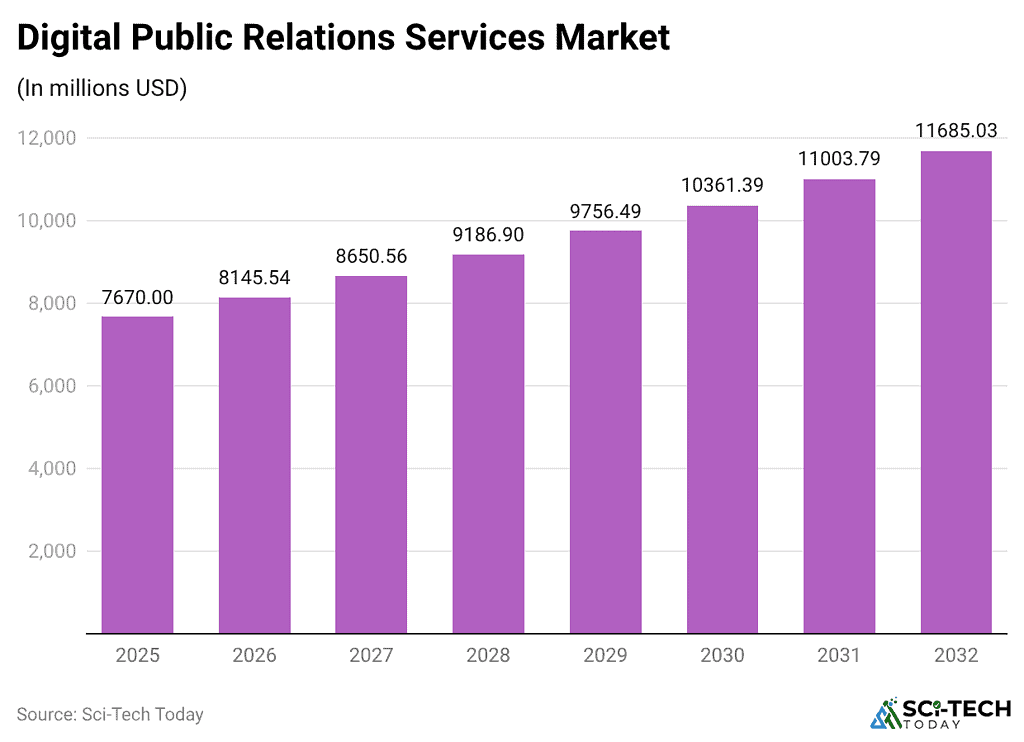
- The Digital Public Relations (DPR) services market is kind of riding a steady growth path, since organizations keep increasing investments in online brand visibility and reputation management.
- The global market was valued at USD 7.67 billion in 2025 and is expected to reach USD 8.14 billion in 2026.
- Looking ahead, the market should expand to USD 11.55 billion by 2034. 2025–2033 industry forecasts suggest the Digital PR agency market grows at a stronger 10.03% CAGR (while the wider digital PR services category grows at 5.7%).
- Taken together, these numbers point to steady demand for digital communication services, because businesses keep prioritizing online engagement and brand credibility.
- The consistent year-over-year rise in market size suggests digital PR is now an essential piece of modern marketing, backed by the growing weight of social media, search visibility, and digital reputation management.
Digital PR Campaigns in 2026 by Region
(Reference: rebootonline.com)
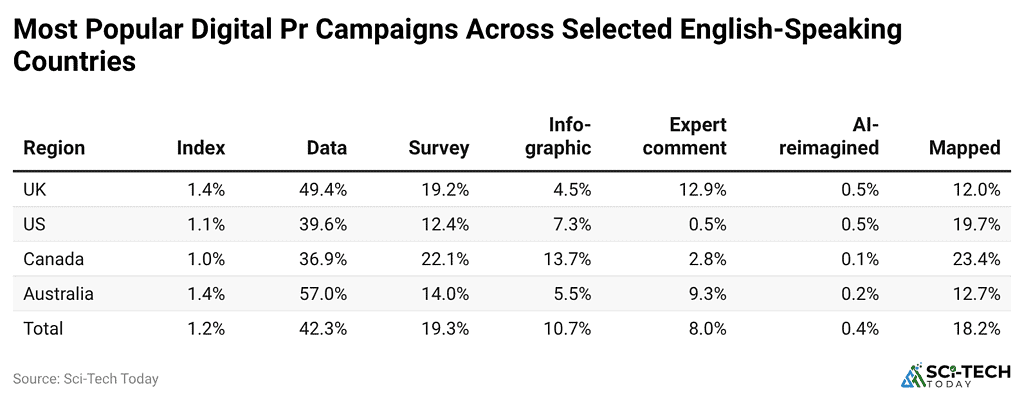
- The newest campaign benchmarks kinda show that data-driven Digital PR campaigns are still, like, the most successful type across most major English-speaking markets.
- From what the Digital PR Campaign Benchmark Report says, data-led efforts make up 42.3% of the widely used Digital PR campaigns worldwide.
- Survey-based campaigns hit 19.3% and land in second place; mapped campaigns take third with 18.2%; and infographic campaigns only bring in 10.7%, while expert comment campaigns sit at 8.0%.
- As for AI reimagined campaigns, they’re still early, just 0.4%, and index-based campaigns barely reach 1.2%.
- Marketers are keeping their focus on original discovery and storytelling that’s backed by evidence, rather than AI-produced content.
- On the regional side, you see a few pretty clear gaps in what campaigns people favor.
- Australia is on top for data-driven campaigns at 57.0%, then the UK at 49.4%, the US at 39.6%, and Canada at 36.9%.
- Canada also shows the highest take-up of mapped campaigns, 23.4%, ahead of the US (19.7%). Survey-based campaigns are most common in Canada at 22.1%, while the UK sits at 19.2%, Australia at 14.0%, and the US at 12.4%.
- Infographic campaigns are strongest in Canada (13.7%), and expert comment campaigns show up most often in the UK at 12.9%.
- Index-based campaigns stay small everywhere, roughly 1.0% to 1.4%, while AI reimagined campaigns keep that low footprint, around 0.1%–0.5% in every country.
- All this kinda points to original data, surveys, and location-based insights still generating the best Digital PR engagement.
Digital PR Backlink Statistics
- Backlink data pretty much shows that high-quality backlinks still stay one of the most solid ranking signals in search engines, as they really don’t get replaced easily.
- In Backlinko’s 2026 analysis of 11.8 million Google search results, sites that have stronger domain authority tend to land better first-page spots.
- The top-ranking page also ends up with about 3.8 times more backlinks than pages sitting around positions 2 through 10.
- Then Semrush adds another angle: 55.1% of websites that have no single backlink fail to show up in Google’s top 10, while 92.3% of the domains that rank in the top 100 have at least one backlink already.
- Still, even with all that weight, 95% of all Google pages end up with zero backlinks, which makes these credible link profiles kind of rare, not “everywhere” like people hope.
(Source: rebootonline.com)
- On top of that, Ahrefs’ research lays out a clear tie between backlinks and organic traffic, almost like a direct cause and effect.
- Ahrefs notes it uncovers roughly 10 million new web pages every 24 hours. But when it studied 14 billion pages, it found that 95.55% basically get no Google traffic at all, and only 0.07% (around 9.8 million pages) pull in more than 1,000 monthly visits.
- Pages with just one referring domain usually see under 1,000 monthly visitors, while pages with a median of four referring domains commonly hit around 1,000–1,500 monthly visits.
- There’s also a jump later: pages with 100 referring domains can rank for about 6,000–6,500 keywords in Google’s top 100, and this can climb to roughly 9,500–10,000 keyword rankings once a page reaches 130 referring domains.
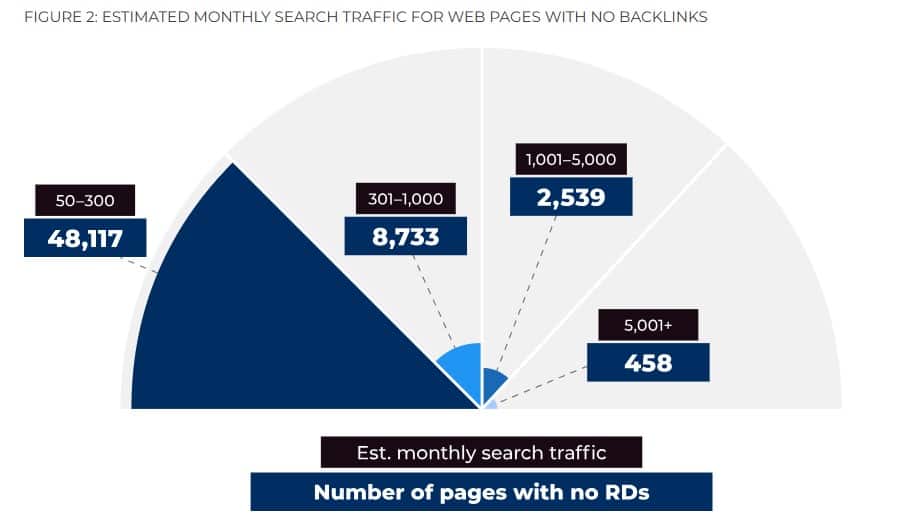
- Even among pages with no backlinks, 48,117 pages still manage 50–300 monthly searches, but only 458 pages (0.8%) go beyond 5,000 monthly searches, which really underlines why getting backlinks matters.
(Source: rebootonline.com)
- Internal Digital PR backlink analysis points out that earned media links have exceptional authority.
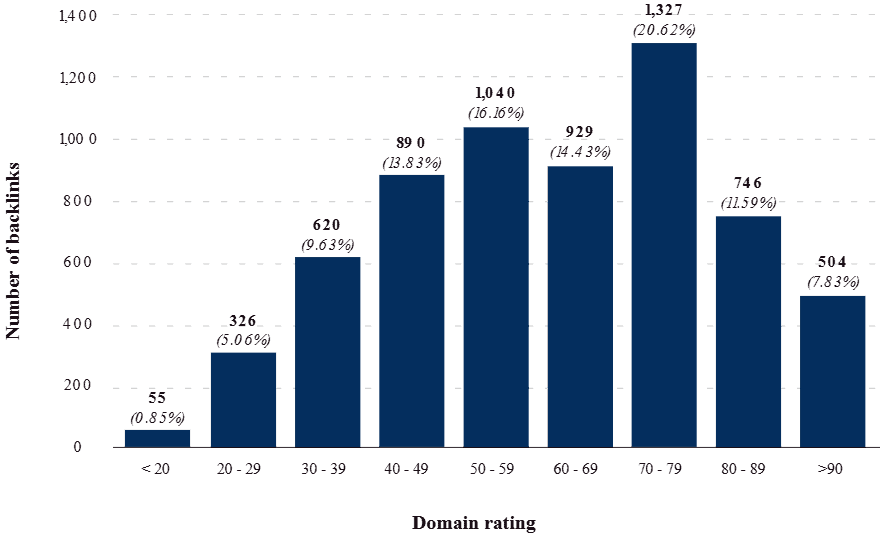
- The mean Ahrefs Domain Rating (DR) for Digital PR coverage hit 61 during 2024, and about 20.62% of backlinks landed in the DR 70–79 group, which ends up being the biggest category.
- Then another 16.16% were placed in the DR 50–59 range.
- Also, 7.83% reached an elite DR of 90 or more, and that ends up corresponding to 27.8% additional links compared with those under DR 30.
(Source: rebootonline.com)
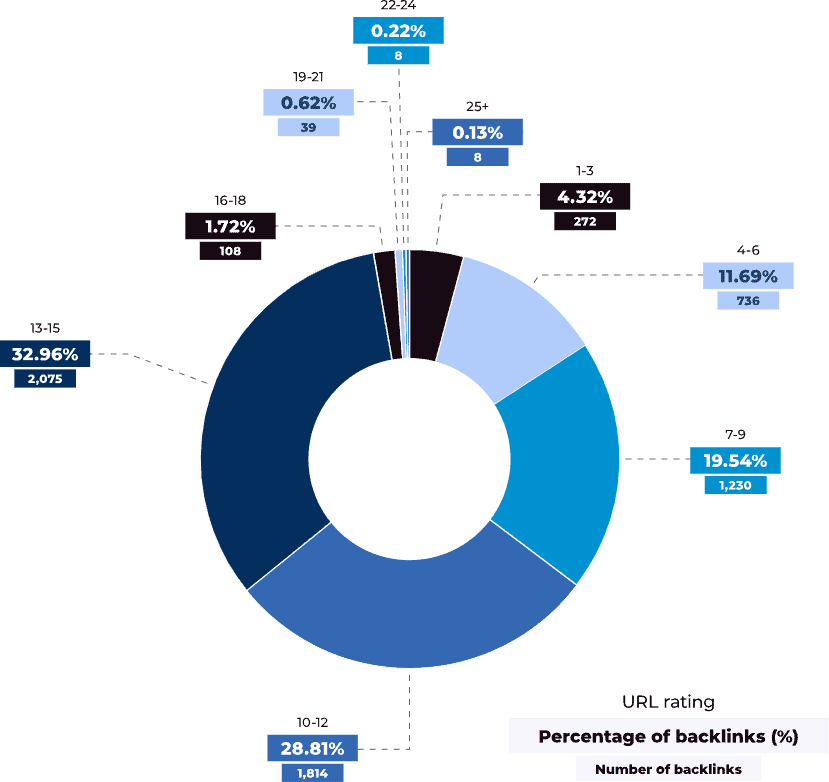
- For the URL Rating (UR), the average came in at 11. Around 32.96% of backlinks scored UR 13–15, while 28.81% fell into UR 10–12.
- Together, these numbers suggest that today’s Digital PR keeps producing high-authority backlinks, the kind that can support SEO outcomes and durable search visibility, over time.
Digital PR and Journalist Relationships Statistics
- Strong links between journalists and PR people are still one of the major reasons Digital PR campaigns work.
- As per Muck Rack, 53% of journalists say their relationships with PR professionals matter, or matter a lot, for their success. Within that, 30% say very important and 23% say important.
- On the PR side, 29% of professionals send or receive roughly 6 to 10 media pitches each day, which is a 4% jump from the prior year.
- So even if media outreach is getting more competitive, building ongoing relationships still improves the odds of earning worthwhile coverage.
- Journalists are also dealing with an overwhelming amount of communication, so relevance feels way more important than sheer quantity.
- Cision says 72% of journalists get over 50 email pitches each week, and Muck Rack adds that 54% of journalists seldom or never respond to PR pitches.
- Meanwhile, 25% of journalists now work for digital-only media outlets, which basically makes digital publishing the most usual workplace in the industry.
- Put together, it suggests that Digital PR folks really need to concentrate on personalized, highly relevant stories instead of just pushing outreach volume, especially since digital-first newsrooms keep growing.
- Cision also reports that 47% of journalists want more data and original research, 45% lean toward embargoed or early-access information, and 42% look for access to expert sources.
- 47% specifically point to original research reports, like market trends or industry data, as especially valuable for shaping a story.
- On the PR materials side, 68% rank press releases as the most useful resource, then come direct pitches (47%) and expert commentary (47%).
- The above numbers really underline that data-driven content, backed by credible research and strong expert perspectives, is now the base layer for effective Digital PR campaigns in today’s media space.
Digital PR: Most common digital PR news articles by sector
- According to Reboot Online’s analysis of more than 370,000 Digital PR news articles, business and economy remained the most noticed sector in 2024, making up 22.2% of all Digital PR news across a set of English-speaking countries.
- Health came in second at 13.6%, and then technology at 6.6%, world news 6.5%, politics 6.3%, and science again 6.3%.
- On the regional side, Canada clocked the top share for business and economy coverage at 30.8%, Australia was next with 24.5%, the UK at 21.8%, and the US with 20.2%.
- The United States was a bit unusual; it was the sole market where health outran every other sector, landing at 24.0% of the analyzed Digital PR articles.
- The industry breakdown also points to pretty clear regional tastes. For instance, technology coverage reached 9.1% in the US and 8.9% in the UK.
- Science stories were at 8.9% in Canada, which was the top figure across all the countries looked at.
- Australia, on the other hand, showed the strongest sports-related Digital PR share at 8.3%, and finance and investing sat at 8.1% of its coverage.
- Lifestyle content looked comparatively smaller, from 3.4% in Canada up to 6.5% in the US.
- Meanwhile, entertainment, travel, culture, and crime each contributed less than 4% of total Digital PR coverage.
- Campaign classification data even further confirms that research-driven storytelling is becoming more and more important, yeah, in a really noticeable way.
- Business and economy made up 57.12% of all index-study campaigns, so it ended up as the leading campaign format in Digital PR.
- The same sector also brought in 24.23% of all data studies, 24.76% of infographics, and 21.53% of survey-based campaigns, which kind of lines up with the bigger overall picture.
- At the same time, technology-led AI reimagined content sits at 28.91%, science-dominated mapped studies are at 22.06%, and health recorded the biggest slice of expert comment campaigns at 16.53%, with lifestyle right behind it at 15.12%.
- These numbers suggest that data studies, index reports, and industry research stay among the most effective content formats for earning media coverage, while AI-powered storytelling is showing up as a quickly rising trend within the technology space.
AI Adoption and Sentiment Analysis in Digital PR
- Generative Engine Optimization, or GEO, has been accelerating fast in digital marketing, and Digital PR is basically at the center of it, helping improve AI search visibility and all that.
- As stated in Muck Rack’s State of AI in PR 2026, 76% of PR professionals now use generative AI in everyday workflows, while over 50% of organizations have already put formal AI usage policies in place.
- Also, 75% of PR professionals pay for at least one AI tool, which signals the shift from early experiments to proper mainstream implementation.
- Princeton University GEO research found that using authoritative sources, expert quotes, and statistical evidence can improve visibility in AI-generated responses by 30–40%.
- Meanwhile, the U.S. Generative Engine Optimization market is projected to reach USD 365.4 million in 2026, expanding at a remarkable 42.9% CAGR, reflecting the rapid commercialization of GEO strategies.
- AI tool adoption is still kinda led by ChatGPT, in a way used by 89% of PR professionals, then Gemini at 17% and Microsoft Copilot at 11%, according to Reporter Outreach.
- Also, 47% of PR teams spend over USD 200 per month on AI tools, and 58% say they plan to raise their AI budgets.
- 59% of PR professionals still prefer to keep journalist relationship management human-led, which means AI can speed things up and all that; however, trust-based media connections stay the real competitive edge.
Digital PR vs. Traditional PR – Cost and ROI
| Cost and ROI metric | Digital PR | Traditional PR |
| Average monthly retainer | USD 5,000–10,000. | USD 10,000–14,500 |
| Estimated monthly value / ROI | 3–5× ROI vs. traditional. | 85–120% ROI, USD 8,500–12,000 value. |
| Lead-to-close rate | 31%. | Not typically tracked this way |
| Cost per impression | USD 0.21. | USD 1.84 (paid digital benchmark). |
| Most effective link-building strategy | 20% of specialists; 48.6% | Not ranked in link-building surveys |
| Businesses are seeing better ROI vs. traditional | 72%. | — |
| Campaigns delivering results in 3–6 months | 85.2%. | Longer payback window |
Conclusion
Digital PR has turned into a strategic growth engine for modern marketing, kinda blending SEO, media outreach, AI optimization, and data-based storytelling so brands can lift their online visibility plus business results. As companies push more money into earned media, credible backlinks, and Generative Engine Optimization, Digital PR is showing real, trackable wins—better search positions, improved AI discoverability, and stronger return on investment.
The broad uptake of generative AI is speeding up campaign work, and at the same time, it keeps proving why original research still matters and why relationships with trusted journalists should not be treated like a checkbox. With a bigger global market and what often looks like a stronger ROI compared with traditional PR, Digital PR is set up as a key pillar for brand growth and digital authority in 2026.
FAQ
Digital PR is a marketing approach that mixes media outreach, SEO, content marketing, and online publishing, all to raise brand visibility and perceived authority.
The worldwide Digital PR market is estimated at around USD 8.14 billion in 2026.
Data-driven campaigns tend to work the best, making up 42.3% of successful Digital PR efforts.
76% of PR professionals use generative AI for smarter content production, faster campaign delivery, and more efficient media outreach.
Strong backlinks help search rankings, and top-ranking Google pages typically have about 3.8× more backlinks than lower-ranked pages.

Sources