









Overview
Internet Usage Statistics: It’s hard to imagine life without being connected to the internet, isn’t it? The internet has become a fundamental part of our lives these days, from how we work and learn to how we shop and socialize. But how big is this world, really? What’s the point behind all the clicks, swipes, and searches?
That’s where these internet usage statistics help us; these are the pulse of our global civilization. We are going to explore who’s online, what they’re doing, and where the next big digital thing is happening.
Understanding these statistics is crucial for anyone who wants to grasp the modern world, from marketers and business owners to content creators and even everyday people. Let’s dive deep into the data and see what it tells us about the condition of the internet in 2025. Let’s get into it.
Must Read by the Editor
- The total number of internet users has officially surpassed the 5 billion mark, now sitting at 6 billion people, which is approximately 67.9% of the global population.
- The non-digital population is shrinking but remains significant, with 2.2 billion people still without internet access, the majority of whom live in developing countries and rural areas.
- China and India are the undisputed leaders in internet user volume, with India projected to cross the 806 million user mark by the end of 2025.
- The global average person spends an impressive 6 hours and 38 minutes daily on internet-connected devices, equating to more than 40% of our waking hours.
- Mobile’s dominance is undeniable, as it accounts for a commanding 45% of all global web traffic, with only 35.71% coming from desktop devices.
- The number of social media users has grown to 41 billion, representing 65.7% of the world’s population, with 241 million new users joining platforms in the past year alone.
- Facebook remains the most used social platform, with 3.07 billion monthly active users, while YouTube and Instagram both have over 2 billion users.
- The global e-commerce market is forecast to reach USD 7.4 trillion in 2025, with mobile commerce accounting for 71% of all online retail sales.
- Google maintains its near-monopoly on search, with an overwhelming 47% market share, making it the primary gateway to online information for billions of people.
- Global digital ad spending is projected to reach a historic USD trillion in 2025 for the first time, with digital channels making up 2% of that total.
Global Internet Expansion
(Reference: sganalytics.com)
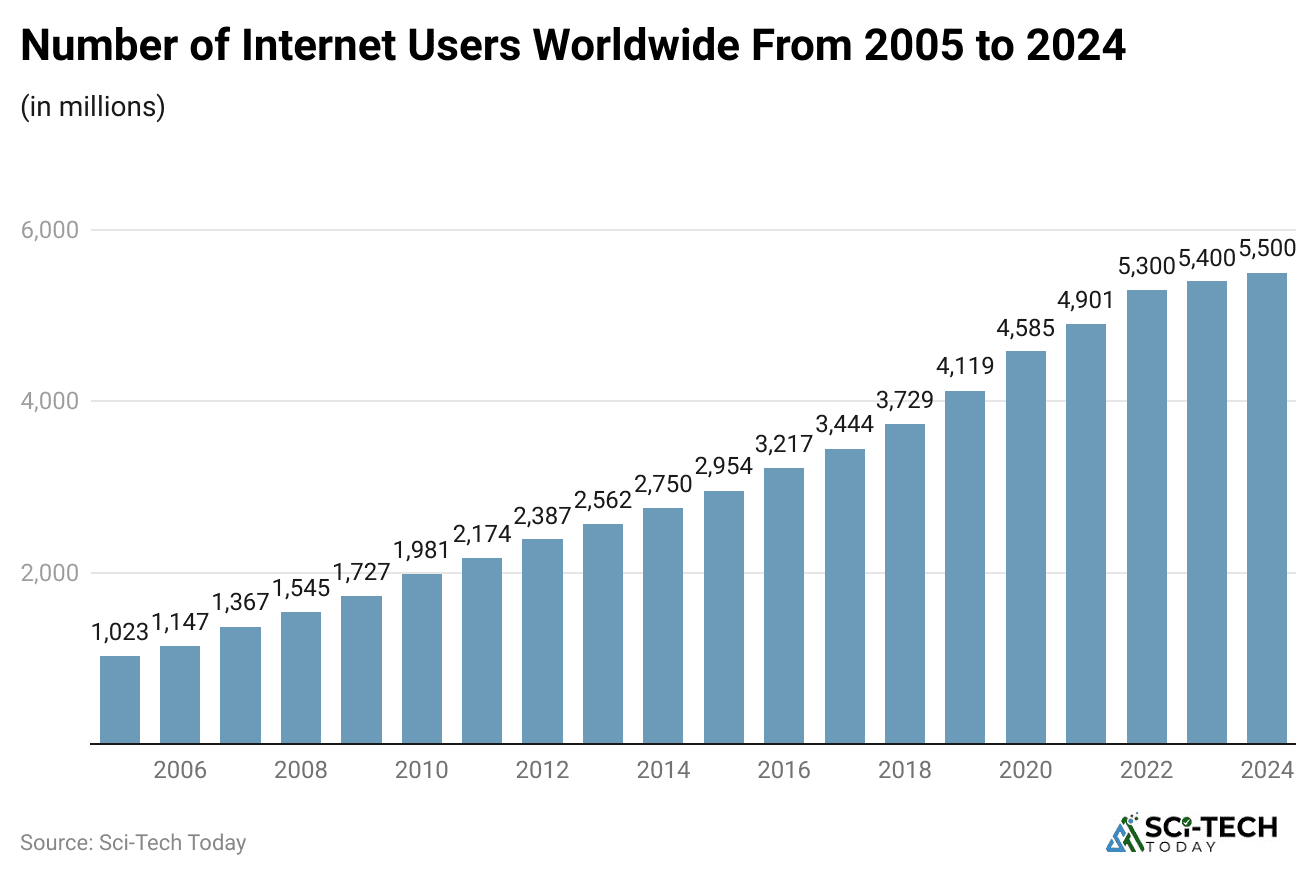
- A total of 6 billion people are now online, which is a year-on-year increase of over 100 million new users.
- This places the global internet penetration rate at 68.7% of the total population, a number that has been steadily climbing for over two decades.
- Over 2.2 billion people remain offline, with the majority concentrated in rural areas and developing nations.
- China, India, and the United States have the largest number of internet users, collectively accounting for more than 77% of the global online population
- The number of mobile phone users has reached 5.76 billion, and this figure is a critical indicator, as mobile phones are the primary access point for new internet users.
- In Africa, internet penetration is at 43%, but it is one of the fastest-growing regions in terms of user adoption, highlighting its future potential.
- In rural areas globally, only 50% of the population has access to the internet, compared to 81% in urban areas, demonstrating a persistent digital divide.
- The average person spends an impressive 6 hours and 38 minutes daily on the internet, with a significant portion of this time dedicated to social media and video.
- The internet’s daily user base has increased by 2.7 million people every day over the past year.
- There are now more than 1.1 billion fixed broadband subscriptions globally, with a monthly growth rate of around 0.37% in key markets.
- The highest internet penetration rates are found in Northern Europe (98%) and North America (96%).
- Around 70% of the world’s population now owns a mobile phone.
- Globally, there are 1.35 billion fixed wireless broadband subscribers, a number that is growing by over 60% per year.
- In India alone, the number of internet users is projected to reach 900 million by 2025.
- The global tele-density (number of telephone subscriptions per 100 people) is over 115%.
- The number of internet users is projected to reach an astounding 7.9 billion by 2029.
| Total Internet Users | 5.65 Billion |
| Global Penetration Rate | 68.7% |
| Unconnected Population | 2.58 Billion |
| Average Daily Online Time | 6 hours 38 minutes |
Internet Users by Country
(Source: World Population Review)
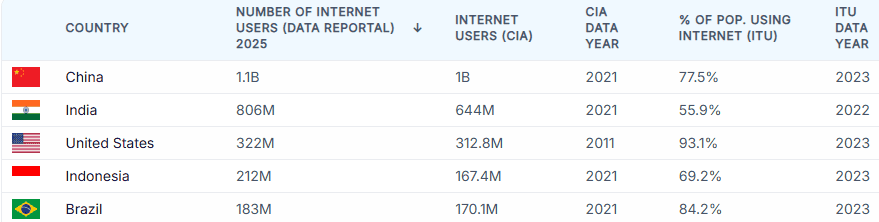
- China leads the world with the largest internet user base, reaching 1.1 billion users in 2025, while 77.5% of its population was using the internet as of 2023.
- India ranks as the second-largest internet market with 806 million users in 2025, with 55.9% of its population online as of 2022.
- The United States holds the third position with 322 million internet users in 2025, and an impressive 93.1% of its population using the internet as of 2023.
- Indonesia ranks fourth with 212 million internet users in 2025, with 69.2% of its population online as of 2023.
- Brazil rounds out the top five with 183 million internet users in 2025, and 84.2% of its population using the internet as of 2023.
Countries with Lowest Internet Usage
- Also, the internet penetration rate of Burundi stands at 87.8%.
- After this comes the Central African Republic, which boasts an internet penetration of 87.5%.
- First place is occupied by North Korea, which has 0% internet penetration since the internet is inaccessible to most of its people.
Mobile-First Use Case – Device and Traffic Analysis
(Reference: explodingtopics.com)
- 9% of all internet users worldwide access the web via a mobile phone at least some of the time.
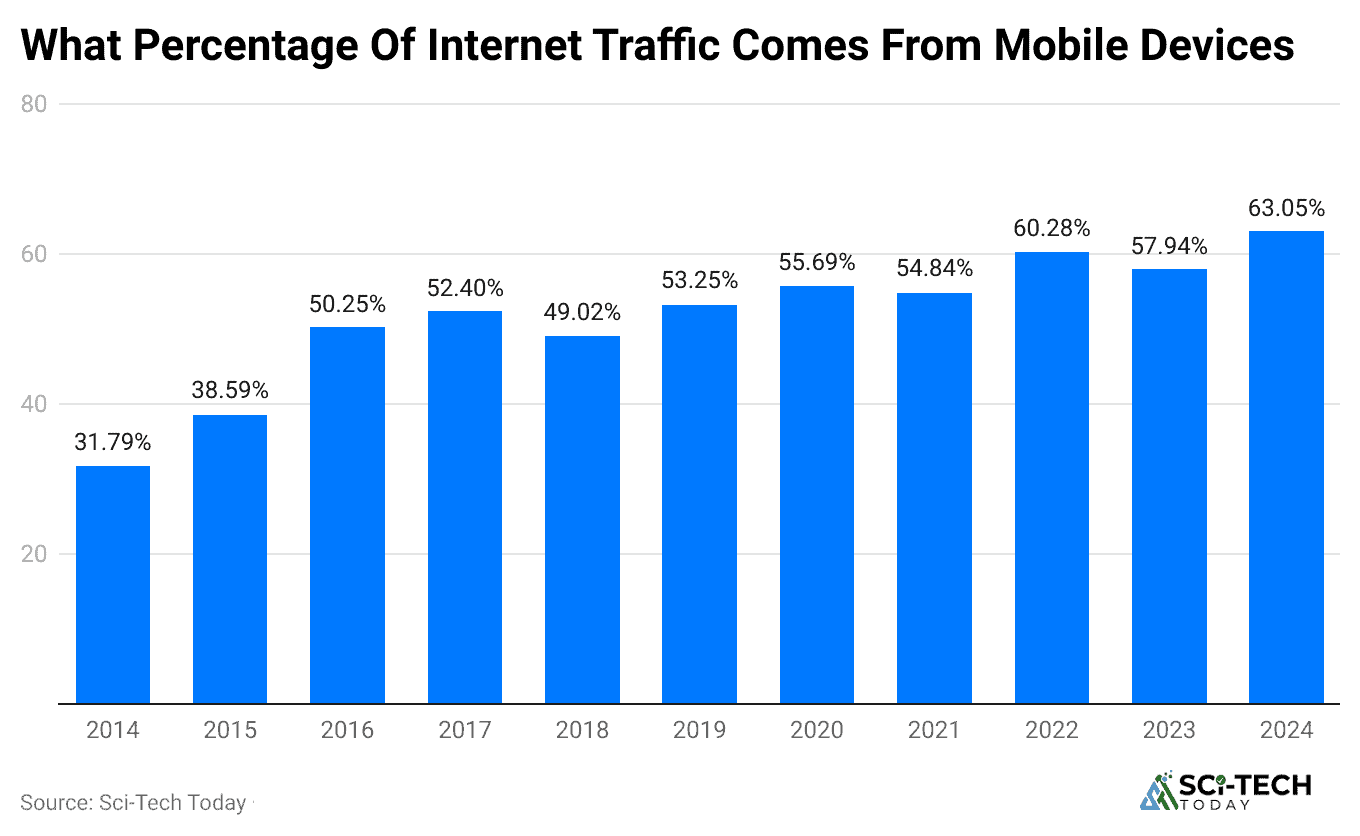
- Mobile devices now account for a commanding 62.45% of all global web traffic, a figure that has been consistently growing and outpacing desktop traffic since 2017.
- The share of desktop web traffic has fallen to 35.71%, with the remaining traffic coming from tablets and other devices.
- In the US, the average adult spends around 5.5 hours a day on their phone, with a significant portion dedicated to online media and apps.
- The number of global 5G subscriptions is expected to reach 3 billion by 2025, which is fueling a new wave of mobile connectivity.
- Mobile e-commerce is projected to make up 71% of all e-commerce sales in 2025, reaching a value of over USD 5.2 trillion.
- More than 4 billion mobile apps were downloaded in the first quarter of 2025 alone.
- The global mobile gaming market is forecast to reach a value of USD 110 billion in 2025, representing more than 50% of the entire gaming market.
- The average monthly mobile data usage per person is expected to exceed 28 GB in developed markets by the end of 2025.
- In developing countries, the cost of mobile data is falling, with the average cost per gigabyte now below USD 2 in many regions.
- Over 80% of all social media usage occurs on mobile devices.
- In countries like India, the mobile-first trend is even more pronounced, with 79.9% of all web traffic originating from mobile devices.
- Mobile browser traffic now accounts for 32% of all web traffic, while mobile apps are responsible for an impressive 44%.
- The average user has 90 apps installed on their phone, and uses around 30 of them each month.
- Around 70% of all online video consumption takes place on a mobile device.
| Mobile | 62.45% |
| Desktop | 35.71% |
| Tablet | 1.84% |
| Mobile E-commerce Share | 71% |
Internet Penetration Rate by Region
- Northern Europe leads the world with the highest internet penetration rate at 97.5%.
- Western Europe follows closely with a 95.1% internet penetration rate.
- Northern America ranks third with 93.3% internet penetration, driven by strong digital ecosystems in the United States and Canada, where internet access is deeply embedded in daily life.
- Southern Europe records a 91.6% internet penetration rate.
- Eastern Europe maintains a strong 90.6% penetration rate, reflecting continued improvements in internet infrastructure and rising digital adoption across the region.
- Southern America has reached 83.2% internet penetration.
- Central Asia (80.8%), Central America (79.2%), and Eastern Asia (78.5%) all show solid internet penetration.
- South-Eastern Asia rounds out the list with 78.2% penetration.
User Engagement and Platform Data
(Source: datareportal.com)
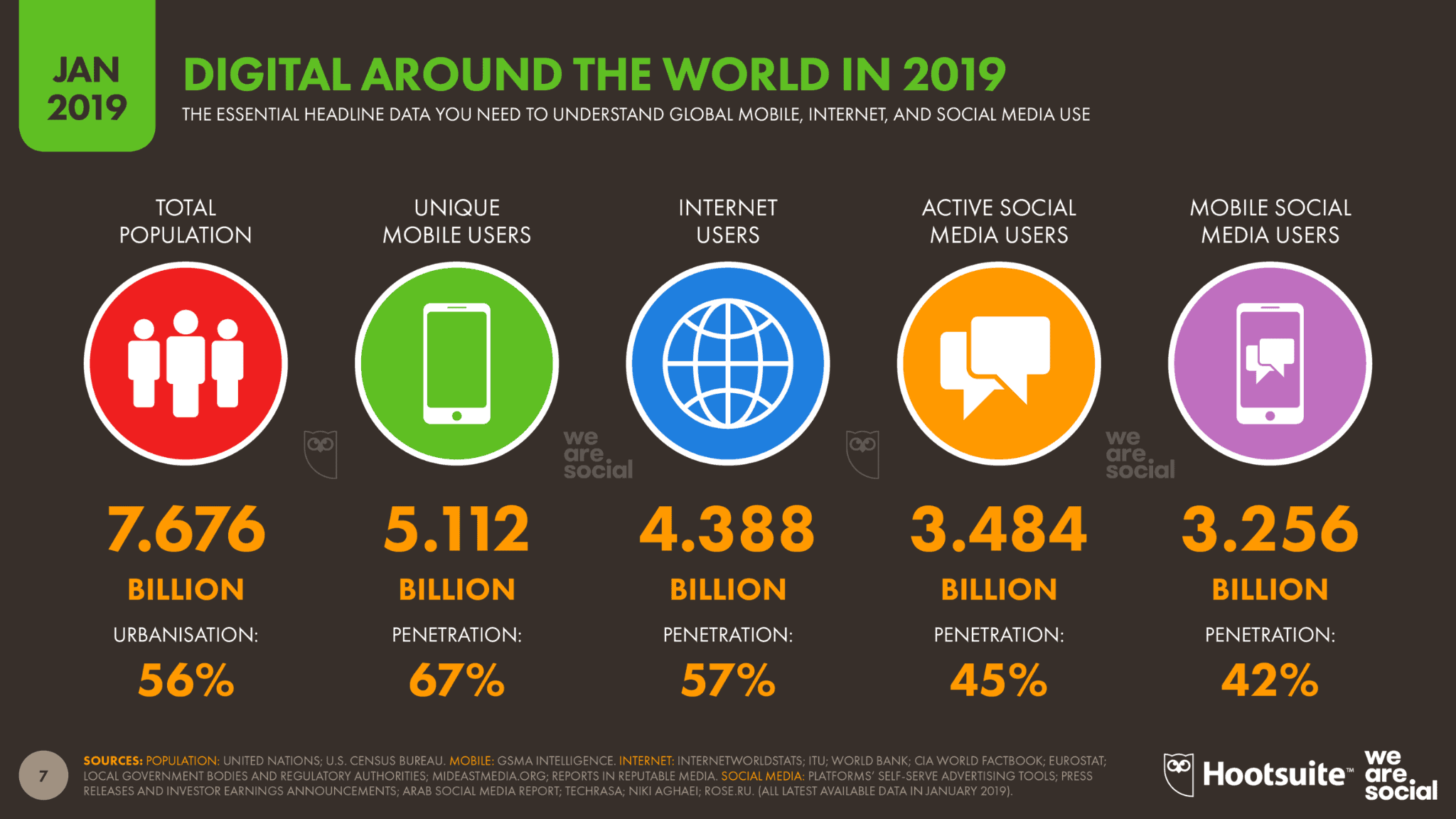
- There are now 5.41 billion active social media users globally, which is about 65.7% of the world’s total population.
- This represents a growth of 241 million new users in the past year alone.
- The average user engages with 6.84 different social media platforms per month, showing that people don’t stick to just one app.
- Facebook is still the largest social media platform, with over 3.07 billion monthly active users.
- YouTube and Instagram have both surpassed the 2 billion user mark, cementing their positions as dominant forces in video and visual content.
- The fastest-growing social platform is TikTok, which now boasts nearly 1.92 billion monthly active users.
- Threads saw an explosive user growth of 67% in the past six months alone.
- The global social commerce market was estimated at USD 3.6 trillion is 2025, driven by platforms like Instagram and TikTok.
- The total ad spending on social media platforms was estimated at USD 340 billion in 2025.
- India has the most social media users, with a projected 410 million people on these platforms.
- Around 70% of all online video consumption takes place on a mobile device.
- In developing countries, the cost of mobile data is falling, with the average cost per gigabyte now below USD 2 in many regions.
- Around 4 billion mobile apps were downloaded in the first quarter of 2025 alone.
| 3.07 Billion | |
| YouTube | 2.53 Billion (Ad Reach) |
| 2 Billion | |
| TikTok | 1.92 Billion |
E-commerce, Content, and Search

(Reference: meetanshi.com)
- The global e-commerce market is projected to be worth an astounding USD 7.4 trillion in 2025, with the number of online shoppers reaching a record 2.77 billion people.
- E-commerce is set to account for 21% of all retail sales this year, up from just 15% in 2020.
- The Asia-Pacific region is the largest e-commerce market, with sales projected to reach over USD 4.2 trillion in 2025.
- Google holds an overwhelming 91.47% of the global search engine market share, making it the primary gateway for billions of information-seekers.
- The global online video streaming market is forecast to reach USD 160 billion in 2025.
- Netflix is still the market leader in streaming, with its revenue projected to exceed USD 37 billion in 2025.
- The global podcasting market is projected to reach USD 34 billion in 2025, with over 500 million active listeners worldwide.
- Voice search is on the rise, with over 50% of all households now using voice-activated assistants.
| Global E-commerce Market (2025) | USD 7.4 Trillion |
| Global Online Shoppers (2025) | 2.77 Billion |
| Google’s Search Share | 91.47% |
| Online Video Market (2025) | USD 160 Billion |
Social Media Apps Usage on the Internet
- TikTok continues to rank among the most-downloaded apps, with roughly 825 million installs in 2024 and 644 million in 2025.
- Instagram climbed from 548M downloads in 2022 to around 768M in 2023 and 817M in 2024, and about 597 million downloads in 2025.
- Facebook remains widely downloaded, with around 571M installs in 2024 and 477M in 2025.
- WhatsApp continues to add hundreds of millions of installs per year, reaching roughly 527M downloads in 2024 and 465M in 2025.
- CapCut has solidified its role as TikTok’s companion editor, with roughly 360-410M global downloads in 2024.
- Snapchat remains a significant social platform, with around 300–330M installs per year in 2023-2024 and roughly 337M downloads in 2025.
- Telegram has continued to grow, from 310M downloads in 2022 to roughly 409M installs in 2024 and around 359M in 2025.
Demographics and Regional Use Case
- Internet adoption is highest among younger adults, with the 15 to 24-year-old age group having a penetration rate of 77%, a full 12 percentage points higher than the global average.
- The global internet gender gap stands at 8%, with 62% of men using the internet compared to 57% of women.
- In the United States, the average adult spends around 5.16 hours a day on their phone, with a significant portion of that time dedicated to social media and online streaming.
- In India, internet penetration is at 70% of the total population, with the number of users expected to cross the 1 billion milestone by 2027.
- The urban-rural digital divide in India is significant, with 80% of urban residents using the internet compared to only 55% of rural residents.
- The highest rates of social media usage are among 18 to 34-year-olds.
- In Southern Asia, a significant gender gap exists, with the male-to-female ratio on social media being 66% to 34%.
| Internet Use Among 15 to 24-Year-Olds | 77% |
| Male vs. Female Internet Users | 62% vs. 57% |
| India Urban vs. Rural Penetration | 80% vs. 55% |
| Daily Phone Time (US Adults) | 5.16 hours |
Trends and the Future Expectations
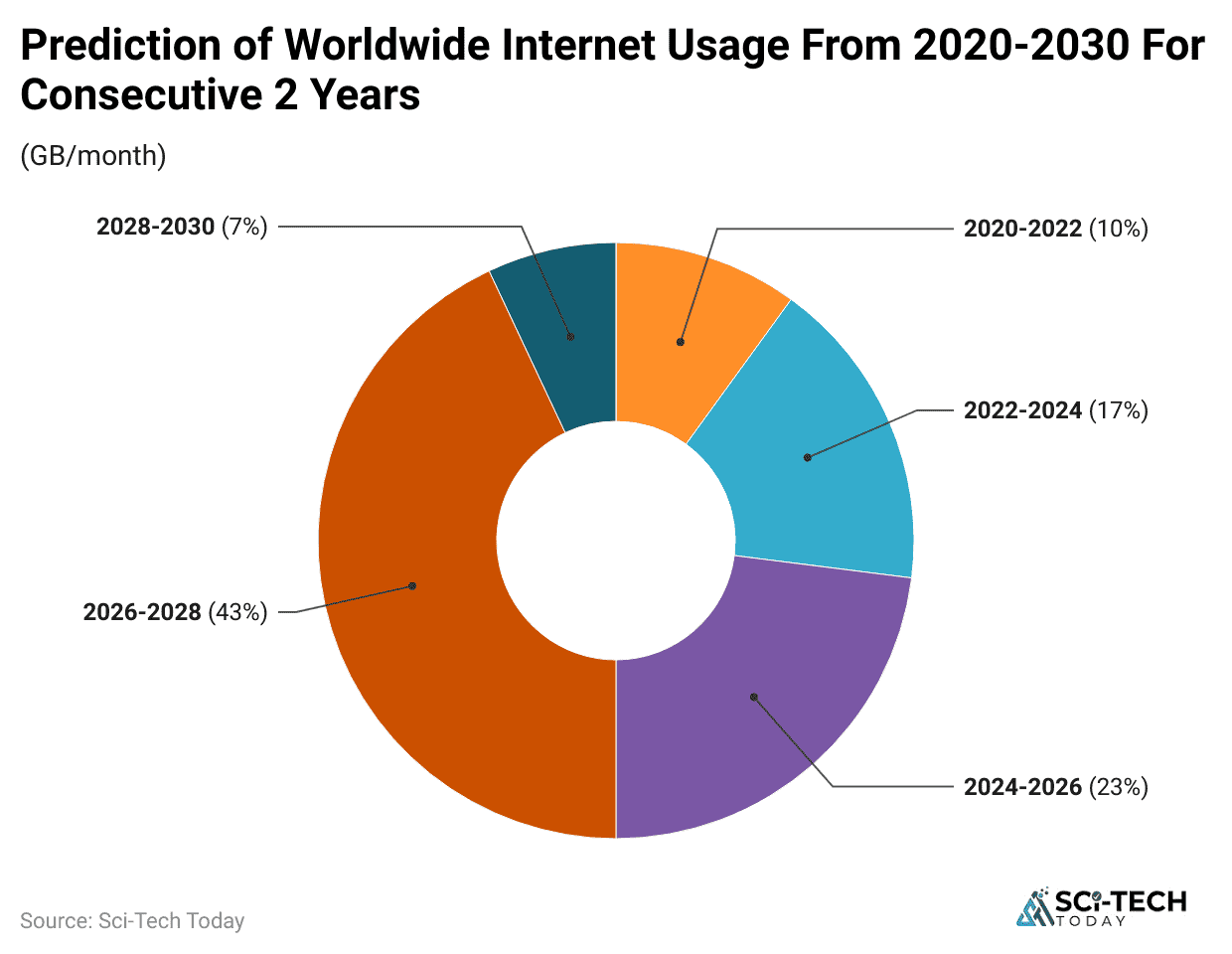
(Reference: researchgate.net)
- Global digital advertising is forecast to grow by 7.9% in 2025 to reach a historic USD 678.7 billion for the first time.
- Programmatic advertising is projected to grow by 8.4%, while ad spending on retail media is expected to increase by an impressive 13.9%.
- The global AI market was valued at USD 184 billion in 2024 and is expected to reach USD 826 billion by 2030.
- Over 42% of enterprise-scale companies report using AI in their business, and an additional 40% are exploring it.
- The Internet of Things (IoT) continues to expand, with projections that there will be nearly 17 billion connected devices by the end of 2025.
- The global cybersecurity market is forecast to reach USD 213 billion in 2025, driven by the rising urgency around application security and AI-related threats.
- Global cryptocurrency adoption saw an acceleration in the past year, with Asia-Pacific emerging as the fastest-growing region, with a 69% year-over-year increase in value received.
- In the US, AI is most commonly used by B2B marketers for content-related tasks (52%), coding (39%), and presentations (35%).
| Global Digital Ad Spend (2025) | USD 678.7 Billion |
| AI Market Value (2024) | USD 184 Billion |
| Connected IoT Devices (2025) | 17 Billion |
| Cybersecurity Market (2025) | USD 213 Billion |
Summary
Overall, when we look at these internet usage statistics, we can see billions of people getting connected, and the world is becoming more integrated and interdependent than ever before. From the dominance of mobile devices to the scale of social media and the rapid growth of e-commerce, this data shows a dynamic and changing landscape.
While we’ve made good progress in bridging the digital divide, the stats also remind us that a significant portion of the world remains offline. The challenge now is to continue the work of expanding access and ensuring that the benefits of a connected world are shared by everyone. I hope you like this article. Thanks for staying up till the end.
FAQ
China is the number one country for the most internet users, boasting an online population of over 1.1 billion individuals.
Commercial 6G networks do not exist yet, but China, South Korea, and India are the global leaders in experimental 6G technology. Prototype testing and lab trials have produced blazing speeds exceeding 100 Gbps.
No 7G mobile or cellular network has been launched in any country. Cellular technology standards currently only go up to 5G, while 6G networks are still in the early, pre-standardization research phase.