








Beginning
Pfizer Statistics: Pfizer is one of the biggest names in the global pharmaceutical industry. The company develops medicines, vaccines, and other healthcare products that reach millions of people worldwide. Its success with the COVID-19 vaccine brought Pfizer even more global attention, but the company’s business goes far beyond vaccines. Pfizer has a broad portfolio of products across areas such as oncology, immunology, and rare diseases. Its financial performance, drug sales, research investments, and global workforce also show the scale of its operations.
In this article, we explore the latest Pfizer statistics, including revenue, market performance, top-selling medicines, employees, and other key facts that highlight the company’s growth and impact.
Editor’s Pick
- Pfizer generated USD 15 billion in Q2 2026 revenue, up 3% year over year.
- Launched and acquired products grew 18% operationally during the quarter.
- Pfizer raised 2026 revenue guidance to USD 60.5-USD 62.5 billion.
- Q2 adjusted diluted EPS was USD 0.77, nearly unchanged year over year.
- Pfizer announced an additional USD 2.5 billion in productivity savings for 2027-2029.
- The company expects to spend USD 10.5-USD 11.5 billion on R&D in 2026.
- Eliquis remained Pfizer’s top-selling product in 2025, generating about USD 8 billion.
- Oncology remains a key growth priority, supported by Pfizer’s Seagen portfolio.
- Braftovi Phase 3 results showed a 56% reduction in the risk of disease progression or death.
- Pfizer had about 75,000 employees globally as of December 2025.
Pfizer’s Evolution: From Chemicals to Global Pharma
- 1849: Charles Pfizer and Charles Erhart founded Pfizer in Brooklyn. Its first product was santonin, a treatment for intestinal worms.
- 1919: Pfizer began mass-producing citric acid through mold fermentation, reducing reliance on European citrus supplies and building expertise that later supported penicillin production.
- 1936: Pfizer developed a new process for vitamin C and became the world’s leading vitamin C producer.
- 1941-1944: Pfizer used fermentation to produce penicillin at scale. By 1944, it had become the world’s largest penicillin producer, supplying most of the penicillin used by Allied forces on D-Day.
- 1942: Pfizer went public on June 22, issuing 240,000 new common shares.
- 1950: Terramycin became Pfizer’s first U.S. pharmaceutical sold under its own brand.
- 1972: Annual sales exceeded USD 1 billion, while Feldene became its first product to reach USD 1 billion in lifetime sales.
- 2000-2023: Major acquisitions, including Warner-Lambert, Pharmacia, Wyeth, Hospira, and Seagen, significantly expanded Pfizer’s portfolio.
- 2020-2026: Pfizer shifted focus beyond COVID-19 products. In Q1 2026, revenue reached USD 14.5 billion, while non-COVID revenue grew 7% operationally and launched/acquired products grew 22%.
- As of May 5, 2026, Pfizer had about 75,000 employees, 36 manufacturing sites, operations in roughly 200 countries and territories, and 96 pipeline projects. Its 2026 revenue guidance stood at USD 59.5-62.5 billion, with about 20 pivotal studies planned.
Pfizer Overall Performance
- Pfizer reported Q2 2026 revenue of USD 15 billion, up 3% year over year and 1% on an operational basis.
- Excluding Comirnaty and Paxlovid, revenue increased 5% operationally, while launched and acquired products grew 18% operationally.
- Reported diluted loss per share was USD 0.04, compared with EPS of USD 0.51 in Q2 2025. The loss included USD 4.3 billion in non-cash intangible asset impairments.
- Adjusted diluted EPS was USD 0.77, broadly unchanged from USD 0.78 a year earlier.
- Pfizer announced an additional USD 2.5 billion in expected productivity savings, which it plans to realize from 2027 through 2029.
Financial Guidance
(Source: quantumrun.com)
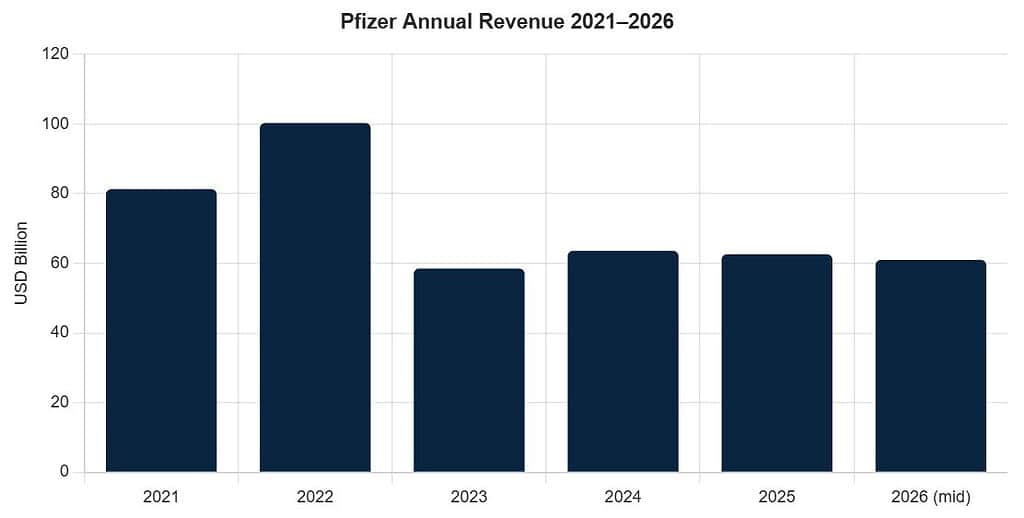
- Pfizer raised its full-year 2026 revenue guidance to USD 60.5-USD 62.5 billion, from USD 59.5-USD 62.5 billion previously. The midpoint increased by USD 500 million to USD 61.5 billion.
- The company expects non-COVID products to contribute about USD 1.5 billion more than previously expected, while COVID-19 product revenue is now projected at approximately USD 4 billion, down from USD 5 billion.
- Adjusted diluted EPS guidance remains USD 2.80-USD 3.00.
- The EPS outlook includes an approximately USD 0.10 impact from the Innovent Biologics transaction and a USD 650 million acquired in-process R&D charge.
- Pfizer maintained adjusted SI&A expenses at USD 12.5-USD 13.5 billion, adjusted R&D expenses at USD 10.5-USD 11.5 billion, and an adjusted effective tax rate of approximately 15%.
Revenue Breakdown
- Biopharmaceutical revenue reached USD 14.661 billion, up 2% reported and 1% operationally year over year.
- Pfizer CentreOne generated USD 373 million, increasing 7% reported and 5% operationally.
- For the first six months, total revenue was USD 29.484 billion, up 4% reported and 2% operationally.
- According to investors.pfizer.com, the United States contributed USD 17.588 billion, up 1.9%, and accounted for 59.7% of total revenue.
- International developed markets generated USD 7.169 billion, rising 9.1% and representing 24.3% of revenue.
- Emerging markets delivered USD 4.727 billion, up 4.4%, contributing 16.0% of total revenue.
Pfizer’s Cost and Expense Performance
- Cost of sales increased 8% to USD 4.092 billion in Q2 2026, while the six-month figure rose 15% to USD 7.640 billion.
- As a share of revenue, Q2 cost of sales increased to 27.2% from 25.8%.
- SI&A expenses remained broadly stable at USD 3.411 billion in Q2 and declined 1% operationally.
- R&D expenses increased 13% to USD 2.809 billion in Q2.
- Other income/deductions reached USD 3.716 billion.
- On an adjusted basis, cost of sales rose 4% to USD 3.656 billion, while R&D increased 12% to USD 2.730 billion. Adjusted SI&A declined 1% to USD 3.344 billion.
- Pfizer’s reported effective tax rate was 62.4%, while the adjusted rate was 14.1%.
Pfizer Earnings Per Share
- According to annualreview.pfizer.com, in 2025, Pfizer reported diluted EPS of USD 1.36, down from USD 1.41 in 2024. Adjusted diluted EPS rose 4% to USD 3.22, compared with USD 3.11 in 2024.
- As of 2026, Pfizer guides for adjusted diluted EPS of USD 2.80-USD 3.00, with a USD 2.90 midpoint, based on 5.74 billion shares and no repurchases.
- The midpoint implies a 9.9% decline from 2025 adjusted EPS.
Pfizer R&D Spending and Pipeline Investment
(Source: quantumrun.com)
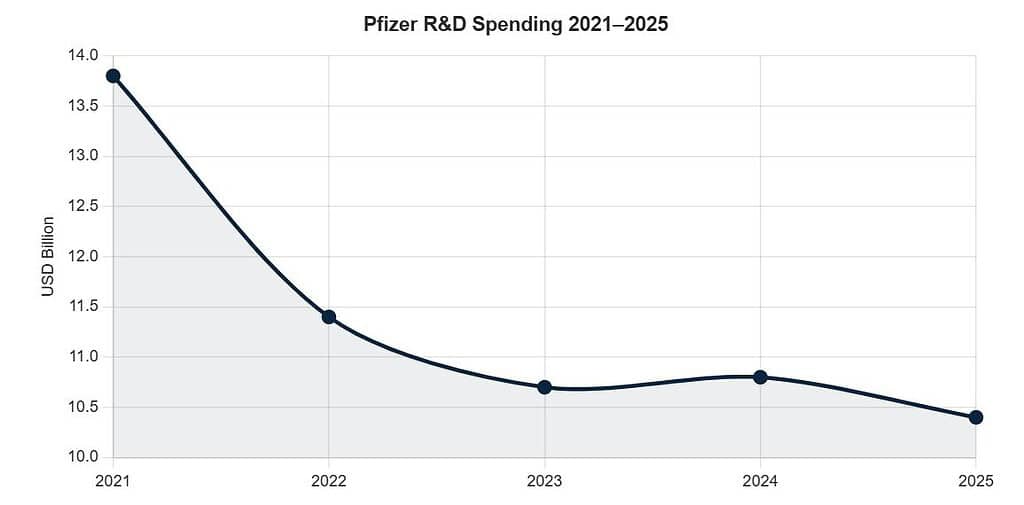
- In 2025, Pfizer spent USD 10.4 billion on R&D, down from USD 10.8 billion in 2024.
- As of 2026, Pfizer expects R&D spending of USD 10.5-USD 11.5 billion, supported by higher investment in PD-1 × VEGF and Metsera obesity programs.
- Pfizer also invested about USD 8.8 billion in business development in 2025, including Metsera and a 3SBio licensing deal.
Pfizer Employee Headcount
(Source: reveliolabs.com)
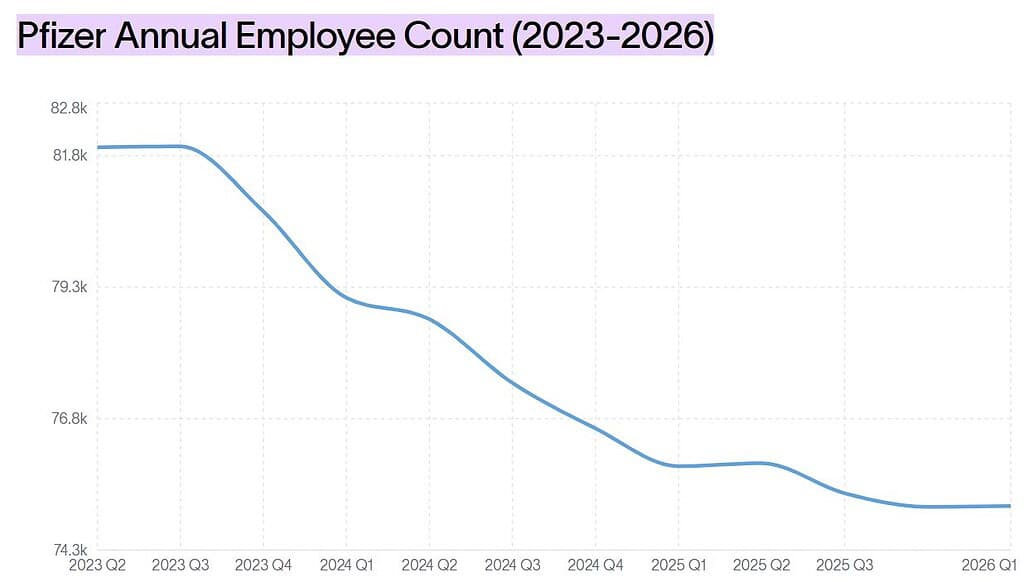
- Pfizer had about 75,000 employees globally as of December 31, 2025.
- External estimates put headcount at 75,157 in March 2026, down 758 employees (1.9%) year over year.
- Pfizer had 2,887 active job postings in 2026, with an estimated 2,184 new openings monthly, or 26,208 annually.
- The company operates 36 manufacturing sites and serves about 200 countries and territories.
By Region
| Region | Employees | Total Share |
| North America | 32,050 | 43.3% |
| South Asia | 8,597 | 11.6% |
| Northern Europe | 6,395 | 8.6% |
| East Asia | 5,523 | 7.5% |
| Western Europe | 4,894 | 6.6% |
| Southern Europe | 3,688 | 5.0% |
| Southeast Asia | 2,777 | 3.8% |
| Central America and the Caribbean | 2,662 | 3.6% |
| South America | 2,151 | 2.9% |
| North Africa | 1,267 | 1.7% |
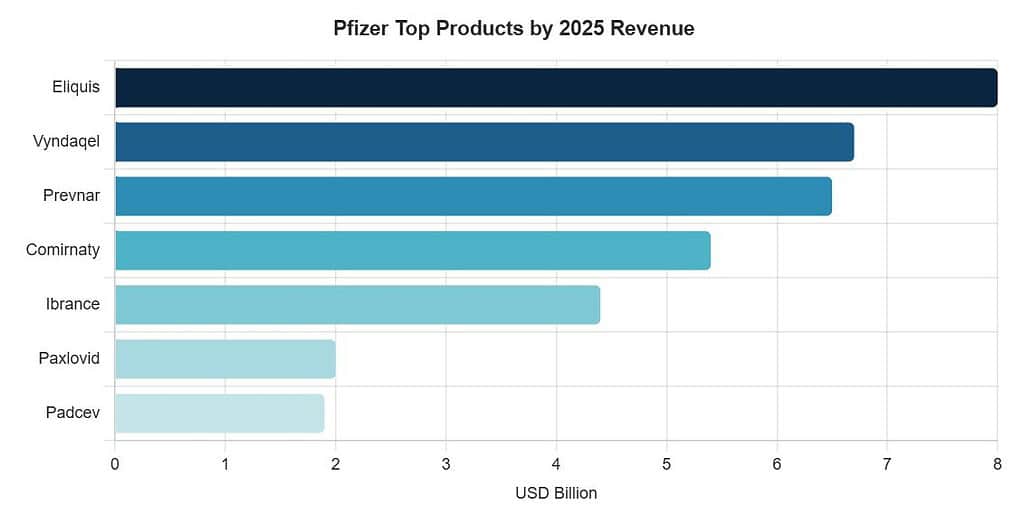
Pfizer Top-Selling Products in 2025
(Source: quantumrun.com)
- Eliquis remained Pfizer’s top product, generating about USD 8 billion in revenue.
- The Vyndaqel family followed with USD 6.7 billion, while Prevnar generated USD 6.5 billion.
- Moreover, Comirnaty delivered approximately USD 5.4 billion.
- Ibrance generated USD 4.4 billion, while Paxlovid and Padcev contributed USD 2.0 billion and USD 1.9 billion, respectively.
Pfizer’s Therapeutic Area Strategy
Oncology
- Pfizer sees oncology as a major growth engine, supported by the 2023 Seagen acquisition and its antibody-drug conjugate portfolio.
- Key programs include Padcev, Elrexfio, sasanlimab, and vepdegestrant.
- Vepdegestrant showed a 0.57 hazard ratio in VERITAC-2, with a 95% CI of 0.42-0.77 and p<0.001.
Vaccines
- Pfizer is expanding beyond COVID-19 vaccines through Abrysvo, mRNA flu programs, and a combined COVID–flu vaccine.
- Abrysvo showed 66.7% efficacy against RSV-LRTD in older adults and 81.8% efficacy against severe RSV-LRTI in infants through maternal vaccination.
Inflammation and Immunology
- Pfizer is targeting autoimmune diseases, particularly ulcerative colitis and dermatology.
- Velsipity achieved 32% clinical remission at Week 52 versus 7% for placebo, while ritlecitinib supports its alopecia areata franchise.
Rare Diseases
- Pfizer focuses on rare cardiomyopathy, hemophilia, neuromuscular, and metabolic diseases.
- Tafamidis delivered a 0.70 hazard ratio for mortality, while marstacimab reduced annualized bleeding by 93%.
Internal Medicine and Anti-Infectives
- Pfizer is exploring obesity medicines, including a GIPR antagonist in Phase 2, while continuing selective investments in antivirals, antifungals, and infection prevention.
Pfizer Stock Key Statistics
- A report shared by TIKR says Pfizer’s current stock price is USD 25.62, while the TIKR mid-case target is around USD 28.
- The average Wall Street target is approximately USD 29, implying a potential total return of about 10%.
- Based on these estimates, the stock offers an annualized IRR of roughly 2%.
Key Product and Business Developments
- Braftovi: In May 2026, Phase 3 BREAKWATER results showed a 56% reduction in the risk of disease progression or death, with an HR of 0.44. Updated overall survival showed a 44% reduction in the risk of death, with an HR of 0.56. No new safety concerns were identified.
- Comirnaty: In July 2026, the European Commission approved Pfizer and BioNTech’s 2026-2027 XFG-adapted COVID-19 vaccine for people aged 6 months and older. In May, the EU also approved an updated pediatric formulation, including a 10-μg dose and a 2-dose primary series.
- Hympavzi: In June 2026, the FDA expanded its use to patients aged 6 years and older with hemophilia A or B. The EU also expanded its indication in May for patients aged 12 years and older weighing at least 35 kg.
- Ibrance: FDA approval in June 2026 expanded its use in HR+/HER2+ metastatic breast cancer, making it the first and only CDK 4/6 inhibitor approved for HR+ metastatic disease regardless of HER2 status.
- Litfulo: July 2026 Phase 3 results showed meaningful improvements at both 50 mg and 100 mg doses in vitiligo, supporting plans for global regulatory filings.
- Lorbrena: Seven-year data showed a 55% chance of remaining alive without disease progression versus 3% for Xalkori, with an HR of 0.19, representing an 81% reduction in progression or death risk.
- Talzenna: Phase 3 data showed a 52% reduction in radiographic progression or death risk, while 3-year rPFS was 77% versus 56%.
Final Thoughts
Pfizer remains a major player in the global pharmaceutical industry, but it faces challenges from falling COVID-19 product sales and patent expirations. At the same time, the company is working to support growth through new medicines, a strong product pipeline, and cost savings.
Pfizer’s future performance will depend on how well it replaces lost revenue with new products and expands its business. Overall, the company has a strong base but must continue to adapt to changing market conditions.
FAQ
Pfizer is known for medicines and vaccines across areas such as oncology, vaccines, rare diseases, inflammation and immunology, internal medicine, and anti-infectives.
Pfizer supplies its products to around 200 countries and territories worldwide.
Yes. Pfizer’s COVID-19 vaccine may cause side effects such as fatigue (43%), muscle pain (39.67%), headache (33.27%), and joint pain (25.75%).