









Introduction
Piracy Statistics: Piracy is one of the leading issues faced in 2026, and it affects markets like entertainment, software, and publishing. Even though people have tried to impose restrictions on illegal downloading, streaming, or sharing of files, it is still a widespread problem because there is a lot of free content that is easily available on the internet.
As per the piracy statistics 2025, vast encroachment by digital technologies, fast broadband internet, coupled with the appetite for digital content, has caused monumental losses for companies across the globe.
Best In The Editor’s Eye
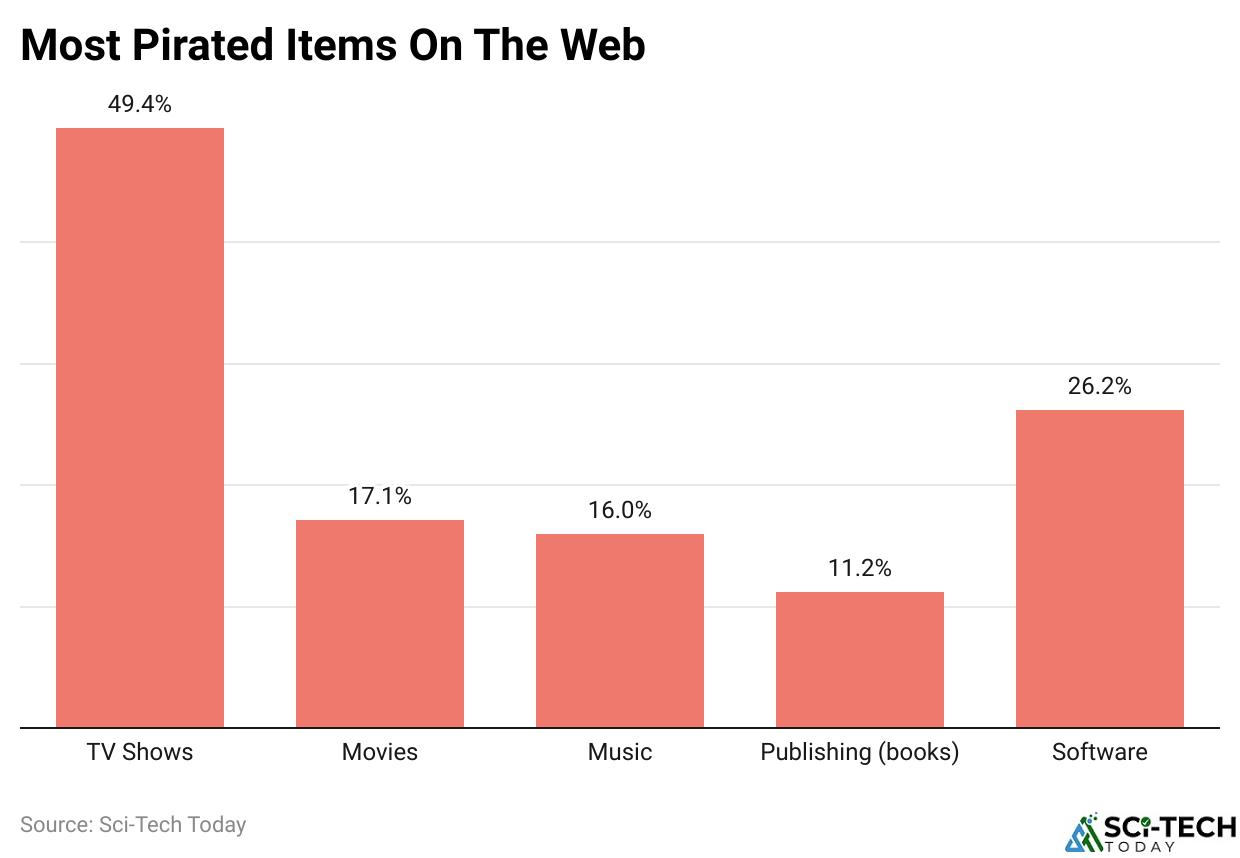
- According to Piracy statistics, in the year 2025, television shows were reported as the most pirated type of media with 45.3% of all piracy visits, second to publishing with a 27.7% share, followed by films with 12.9%. Music and software represent 7.5% and 6.6% shares each.
- Between January 2017 and November 2023, visits to software piracy websites amounted to nearly 84.77 billion.
- The U.S. pay TV industry was predicted to suffer a loss of USD 6.6 billion this year due to account sharing and piracy, based on the data provided by Bloomberg through the statistics of Piracy, and it is anticipated that this loss will increase to USD 9 billion in 2024.
- In 2023, Russia contributed to over 8.5% of the total software piracy in the world.
- However, in 2023, as many as 40% of software vendors sustained losses due to software piracy, an increase from 17% the year before.
- It was also noted that 33% of the respondents in the IT firms said that they experienced losses due to piracy in the range of 6-10%, while 8% of them indicated that their losses were more than 30%.
- According to piracy statistics, 67% of the data in the population consists of the countries of North America and Western Europe, where the majority of the pirate sites are situated.
- In the same year, reports published on the number of users of illegal software reported that China was at the forefront. In the year 2021, out of all the traffic driven by piracy, television piracy accounted for 50.3%.
- The U.S. music industry, on its own, reportedly loses USD 12.5 billion due to piracy every year.
- Additionally, they are four times more prone to losing their identity because 44% of such people fall victim to this, compared to 10% of people using legitimate content.
- In Central/Eastern Europe and the Asia Pacific, 57% of computer users confessed to having once downloaded pirated software, whereas most countries had over 50% unlicensed software usage.
- The average cost incurred in a single attack of malware is estimated to be USD 2.4 million, and on average, it takes about 243 days to identify the malware, with an extra 50 days to do away with it.
- Piracy statistics indicate that the U.S. content and distribution industry experiences losses estimated to range between USD 29.2 billion and USD 71 billion every year as a result of digital video piracy, with the online movie and television industry poised to lose USD 11.58 billion in the year 2022.
- Close to 127 billion episodes of U.S. television programs are downloaded illegally and streamed each year, whereby 230 billion people in the world pirate-watch series and movies.
- Piracy statistics show that in 2004, the average profile of a pirate belonged to a young male residing in cities who was between the ages of 16 and 24.
- These days, people in the age group 30 to 44 are the most common book pirates. In the year 2023, the most downloaded films on the pirate sites were “Spider-Man: No Way Home” with 21%, “The Batman” with 13%, and “Doctor Strange” with 10%.
Piracy Key Facts
- As a result, more viewers are attempting to find alternative mediums to access music or television even before they are released to the general public. This sometimes leads to finding ways to break the law to access the preferred films or series.
- Piracy cases can be found in critics such as Egrit Yusoff’s case; but in America, 51% of the audience polled was found consuming pirated works.
- Media piracy occurs in different categories; video piracy is among the most widespread of such media forms.
- For example, among the population residing in Spain and Canada, one-third admitted to having watched pirated video works.
- Among the many reasons behind video-on-demand piracy is the eternal desire to see new movie titles right from home without necessarily paying high cinema entry tickets or cable charges for television.
- The commonest piracy techniques include stream ripping, which means unauthorized download/streaming or illegal use of any such content.
- In the wake of the advancements in technology and digitization, this, in turn, has led to a decline in the sales of physical albums.
- Whereby music absorption via streaming rather than physical copying.
- Recent piracy statistics show that more than half of the individuals who use the internet and are in the age bracket of 16-24 years have engaged in music piracy, with the highest reported rates from Spain and Brazil.
- A new market for piracy purposes has developed due to the introduction of e-readers.
- It is estimated that in the US alone, 16.5 million people download books illegally, causing losses amounting to USD 315 million in sales.
- Although music piracy is rampant among the youth, book piracy is often observed more among individuals aged 30 to 44 years, while older age cohorts record significantly lower rates.
- The ease and zero cost associated with illegal downloading are the main reasons for this, as some people are forced to download illegal eBooks because they cannot find the titles they want in bookstores online.
- Hence, some sites such as 4shared.com and bookos.org still thrive as people look for less expensive and more convenient ways of obtaining the content they need.
Pirated Items on the Web
(Reference: techreport.com)
- According to Piracy statistics, in the year 2025, television shows were reported as the most pirated type of media with 45.3% of all piracy visits, second to publishing with a 27.7% share, followed by films with 12.9%. Music and software represent 7.5% and 6.6% shares each.
- A 2025 report stated that during the COVID‑19 period (2020–2022), software piracy increased by roughly 20–30%, reversing part of that earlier decline.
- By 2024, MUSO tracked 216.3 billion visits to piracy sites, a 5.7% decline from 2023. Software piracy visits edged down to 14.9 billion, ‑2.1% year‑on‑year, while TV, film, and music also declined and publishing piracy was the only major sector to grow.
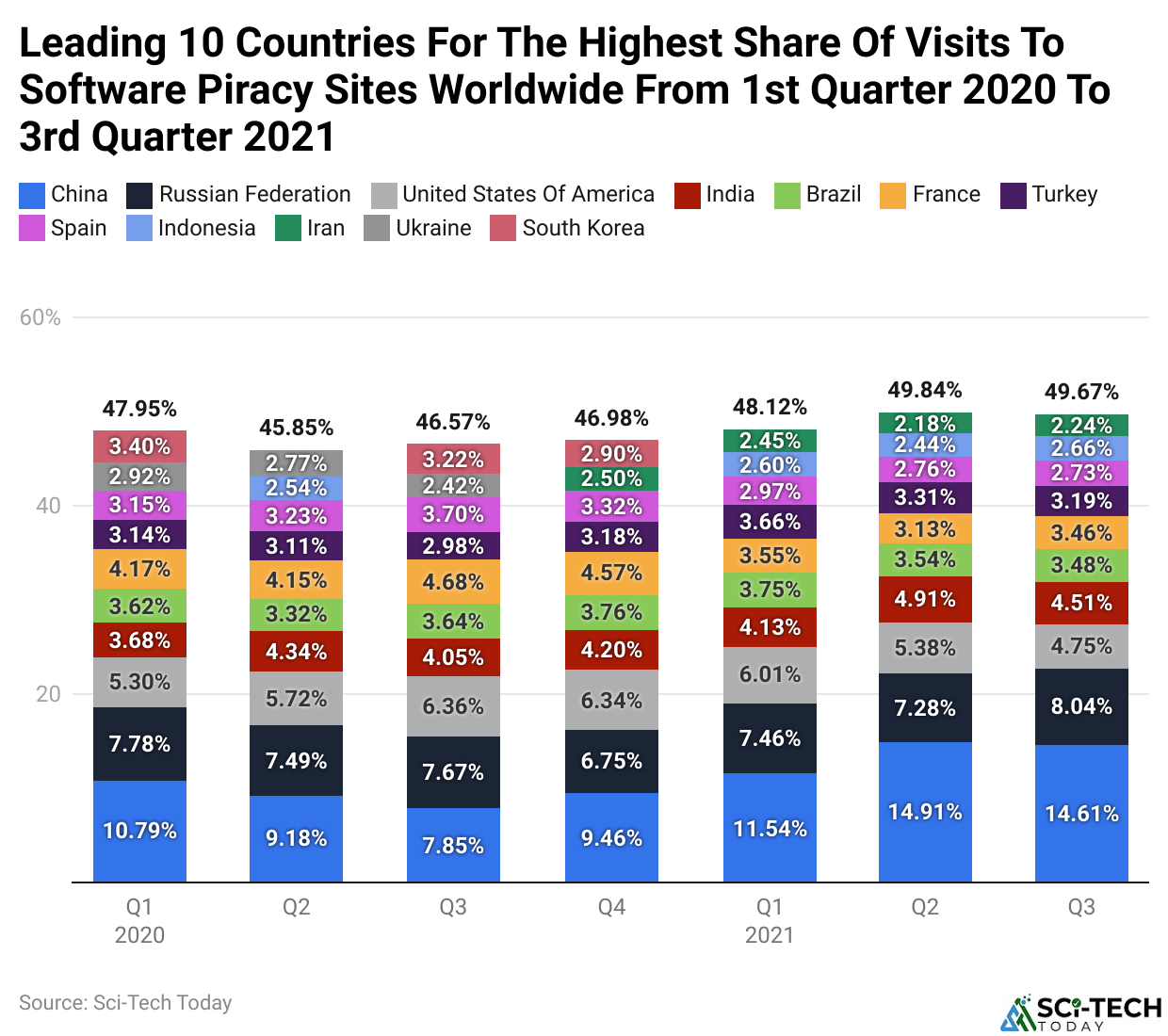
Countries Ranking Highest In Visiting Software Piracy Websites
(Reference: statista.com)
Revenera’s Compliance Intelligence data updates the latest detailed ranking of “top countries using pirated software” as of November 2025:
- China
- Russia
- India
- United States
- Brazil
- Germany
- Vietnam
- Hong Kong
- France
- Iran
Piracy Statistics by Streaming Industry and Password Sharing
(Reference: proxy.parisjc.edu:8293)
- In the present day, the activity of video streaming has dramatically grown to become a multi-million-dollar industry, and Netflix has been at the forefront of implementing changes in home entertainment.
- The increased participation in video streaming has also attracted the attention of big media players such as Disney, NBC Universal, and Warner Media, which are active in the market, along with Amazon and Apple, all of whom are fighting for a piece of the streaming money.
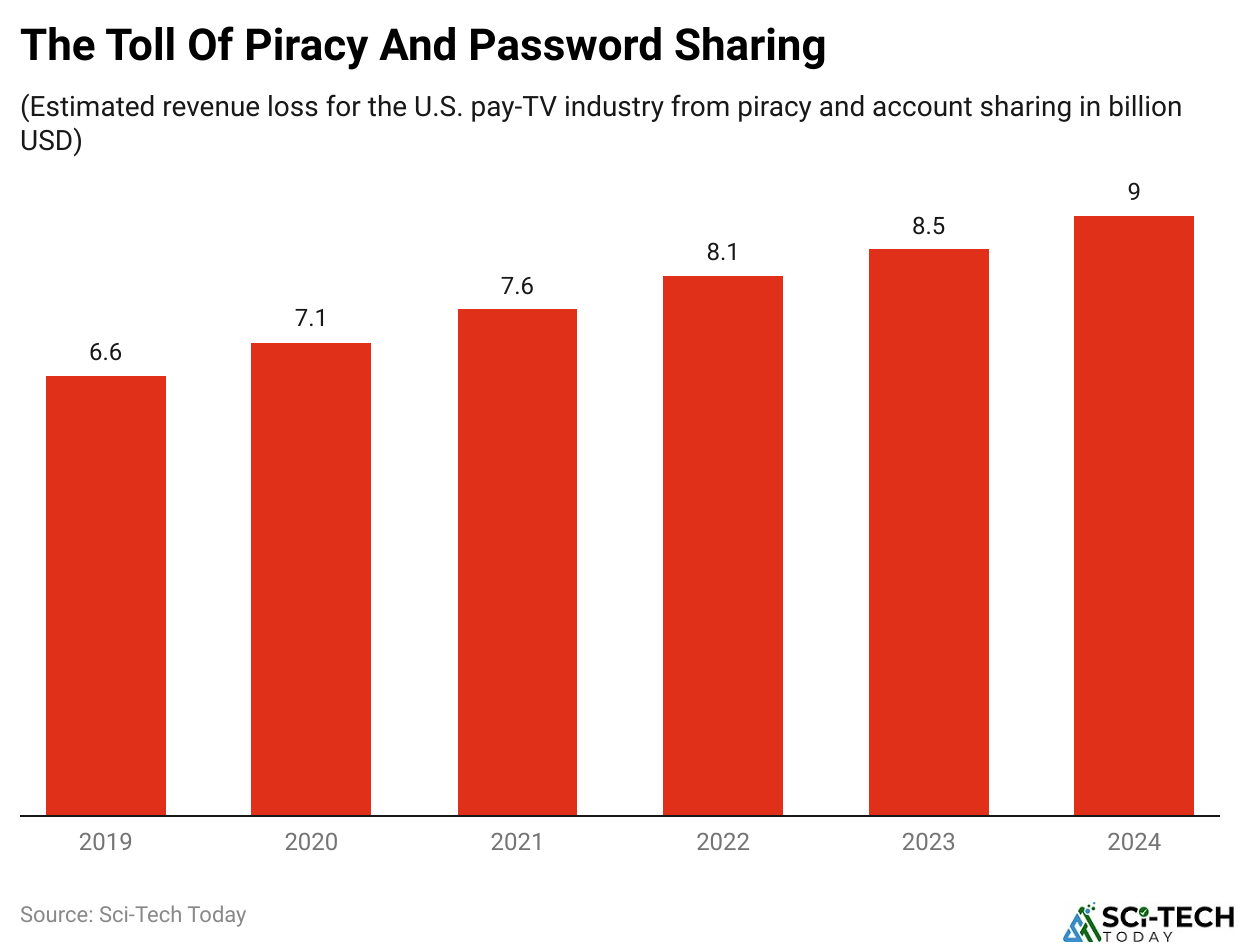
- Despite the positive projection one would have on the prospects of the streaming sector, there are lurking problems mostly associated with password sharing, which is a norm that causes billions of losses every year.
- The U.S. pay TV industry was predicted to suffer a loss of USD 6.6 billion this year due to account sharing and piracy, based on the data provided by Bloomberg through the statistics of Piracy, and it is anticipated that this loss will increase to USD 9 billion in 2024.
- In response, a coalition of companies, including Netflix and HBO, is reportedly preparing to take action against password sharing, exploring potential strategies to prevent subscribers from sharing their accounts with friends and family.
- Previously, Netflix adopted a more lenient approach to the issue; CEO Reed Hastings remarked that it was a practice “you have to learn to live with,” given the blurred lines between legitimate and illegitimate sharing.
- However, with escalating competition in the streaming sector, the company’s stance appears to be changing, much to the dismay of many users who enjoy free access to streaming content.
Media Sector Share of Worldwide Visits to Piracy Websites
(Reference: proxy.parisjc.edu:8293)
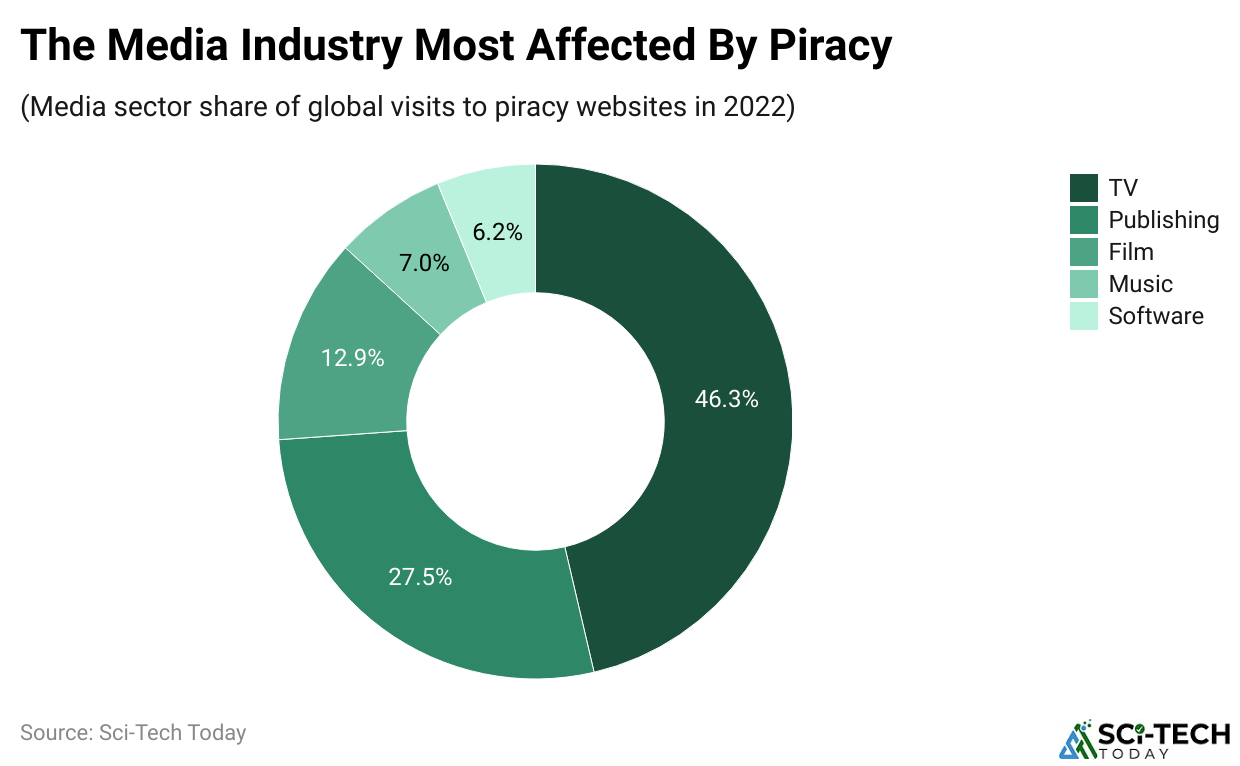
- Recent Piracy statistics reveal that among all the piracy websites visited in 2024, 46% of the visits went to websites containing copyrighted TV content, while less than 13% of the visits went to websites displaying pirated movies.
- As shown in our graph, less than 15% of illegal online traffic is attributed to music and software piracy as compared to the other forms of online abuse.
- 28% of the worldwide illegal web traffic is derived from the publishing industry, which includes e-book piracy and the scanning of physical books.
- In the TV and film industry, Muso looks closely at the visits by country and states that the leading five are the USA (14 billion), India (9 billion), and Russia (8 billion).
- At the same time, China and the UK have the same number of visits, 4 billion each. 95% of all the traffic associated with television piracy and crimes related to viewing or downloading movies is generated from illegal streaming websites.
- Torrents used to be a very common peer-to-peer file-sharing tool, which has become obsolete in today’s world because the total piracy traffic constitutes only a small percentage of the total traffic.
- Piracy statistics indicate that in countries like Russia, where a large number of music and movie piracy websites are available, piracy statistics reported that over 216.3 billion visits to such websites occurred in 2024, down 5.3% from the year before.
- The most important issue is the extent of harm caused by piracy, as different sources report significantly different rates of figures lost because of participants’ inability to pay.
Piracy Statistics By Country
| # | Country | Billion visits |
| 1 | United States | 26.68 |
| 2 | India | 17.56 |
| 3 | Russia | 15.40 |
| 4 | Indonesia | 12.11 |
| 5 | Vietnam | 7.44 |
| 6 | Turkey | 5.93 |
| 7 | Canada | 5.83 |
| 8 | United Kingdom | 5.82 |
| 9 | France | 5.64 |
(Source: dataprot.net)
- Recent Piracy statistics concerning digital content theft reveal that more than half (over 50%) of all recorded traffic is targeted at streaming websites, which are still the favorite among a large number of users today.
- However, the advancement of torrents and direct download websites has not declined either. Interestingly, despite numerous restrictions on pirate websites and public disapproval of such practices, the UK was still one of the top 10 countries.
- The first, nearly 26.70 billion downloads, came from the United States, followed by India and Russia.
- Strangely, even though most narratives portray China as a country that heavily relies on pirated downloads, the country has surprisingly yet to appear in the rankings.
- It only managed to get 4.6 billion visits in 2019, which means it was in 18th place on the list, which is not great at all for the country with the largest population of 1.4 billion.
Danger of Digital Piracy
- Digital Piracy includes risks such as being exposed to adult or inappropriate content, getting infected by malicious software, and falling victim to phishing tactics or cyber crimes, among others.
- However, purchasing or using pirated materials may also affect you financially, as a few individuals may engage in fraud to obtain money from you.
- Digital Citizens Alliance (DCA), a non-profit organization, has surfaced and claimed that out of the total number of people who use credit cards to buy piracy services from any pirate websites in America, 72% of them have experienced cases of fraud after the completion of the transaction, while the other 18% who do not indulge in such transactions.
- Additionally, they are four times more prone to losing their identity because 44% of such people fall victim to this, compared to 10% of people using legitimate content.
- In light of these figures, the DCA has collaborated with the Attorneys General of 19 US jurisdictions and Washington, DC to develop and distribute PSAs.
- These PSAs warn viewers of certain risks, such as malware or credit card fraud, and ZIP piracy.
- To sum up, the adverse effects of consuming pirated materials will often surpass the enjoyment derived from accessing the content.
Efforts To Combat Piracy
- Stricter actions against illegitimate practices such as piracy are being taken by many governments through organizing campaigns and working with relevant local technology companies.
- In the same year, for example, in 2024, the United States of America and the European Union made it compulsory to pay a penalty of USD 150,000 to any person caught engaging in the distribution of pirated works.
- The existence of easy and legitimate streaming services such as Netflix and Amazon Prime has contributed positively to the fight against piracy by providing better options.
- Currently, it has become difficult to locate any consumer whose illegal consumption accounts for more than 30% of their total consumption of these services, which have increased with tremendous speed and worldwide spread.
- Technological means such as digital rights management (DRM) solutions, isotopic watermarking, and artificial intelligence-based content monitoring systems are used to monitor the internet for illegal content uploads and deter them.
- However, in the year 2024, several of these measures are rendered ineffective by piracy-averse hackers; hence, piracy remains a concern.
Final Thoughts
Despite the steps taken to mitigate the problem of piracy and the advancement in technology, in 2026, piracy remains a serious global problem. Statistics concerning piracy have revealed that a lot of industries stand to lose a fortune each year due to this issue. Efforts to curb piracy would include concerted efforts from governments, technological companies, and content distributors to provide realistic options for punishing pirates.
This may bring some hope, as the downward trend may even be affected by the statistics for these crimes in a few years, with increasing awareness and measures to mitigate these crimes.
FAQ
Piracy has two main definitions: the historical and legal act of robbery or violence at sea, and the modern term for the unauthorized reproduction and distribution of copyrighted material.
Legally, digital piracy is classified as copyright infringement rather than traditional theft. While theft involves permanently depriving someone of their physical property, piracy involves making an unauthorized digital copy, allowing the original owner to retain their work.
Digital piracy began in the mid-1970s with early computer hobbyists and hackers. Long before the internet, these individuals subscribed to a philosophy of open information access, copying and distributing hard copies of computer software and games via early social computer clubs and magnetic media.