








Brief Overview
Online Banking Penetration Statistics: Online banking has become a regular part of daily life for managing finances, shopping, and subscriptions. In recent years, most customers are using banking applications and websites to check their balances, transfer funds, pay bills, and track spending. Due to technological progress, smartphone use increased, internet costs declined, and banks shifted more services to digital channels to make banking faster and easier, thereby expanding the digital economy.
Online Banking Penetration Statistics include several recent analyses from diverse sources that indicate the number of people who use these services and the frequency with which they rely on them. All the detailed information will also help compare adoption across countries and groups, such as younger and older users, higher- and lower-income households, and urban and rural communities. Meanwhile, it highlights several challenges, including concerns about scams, poor connectivity, low digital skills, and limited trust.
The Editor’s Must-Reads
- According to a report by Fortunly.com, the digital banking platform market may reach USD 11.56 billion by 2025.
- The global digital transaction management market is expected to reach around USD 20 billion by 2025, up from USD 15.4 billion in 2024.
- 59.4% of users preferred online banking via mobile apps in 2025.
- By 2029, more than 79% of Americans may use online banking.
- As of February 2025, the largest number of online banking users was in the Far East and China, at 805.1 million.
- A report by CoinLaw further states that online banking use is highest in North America (85%).
- According to a report published by Self, 52.6% of people use online banking weekly, and daily users (27.1%).
- Around 64.3% of people primarily want 24/7 access and a mobile app (59.1%) to bank at any time.
- Most people access online banking using a smartphone (70.8%) and a laptop (54.1%).
- 35% of survey respondents reported that security and fraud are their primary concerns regarding digital banking.
- According to Worldpopulationreview.com, in 2025, Denmark and Iceland had the highest online banking participation, at 100% each.
- In 2024, Chase Bank is a leading online banking platform with more than 51 million online banking users.
- In 2025, approximately 78% of people aged 18-34 report that mobile banking is their primary banking method, according to coinlaw.io.
- scoop.market.us further reported that in 2024, online banking accounted for the largest share among users aged 65 years and above (28.2%).
General Online Banking Penetration Statistics
- According to self.inc, in 2023, approximately 66% of people in the U.S. used digital banking, and this is expected to rise to over 79% by 2029.
- Most users preferred online banking via mobile app (59.4%), while 27.4% chose a web browser and 10.5% still prefer going to the bank in person.
- The primary concern is security and fraud (35%), followed by fear of losing access due to technical issues (31.5%).
- Meanwhile, 23% reported encountering online banking scams.
- Common uses include checking balances (73.2%) and moving money between accounts (69.2%).
- Still, 51.3% report that branches matter, and 83.9% have visited one in the past year.
- Additionally, 56% distrust online-only banks, and 22% cite security concerns.
- According to a report by Fortunly.com, the digital banking platform market may reach USD 11.56 billion by 2025.
- As of 2024, 55% of Americans preferred mobile banking apps, and 63% did transactions on smartphones or tablets.
- 96% are happy with their bank’s online and mobile app experience.
- Age gaps persist, as only 35% of Baby Boomers used mobile apps in 2024.
- 66% of Millennials often log in about five times per week.
- Digital wallets handled USD 10 trillion in transaction value in 2024, and the digital payments market is forecast to reach USD 20.37 trillion in 2025.
- In 2024, 91% said mobile and online access mattered when selecting a bank.
Digital Transaction Management Market Size
(Source: market.us)
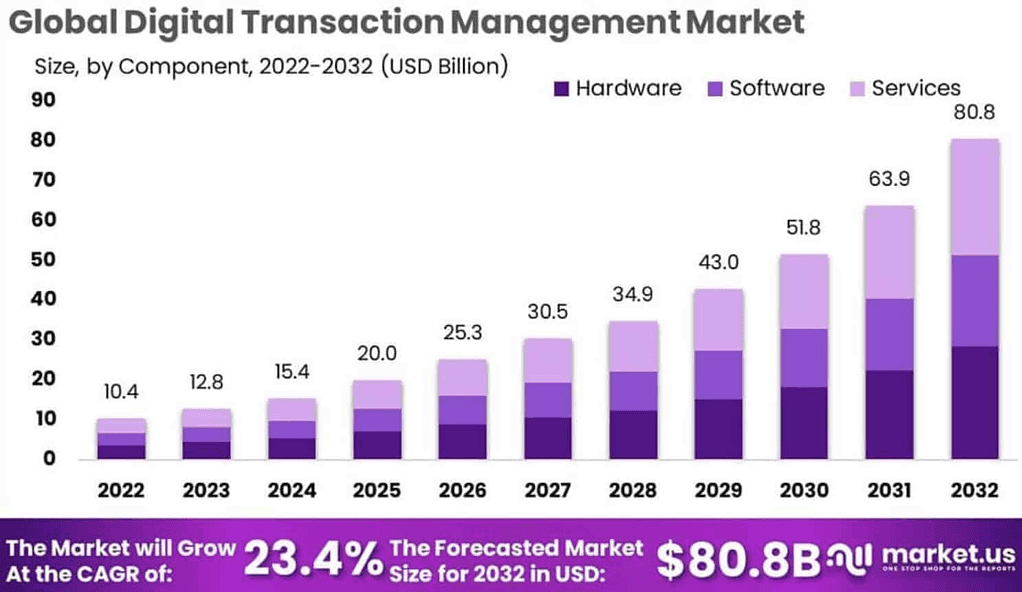
- The global digital transaction management market is expected to reach around USD 20 billion by 2025, up from USD 15.4 billion in 2024.
- The estimated market valuations are projected to be USD 25.3 billion in 2026, USD 30.5 billion in 2027, USD 34.9 billion in 2028, USD 43 billion in 2029, USD 51.8 billion in 2030, USD 63.9 billion in 2031, and USD 80.8 billion in 2032.
- The market will grow at a 23.4% CAGR from 2026 to 2032.
Active Online Banking Penetration Statistics by Region
(Source: coinlaw.io)
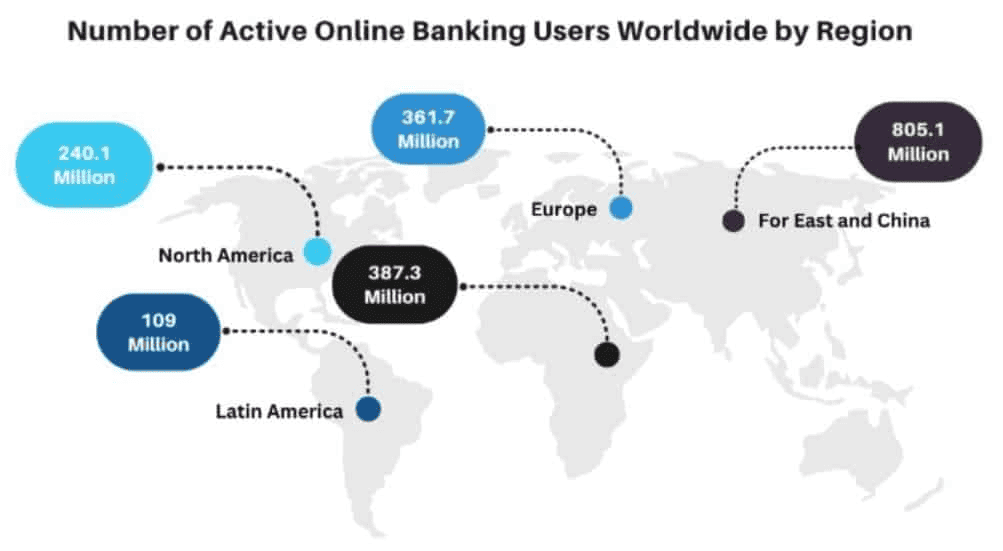
- At the end of February 2025, the largest number of online banking users was in the Far East & China, with 805.1 million people.
- Online banking users were distributed across North America (240.1 million), Europe (361.7 million), and Latin America (109 million).
- The remaining part of the world consisted of 387.3 million online banking users.
The previous years’ user counts are mentioned in the table below:
| Region | 2024 | 2023 | 2022 | 2021 | 2020 |
| Users (in millions) | |||||
| Far East & China | 974.3 | 928.9 | 885.6 | 844.4 | 805.1 |
| North America | 279.6 | 272.7 | 261.4 | 250.5 | 240.1 |
| Europe | 435 | 416.4 | 398.1 | 379.9 | 361.7 |
| Latin America | 198 | 170.4 | 146.7 | 126.4 | 109 |
| The rest of the world | 664.9 | 578.5 | 504.9 | 441.8 | 387.3 |
Global Online Banking Adoption Statistics
- A report by CoinLaw further states that online banking use is highest in North America (85%), while in Europe, about 78% of adults use it, with Scandinavian nations even higher.
- The Asia-Pacific region is growing the fastest, adding 26% more users in 2025, with China, India, and Indonesia leading the growth.
- Latin America is projected to surpass 150 million users in 2025 as infrastructure improves.
- Africa made up 35% through mobile banking and fintech.
- China has more than 940 million users, and Australia has 72% penetration.
Preferred Methods of Banking Penetration Statistics
(Reference: self.inc)
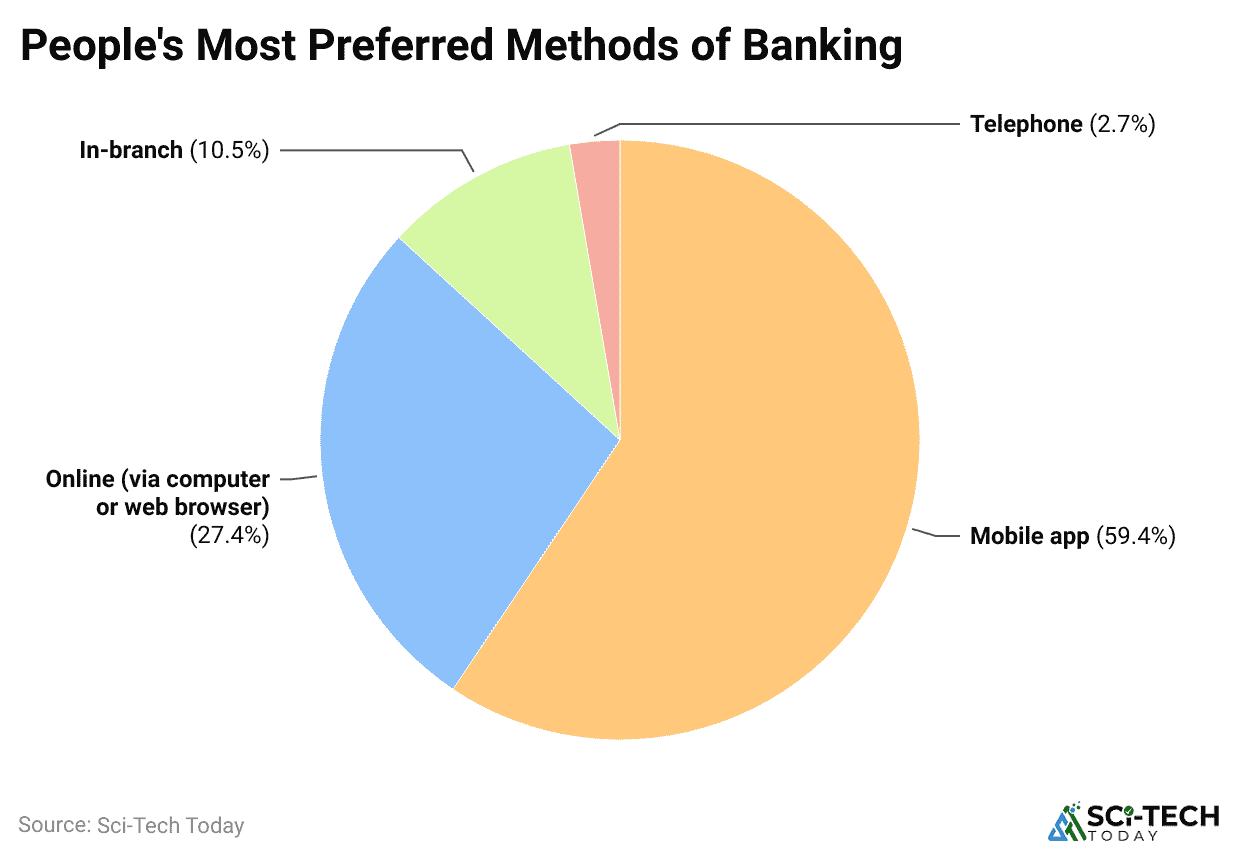
- 59.4% of individuals choose mobile banking apps for their banking transactions.
- As against 27.4% who opt for online banking through computers or web browsers.
- Minor percentages depend upon branch visits (10.5%) and telephonic banking (2.7%).
Online Banking Penetration Statistics by Frequency of Use
- According to a report published by Self, 52.6% of people use online banking weekly and daily users (27.1%).
- Others use it monthly (18.2%), a few times a year (1.7%), or never (0.4%).
By Activity
- As of 2025, the most common online banking activities are checking balances (73.2%) and transferring money (69.2%).
Other reasons are stated in the table below:
| Online Banking Activity | User Share |
| Sent money to another person | 53.3% |
| Set up or schedule payments | 36.3% |
| Did none of these | 1% |
Online Banking Usage Statistics by Device
- Most people access online banking using a smartphone (70.8%) and a laptop (54.1%).
- Meanwhile, desktop computers accounted for a usage share of 38.7%, followed by tablets (14.4%).
Reasons for Using Online Banking Statistics
- Around 64.3% of people primarily want 24/7 access and a mobile app (59.1%) to bank at any time.
- Many also value money transfers (52.4%) and bill payments (50.6%) for facilitating payments.
- Fewer users focus on managing multiple accounts (29.2%).
Online Banking Penetration Statistics by Common Concerns
| Top Concerns | Users Share |
| Worries about security issues and fraud | 35% |
| Fear of being locked out because of technical faults | 31.5% |
| Not enough help from customer support | 17.8% |
| No worries at all | 13% |
| Low trust in online services | 2.8% |
By Security and Fraud
- 37% of survey respondents reported that security and fraud are their primary concerns regarding digital banking.
- 54.1% have experienced fraud attempts with online banking.
- Among online financial or cybercrime fraud victims, 23% reported experiencing online banking fraud or scams.
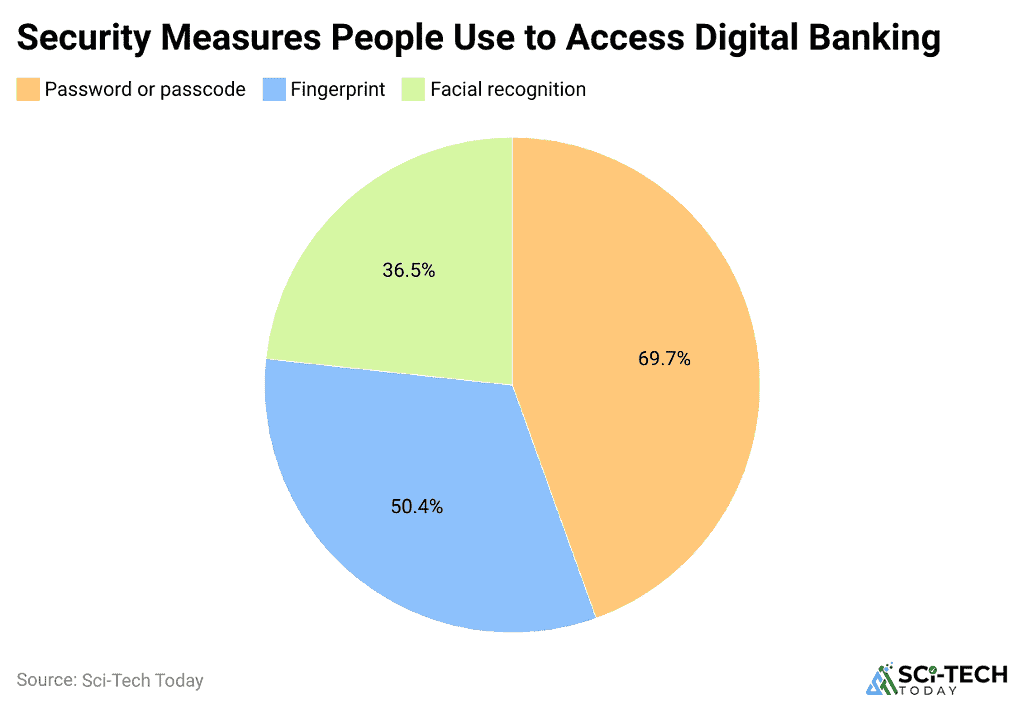
(Reference: self.inc)
- 69.7% of people sign in to their bank account online or in mobile apps using a password or passcode.
- 50.4% of users access online banking via fingerprint authentication, whereas 36.5% use face recognition.
Trust Level of Online Banking User Statistics
- Only 10% of respondents report high trust in online-only banks, while 34% report medium trust.
- Meanwhile, 56% of users have low trust in online banks.
Online Mobile Banking Penetration Statistics by Country
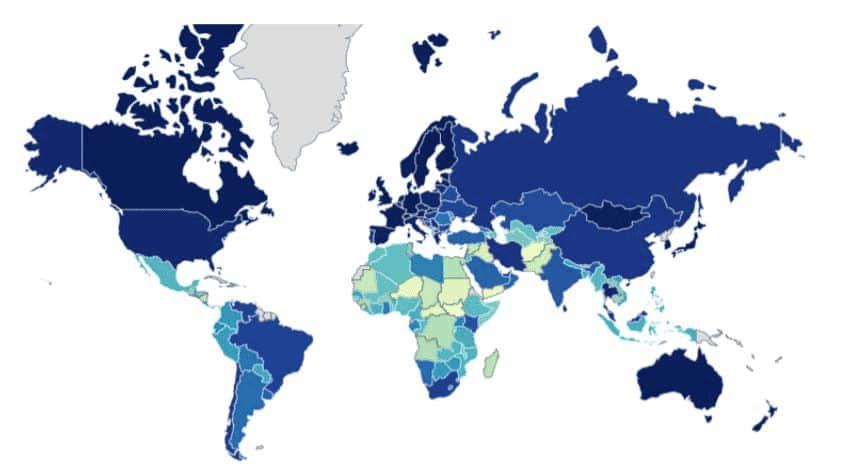
(Source: worldpopulationreview.com)
- According to Worldpopulationreview.com, in 2025, Denmark and Iceland had the highest online banking participation, at 100% each.
- Moreover, other countries’ mobile banking user shares are followed by Germany (99.98%), Austria (99.95%), and the United Kingdom (99.76%).
| Country | User Share |
| Sweden | 99.69% |
| Norway | 99.48% |
| Canada | 99.63% |
| Australia | 99.32% |
| Mongolia | 98.46% |
| Russia | 89.72% |
| United States | 94.95% |
| China | 88.71% |
| Kazakhstan | 81.11% |
| Brazil | 84.04% |
| India | 77.53% |
| Serbia | 89.42% |
| France | 99.24% |
| Spain | 98.30% |
| Turkey | 74.09% |
| Thailand | 95.58% |
| Egypt | 27.44% |
| Saudi Arabia | 74.32% |
| Namibia | 71.35% |
| Bolivia | 68.89% |
| South Africa | 85.38% |
| Botswana | 58.76% |
| Mozambique | 49.49% |
| Nigeria | 45.32% |
| Ethiopia | 46.48% |
| Algeria | 44.10% |
| Vietnam | 56.27% |
| Japan | 98.49% |
| Oman | 73.60% |
| Libya | 65.67% |
| Morocco | 44.37% |
Online Banking User Statistics by Platforms
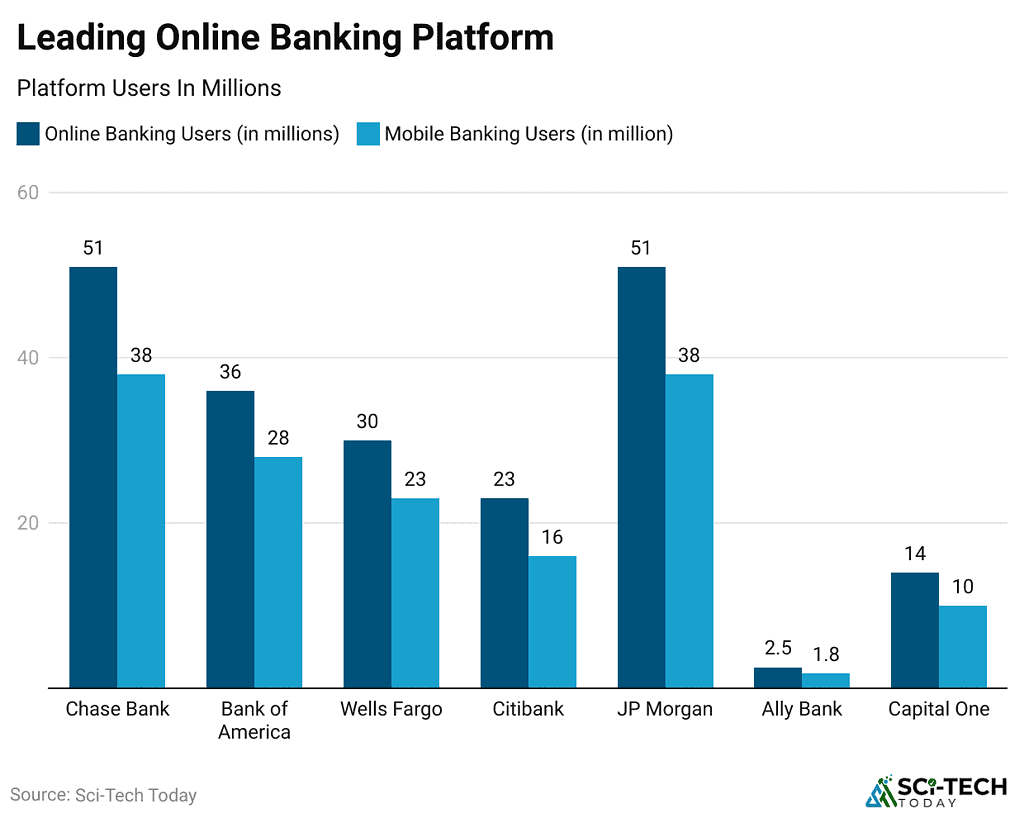
(Reference: scoop.market.us)
- In 2024, Chase Bank is a leading online banking platform with more than 51 million online banking users.
Users of other digital baking platforms are mentioned in the table below:
| Platform Name | Online banking |
| Users (in millions) | |
| Bank of America | 36 |
| Wells Fargo | 30 |
| Citibank | 23 |
| JPMorgan Chase | 51 |
| Ally Bank | 2.5 |
| Capital One | 14 |
Online Banking Penetration by User Demographics
- In 2025, approximately 80% of people aged 18-34 report that mobile banking is their primary means of banking, according to coinlaw.io.
- Gen X is also moving online, with 63% using online banking for most transactions, whereas Baby Boomers are catching up, at 43% among those aged 55 years and above.
- Women show a slightly higher preference for mobile-only use, with 54% reporting exclusive use of mobile banking.
- In rural and suburban US areas, online banking use has increased by 12% thanks to better internet. Higher-income households are 25% more likely to use these services.
- Meanwhile, 82% of college graduates use online banking, compared with 12% of those with only a high school diploma.
By Age Group
- scoop.market.us further reported that in 2024, online banking accounted for the largest share among users aged 65 years and above (28.2%).
- Meanwhile, the shares of online banking users by age group are 12.9% (25-34 years), 18.4% (35-44 years), 22.8% (45-54 years), and 27.3% (55-64 years).
By Ethnicity
- Among people who identify as two or more races, around 20.6% use online banking in 2024.
- Use of online banking is highest among Black (25.8%) and Hispanic (25.7%) groups.
- It is lower among White (13.3%), Asian (12.1%), and Native American or Alaska Native (11.6%) individuals.
By User Preferences and Behaviour
- In a Financial Brand survey, 71% of respondents preferred a banking app.
- Javelin Strategy & Research reports that 76% of online banking users check balances online, and 67% transfer money between accounts.
- Deloitte found 40% use online banking at least weekly, while 11% do it daily.
- NortonLifeLock’s report further states that 74% of users are concerned that their financial information may be stolen.
By Technological Innovations
- Technology use in online banking is rising fast, with AI adoption up by 45% for chatbots, fraud checks, and personalised support.
- Around 18% of banks are using blockchain to boost security and improve transaction transparency.
- For lending, 30% apply machine learning to improve the accuracy of credit scores and loan decisions.
- Voice features are also spreading, as 22% of banks now provide voice recognition for simpler access.
- AR is used by only 5% of banks for testing, training, and guidance apps.
- 27% use RPA to automate repetitive banking operations to reduce costs.
- Cloud banking is widely used by 50% of financial firms.
- Meanwhile, 8% of firms are exploring quantum computing.
- Digital twins are used by 10% of major banks, and 55% use predictive analytics for targeted offers.
Wrap Up
In conclusion, online banking has become a day-to-day requirement rather than a choice for many customers. In recent years, as millions of people began using smartphones and gained access to faster internet, online banking has experienced rapid growth. Now, users can pay online, send money, and check their balance in a few taps. In contrast, many older adults and rural residents are less willing to use online banking due to security concerns and challenges, including scams and fraud.
Though many people still don’t have suitable devices, sufficient digital skills, or stable internet access. These statistics will explain the overall market growth, supported by improved security, easier app design, and greater support for learning digital banking.
FAQ
Helps in checking balance, money transactions, and easy bill payments via your bank’s website or mobile app.
Due to increased application usage, smartphone adoption, improved internet speed & connectivity, and digital payments.
Convenience, time savings, 24/7 access, low-cost transactions, and better user experience.
Limited digital skills, concerns about scams, slow internet, low trust, and confusing apps or websites lead people to avoid online activities.
Supportive regulations for digital ID, online payments, and cybersecurity can help more people adopt them.