








Introduction
Influencer Fraud Statistics: Influencer marketing has kind of become one of the fastest-moving digital advertising lanes, and yeah, global spending is already above USD 33 billion in 2025, plus it keeps getting bigger during 2026. At the same time, though, along with all that momentum, there has also been a noticeable uptick in influencer fraud- think fake followers, bot-generated engagement, AI-made influencers that look too real, audience inflation tricks, sponsorships that are not properly disclosed, engagement pods, and impersonation-type scams.
So brands are more and more putting money into AI verification platforms, tools focused on audience authenticity, and fraud detection software just to safeguard those marketing budgets. And since regulators are looking closer every day, and AI content is getting harder to separate from genuine influence, stopping influencer fraud is now a major priority for marketers worldwide, for real. The article below on influencer fraud statistics will show the market trends and Fraud Tactics.
Editor’s Choice
- Global influencer fraud losses are projected at USD 4.8 billion in 2026, which is a wild 269% jump from USD 1.3 billion in 2019.
- 76% of brands are now worried about fake influencers, up from 67% the year before, showing fraud awareness is climbing fast.
- One in three brands (33%) unknowingly paid an AI-generated fake influencer, and that basically shows that synthetic identities are now a mainstream business hazard.
- 18.6% of influencer marketing budgets go missing due to fraud, with marketers saying they see about 3.4 fraudulent incidents per quarter on average.
- 52.3% of Instagram influencer accounts have signs of artificial follower growth, so audience authenticity ends up mattering more than follower count.
- AI-synthetic influencer fraud is responsible for USD 2.1 billion in yearly losses, so it’s currently the biggest driver behind influencer marketing fraud.
- Three-layer verification systems somehow reduced the global fraud rate from 23% down to 14%, showing that AI plus manual validation actually works in practice.
- 55% of Instagram influencer engagement is fake, which kinda means engagement metrics alone can really mislead campaign performance.
- 74% of marketers say they plan to raise influencer marketing budgets.
- 86% of consumers expect AI-generated influencer content to be clearly disclosed.
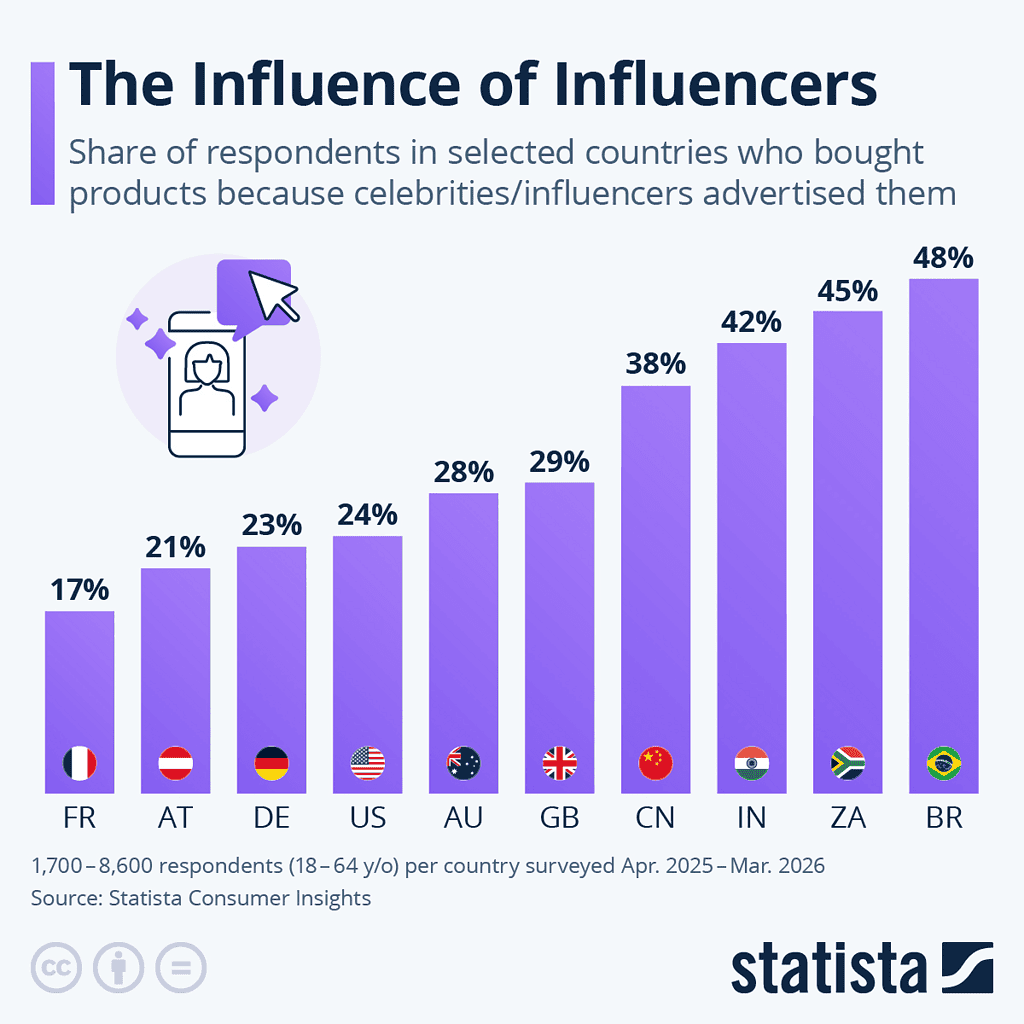
Global Influencer Purchase Influence Statistics by Country
(Source: statista.com)
- The newest survey data points out that influencer marketing is now a big driver behind how people decide to buy stuff, even if the effect isn’t the same everywhere.
- Brazil is in front worldwide, with 48% of online consumers saying they bought something because it was promoted by a celebrity or influencer.
- After that comes South Africa at 45%, and then India (42%), plus China (38%), which also show unusually strong influence levels.
- The above results seem to say that in digital markets that are still accelerating, influencer recommendations have kind of moved past simple brand visibility and turned into a persuasive force behind real purchasing choices.
- Meanwhile, influencer-driven buying stays noticeably lower across most of the more developed Western markets.
- The United Kingdom lands at 29%, Australia 28%, the United States 24%, Germany 23%, Austria 21%, and France sits at just 17%, so France is basically the weakest influencer-driven market in the group that was checked.
- Even if take-up is slowly rising across parts of Europe, the numbers suggest people there still lean on influencer endorsements less when deciding what to purchase.
- That huge 31% gap between Brazil (48%) and France (17%) shows just how much influencer marketing results depend on the market itself, which really underlines the need to shape campaigns around local consumer behavior instead of using a universal template for everything.
Fake Influencer Concerns
(Source: amraandelma.com)
- The most recent industry stats suggest that fake influencers are turning into one of the fastest-growing risks inside influencer marketing, kind of quietly at first, then all of a sudden.
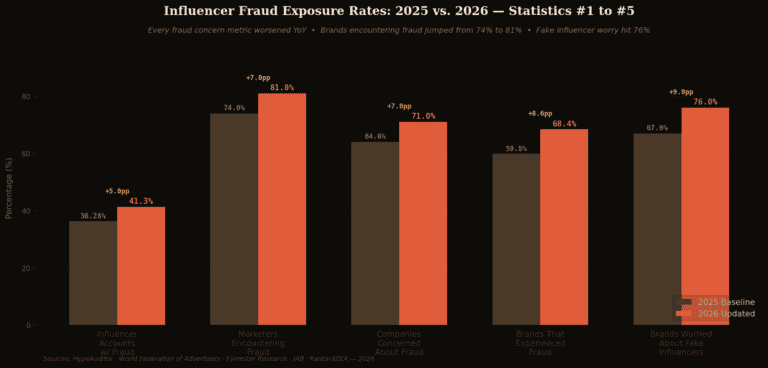
- In a Kantar and IZEA joint study with 3,800 brand managers across 19 markets, the portion of brands worried about fake influencers rose from 67% in 2025 to 76% in 2026. That’s a 9% jump, year-over-year.
- A big part of the spike seems tied to a 91% annual surge in AI-made synthetic profiles.
- The whole deception can be surprisingly convincing, so much so that one in three brands (33%) say they’ve unknowingly paid a totally invented AI persona within the past year.
- AI-driven fraud isn’t some niche worry anymore, but a mainstream problem showing up across influencer marketing everywhere.
- The data also hints that brands are slowly changing gears, from just tracking popularity metrics toward checking authenticity more deliberately.
- For example, companies concerned about influencer fraud moved from 64% to 71%, while brands reporting they’ve faced fraud went from 59.8% to 68.4%. So it’s not only suspicion growing, it’s real exposure spreading across the ecosystem.
- As fake digital identities get better at blending in, marketers are likely to lean more on audience verification, AI-powered fraud detection, and authenticity scoring before they sign off on influencer partnerships.
- These trends basically underline that trust and transparency are becoming just as crucial as reach and engagement for getting influencer marketing campaigns to actually work.
Influencer Fraud Is Becoming a Multi-Billion-Dollar Challenge for Brands
- The latest statistics say influencer fraud isn’t just some small isolated hiccup anymore; it’s turning into a real business risk, one that tangles up marketing results, makes campaign work less effective, and also drags down advertising budgets.
- In Gartner’s 2026 Marketing Technology Survey, they polled 1,950 digital marketing professionals, and 21.7% of marketers said influencer fraud is one of their main day-to-day operational problems, which is up from 11.9% mentioned in the prior round.
- On average, marketing teams run into about 3.4 fraudulent influencer incidents per quarter, and meanwhile, 18.6% of their influencer marketing budgets get swallowed by undetected fraudulent behavior.
- Influencer fraud is a meaningful financial worry, not merely a compliance kind of headache, which means many organizations are now trying to tighten verification steps before they commit money into creator partnerships.
- A Modash and Credibility Corporation analysis of 4.2 million Instagram accounts looked at historical signals and found 52.3% had some evidence of artificial follower growth at some stage.
- The biggest exposure showed up in mid-tier influencers, specifically those with 100,000–500,000 followers, where 61.8% of accounts had suspected fraudulent activity.
- The report also estimated that creators who were actually caught purchasing fake followers spent around USD 3,400 per incident, give or take.
- Earlier industry research lines up pretty closely, noting that nearly 49% of Instagram influencers had used fake followers, which sort of confirms how widespread audience manipulation really is across the platform.
- Influencer fraud has sort of grown into this multi-billion-dollar global thing, and it feels like it’s not slowing down.
- The Global Influencer Fraud Economic Loss Report by Cheq and the University of Baltimore suggests that worldwide losses are projected to touch USD 4.8 billion in 2026, which is a 269% jump versus the USD 1.3 billion reported in 2019.
- The same report also said AI-synthetic fraud makes up USD 2.1 billion of the total, basically surpassing bot-driven fraud and becoming the biggest part of the mess.
- So, if influencer marketing keeps expanding, then funding into AI-powered fraud detection, plus checks on audience authenticity, will become more and more important for safeguarding ad budgets and squeezing better campaign outcomes.
Detection and Verification Practices
- Brands are replying by using layered verification stacks, like some kind of “more than one lock” approach.
- Influencer Marketing Hub’s 2026 Benchmark Report notes that advertisers running a three-layer verification stack (AI detection, manual review, and platform-level vetting) helped push the global fraud rate from 23% down to 14% during 2020 to 2026.
- Influencer Marketing Hub’s 2026 Benchmark Report shows that AI is now the default detection layer, not really some experiment anymore.
- Around 7.22% of marketers say “fraud detection” is their main AI use case in influencer marketing, after creator discovery, content generation, and reporting.
- In reality, AI tools evaluate follower authenticity, spot sudden follower surges, and point out weird engagement rhythms that can hint at bots or engagement pods.
- Manual vetting still matters, like actually matters. A lot of brands mix automated scores with a human look-over, comment quality, audience geography, and whether the content stays consistent before they even sign contracts, especially on bigger campaigns.
- Also, longer partnerships tend to lower the risk. Aspire’s State of Influencer Marketing 2026 report shows 63% of creators prefer longer‑term relationships, and brands are leaning into that more and more because short one-off stints are where misaligned expectations, and yes, fraud stuff, is most likely to show up.
Business Impact and Marketer Sentiment
- In Aspire’s 2026 benchmark report, 74% of marketers are still planning to increase influencer marketing budgets, even with fraud concerns, because creator content keeps beating brand-directed posts, and CPMs have dropped by about 42% year over year.
- TechnologyChecker also points to data that influencer marketing CPM is around USD 2.68 in 2025, which signals cost efficiency even when fraud is part of the conversation.
- Surveys keep coming back with about 69-70% of consumers saying they trust influencer recommendations, and Statista Consumer Insights country-level purchase data backs up that there is real behavioural lift, though the trust is never total, nor fully absolute.
- The fact that 71% of marketers have seen fraud, and more than half of the fraud or quality problems connect back to fake followers, is pushing platforms toward more transparent authenticity metrics.
The Rise of AI-Generated Synthetic Influencers
- The rapid adoption of AI-generated influencers is shifting the creator economy in a big way, but the most recent numbers sorta suggest it’s also turning into one of the industry’s largest trust problems.
- Industry estimates point to AI-synthetic influencer and audience fraud that adds up to about USD 2.1 billion in annual losses, and that’s close to roughly half of the wider USD 4.2 billion global influencer fraud market.
- Influencer marketing keeps growing, and the deception powered by AI is getting more advanced and financially painful.
- Also, consumer research feels pretty clear that transparency is becoming a key piece for keeping trust. Meltwater and YouGov say 69% of consumers trust AI-generated content less than content made by humans.
- Meanwhile, Emplifi reports that 31% of consumers flat out do not trust AI-generated content at all.
- Browsermedia found 86% of consumers think AI-generated content should be clearly disclosed, so there’s a pretty strong tilt toward openness whenever brands use virtual influencers or synthetic media in ad campaigns.
- These results imply that disclosure is quickly turning into a differentiator, not just a checkbox to satisfy rules.
- The statistics really point towards a noticeable shift in how brands will judge influencer partnerships over the next few years, like in the next cycle or so.
- Broader fraud research from Sumsub estimates that global fraud losses topped more than USD 12.5 billion in 2024, and that’s a 25% year-over-year jump, while AI-enabled fraud is expected to take up an even bigger piece of future losses.
- These numbers suggest that organizations will keep investing in AI-powered verification, deepfake detection, audience authenticity analysis, plus governance frameworks, so they can separate transparent virtual influencers from fraudulent synthetic personas.
- In other words, it should help protect both marketing budget and long-term consumer trust, because the stakes are kind of higher now.
Breakdown of Common Influencer Fraud Tactics
- The newest industry research suggests influencer fraud still drags down campaign results, mostly by making audience numbers and engagement metrics look bigger than they actually are.
- As per HypeAuditor, over a third of influencer accounts worldwide are hit by some kind of fraud, and fake followers are still the main tactic people keep using.
- Modash’s 2026 analysis says that 52.3% of the influencer accounts it reviewed showed signs of artificial follower acquisition, like abnormal follower growth, and a few sketchy audience patterns that don’t match real behavior.
- So basically, these stats mean audience size alone isn’t a dependable signal of an influencer’s value anymore, and that audience quality has to be treated as the key piece in campaign evaluation.
- Research shared by Eleve, using HypeAuditor data, suggests that about 55% of Instagram influencer engagement is fake, made up by bots, engagement pods, or automated interactions, not by actual audience involvement.
- So, more than half of the likes, comments, and shares brands end up paying for don’t really show authentic consumer interest.
- Because of that, relying just on engagement rates can blow things up, as it overestimates how well a campaign performed and what kind of ROI brands get.
- Sumsub reports that worldwide fraud losses went past USD 12.5 billion in 2024, which is a 25% jump year over year. In particular, AI-enabled scams and synthetic identities are showing up as the fastest-growing fraud types.
- Digital deception keeps getting sharper; brands are expected more and more to put money into AI-driven fraud detection, audience verification, and performance analytics, just to make sure marketing budgets land on real creators and real consumer engagement.
Conclusion
Influencer fraud has sort of evolved into one of the biggest risks digital marketing faces in 2026, pushed along by AI-made influencers, fake followers, engagement games, and synthetic audiences. Even so, influencer marketing still brings solid returns, and it keeps growing consumer influence, but brands are now leaning more toward authenticity than vanity numbers.
That means AI-driven checks for verification, deeper audience quality analysis, plus multi-step fraud detection are becoming a must to keep marketing spend protected. At the same time, consumers are asking for clearer transparency about AI-generated posts and sponsored collaborations. In practice, organizations that mix strict verification with reliable creator relationships will likely be the ones that get the best campaign results, protect budgets, and keep building long-term consumer confidence.
FAQ
Influencer fraud is when someone uses deceptive methods like fake followers, bot engagement, AI-generated influencers, or inflated audience metrics.
Global influencer fraud is expected to lead to USD 4.8 billion in losses in 2026.
Fake followers and artificial engagement are still the most widespread forms of influencer fraud across major social media platforms.
Brands typically rely on AI authenticity tools, audience verification steps, manual reviews, and engagement analysis to spot fraudulent influencers.
Because 86% of consumers feel AI-generated content should be clearly disclosed, transparency supports trust and keeps brand credibility stronger.

Sources