








Introduction
Mind-Boggling Social Media at Workplace Statistics: Social media has turned into a sword-like instrument in today’s workplace. The information harbors opportunities for both networking and market exposure, as well as being well-informed; on the other hand, it can turn the problem into a big distraction and loss of productivity. In 2026, the relationship between social media and workplaces has become infinitely more complicated, with employers trying to benefit from the positives while minimizing the negatives.
The article goes into some mind-boggling social media at the workplace statistics. It makes for a fascinating read about the impact of social media at work.
Editor’s Choice
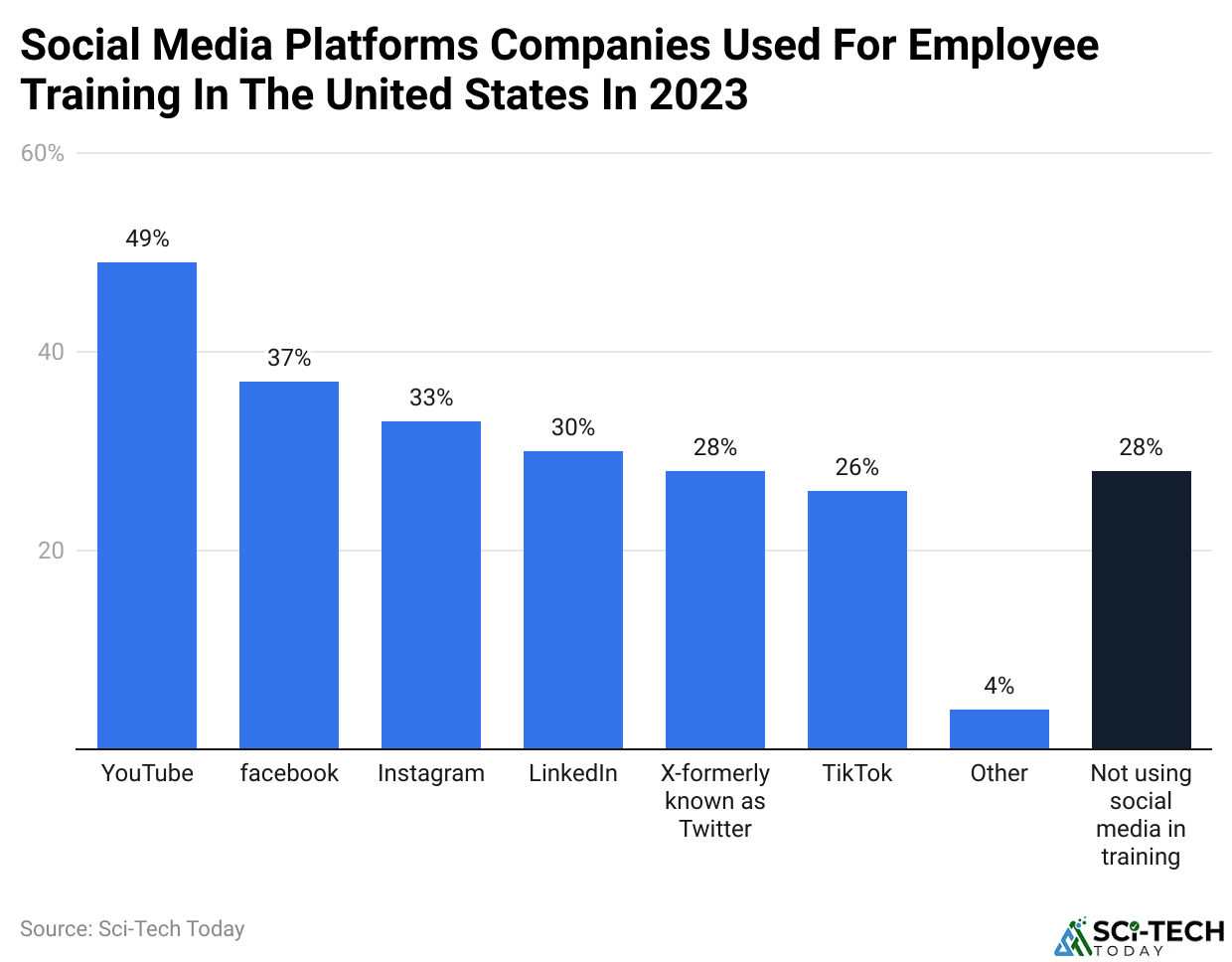
- Mind-boggling social media at workplace statistics state that YouTube, in the year 2023, became the most popular social media platform for employees’ training purposes in the United States.
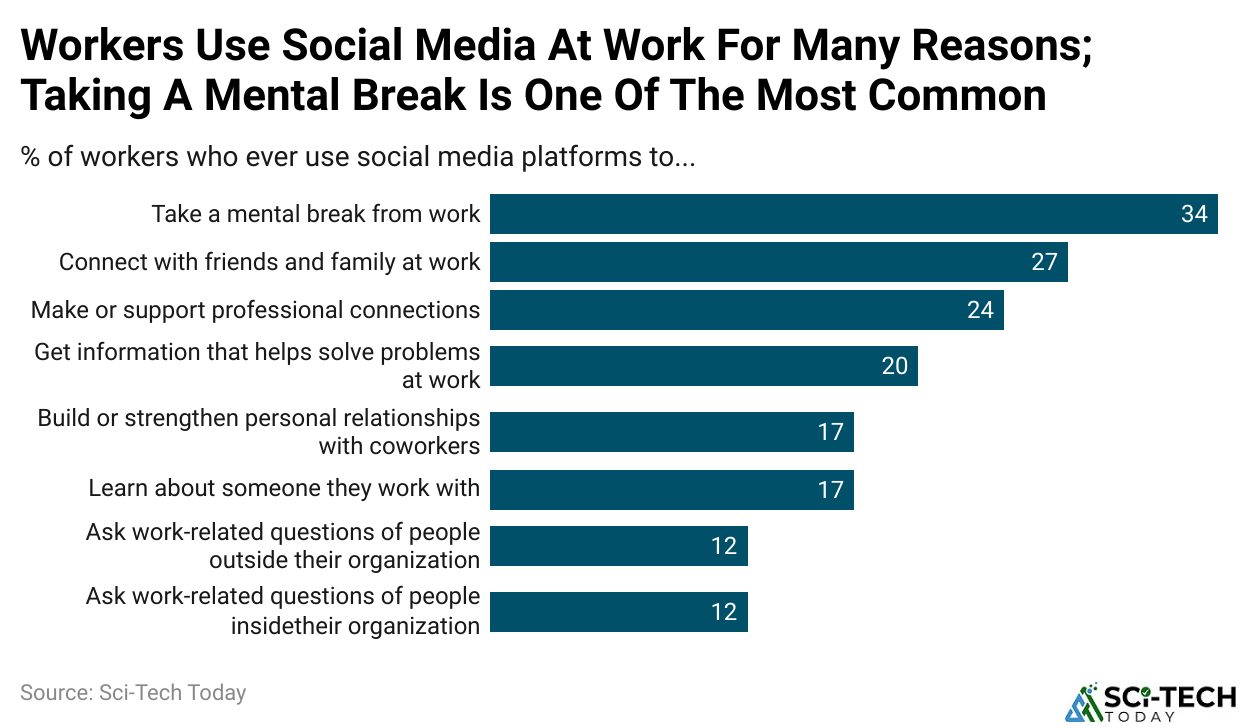
- Social media is used by employees who need a break during their busy working hours (34%), keep in touch with family and friends (27%), make professional contacts (24%), and get answers or develop professionally (17%).
- Workers aged 18-29 are generally found to be more likely to discover both positive (23%) and negative (29%) information about their colleagues via social media than older cohorts.
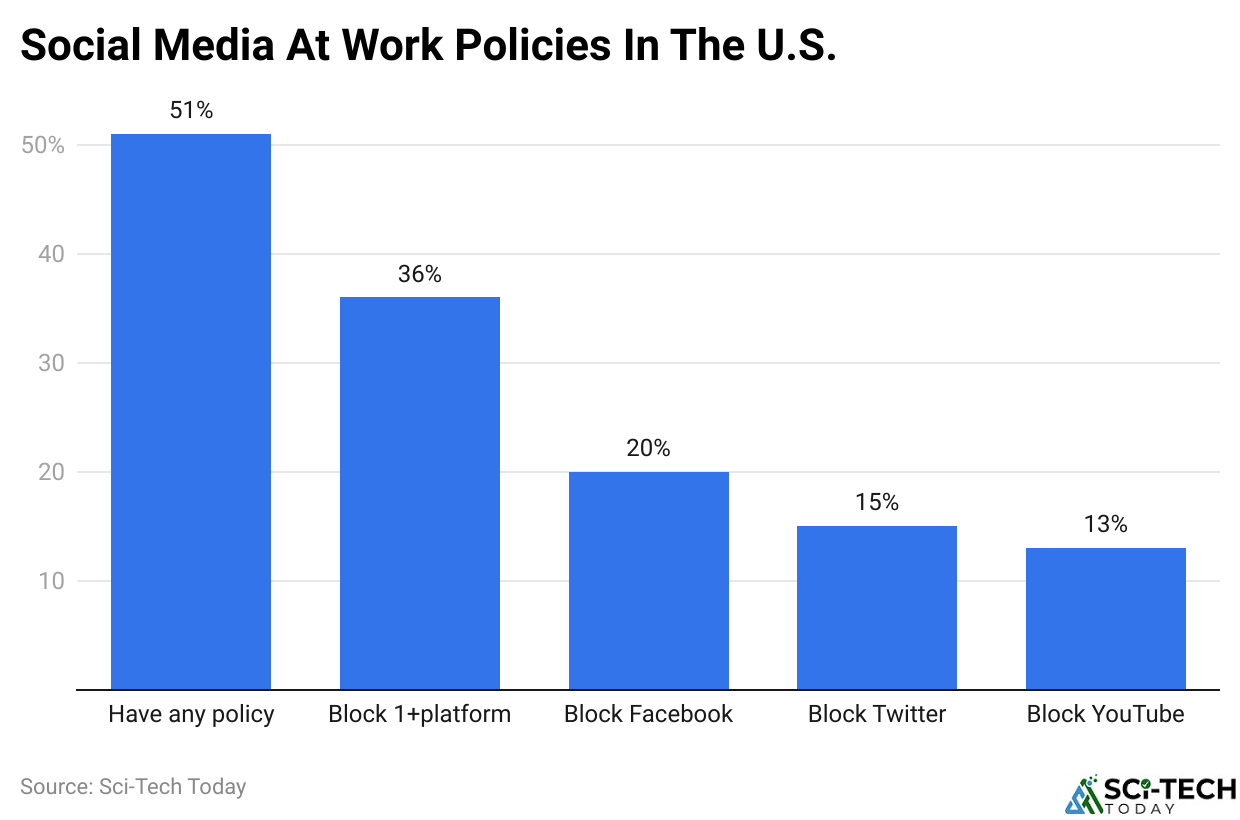
- The vast majority of organizations in the USA (51%) have social media policies. To be specific, while 36% of organizations blocked access to websites like Facebook (20%), Twitter (15%), and YouTube (13%), the remaining organizations stated having social media policies.
- On the usage of social media in the workplace: 18.7% use it up to 15 minutes daily, 17.2% between 16 minutes and 30 minutes, while a smaller number spend more than an hour on this particular activity, which is estimated to affect productivity by about 9.5% in a day.
- According to mind-boggling social media at workplace statistics, 81% of employees use social media during work hours, while 80% agree that social media usage should be governed by company rules.
- An average employee spends around 52 full minutes daily on social networking sites that are not work-related; hence, most of them (57%) said such an act cuts down their focus and productivity. Social media constitutes effective communication, collaboration, and better relationships, as explained by 56% of employees.
- Mind-boggling social media at workplace statistics reveal that approximately 82% feel it favors professional ties, while 60% would apply it in decision-making. Earnings play a part in the use of social media in the workplace.
- Conversely, 41% of individuals making less than £25,000 annually use social media, whereas about 93% of individuals making more than £80,000 use social media.
- According to mind-boggling social media at workplace statistics, 36% say they benefit from social media in terms of communication, 88% in relation to keeping up with news from organizations, 45% are for professional networking, and 73% with regard to quick retrieval of information.
- Although 38% of individuals would agree that they misused it in an office setting.
- Social media tools like Facebook (19%), LinkedIn (14%), and employer-provided platforms (9%) are being used to perform work-related tasks, while productivity effects are divided among respondents.
Social Media Platforms Used At Workplace
(Reference: statista.com)
- In 2026, Facebook became the first and number one social media platform used by marketers in the US.
- This was mainly due to its abundant stock of videos and easy access to them, making it a clear favorite for organizations looking to upgrade their workforce.
- Instagram is in the second position, with 82% of respondents reporting using it for their marketing needs.
- It was probably because of the high reach and the opportunity to create private groups for targeted learning.
- LinkedIn holds a strong third position at 72%, reflecting its critical importance for B2B marketing, professional networking, thought leadership content, and targeted advertising aimed at decision-makers and industry professionals.
- YouTube captures 58% of marketer adoption, highlighting the growing significance of video content marketing.
- TikTok’s 32% adoption rate signals a growing but still emerging presence in the marketing landscape.
- X (23%) and Threads (13%) trail significantly, indicating declining marketer confidence in X’s advertising ecosystem, mainly due to platform instability and brand safety concerns, while Threads remains in its early stages of adoption.
Workers Use Social Media For Reasons
(Reference: pewresearch.org)
- An employee uses social media in his or her workplace for various reasons.
- As claimed by the research agency’s mind-boggling social media at workplace statistics, the most adopted usage (34% of respondents) is for taking a mental break from work pressure.
- Others include keeping in touch with family and friends (27%) and using social media to generate professional links (24%).
- Less frequent include things such as finding a solution through other people or forums outside work (20%), enhancing one’s professional network (17%), or even adding some know-how (17%), and shared work-related advice (12%).
Younger Workers Prefer Social Media In The Workplace
(Reference: pewresearch.org)
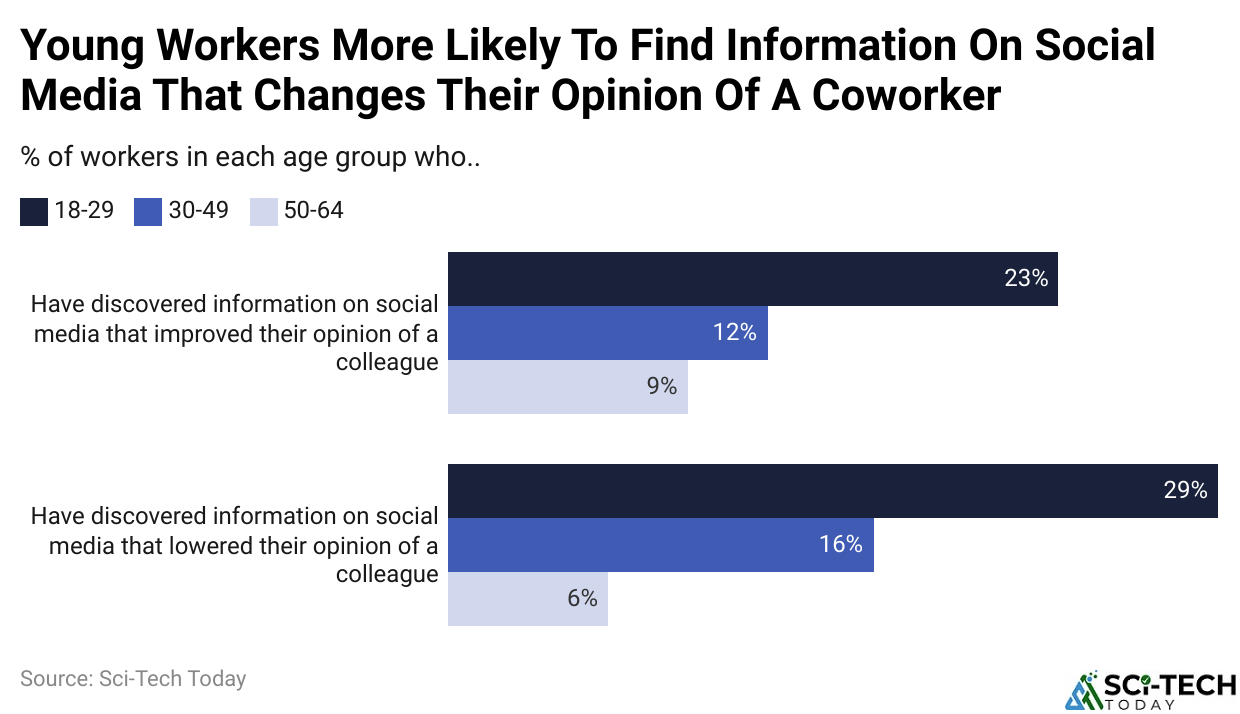
- Mind-boggling social media at workplace statistics state that younger workers tend to declare having found something on social media, bolstering or belittling one’s perception of a co-worker, more than older workers.
- Among 18 to 29-year-old employees, 23% would say they found info on social media that raised their regard for a peer, while 12% of 30 to 49-year-olds and only 9% of 50 to 64-year-olds would say the same.
- On the other hand, regarding those claims, 29% of young people in the age group 18 to 29 stated that they had found negative effects on their opinions about a co-worker, compared with 16% of those aged 30 to 49 and just 6% of those aged 50 to 64.
Social Media Policies At The Workplace In The US
(Reference: zippia.com)
- Only 51% of organizations across the United States reported having any social media policies to guide the use of such networks in the workplace.
- Despite this, 36% of the respondents indicated that their workplaces had blocked access to at least one social media platform.
- Of these, 20% implement policies to block Facebook, 15% create restrictions on Twitter, and 13% block access to YouTube.
- The measures taken show the nature of the different approaches businesses adopt in dealing with productivity versus security issues in the context of social media.
Time Spent On Social Media At the Workplace
- The average amount of time employees spend on social media sites is 2 hours per day at work.
- This time is used by employees for personal reasons.
- 56% of employees use social media to network professionally and keep themselves updated about industry trends; they spend about 1 hour a day on work-related activities.
- 45% of the workforce acknowledges that they spend more than 30 minutes each day on social media during work hours, resulting in distractions.
- The use of social media for job hunting accounts for about 31% of employees’ time spent online during work hours.
- On average, 26% of the workforce checks social media sites in meetings.
- Employees log into social media more than once every hour, with an average session lasting 45 minutes.
- 35% of employees log into social media sites to be in touch with their colleagues, particularly in remote working scenarios.
- Younger employees aged between 18 to 34 years spend up to 3 hours per day on social media sites at work.
- According to a study by 52% of employers, workers spend 1-2 hours daily on social networking during working hours, reducing their productivity.
- As per a study, almost 58% of employers believe that social networking is capable of increasing worker engagement, with moderate usage taking an average of 45 minutes daily.
- 40% of employers conduct social media monitoring at their workplaces to ensure productivity, where most consider social media usage to be unproductive.
- 67% of employers find social networking valuable for recruiting purposes, but 39% consider it a big time waster for their workers.
- 30% of the companies block social networking websites at their workplaces so as to prevent wastage of working hours.
- 54% of employers consider social media as a tool to improve worker interaction and sharing of knowledge. Consequently, they spend an hour on social media daily for good purposes.
- 22% of employers claim that their workers’ social networking improves their creativity and problem-solving abilities. Workers usually spend one hour daily on this activity.
- 60% of companies have implemented policies relating to social media usage and permit up to half an hour of personal usage.
Impact Of Social Media On Employee Behaviour And Productivity
- The unrestricted use of social media within the workplace has proven to negatively affect employee productivity, registering, on average, an estimated productivity loss of 9.5 % every single day.
- They spend, perhaps, about 40-45 minutes surfing an organization’s internal social media platform for non-business purposes during working hours.
- Employees use such social media platforms to stay updated on current events or serve as temporary escapes from work stressors.
- On a positive note, they are also used by employees to communicate and share work-related information with colleagues, all of which is aimed at facilitating smoother communication and contributing to the wider organizational goal.
- WhatsApp, Google Hangouts, Twitter, Facebook, Instagram, YouTube, and LinkedIn are the most accessed social media platforms during working hours.
- Though very high penetration accompanies the use of social media, approximately 81 % of employees access these platforms during duty hours.
- According to mind-boggling social media at workplace statistics, most respondents (about 80%) believe that there should be policies concerning social media usage implemented in companies.
- Employees, on average, spend 52 minutes a day indulging themselves on social sites not related to work.
- Their perception of social media as a stress reliever is often brought into question, with nearly 57 % of them admitting that it reduces their concentration and productivity.
- Unrestricted Use can thus deviate an employee from his tasks; however, the assertion remained valid in most cases that a good number of people cherish social media for the role it plays in enhancing communication as well as collaboration digitally, leading to the achievement of organizational objectives.
- This picture underscores how dual-edged social media is in the workplace and thus bestows the necessity of having balanced, clear policies to yield maximum benefits while lessening the negative.
Benefits of Using Social Media At The Workplace
(Reference: jobera.com)
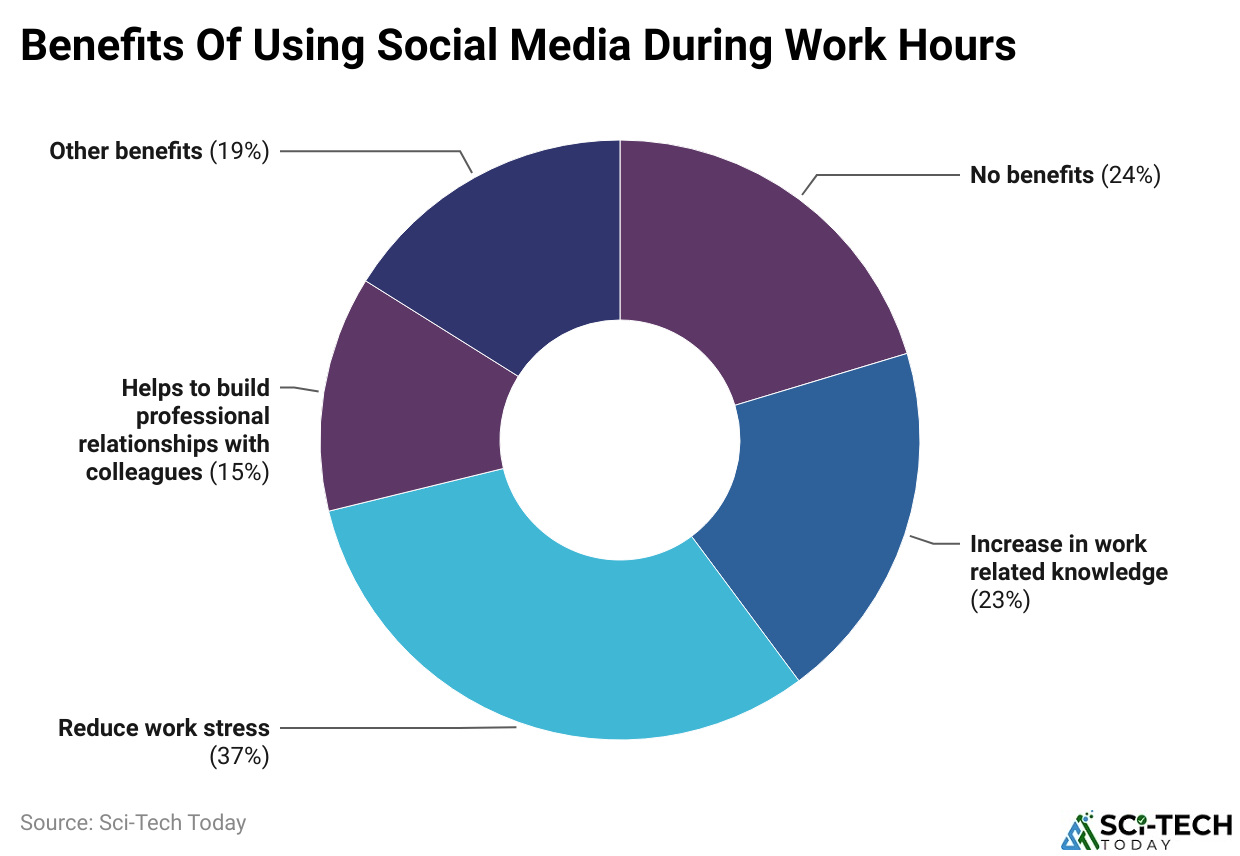
- Mind-boggling social media at workplace statistics indicate that among employees aged 18 to 29, about 23% said that what they read on social media influenced their opinions positively about colleagues.
- Even in organizations with a social media policy in place, from these employees, 30% of them have been found using these sites to help cope with work-related stress. Interestingly, nearly 40% of employees in organizations that do not have such regulations still engage with social media during work hours.
- A good number of employees regard workplace social media as valuable, with 56% believing that it may improve productivity and 82% stating that it makes their work relations much stronger.
- Besides that, 60% of employees claim that social media helps them in decision-making, while 52.7% say it increases their work efficiency.
- Also, 54% of respondents reported that breaks from social media would help refresh them at work.
Reasons For The Usage Of Social Media At Workplace
- 70% of employees use social media for professional networking and widening industry networks.
- 58% of employees monitor social media industry groups in order to get updated information.
- 61% of workers use social media at work to stay engaged with the organization’s events and activities.
- 72% of organizations use social media for brand and marketing activities, where employees participate in social media interactions and content creation.
- 55% of employees use social media to communicate with colleagues inside an organization as well as collaborate remotely.
- 39% of employees use social media during working hours to find new employment opportunities.
- 45% of businesses use social media to appreciate employees’ successes and create a positive atmosphere.
- 27% of employees use social media during breaks from work to relax.
- 49% of employees use social media to answer customers’ questions or promote services.
- 58% of employers publish job openings on social media and look for recruits there.
- 65% of organizations encourage employees to use social media to strengthen their employer brand.
Social Media Policies At The Workplace
- Many employees are reporting that their companies have policies on social media use during office hours or on how their employees present themselves online.
- About 51% of full-time and part-time employees say their workplace has rules regarding the use of social media during the course of work; 45%, however, declare that such rules do not exist.
- This aside, 32% of employees mention that their employers regulate how they present themselves on the Internet; 63% indicate the absence of such policies.
- Likewise, workplaces that seem to have social media policies seem to have similar predicates concerning the behaviors of employees.
- If companies exercise proper at-work social media policies, then they are less likely to see employees using these platforms for personal purposes while they are at work.
- As an example, 30% of workers in regulated environments use social media to take breaks compared to 40% in environments that have no such regulation.
- Mind-boggling social media at workplace statistics state that 20% of employees rely on social media to stay in touch with family and friends, compared to 35% outside of such restrictions.
- Meanwhile, only 16% of workers in regulated workplaces use social media for job-related information, compared to 25% in non-regulated settings.
- However, workplace policies have very little to say in some cases where professionals use social media.
- Employees, however, find social media extremely effective in putting together professional networks, learning about colleagues, strengthening relationships, and seeking advice within or outside their organizations.
- An insignificant portion of employees use specific social media sites to carry out work-related tasks. About 19% use Facebook, 14% use LinkedIn, 3% use Twitter, 9% do work tasks on tools of the employer, and 5% use other sites. As much as there are advantages to social media use, there are also differences in opinion about its effects on job performance.
- Of all those who use social media for work purposes, 56% agree that it is distracting, while 30% strongly agree. Of the remaining group, 42% disagree.
- In addition, 54% of this same group state that breaking away from work to use social media helps them recharge, while 46% think otherwise.
- Another major finding is that 51% agreed that social media exposed too much personal information about coworkers, while 47% disagreed.
Social Media Marketing Jobs and Salaries
(Reference: coursera.org)
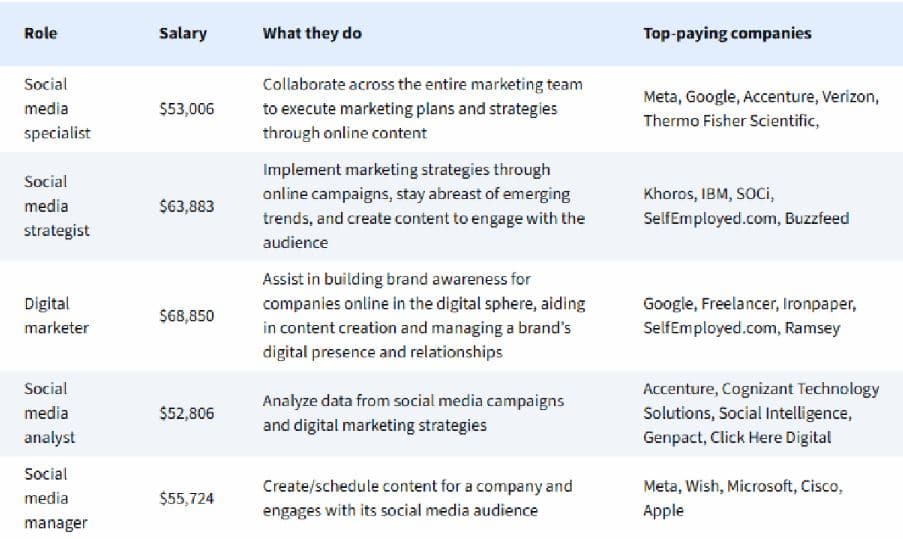
- Digital Marketer leads with the highest salary at USD 68,850, reflecting its broad scope in brand building, content creation, and managing digital presence.
- Social Media Strategist earns USD 63,883, focusing on campaign implementation, trend monitoring, and audience engagement for companies like Khoros, IBM, and SOCi.
- Social Media Manager makes USD 55,724, handling content scheduling and audience interaction, with top employers including Meta, Microsoft, Cisco, and Apple.
- Social Media Specialist earns USD 53,006, executing marketing plans through online content for major brands like Meta, Google, Accenture, and Verizon.
- Social Media Analyst is the lowest-paid at USD 52,806, despite playing a vital role in analyzing campaign data for firms like Accenture, Cognizant, and Genpact.
Social Media At The Workplace – By Employee Perception
- All employees have a perception that social media is one of the most useful tools for different activities in the workplace.
- 36% of employees consider it a possible channel of communication, while 88% say social media helps them acquire news and updates about their jobs.
- Mind-boggling social media at workplace statistics reveal that 45% of employees think social media creates an opportunity to connect with professionals around the globe, and 68% consider that social networking sites help them gain access to recent trends and developments in their organizations.
- Furthermore, 32% believed that social media enhances collaboration with their colleagues.
- 59% of employees think that social media is useful in terms of learning and professional development, while 73% of them use it to find quick answers to queries regarding work.
- The practice of tweeting allows its employees to have very high satisfaction rates, as those surveyed indicated that it has a positive impact on their work experience, which stood at 42%.
- Furthermore, 27% use this medium to link with co-workers, and 33% share opinions about various matters within the workplace.
- On the contrary, however, 38% of employees have accepted misconduct on social media within the work environment.
- Mind-boggling social media at workplace statistics present the fact that social media has two-sided effects on increased productivity and, at the same time, presents challenges for an organization.
Conclusion
Social media in workplaces is now permanent. The truths here reveal both challenges and opportunities. According to mind-boggling social media at workplace statistics, social media can be harnessed by organizations if such knowledge is turned into wise policy, with minimal risks entailed.
The numbers tell a story: It is not just a distraction- another tool for productivity, culture, and the success of an organization when wielded rightly.
FAQ
Social media at the workplace includes the use of social networking sites either external social networking sites (e.g., LinkedIn, X, or Instagram) or internal corporate social networking sites (such as Slack, Microsoft Teams, or Meta Workplace) for various professional and communication purposes.
Social media usage provides employees with a means of taking mental breaks without having to step away from their workspace, hence resulting in increased productivity. Relationships: The appropriate use of social media allows the building of relations between employees both professionally and socially.
Social media at the workplace is both beneficial and risky for employers. Even though social media helps in increasing productivity and other benefits, it does bring about risks such as loss of productivity, breach of data confidentiality, and workplace bullying.

Sources