








Overview
Social Media Recruitment Statistics: Recruiting good talent is always stimulating for companies, especially in a highly ruthless job market. One of the most notable changes in recent years has been the switch towards social media recruitment. In the current digital age, social media has become a private part of our daily lives. It is not surprising, then, that social media has also become a crucial tool for human resource recruiters looking to source and attract good talent.
Social media platforms have become an essential tool for recruiters to engage with potential candidates. In reality, social media recruitment has become so famous that it is currently considered a usual practice for many companies. Let us shed more light on social media recruitment statistics.
Must Read By The Editor
- Roughly 73% of the millennials have found their current jobs from social media platforms.
- Even though social media reaches a lot of people, it’s hard to find local people for jobs sometimes.
- The employers also use Facebook, along with the LinkedIn platform, for hiring, which has resulted in almost 71%.
- Active job applicants spend almost 17 minutes on LinkedIn, while 40% of the overall accounts that are registered access the other platforms daily.
- X is also a platform used for job seekers to check their company profiles. Almost 58% of them follow the recruiters on X, and 41% apply for job postings in tweets.
- In 2025, Glassdoor‑cited data finds that 79% of all job seekers say they are likely to use social media to find jobs, and this rises to 86% among those in the first 10 years of their career.
- LinkedIn has over 1 billion subscribers from more than 200 nations and regions.
- Most employers see social media as highly effective, 56% say they find their best candidates there, and 82% use it specifically to reach passive talent.
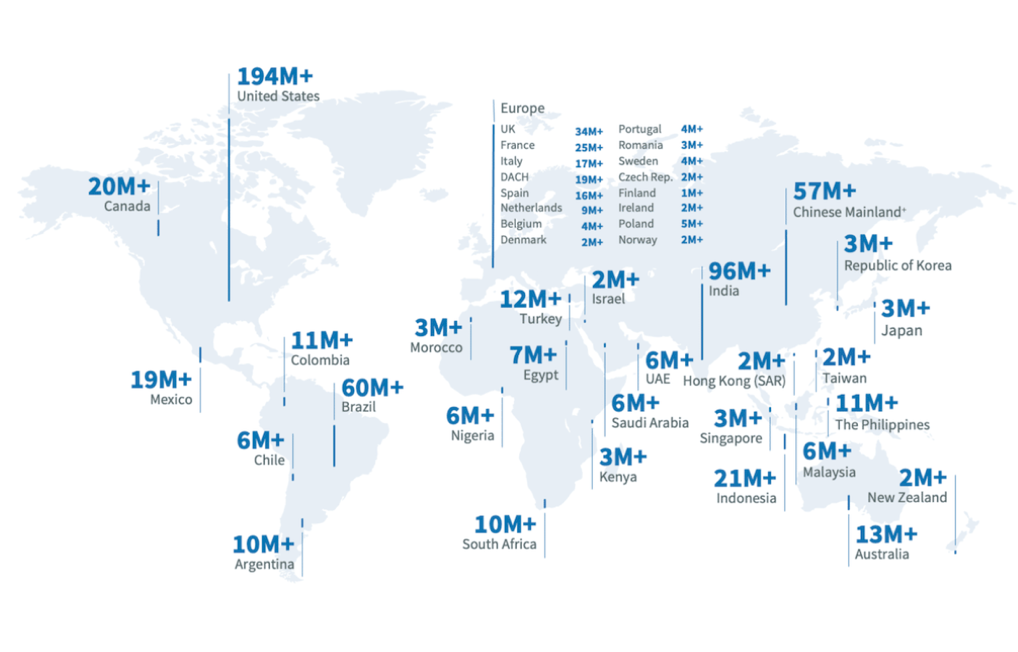
- The following are the top countries and the overall number of registered LinkedIn accounts: 194+ million in the United States, 96 million+ in India, six million+ in the UAE, 10 million+ + in South Africa, and 20 million+ in Canada.
- With social media, we can easily check out applicants’ backgrounds.
- Practically, 94% of recruiters use social media to communicate their company, achievements, and culture to attract potential job seekers.
- Whereas almost 55% of the job applicants are between the salary bracket of 18,000 to 30,000.
- There are almost 61% of the 70,000 pounds and above salary bracket are searching for jobs online.
Social Media Recruitment Statistics 2026
- DataReportal’s April 2026 update puts the figure at 5.79 billion social media user identities, or 69.9% of everyone on Earth, with 9.3 new users joining every second.
- In 2025, Glassdoor‑cited data finds that 79% of all job seekers say they are likely to use social media to find jobs, and this rises to 86% among those in the first 10 years of their career.
(Source: contentstadium.com)
- A 2025 compilation of social media recruitment stats reports that 62% of Gen Z (around 18–27) have found job opportunities on social media.
- One 2025 recruitment guide notes that 94% of recruiters use platforms like LinkedIn, Facebook, and Twitter/X to source candidates.
- Practically, 94% of recruiters use social media to communicate their company, achievements, and culture to attract potential job seekers.
- Roughly 67% of recruiters use social media websites to find potential job seekers and learn more about their personal and professional achievements.
- Around 80% of employers believe that social media recruitment has helped them find passive candidates.
- 70% of the managers have hired many employees through social media successfully and have built a more talented workforce.
- LinkedIn has over 1 billion subscribers from more than 200 nations and regions.
- Glassdoor states that almost 79% of job applicants use social media when searching for a job.
- According to a recent survey, 52 million people use LinkedIn to search for jobs every week.
- According to a survey by Monster, 65% of people logged in would like to hear about a new job opportunity.
- Around 9,000 job applications are submitted on LinkedIn each minute (about 150 per second), and roughly 6 people are hired every minute.
Key Social Media Recruiting Statistics For Recruiters
- Roughly 70% of job seekers globally are passive candidates, whereas just 30% are active job seekers for new jobs.
- Job boards are getting more expensive while underperforming: only about one‑third (37%) of recruiters say job boards produce their best candidates, compared with 56% for social media.
- More than 100 million students are currently active on all social media platforms.
- LinkedIn is the most famous choice for social media recruitment. Almost 90% of the managers use LinkedIn regularly to search for a demanding candidate, while 55% use Facebook, 47% use Twitter, and 11% use Instagram.
- Around 56% of the managers find the most suitable candidates through social media.
- Almost 79% of the candidates use social media to get knowledge about the company policies and reviews.
- 75% of the candidates inform their career decisions using social media, mostly through WhatsApp.
- Every week, 40 million people look for jobs on social media.
- As per the HR Magazine, the median cost of a bad hire is thrice the salary paid to the candidate.
(Source: contentstadium.com)
- 67% of hiring decision-makers use social media to find job seekers, and 54% believe it can effectively screen out unqualified people.
- According to a Betterteam survey, candidates recruited through social media work efficiently, as 70% of the managers state that they have successfully hired candidates from social media.
- Most employers see social media as highly effective, 56% say they find their best candidates there, and 82% use it specifically to reach passive talent.
- According to a survey by SHRM, 84% of companies are already using social media for recruitment, whereas 9% are still planning to use it.
- The job applicants rank social media and professional networks as more useful than job advertisements and recruitment agencies.
Demographic Insights Of Social Media Recruitment
- 62% of Generation Z people around the world make use of social media to find jobs.
- Millennials feel that close to 56% of them search for career opportunities via social media networks.
- There are close to 31% Generation X people and 12% baby boomers among the population.
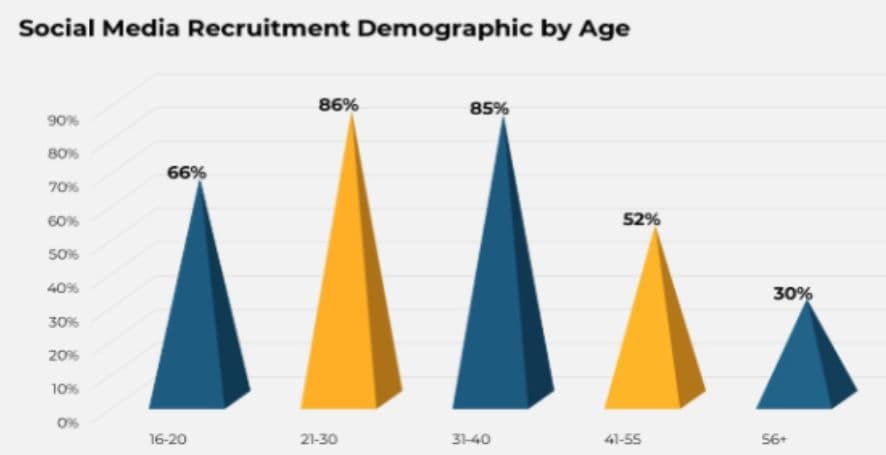
- In respect of the age demographics of job seekers, nearly 66% of those who apply for jobs between the ages of 16 to 20 make use of social media.
- The largest percentage of those who apply for jobs via social media belongs to the age range of 21 to 30, which constitutes 86%.
- With little variation, the 31 to 40 age group consists of 85% of social media job searchers.
- Similarly, almost 52% and 30% of candidates are from the age categories of 41-55 and more than 56 years, respectively.
(Source: Market.Biz)
- The job applicants who earn a yearly salary of 18,000 pounds have also proved that around 71% of them rely on social media for their job search activities globally.
- On the other hand, approximately 55% of job seekers earn a salary between 18,000 and 30,000 pounds per year.
Benefits Of Social Media Recruitment Statistics
- Cutting Screening Time: Using social media for hiring helps reduce the time spent screening applicants. By looking at candidates’ social media profiles, we get a quick idea of their personalities and interests. This means we can spend less time on interviews and resume reading.
- Boosting Visibility: When we share job ads on social media platforms like Facebook and LinkedIn, they’re seen by a lot of people. There are more users on these platforms than on traditional job boards. Plus, it’s easy for people to share these ads, so they reach even more folks. This increases the chances of getting a quick response.
- Saving Money: Posting job ads on social media is cheaper than putting them in newspapers or magazines. Sometimes, it’s even free! And because social media lets people search for jobs based on what they’re looking for, it helps us reach the right candidates without spending too much.
- Streamlining Background Checks: With social media, we can easily check out applicants’ backgrounds. For example, LinkedIn shows their work history and skills. We can also see how active they are on platforms like Twitter. This helps us make better hiring decisions.
- Adding a Personal Touch: social media lets us learn more about candidates’ interests, both personal and professional. This helps us personalize job offers, showing candidates that we care about them. It makes the hiring process feel more personal and friendly.
- Reaching Passive Candidates: Some people have the skills we need but aren’t actively looking for a job. Social media helps us find these “passive” candidates. We can keep track of them and reach out when we have a job opening that suits them.
- Using social media for hiring can save time, money, and effort while helping us find the right candidates more efficiently.
Drawbacks Of Social Media Recruitment Statistics
Social media recruitment is great for finding job candidates, but it needs some fixing. Here are the main ones:
- Not the right Candidates: Sometimes, the people who apply for jobs on social media aren’t a good fit. They might not have the right skills or experience.
- Can’t Find Local Talent: Even though social media reaches a lot of people, it’s hard to find local people for jobs sometimes.
- People Don’t Respond: Some job applicants don’t show up for interviews or don’t talk much when contacted through social media.
- Lots of Competition: Many companies are looking for good employees, just like you. So, it’s tough to stand out and get the best people.
- Costs Money: Putting ads for jobs on social media can be expensive, and it’s not always clear if it’s worth it.
- Privacy Concerns: Looking at someone’s social media can feel like snooping. And sometimes, what you see online might not show if someone is good for a job.
- Legal Problems: Some things, like someone’s race or religion, are protected by law. Using that info to decide who to hire could get you in trouble.
- Social media isn’t Work: Just because someone acts a certain way online doesn’t mean they’ll be good at a job. They might have different rules for how they act on social media versus at work.
Social Media Recruitment Statistics By Platforms
(Source: enterpriseappstoday.com)
- Active job applicants spend almost 17 minutes on LinkedIn, while 40% of the registered accounts access the other platforms daily.
- According to social media recruitment statistics, there are over 1 million above communications between the managers hiring and the candidates on LinkedIn.
- According to the survey, there are almost 58 million organizations and 875 million job-seeking candidates.
(Reference: contentstadium.com)
- As LinkedIn is the most professional job-seeking and candidate-searching platform, its fame has spread all over the world, and every nation represents millions of registered organizations along with their employees.
- The following are the top countries and the overall number of registered LinkedIn accounts: 194 million+ in the United States, 96 million+ in India, six million+ in the UAE, ten million+ in South Africa, and 20 million+ in Canada.
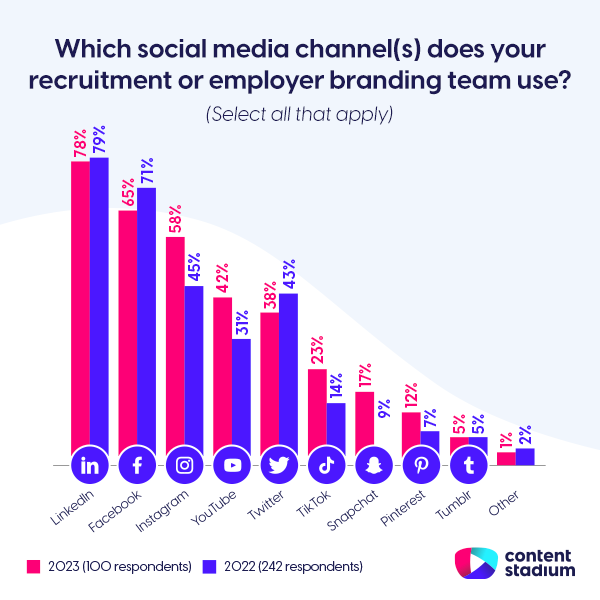
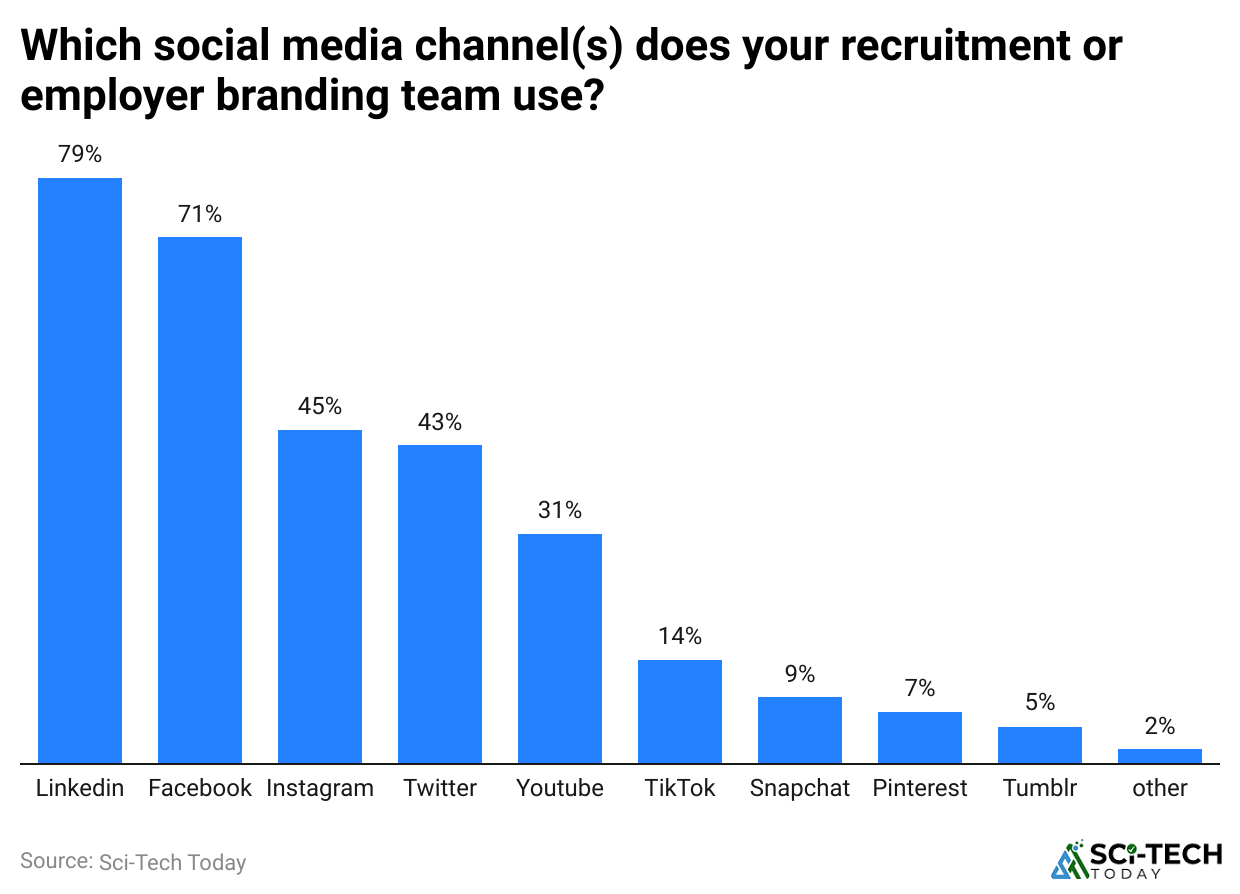
- Across the world, as surveyed by social media recruitment, employers use LinkedIn more than any other platform for hiring, resulting in almost 79%.
- Employers also use Facebook and the LinkedIn platform for hiring, which has resulted in almost 71%.
- With a slight difference, Twitter and Instagram are also used with 43% and 45%, respectively.
- YouTube and TikTok are also social media platforms used in recruitment, with 31% and 14%, respectively.
- Companies also use other social media accounts to search for an appropriate candidate, with 9% of Snapchat, 7% of Pinterest, 5% of Tinder, and 2% of other networks.
- Nearly 3% of the organizations consider working with hiring agencies when getting new candidates.
- There are almost 11.8% of organizations post their requirements on job boards like Monster and Indeed. Etc.
- Several companies, with 12.5%, post on social media networks like LinkedIn to find a proper candidate.
- While just 1.1% of the organizations use Twitter, Instagram, and Facebook for posting jobs.
- There are nearly 7.9% of the organizations that access other networks, and 17.5% prefer to post the requirement directly on their official website.
Job Seekers’ Social Media Statistics
- Nearly 79% of the candidates looking for a job have used social media in their job searching process.
- One out of 9 candidates uses social media to make their post, where they can attract the employer.
- Roughly 73% of the millennials have found their current jobs from social media platforms.
- Almost 40 million job seekers search for jobs weekly on LinkedIn.
- According to Statista, 84% of people believe they have used LinkedIn to strengthen their network on the professional platform.
- Twitter is also a platform used for job seekers to check their company profiles. Almost 58% of them follow the recruiters on Twitter, and 41% apply for job postings in tweets.
- Almost 59% of job seekers think that posting a job requirement on Twitter is very effective.
(Source: contentstadium.com)
- As LinkedIn is the most professional job-seeking and candidate-searching platform, its fame has spread all over the world, and every nation represents millions of registered organizations along with their employees.
- The following are the top countries and the overall number of registered LinkedIn accounts: 194 million+ in the United States, 96 million+ in India, six million+ in the UAE, ten million+ in South Africa, and 20 million+ in Canada.
- Across the world, as surveyed by social media recruitment, employers use LinkedIn more than any other platform for hiring, resulting in almost 79%.
- Employers also use Facebook and the LinkedIn platform for hiring, which has resulted in almost 71%.
- With a slight difference, Twitter and Instagram are also used with 43% and 45%, respectively.
- YouTube and TikTok are also social media platforms used in recruitment, with 31% and 14%, respectively.
- Companies also use other social media accounts to search for an appropriate candidate, with 9% of Snapchat, 7% of Pinterest, 5% of Tinder, and 2% of other networks.
- Nearly 3% of the organizations consider working with hiring agencies when getting new candidates.
- There are almost 11.8% of organizations post their requirements on job boards like Monster and Indeed. Etc.
- Several companies, with 12.5%, post on social media networks like LinkedIn to find a proper candidate.
- While just 1.1% of the organizations use Twitter, Instagram, and Facebook for posting jobs.
- There are nearly 7.9% of the organizations that access other networks, and 17.5% prefer to post the requirement directly on their official website.
Recruiter Activities On Social Media
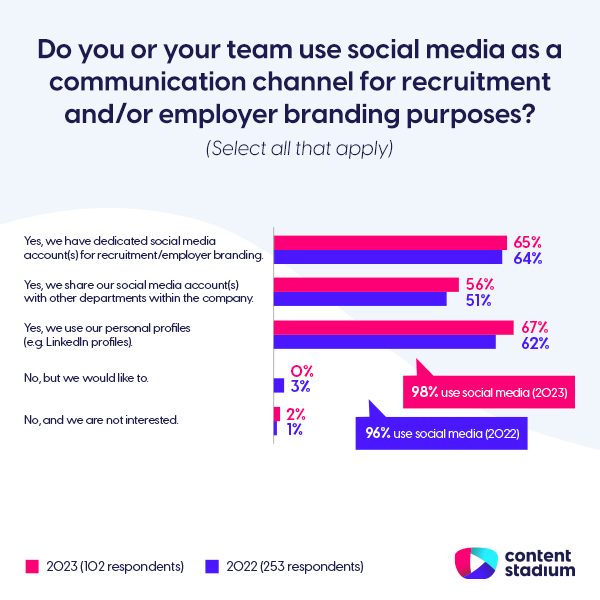
- 82% of companies utilize social media solely for reaching out to this particular demographic, which constitutes 70% of the employee population.
- Checking the profile of potential candidates is another popular activity, with 70% of recruiters making use of social networks in such a way.
- Moreover, 67% use their personal profiles for recruitment activities, while 66% publish job vacancies via social networks.
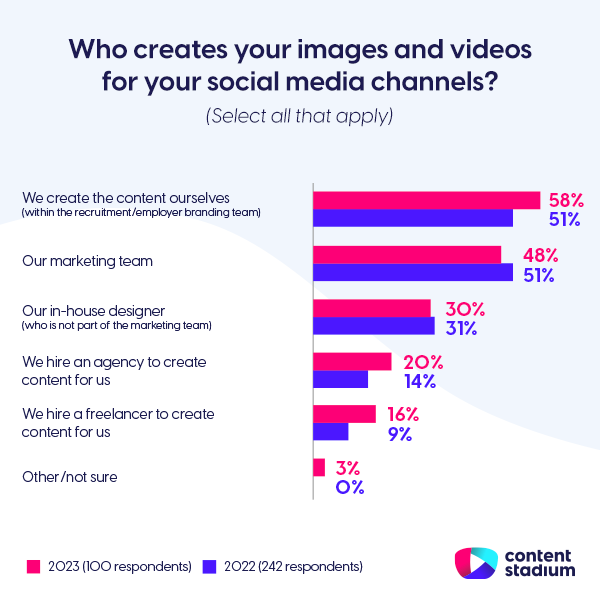
- The content creation process is now becoming one of the key activities for the recruitment teams, with 58% of them creating images and videos themselves rather than leaving this responsibility to the marketing department.
- 90% of the successful recruitment teams actively encourage employees to interact with recruitment-related posts.
- Regarding interaction, the most engaging posts in terms of recruitment are job vacancy posts, generating 43% of interaction.
- “Life at the company” posts take second place, generating 25% of interaction, followed by the company’s news and events at 8%.
| Recruiter Activity on Social Media | Percentage |
| Sourcing passive candidates | 82% |
| Screening candidate profiles | 70% |
| Using personal profiles for recruitment | 67% |
| Advertising job vacancies | 66% |
| Creating original video/image content | 58% |
Social Media Red Flags For Recruiters
- 21% of recruiters admit that they never considered a candidate since they came across content on Facebook about them, which led to them forming a negative perception.
- 5% of recruiters have admitted that they have canceled job interviews based on negative perceptions from social media.
- Content that is offensive about any sensitive topic can be disturbing for some recruiters.
Top Recruitment Websites By Traffic
- Indeed, by 2025, the monthly number of active visits to Indeed.com is more than 429.58 million.
- LinkedIn, up to June 2025, has been visited by more than 1.41 billion people.
- By April 2025, Jooble.org’s monthly number of visits is more than 36.07 million
Summary
As we go through the above social media recruitment statistics, the picture is clear that social media recruitment has grown in popularity since the development of the technology. LinkedIn has the highest number of users in the United States and India who are connected with both companies and candidates.
Because of the COVID-19 pandemic, even the managers were using Zoom and Google Meet technology for conducting interviews and meetings, and this trend continues. The overall job-seeking process and candidate hiring have become very easy due to social media platforms. The professional platforms are a boon to society.
FAQ
Social media recruitment or social media hiring is defined as the use of different social media networks, such as LinkedIn, Facebook, Instagram, and X (previously known as Twitter), for job advertisement, sourcing candidates, and building an employer brand. This approach enables organizations to recruit both active and passive candidates through social media channels.
LinkedIn is the best social media platform for job recruiting purposes. Being a networking website that is designed professionally, LinkedIn makes job advertisements and resume submission very easy. Moreover, LinkedIn has a feature of boosting posts to increase the chances of promotion of job advertisements.
Recruitment on social media platforms helps to get to know more about the personal and professional interests of the candidates and based on that, the job can be customized for them.

Sources